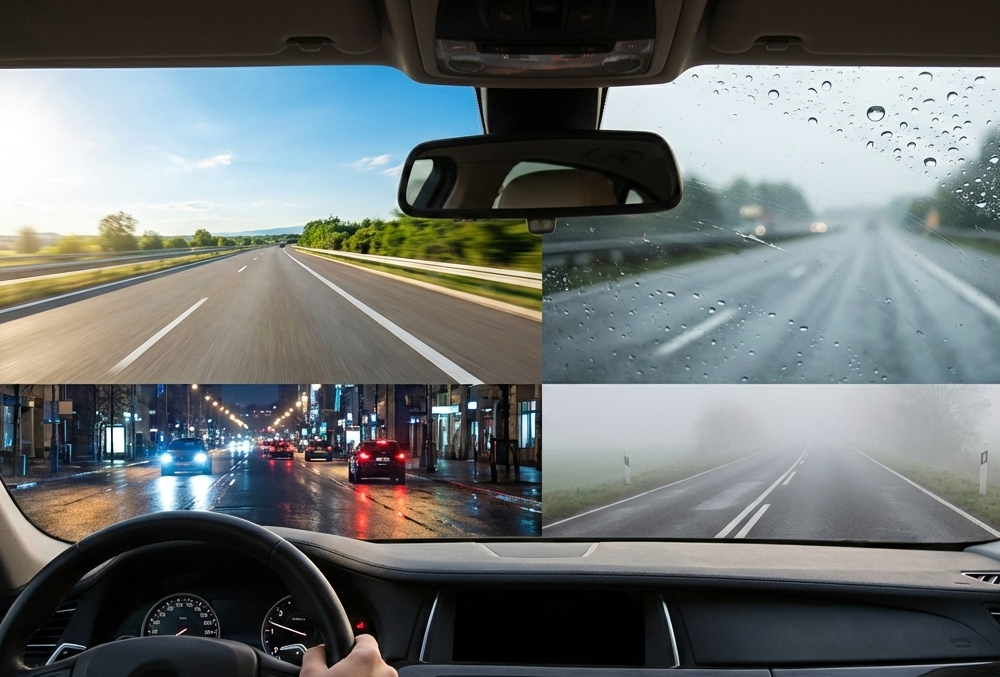
How Premium Glass Enhances Visibility in All Driving Conditions
When purchasing a car, we frequently become fixated on factors like horsepower, safety ratings, and fuel efficiency. We test the sound system, inspect the legroom, and test the tires. However, we almost never think twice about the one part we examine every mile: the windshield. Your windshield serves as more than simply a wind and bug barrier. It has a direct impact on your ability to respond to the road ahead and is an essential safety feature. Standard auto glass works well, but it has drawbacks, particularly in bad weather or with difficult illumination. Premium auto glass can help in this situation.It’s not only a luxury to upgrade to or select cars with premium, acoustic, or hydrophobic glass; doing so is a safety precaution.
Get An Auto Glass Replacement Quote Now 866.278.7417

Windshield Replacement & Repair
Our competitors push you into going to their shop to get your glass fixed-making it cheaper for them. We make it easier for YOU to get back on the road by offering free mobile repairs at your home or work. With our free mobile services servicing the entire Orange County & Los Angeles area, we can often handle your windscreen replacement the same day! So the next time you need a windshield replacement, give us a call.
Talk to a Windshield Replacement Specialist Now 866.278.7417

Calibration
Calibration is the process of returning a vehicle’s ADAS to OEM specifications. Calibration is necessary after a new glass installation, particularly a windshield with a camera mounted to it, to ensure that the ADAS features continue to function properly despite having been moved during installation. If a car’s ADAS is not properly calibrated, the system may not function safely. A misaligned camera could jeopardize the functionality of the system and lead to dangerous driving or accidents, so it is crucial that the cameras are aligned perfectly, which is what windshield calibration ensures.
Talk to a Calibration Specialist Now 866.278.7417

Fleet Auto Glass Repair
We provide expert auto glass repair and windshield replacement services for commercial fleets of all sizes. We are experienced with all manufacturers and machine types of domestic or foreign cars, trucks, vans, or commercial vehicles, including heavy equipment. Our same day mobile auto glass and windshield repair service will enable you to get back on the road faster and start saving you time and money instantly. Give us a call today! We are here to help!
Talk to a Fleet Auto Glass Specialist Now 866.278.7417
What Qualifies Glass as Premium
Auto glass is not all made equal. Laminated glass, which consists of two layers of glass with a layer of vinyl between, is commonly used to make standard windshields. Although this is safe and efficient for basic impact resistance, high-end producers have advanced this technology.
High-end glass frequently uses certain chemical treatments and production techniques intended to control moisture and light. This comprises: Treatments that reject water at the molecular level are known as hydrophobic coatings.
Acoustic interlayers: Vinyl layers intended to reduce driver fatigue by attenuating sound frequencies.
High-definition clarity: Production techniques that lessen optical distortion, which is typical with less expensive aftermarket glass.
Knowing these characteristics makes it easier to understand why the view through the windshield of a premium car frequently feels “crisper” compared to the view through the glass of a regular economic car.
Hydrophobic Technology: Overcoming the Rain. One of the most frequent reasons for poor visibility is rain. Standard windshield wipers frequently can’t keep up with a strong downpour, leaving a smeary coating of water that skews road signs and brake lights.
High-end glass frequently has hydrophobic coatings applied to it. The precise translation of “hydrophobic” is “water-fearing.” Rain does not spread out into a sheet when it hits this kind of glass; instead, it beads up right away. The wind created by the driving vehicle can readily blow these beads off, and wipers can simply remove them without leaving any traces.
The Effect on Safety
The difference can be quantified. According to studies, hydrophobic auto glass can increase visual acuity by up to 34% when it rains. That improvement adds up to an almost one-second advantage in reaction time at highway speeds. A safe stop and a collision frequently depend on just one second.
Sunlight and Headlights to Combat Glare: Visibility is about controlling light, not just seeing through bad weather. On the roadways, glare is a silent killer. It is caused by either the piercing LED headlights of oncoming cars at night or the blinding afternoon sun striking a dirty windshield.
Superior optical quality and specialized tinting technologies are two ways that premium glass handles this.
Sun at a Low Angle: Cheaper glass frequently develops microscopic pitting or “haze” over time. Light strikes these flaws and disperses when the sun is low on the horizon, causing a “whiteout” effect that renders the motorist totally blind.
High-quality glass has a cleaner surface that lets light go through directly without scattering since it is tougher and more resistant to micro-pitting.
Driving at Night: The challenge becomes even greater at night. Driving after dark requires more than simply avoiding being blinded by artificial light—you must also be able to see clearly into the surrounding darkness.
High-quality auto glass is designed to reduce the “halo” or starburst effect that commonly appears around streetlights, traffic signals, and oncoming headlights. By controlling how light is transmitted and refracted, premium glass minimizes glare and improves edge definition, allowing illuminated objects to remain crisp rather than blooming into visual noise.
This enhanced light control improves contrast between the road surface and potential hazards, making it easier to detect animals, cyclists, or pedestrians along the shoulder or crossing ahead. Subtle details—like uneven pavement, lane markings, or debris—remain visible instead of being washed out by glare, giving drivers more time to recognize and react to changing conditions.
Do you have a Question?
Get An Auto Glass Replacement Quote Now 866.278.7417
Focus and Acoustic Comfort
What does sound have to do with vision? As it turns out, quite a bit. Our ability to process visual information is directly affected by cognitive load—the amount of mental effort our brain must expend to manage incoming sensory data.
When a vehicle’s cabin is filled with wind rush, tire noise, and road vibration, the brain works harder to filter out that background noise, leaving fewer mental resources available for interpreting what the eyes see.
This constant sensory strain accelerates fatigue, and a fatigued brain processes visual cues more slowly and less accurately. Premium acoustic glass addresses this issue by incorporating a specialized sound-dampening interlayer between the sheets of laminated glass. This layer can reduce cabin noise by several decibels, creating a noticeably quieter driving environment.
In that calmer cabin, the driver’s mental energy can be fully focused on scanning the road, judging distances, and anticipating hazards. While the sound dampening doesn’t change what your eyes physically see, it improves how quickly and accurately your brain interprets visual information—resulting in better reaction times, improved awareness, and a safer, more confident driving experience.
Defogging and Efficiency of Heat
Everybody has been frustrated by a foggy windshield on a chilly morning. When moisture condenses on the glass’s chilly inside, fog is created.
Better thermal insulation qualities or incorporated heating elements—similar to those found in heated rear windows but almost undetectable in front—are common features of premium glass. By doing this, the temperature discrepancy that initially causes fogging is avoided.
High-end windshields save you from repeatedly adjusting the defroster settings while driving by maintaining a more steady glass temperature. This feature eliminates the urge to wipe away the fog with your hand, which only leads to smudges that can cause glare later on.
Investing in Your Opinion: When you drive, your windshield serves as the lens through which you see the outside world. A warped, water-stained, or overpowering glare lens jeopardizes your ability to respond swiftly and securely.
Good visibility is essential to driving safety and isn’t merely for comfort. High-quality car glass is designed to minimize optical distortion, lessen glare from low-angle sunlight and oncoming headlights, and preserve clarity in fog, rain, and changing light conditions.
Every time you get behind the wheel, the investment pays off, even if quality glass options are more expensive than typical aftermarket replacements. Advanced acoustic layers make the cabin quieter and less taxing, hydrophobic coatings let water roll away and bead during storms, and improved optical clarity lessens eye strain on lengthy rides. When combined, these advantages make driving more peaceful and regulated.
Whether you are buying a new car or replacing a shattered windshield, it is beneficial to ask questions about the glass placement. If road noise is an issue, look for OEM (Original Equipment Manufacturer) or OEM-equivalent quality, ask about hydrophobic and anti-glare treatments, and think about acoustic alternatives. Your perspective shouldn’t be as uncertain as the road itself.
Driving with Crystal Clear Vision
Driving blindly into a setting sun is one of the most annoying—and dangerous—things there is. The road ahead vanishes into a wave of white light because the visor doesn’t go low enough and your sunglasses don’t assist.
Glare and distortion are examples of visual impairments that are more than simply a nuisance; they are serious safety risks that cause thousands of accidents annually.
In addition to the immediate threat of low vision, your car is constantly subjected to environmental stressors. Over time, UV radiation, intense heat, and road debris erode your car’s exterior and interior, lowering its value and making driving less comfortable.
Thankfully, there are answers available in contemporary car technology. Owning a car doesn’t have to mean putting up with a damaged dashboard or a foggy windshield. You may take particular precautions to safeguard your investment and guarantee a safer, clearer driving experience by being aware of the causes of visual noise and environmental harm.
A Guide to Combating It: In essence, glare is too much brightness that obstructs your eyesight. While the sun is the main source of glare, other sources include headlights at night, light bouncing off your own dashboard, and reflections from damp roadways. Its reduction calls for a multifaceted strategy.
Maintain Perfect Glass
Although it may seem like a simple cosmetic issue, a dirty windshield is one of the most frequent and underestimated causes of excessive glare. Over time, the interior surface of your glass accumulates a thin, greasy film made up of dust, residue from smoking or vaping, skin oils, and the gases released by interior plastics and vinyl—a process known as “off-gassing.”
This film is often invisible in normal daylight, but it becomes glaringly obvious when sunlight hits at a low angle or when oncoming headlights shine through it at night. Instead of light passing cleanly through the glass, it scatters in all directions, turning a controlled light source into a hazy, blinding wall that reduces contrast and slows your ability to detect hazards.
Consistently cleaning the inside of your windshield with an ammonia-free glass cleaner and a clean microfiber towel can dramatically restore optical clarity. Ammonia-free products are especially important, as ammonia can damage window tint and interior surfaces.
Using a dedicated microfiber towel prevents streaking and ensures that the film is fully removed rather than smeared across the glass. For best results, clean the windshield regularly, not just when it looks dirty—because by the time you notice the haze, your visibility has already been compromised.
It is just as important to pay attention to your windshield wiper blades. Even with perfectly clean glass, old or worn wipers can undo all your efforts in seconds. Hardened rubber, cracks, or debris trapped along the blade edge cause streaks and uneven wiping, which momentarily distort your vision during rain or snow.
In heavy weather, those split-second visual disruptions can prevent you from seeing brake lights, lane markings, or pedestrians in time to react. Replacing worn wipers and keeping both the blades and the exterior glass clean ensures clear, uninterrupted visibility when driving conditions are at their worst.
Dashboard Covers’ Function
One of the main causes of eye strain is light bouncing off a polished dashboard and onto the inside of the windshield. This is frequently referred to as “veiling glare.” Think about getting a matte dashboard cover if the dashboard of your automobile is highly glossy or light in color. Instead of reflecting sunlight, these cloth mats absorb it, preventing it from ever reaching the glass.
Window Tinting: Window film of superior quality is one of the best ways to reduce glare. But not all tints are made equal. While standard dyed films aid by darkening the glass, contemporary ceramic and carbon films accomplish much more.
They reduce the harshness of the sun while selectively filtering light to let you see properly. When the sun is too low for the visor to obstruct, a “brow” strip across the top of the windshield works very well.
Getting Rid of Visual Distortion: Glare and distortion are not the same thing. It is an image warping that causes things to appear misplaced, wavy, or hazy. This issue can lead to headaches and impair one’s ability to measure distances precisely.
The Issue with Poor Tint Quality: If you have ever seen cars behind you appear to be in a funhouse mirror when gazing through a rear window, you are seeing distortion brought on by poor-quality window film. Cheap films frequently have production flaws or uneven adhesive coatings that cause unpredictable light bending.
Invest in high-performance films that are installed by trustworthy experts to prevent this. Seek out movies that promise to reduce “low angle haze.” This guarantees that the view is clear and unchanged even when the sun strikes the glass at a steep angle.
Integrity of the Windshield: A lens is your windshield. That lens will distort your view if it is chipped, pitted, or composed of poor quality glass. Although they may not seem like much, tiny chips can distort light. Driving into the sun can eventually produce a “sparkle” effect due to millions of micro-pits made of sand and road debris.
Polishing your old, badly pitted windshield may help, but replacing it is frequently the only way to achieve perfect optical purity. Demand OEM (Original Equipment Manufacturer) or OEE (Original Equipment Equivalent) glass when replacing a windshield. Long drives may strain your eyes due to the slight waves and flaws in cheaper aftermarket glass.
Do you have a Question?
Get An Auto Glass Replacement Quote Now 866.278.7417
Fighting Environmental Stress
Your vehicle is constantly fighting the weather. The silent killers of both your personal comfort and the lifespan of your car are heat and UV rays.
Technology for Heat Rejection: When parked in the sun, an automobile behaves like a greenhouse. Within minutes, the interior temperature can rise sharply, drying out plastics, stressing leather, and making the cabin intolerably hot.
Nano-Ceramic window technology excels in this situation. Ceramic tints use small particles to filter infrared (IR) radiation, in contrast to traditional tints that rely on darkness to inhibit heat. This advantage implies that compared to a dark, dyed limo tint, a very light tint can block a lot more heat. You may lessen the strain on your air conditioner and avoid the heat expansion cycles that lead to interior material cracking and squeaking by keeping the cabin cooler.
UV Defense for Both You and Your Vehicle: Standard vehicle glass is frequently less efficient against UVA rays, which cause severe skin damage and aging, but it can filter some UVB rays, which cause sunburn. This explains why the left side of truck drivers’ faces frequently has greater sun damage.
High-quality window films block 99.9% of UV rays. As a result, a protective bubble is formed inside the vehicle. In addition to protecting your skin and eyes during lengthy trips, it maintains the color of your upholstery.
Ceramic Coatings for External Defense: Environmental stress also attacks your car’s exterior. Road salt, tree sap, bird droppings, and acid rain all erode the clear coat, causing oxidation and dullness.
A liquid polymer called ceramic coating is put on the car’s exterior. It forms a protective coating by chemically bonding with the factory paint. Water is repelled by this layer because it is hydrophobic.
Hazardous pollutants wash off more readily, while mud and filth have a harder time adhering to the surface. A ceramic coating serves as a sacrificial layer against chemical etching and UV oxidation, keeping the paint glossy and shiny for years even if it won’t prevent rock chips.
Invest on Your Experience Driving
Driving shouldn’t feel like a never-ending struggle with the weather. Reduced glare lowers the chance of delayed reactions and avoidable collisions by allowing your eyes to remain focused on the road rather than straining against the intense sunlight or approaching headlights.
Eliminating optical distortion improves the way your brain interprets visual information, which lessens driver fatigue and makes lengthy car trips or commutes much less taxing. Additionally, by reducing environmental stress through UV protection and heat rejection, you maintain your comfort level and safeguard your car’s interior components, preventing premature wear, cracked dashboards, and fading upholstery.
Examine your vehicle critically right now. Has years of road detritus caused the windshield to become foggy or pitted? On sunny afternoons, does the dashboard reflect sharply in the glass?
Even with the air conditioner running at full blast, is the cabin still too hot? It could be time to look into professional window film and appropriate glass care if any of these questions have a yes response. Every time you turn the key, these seemingly insignificant improvements yield enormous benefits in terms of comfort, safety, and driving confidence.
Mobile Safe Auto Glass
14241 E Firestone blvd suite 400,
La Mirada, CA 90638
Phone: (562) 608-1154
Toll Free: 1 866 278 7417
Mail: sales@mobilesafeautoglass.com
Get a FREE QUOTE today! You can get a free quote and schedule 24/7 using this free quote wizard.
Mon – Fri 8am – 5pm
Saturday 8am – 1pm
Sunday Closed