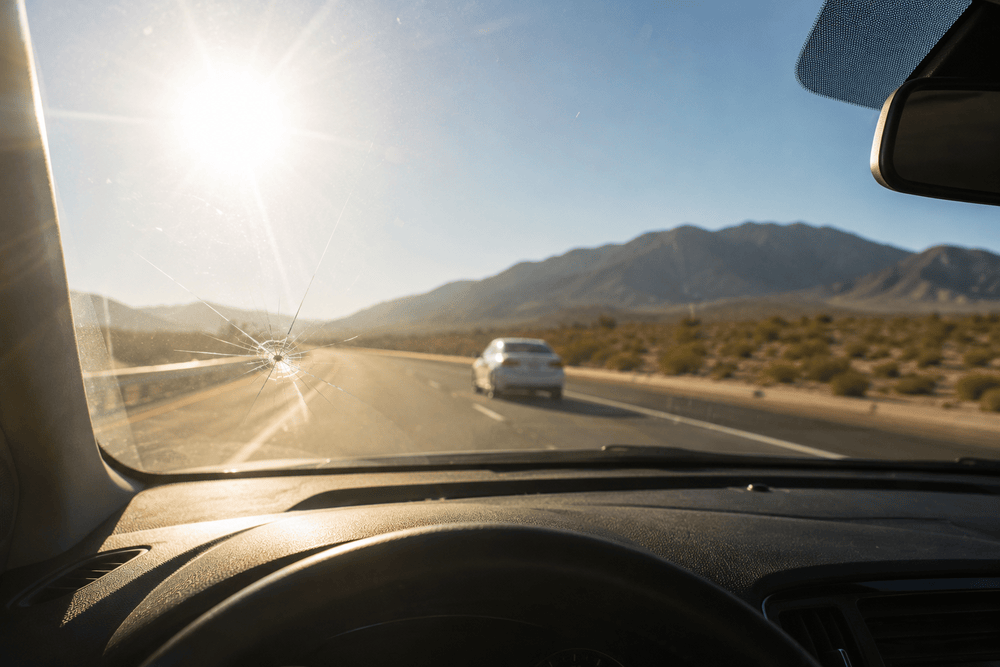
Heat Makes Chip Fix Cracked Windshield More Important
It’s a natural reaction for most people to think, “I’ll deal with it later,” when they see a little chip in their windshield since it doesn’t obstruct their vision, the vehicle is still operating OK, and scheduling a repair seems like another task to add to an already hectic week. However, if summer arrives later, that tiny chip could subtly grow into a much larger issue. One of the most damaging factors affecting your windshield is heat. Every day, it creates stress on your glass, and a pre-existing chip provides a starting point for that tension. When temperatures rise, what starts out as a dollar-sized blemish can spread across your windshield in a matter of days or even hours.
Get An Auto Glass Replacement Quote Now 866.278.7417

Windshield Replacement & Repair
Our competitors push you into going to their shop to get your glass fixed-making it cheaper for them. We make it easier for YOU to get back on the road by offering free mobile repairs at your home or work. With our free mobile services servicing the entire Orange County & Los Angeles area, we can often handle your windscreen replacement the same day! So the next time you need a windshield replacement, give us a call.
Talk to a Windshield Replacement Specialist Now 866.278.7417

Calibration
Calibration is the process of returning a vehicle’s ADAS to OEM specifications. Calibration is necessary after a new glass installation, particularly a windshield with a camera mounted to it, to ensure that the ADAS features continue to function properly despite having been moved during installation. If a car’s ADAS is not properly calibrated, the system may not function safely. A misaligned camera could jeopardize the functionality of the system and lead to dangerous driving or accidents, so it is crucial that the cameras are aligned perfectly, which is what windshield calibration ensures.
Talk to a Calibration Specialist Now 866.278.7417

Fleet Auto Glass Repair
We provide expert auto glass repair and windshield replacement services for commercial fleets of all sizes. We are experienced with all manufacturers and machine types of domestic or foreign cars, trucks, vans, or commercial vehicles, including heavy equipment. Our same day mobile auto glass and windshield repair service will enable you to get back on the road faster and start saving you time and money instantly. Give us a call today! We are here to help!
Talk to a Fleet Auto Glass Specialist Now 866.278.7417
What Really Takes Place in the Heat with a Chipped Windshield
It helps to grasp what a windshield chip is in order to comprehend why heat is so harmful. Laminated safety glass, which consists of two layers of tempered glass joined by a plastic interlayer (usually polyvinyl butyral, or PVB), is used to make modern windshields.
A fracture point is created in the outer layer of the glass when a rock or piece of debris hits it. There is structural vulnerability in that crack. The surrounding glass is under strain, and any more physical or thermal stress might lead to the break spreading.
Thermal expansion: When glass warms up, it expands. This is how heat applies that stress. The surface temperature of a windshield may rise beyond 190°F (88°C) on a hot summer day.
The glass pushes on the existing fracture from all sides as it widens. The expanding glass has little choice but to follow the route of least resistance, which is outward along the fracture, if the chip has sharp interior edges, as most do.
Differences in temperature: This is where things get most harmful. The outside of your automobile warms up far more quickly than the inside when you park it in the sun. A stress gradient is produced across the glass as a result of that temperature difference.
The inner layer opposes the outer layer’s desire to grow. It is doubtful that a chip trapped between those two pressures would survive.
Air conditioning shock: An already heat-stressed windshield experiences a sudden cooling event when you turn on your car’s air conditioning after it has been scorching in the sun. A chip that had been steady for weeks may break as a result of such abrupt shrinkage.
How Quickly Can a Chip Become a Complete Crack
quicker than most people anticipate. When summer approaches, a chip that remains dormant for an entire mild spring may suddenly fracture. Every day, a cycle is created by the combination of daytime heat, sun exposure, and the thermal shock of your air conditioner.
Under the correct circumstances, a fracture that begins as a tiny chip might expand several inches in a single day. The threshold varies by insurance and repair company, but if a break reaches around six inches, it usually cannot be sealed with resin and necessitates a complete replacement of the windshield.
There is a big price difference. Many motor insurance plans cover chip repairs with no deductible, and they often cost between $50 and $150. Depending on your car, a complete windshield repair might cost anywhere from $200 to $1,000 or more.
Does the Chip Type Matter? Under heat stress, different chips exhibit different behaviors. A chip’s likelihood of cracking depends on its depth and form.
Bullseye chips, which are circular hits with a neat cone, are often easier to fix and more stable. Because the fracture lines provide a quick conduit for heat-induced stress, star breaks—multiple legs radiating from the impact point—are more likely to shatter.
The most dangerous are combination breaks and edge cracks (chips along the edge of the windshield); edge cracks may grow quickly since the glass is under increased stress around the edge. Regardless of the season, it is much more urgent to fix your chip if it is close to the windshield’s edge.
Do you have a Question?
Get An Auto Glass Replacement Quote Now 866.278.7417
Additional Summertime Factors That Make the Issue Worse
Heat is not an independent force. In addition to high temperatures, summer brings a number of other factors that hasten windshield deterioration.
UV radiation: Over time, the PVB interlayer within the windshield may deteriorate due to prolonged UV exposure. The interlayer is immediately exposed to UV radiation when a chip penetrates the outer layer of glass, which might degrade the structural integrity around the damage site.
Road surface vibration: Summertime road excursions result in more mileage, which increases the amount of vibration that passes through the glass. While vibration by itself seldom results in chip cracking, it may drive an unstable chip over the edge when accompanied with heat stress.
Abrupt rainstorms: After a hot afternoon, a summer shower causes the surface temperature to drop quickly. This is a variation of the previously discussed heat shock, except it might occur unexpectedly while you’re driving.
If a chip has already begun to crack, is it still possible to have it fixed? The crack’s length and position determine this. In order to restore structural integrity and stop a chip from spreading further, windshield repair professionals employ resin injection to fill the gap created by a chip. Chips and extremely little cracks (usually less than an inch) are good candidates for this
Keep Your Windshield Safe
If you’ve found a chip but haven’t been able to schedule a repair yet, there are a few things you can do to slow it down: Park in a garage or in the shade whenever you can to prevent thermal expansion and direct light exposure.
When you initially get in the automobile, try not to blow cold air straight at the windshield. Allow the temperature to gradually equalize. Avoid cooling the glass by pouring cold water on it, since this produces the type of sudden temperature change that leads to chips cracking.
Steer clear of slamming doors, since this may rattle a chip free and send a pressure wave through the cabin. To keep moisture and dirt out, temporarily cover the chip with a thin piece of transparent tape. A clean resin fill is more difficult to accomplish when the chip is contaminated. These actions buy time. They don’t take the place of a repair.
The Safety Case for Quick Action: There is a structural argument that goes beyond the financial one. One load-bearing part of your car’s safety system is its windshield. According to the Auto Glass Safety Council, it serves as the passenger-side airbag’s backstop during deployment and can sustain up to 30% of the roof’s structural strength in a rollover.
A compromised windshield is one that is cracked. The overall integrity of the glass is weakened by even a break that doesn’t block your vision. That’s important in a collision.
The reasoning behind this is simple: Don’t Let Summer Turn a $75 Fix Into a $700 Replacement. A small annoyance is a chip in the spring.
A ticking clock is the same chip that was left throughout the summer. Road vibration, heat, UV radiation, and thermal stress from air conditioning all combine to transform something that can be repaired into something that has to be completely replaced.
One of the least expensive and simplest maintenance jobs you’ll ever encounter is a little chip that is discovered early. There’s really no way to put it off throughout the summer.
Common Questions
Is it possible for a windshield chip to shatter overnight due to summer heat? Indeed. A chip may shatter overnight if it is subjected to severe heat stress, especially after a day of direct sun exposure followed by quick cooling via air conditioning. One of the main causes of chip propagation is temperature differences.
Does auto insurance cover a chipped windshield? Yes, in a lot of situations. Since fixing a chip is far less expensive than replacing the whole windshield, comprehensive vehicle insurance plans often include windshield chip repair with no deductible. Verify your coverage by contacting your insurance.
How long can I put off fixing a chip in my windshield? Particularly during the heat, the earlier the better. When temperatures rise, a chip that is stable in moderate conditions may break in a matter of days. Chips that are close to the windshield’s edge or have several broken legs are more dangerous and need to be fixed right away.
At what temperature is a chipped windshield dangerous? In direct summer sun, windshield surfaces can rise above 190°F (88°C), though there is no universal threshold. Any prolonged exposure to excessive temperatures increases the likelihood of a chipped windshield breaking, especially when combined with the thermal shock of air conditioning.
Does a windshield chip usually shatter when you park in the sun? Not usually, but the danger is much elevated. The chip is increasingly stressed by the repeated cycles of heating and cooling that occur on any summer day until it finally spreads. The best short-term protective approach is to park in a garage or in shade.
Hot Weather Can Become a Serious Issue
Although a cracked windshield is always dangerous, it can get much worse in hot weather. Glass expands due to heat, which accelerates the propagation of already-existing fractures. It is significantly less expensive and safer to fix minor chips and cracks before the summer heat arrives than to replace the complete windshield.
It’s likely that you’ve spotted a little crack in your windshield and promised yourself that you’d take care of it “eventually.” However, when summer comes and the temperature rises, that tiny chip manages to slip halfway across the glass overnight. This is not unlucky. It’s physics.
One of the most damaging factors affecting a broken windshield is heat. The majority of drivers are unaware that a crack represents a structural problem rather than only a cosmetic one. And that structural issue worsens quickly as temperatures rise.
You might save hundreds of dollars and, more importantly, stay safe while driving if you know why this occurs and how to prevent it. This article explains how heat affects shattered glass, what to look out for, and when mending becomes a complete replacement.
Why Does Heat Exacerbate Cracks in Windshields? Glass shrinks as it cools and expands when it warms up. A healthy, undamaged windshield normally manages this temperature cycling without any problems. But that’s not the case with a cracked windshield.
The material around a chip or fracture in glass is already under stress. The outer surface of your windshield heats up more quickly than the inner layer, causing the glass on either side of the crack to expand unevenly. The only way the glass can react to the stress created along the crack line by this temperature differential is to propagate the fracture.
On a hot day, this process, known as thermal stress cracking, may transform a one-inch chip into a foot-long fissure in a matter of hours. According to studies from San Jose State University, dashboard temperatures may reach 130°F (54°C) on a bright day, thus parking your automobile in full sunlight increases this significantly.
The Most Dangerous Crack Types for Heat Damage
Different types of windshield damage react differently to heat. Certain cracks are more likely to spread than others.
Edge cracks: The most serious cracks begin two inches from the edge of the windshield. Heat causes these cracks to spread quickly across the windshield, with the edges experiencing the most structural stress. Rather than being repaired, edge fractures almost invariably need replacing the whole windshield.
The circular impact marks known as bullseye and star cracks are usually brought on by pebbles or other debris. If found early, little bullseyes may often be successfully corrected. Heat, however, may cause the surrounding glass to shatter even more, transforming a chip that can be repaired into a complicated star-shaped fracture that is far more difficult to repair.
Stress cracks: These show up as a sudden fracture without any visible impact, such as a rock or debris. Extreme temperature shifts, like blasting the air conditioner onto a hot windshield or dumping cold water on sun-baked glass, can cause stress fractures. These temperature fluctuations may cause stress fractures along pre-existing fault lines if your windshield already has moderate damage.
Do you have a Question?
Get An Auto Glass Replacement Quote Now 866.278.7417
The Worsening Effects of Hot Weather Habits
Windshield damage is unintentionally accelerated by the way most people react to hot weather. Blasting the AC: Anyone who drives a hot automobile will automatically turn the air conditioner on full power as soon as they get in. The sudden temperature differential created by cold air striking superheated glass is precisely the kind of thermal shock that spreads cracks.
Parking in direct sunlight: Although it is sometimes unavoidable, regularly parking your automobile in direct sunlight elevates both the temperature of the glass and the inside of your car. A cracked windshield can experience enough thermal stress from an hour in the intense summer sun to show signs of spreading.
Ignoring tiny chips: A chip smaller than a dollar coin can usually be fixed for $50 to $100 in less than 30 minutes. If you wait too long in hot weather, the chip could have developed into a crack that is too big to fix, necessitating a complete replacement that might cost $200 to $500 or more, depending on your car.
How to Prevent Crack Spreading in Hot Weather: There are things you can do to lessen thermal stress on your windshield in the interim if you are unable to see a repair shop right away.
Use a windshield sun screen or park in the shade. You may purchase time by lowering the glass’s surface temperature, which also lessens thermal expansion.
Slide inside the air conditioner. Before boosting airflow, start with modest fan settings and allow the vehicle to cool down gradually. Initially, direct cool air away from the windshield.
Steer clear of automated vehicle washes. A broken windshield may be stressed by high-pressure water jets and temperature variations from water sprays.
Cover the crack with transparent tape. Clear packing tape over a tiny crack can prevent moisture and debris from weakening the glass, but it won’t repair the damage.
Does Windshield Repair Get Covered by Auto Insurance
Yes, in a lot of situations. Windshield damage brought on by inclement weather, debris, or traffic hazards is usually covered by comprehensive auto insurance. Since it is less expensive for them to pay for a repair than a complete replacement, many insurance cover chip and crack repairs with no deductible.
Prior to making an out-of-pocket payment, review your coverage. A windshield repair can be completely free if you have comprehensive coverage.
Before the Summer Heat Forces You To Do It
Hot weather won’t allow a broken windshield to remain stable, and it won’t mend itself. A small repair is more likely to become a large investment the longer you wait due to heat, vibration, and regular driving.
The sensible course of action is simple: evaluate the damage right away, verify your insurance coverage, and schedule a repair appointment before the summer heat waves arrive. The majority of repairs are completed in less than an hour.
It takes a lot longer and is much more expensive to replace a windshield that is irreparably cracked. Your windshield is more than just a piece of glass; it is a structural part of your car. Be mindful of that fracture.
Frequently Asked Questions: Can I drive in hot weather if my windshield is cracked? While it may be impossible to avoid short distances, it is dangerous to drive in hot weather with a broken windshield. A weakened windshield provides less structural support in the case of an accident or rollover, and heat may cause the break to develop quickly. Get it fixed as soon as you can.
How fast can heat spread a fracture in the windshield? A crack can spread several inches in a single day—sometimes even in a matter of hours—in extremely hot conditions. Rapid crack propagation is most likely to occur in cars that are parked in direct sunlight and have interior temperatures higher than 130°F.
Before summer arrives, is it worth fixing a little chip? Indeed. Before summer heat hits, fixing a minor chip usually takes less than an hour and costs between $50 and $100. A complete replacement may cost $200 to $500 or more if the chip develops a large fracture as a result of heat stress. In most cases, early repair is the more economical option.
Which temperature poses the most risk to a windshield crack? The most harmful circumstances are caused by frequent exposure to temperatures exceeding 90°F (32°C), direct sunshine, and internal heat accumulation. However, there is no single threshold. Particularly dangerous are sudden changes in temperature, like a chilly air conditioner blast on a heated windshield.
Will windshield repair be covered by insurance? Windshield repair is typically covered by comprehensive auto insurance, frequently with no deductible. Each insurance has different coverage for complete windshield replacement. Before making an out-of-pocket payment, find out what your coverage covers by contacting your insurer.
Mobile Safe Auto Glass
14241 E Firestone blvd suite 400,
La Mirada, CA 90638
Phone: (562) 608-1154
Toll Free: 1 866 278 7417
Mail: sales@mobilesafeautoglass.com
Get a FREE QUOTE today! You can get a free quote and schedule 24/7 using this free quote wizard.
Mon – Fri 8am – 5pm
Saturday 8am – 1pm
Sunday Closed