Crack Size Effects on Cracked Windshield Repair
The sound is familiar to you. While you’re traveling down the highway, there’s a sudden, harsh thwack that interrupts your music or podcast. When you notice a stain on your immaculate windshield, your heart drops. A headache might easily develop from that small impact point. You’re probably asking yourself one costly question as you look at the damage: Is it possible to fix this, or do I need to replace the entire windshield? Size is usually always the key to the solution. Despite significant advancements in auto glass technology, a technician’s safe repair capabilities remain physically limited.
Get An Auto Glass Replacement Quote Now 866.278.7417

Windshield Replacement & Repair
Our competitors push you into going to their shop to get your glass fixed-making it cheaper for them. We make it easier for YOU to get back on the road by offering free mobile repairs at your home or work. With our free mobile services servicing the entire Orange County & Los Angeles area, we can often handle your windscreen replacement the same day! So the next time you need a windshield replacement, give us a call.
Talk to a Windshield Replacement Specialist Now 866.278.7417

Calibration
Calibration is the process of returning a vehicle’s ADAS to OEM specifications. Calibration is necessary after a new glass installation, particularly a windshield with a camera mounted to it, to ensure that the ADAS features continue to function properly despite having been moved during installation. If a car’s ADAS is not properly calibrated, the system may not function safely. A misaligned camera could jeopardize the functionality of the system and lead to dangerous driving or accidents, so it is crucial that the cameras are aligned perfectly, which is what windshield calibration ensures.
Talk to a Calibration Specialist Now 866.278.7417

Fleet Auto Glass Repair
We provide expert auto glass repair and windshield replacement services for commercial fleets of all sizes. We are experienced with all manufacturers and machine types of domestic or foreign cars, trucks, vans, or commercial vehicles, including heavy equipment. Our same day mobile auto glass and windshield repair service will enable you to get back on the road faster and start saving you time and money instantly. Give us a call today! We are here to help!
Talk to a Fleet Auto Glass Specialist Now 866.278.7417
The General Rules of Measurement
To assist drivers in rapidly assessing damage, the auto glass industry has long relied on a few common analogies. These broad recommendations continue to be the industry standard, even though many shops may have somewhat differing capacities depending on their equipment.
The Dollar Bill Rule: Take a dollar bill out of your wallet to test for a lengthy crack or a linear break in the glass. The crack is typically a possibility for repair if it is less than the bill, which is about six inches. A crack longer than the bill likely jeopardizes the glass’s structural integrity, necessitating a complete replacement.
Use a quarter for chips, “bullseyes,” or stars (impact damage that hasn’t yet extended into a lengthy line). It is nearly always repaired if the coin, which has a diameter of about an inch, can entirely cover the damage. A typical resin fill is probably not able to handle the damage if the spider-webbing stretches past the quarter’s edges.
Why There Are Size Limits: Although it may seem arbitrary that a six-inch fracture can be repaired while a seven-inch crack cannot, these limitations are based on safety and physics.
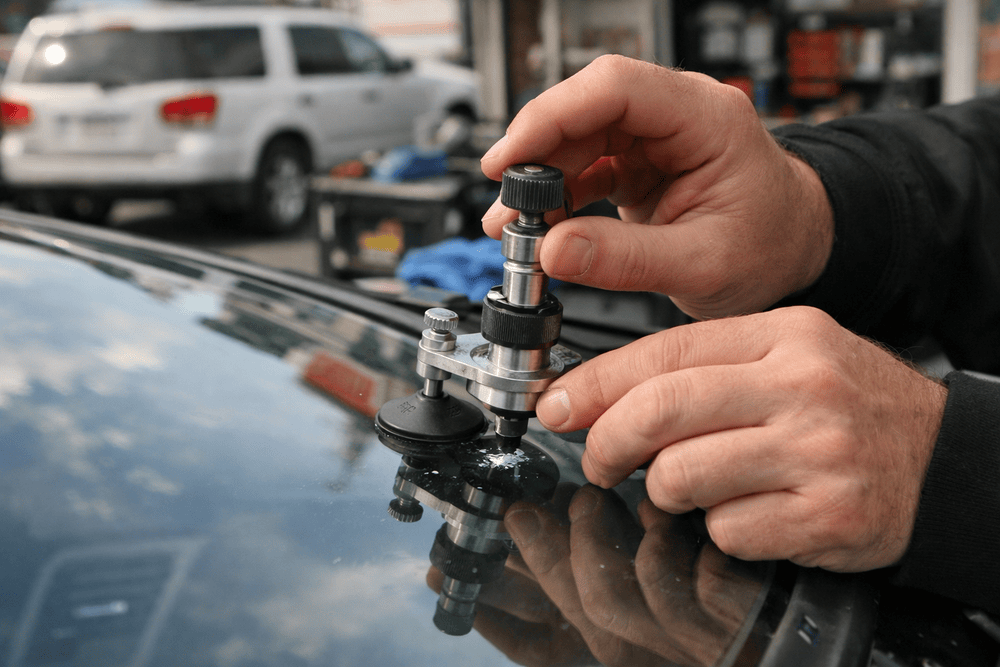
A specialty resin is injected into the gap left by the crack to fix a windshield. UV radiation is used to cure this glue, which fuses the glass back together and stops the break from expanding. The resin isn’t magic, though. It is supported by the glass around it.
Integrity of Structure
Your car’s windshield greatly influences its structural strength. The windshield helps keep the roof from collapsing in a rollover collision. The glass loses its tension and hardness when a crack grows too big.
A significant break cannot be repaired with resin to return the glass to 100% of its initial strength. The patch is only ornamental and won’t withstand the tremendous pressure of a collision if the crack is too long.
Optical Clarity: No matter how good the fixes are, they are still apparent. In essence, they transform a fissure into a thin, translucent line or a small imperfection. This apparent distortion is insignificant on a little six-inch crack. The cured resin forms a lengthy, refractive line on a twelve- or fourteen-inch crack that might cause light distortion and divert the driver.
Weather and Stress: As temperatures fluctuate, glass expands and shrinks. A lengthy fissure offers a significant vulnerability. When the AC blasts hot glass in the summer or the defroster strikes cold glass in the winter, a large crack is likely to reopen even if it is filled with resin. The failure rate increases with the size of the fix.
Do you have a Question?
Get An Auto Glass Replacement Quote Now 866.278.7417
Crack Types and Tolerance for Size
Damage is not created equal. How much of a repair is possible depends on the impact’s shape.
Bullseye and Star Breaks: These are round fractures that typically occur when a rock strikes glass directly.
Repairable: Usually up to one inch across.
The Risk: These frequently have microscopic cracks or “legs” that radiate outward. Resin might not be able to reach all of the tiny cracks if the impact site is squashed too severely, resulting in a patchy fix. Straight or slightly curved lines are known as linear cracks.
Repairable: Up to 6 inches (and, with specialist high-tech methods, maybe up to 12–14 inches, though this is uncommon and frequently discouraged).
The Danger: Rapid spread of linear fissures. After striking a single pothole, a 4-inch break that can be repaired can turn into a 12-inch crack that cannot.
Combination Breaks: This type of damage includes both expanding cracks and a chip. Only if the entire diameter—including all radiating cracks—fits within the 2-inch range can it be repaired.
The Risk: Because the glass is broken in several places, these are the hardest to fill entirely.
Location Is Just as Important as Size
Even if your crack is well within the “repairable” size limit, a professional will nonetheless advise replacing it. The location of the damage is typically the cause of this.
The Driver’s Line of Sight: Regardless of size, the majority of respectable shops will decline to fix any damage that is directly in front of the driver (about the width of the steering wheel). Having a blemish in your direct field of vision can be risky because repairs leave a little distortion, especially at night or in strong sunlight when glare becomes a problem.
The Edge of the Windshield: The glass is adhered to the metal car frame at the edge of your windshield. When the car moves, this section experiences the most stress and vibration. A break that starts at the edge or extends to it jeopardizes the relationship between the glass and the vehicle.
After a repair is attempted, there is a substantial likelihood that even a little break near the edge may spread right away. To prevent the windshield from popping out during airbag deployment, the majority of experts will recommend replacing any edge cracks.
Internal Sensors and Cameras (ADAS): Advanced Driver Assistance Systems (ADAS), which are cameras and sensors installed behind the glass and regulate emergency braking and lane departure warnings, are standard in modern cars.
The windshield needs to be replaced if a crack, no matter how big, covers a camera lens or sensor. A repair in this area may cause the camera’s “vision” to be distorted, which could lead to malfunctioning safety systems.
Why Tiny Cracks Turn Into Serious Issues
Crack size is dynamic, which is the most crucial lesson to learn. Damage to windshields is dynamic. Glass is always tense. Extreme temperature swings, slamming automobile doors, and road vibrations are examples of catalysts. Overnight, what begins as a fixable, dime-sized chip might spread into a 10-inch crack that cannot be fixed.
There is a big price difference. The cost of a basic rock chip repair could range from $50 to $100 (and is frequently completely covered by insurance with no deductible). The cost of replacing the entire windshield on a new automobile can range from $400 to more than $1,000, especially if the ADAS camera needs to be calibrated. The greatest method to keep your wallet happy is to fix the crack’s size right away.
Frequently Asked Questions: Is it ever possible to fix a crack that is more than 6 inches long? Technically, the answer is yes. Some proprietary techniques claim to be able to repair cracks up to 14 inches long. But the outcomes are frequently inconsistent. The scar will be more noticeable, and the likelihood of the repair failing later increases with the length of the crack. For safety and liability considerations, the majority of large auto glass franchises adhere to the 6-inch regulation.
When the crack is repaired, will it go away entirely? No. Restoring structural integrity is the goal of a repair, not aesthetic perfection. You will probably still notice a faint outline or a tiny imperfection where the resin hardened, even though the visibility will be decreased by 70% to 90%.
Does the crack’s depth impact its repairability? Indeed. Windshields are composed of two glass layers separated by a plastic (PVB) layer. Usually, repairs are only feasible if the damage is limited to the glass’s exterior layer. The windshield needs to be replaced if the crack has spread to the inner layer, which is located inside the cabin.
Is it safe to fix huge cracks with a do-it-yourself repair kit? Auto parts retailers typically sell do-it-yourself kits that are intended to fix minor chips rather than large cracks. They use lower-quality UV curing lights than professionals, and they rarely apply enough pressure to push resin into a long crack. Repairing a significant crack with a do-it-yourself kit is likely to fail and necessitate a complete replacement.
Select a Safe Option for Your Car
Don’t ignore the sound of that rock hitting your glass. Please use a quarter, dollar bill, or ruler to promptly assess the damage. You are lucky if the damage is minimal, but only if you take quick action.
A repair saves you hundreds of dollars and maintains your windshield’s original factory seal. Accept that getting a replacement is the safer and more sensible course of action if the crack has already spread beyond the 6-inch mark or if it is in your direct line of sight. Your windshield serves as more than simply a window; it is a safety shield. Give it the attention it merits.
Should I replace or repair? A harsh, terrible thwack is the first of three signs that your windshield is past saving. While you are driving down the highway, taking your time, a bit of gravel kicks up from the truck in front of you.
As it arcs through the air and hits your glass, you watch in slow motion. Your heart drops. Your windshield has a noticeable imperfection now.
“Can I ignore this?” A more responsible question to consider is, “Can I patch this up quickly, or am I looking at a full, expensive replacement?”
The answer isn’t always straightforward. Thanks to substantial advancements in auto glass technology, technicians can now repair damage that would have required a complete replacement just ten years ago. But there are boundaries. You can save time, money, and possibly your life by being aware of the standards used by stores to assess damage. Almost invariably, three important factors—length, depth, and spread—determine the outcome.
The Anatomy of Your Windshield
You must first comprehend what you are looking through to comprehend why particular dimensions are important. Unlike the windows in your home, your windshield is more than simply a piece of glass. It is a safety feature that is essential to your car’s structural soundness.
Laminated glass is used to make modern windshields. This “sandwich” is made up of two glass layers that are joined around a polyvinyl butyral (PVB) layer in the middle. This middle layer of plastic prevents the glass from breaking into razor-sharp pieces when it is struck. Additionally, it supports the roof during a rollover and helps keep people inside the car following a collision.
In essence, a technician assessing a chip or crack is determining whether the damage has weakened this structural “sandwich” beyond its safe return point.
Factor 1: Length: Size is the most evident measure of severity. In general, repairs are easier when there is less damage.
For many years, the size of a dollar bill—roughly six inches—was the industry standard for repairable damage. It might be salvageable if the crack were shorter than the bill. The windshield was burned if it went past the bill’s boundaries.
Technology has pushed these limits. Some specialized techniques can now repair cracks up to 12 or even 14 inches long. But length is still important for two reasons:
Resin Stability: To fix a crack, a certain curable resin must be injected. This glue repairs the broken fragments by imitating the visual qualities of glass. It becomes increasingly challenging to fill a crack fully without creating air pockets or weak spots as it gets longer.
When the car bends or rattles during a drive, a long crack that isn’t filled may reopen. Depth is measured vertically, whereas length is horizontal. This element establishes whether the windshield’s structural safety layer has been compromised.
Do you have a Question?
Get An Auto Glass Replacement Quote Now 866.278.7417
The External Layer
Bullseyes, stars, and half-moons are the most prevalent types of rock chips that only harm the glass’s outer layer. After striking the surface and tearing out a cone of glass, the projectile pauses before it can penetrate the middle layer of plastic. These are excellent candidates for fixing. The surface strength is restored when the resin fills the cone and cures under UV light.
The Inner Layer and PVB: Repair is rarely an option if a piece of debris strikes with enough force to pierce the outer glass and harm the PVB layer (the middle plastic layer). The windshield can no longer hold the glass fragments together if that plastic is damaged.
Additionally, the windshield needs to be replaced right away if the damage reaches the inner layer of glass or the side inside the cabin. A crack on the inside layer is far more threatening because it is closer to the passengers and indicates that the structural integrity of the entire unit has collapsed.
Moisture and Delamination: The amount of pollution that enters the damage is also determined by depth. The windshield may start to “delaminate.” This appears as a milky white fog encroaching on the impact site if the crack is large enough to expose the PVB layer to air and water. No amount of resin can stop the glass from separating from the plastic after delamination has begun.
Factor 3: Spread and Location: The “spread” describes the intricacy of the damage and its location on the glass. Some fractures resemble spiderwebs or shattered ice, while others are not straight lines.
The Complexity of the Break
Fixing simple chips is simple. Treating complex cracks—often referred to as “star breaks”—that have several legs extending in various directions is more difficult. The technician must guarantee that the resin reaches the exact tip of each and every leg of the star. As the glass expands and contracts in response to temperature variations, that particular leg will continue to grow if the resin does not reach the microscopic end of a crack.
The “Danger Zone” (The Edge): The location of the damage is just as crucial as its appearance. The outer two inches or so of your windshield are a high-stress area. Here, the glass is fused to the car’s metal frame.
The production process places more stress on the glass near the edge. Compared to a chip in the middle of the glass, a little chip here has a much higher chance of spreading right away into a lengthy, irreparable crack. If substantial damage is discovered along the edges, the majority of trustworthy auto glass companies will advise replacement because a patch is unlikely to withstand the strain.
The Driver’s Line of Sight: If a chip falls directly in the driver’s line of sight, it can still impair the repair even if it satisfies the technical requirements for length and depth.
Although it works, repair resin is not magic. It typically restores clarity by 80–95%, but the damage remains somewhat visible. Usually, there is a tiny hazy patch, a small imperfection, or some refraction.
This flaw may pose a safety risk if it is situated right in front of your eyes, which is typically described as an area the size of a piece of paper just above the steering wheel. It could divert your attention or produce hazardous glare from the sun or approaching headlights. Because of this, expert businesses frequently choose to replace damaged items in the acute line of sight rather than fix them to guarantee optimal visibility.
Reasons Not to Wait
Speed is your best friend if the length, depth, and spread of your windshield damage are within repairable bounds. Despite its rigidity, glass is constantly being attacked.
Variations in temperature are harmful. The quick expansion of the glass can quickly transform a $60 chip that can be fixed into a $400 replacement if you have a minor chip and blast the defroster on a chilly morning. When you turn on the air conditioner on a hot windshield in the summer, the same thing occurs.
Washing fluid and dirt also act against you. The water becomes filthy as debris gradually finds its way into the fissure. Even if you fix it later, the dirt remains within and causes an unsightly, hazy repair.
Making the Call: Your windshield serves as a road lens, a structural support, and a protection. Although it may be tempting to choose a repair for dubious damage to save money, it is crucial for your safety to adhere to the length, depth, and spread limits.
See a qualified vehicle glass specialist if your damage appears to be questionable. To provide you with an unbiased evaluation, they are able to measure the precise depth and stress areas. When in doubt, keep in mind that structural safety and an unobstructed view are significantly more valuable than a deductible.
Mobile Safe Auto Glass
14241 E Firestone blvd suite 400,
La Mirada, CA 90638
Phone: (562) 608-1154
Toll Free: 1 866 278 7417
Mail: sales@mobilesafeautoglass.com
Get a FREE QUOTE today! You can get a free quote and schedule 24/7 using this free quote wizard.
Mon – Fri 8am – 5pm
Saturday 8am – 1pm
Sunday Closed