Auto Windshield Repair Near Me Before Cracks Spread
Every driver fears that sharp, abrupt crack. A pebble hits your window like a bullet when you’re driving down the highway, maybe a bit too closely following a dump truck. You examine the damage. It resembles a tiny star or bullseye. You remind yourself to address it later, as it currently appears to be of lesser importance. Ignoring that tiny chip is a risk that seldom pays off. Windshields are essential to the structural integrity of your car, and even a little cosmetic flaw can soon develop into a severe crack that obscures your vision. After that, you may have to consider a complete and costly replacement instead of a simple and inexpensive repair.
Get An Auto Glass Replacement Quote Now 866.278.7417

Windshield Replacement & Repair
Our competitors push you into going to their shop to get your glass fixed-making it cheaper for them. We make it easier for YOU to get back on the road by offering free mobile repairs at your home or work. With our free mobile services servicing the entire Orange County & Los Angeles area, we can often handle your windscreen replacement the same day! So the next time you need a windshield replacement, give us a call.
Talk to a Windshield Replacement Specialist Now 866.278.7417

Calibration
Calibration is the process of returning a vehicle’s ADAS to OEM specifications. Calibration is necessary after a new glass installation, particularly a windshield with a camera mounted to it, to ensure that the ADAS features continue to function properly despite having been moved during installation. If a car’s ADAS is not properly calibrated, the system may not function safely. A misaligned camera could jeopardize the functionality of the system and lead to dangerous driving or accidents, so it is crucial that the cameras are aligned perfectly, which is what windshield calibration ensures.
Talk to a Calibration Specialist Now 866.278.7417

Fleet Auto Glass Repair
We provide expert auto glass repair and windshield replacement services for commercial fleets of all sizes. We are experienced with all manufacturers and machine types of domestic or foreign cars, trucks, vans, or commercial vehicles, including heavy equipment. Our same day mobile auto glass and windshield repair service will enable you to get back on the road faster and start saving you time and money instantly. Give us a call today! We are here to help!
Talk to a Fleet Auto Glass Specialist Now 866.278.7417
Why Minor Issues Become Serious Issues
Despite its seeming strength, glass is always under stress. In addition to blocking wind, the windshield also supports your car’s roof and aids in the proper deployment of airbags. When a rock chip weakens the glass’s integrity, it exposes it to various environmental elements that cause the damage to spread.
Temperature variations cause glass to expand when heated and compress when chilled. These organic physical alterations put tremendous strain on the weak spot in your windshield if you have a chip.
Summer Heat: When a car is parked in direct sunshine, the glass expands and pushes the chip’s sides against one another until the glass breaks.
Winter Cold: When you use your defroster on a frozen windshield, the temperature changes quickly. This thermal shock is one of the most frequent causes of a little chip that immediately spreads the length of the glass.
Road Vibrations and Stress: Your car’s chassis experiences vibrations from every pothole, speed bump, and gravel road. A clean windshield readily handles this stress.
However, a damaged windshield does not have the structural tension necessary to adequately absorb these shocks. Normal driving causes a chip’s microfractures to enlarge over time.
Moisture and Dirt
An open wound is what a windshield chip is. The laminate layer between the glass panes can be penetrated by rain, washer fluid, and road grime. Water that enters and freezes will expand and push the glass apart. By contaminating the region and preventing the adhesive from bonding properly, even dirt can make a repair challenging or impossible.
Repair vs. Replace: Understanding the Difference It’s useful to know what kind of damage you have before visiting a company. When deciding whether to replace or repair a windshield, the majority of auto glass technicians follow specific guidelines.
The Dollar Bill Rule: The extent of the damage in relation to a dollar bill serves as a general guideline.
Repairable: A specialist can typically fix a chip or crack if it is completely covered by a dollar bill, which is around 6 inches or less.
Replacement Needed: The structural integrity is probably too damaged for a straightforward fill if the crack goes beyond the dollar bill’s edges.
Depth of Damage: A layer of vinyl sits between two layers of glass that make up a windshield. A repair won’t be enough to strengthen the windshield if the damage extends through the inner vinyl layer or both glass layers.
The location is important because even a tiny chip could need to be replaced completely if it lands in the “driver’s critical viewing area.” This is the section of glass right in front of the steering wheel, about the width of a piece of paper.
For safety considerations, businesses frequently refuse to repair damage in this area since restorations might occasionally leave a minor distortion in the glass. Furthermore, chips close to the windshield’s very edge typically need to be replaced since they erode the connection between the glass and the metal frame.
Do you have a Question?
Get An Auto Glass Replacement Quote Now 866.278.7417
What Local Auto Glass Repair Should Include
When you search for “auto windshield repair near me” online, you will likely encounter a multitude of options. How do you decide between small independent stores and national chains?
Convenience is paramount when comparing in-store and mobile services. Numerous trustworthy auto glass businesses provide mobile service, which entails having them come to your house or place of business to fix the damage.
If you have a hectic schedule, this approach is perfect. Resin cures best under certain conditions, so make sure they have the right equipment to keep the room dry and temperature-controlled.
Training and Certification: Repairing glass requires technical expertise. Seek stores that hire Auto Glass Safety Council (AGSC)-certified technicians. This accreditation guarantees that the technician is aware of the safety regulations needed to maintain your car’s roadworthiness.
Workmanship Warranty: A reputable repair business will guarantee the quality of its work. Make sure the fix has a lifetime warranty. Many reputable stores will deduct the cost of the repair from the price of a new windshield if the repaired chip spreads later due to an unsuccessful repair.
Insurance Partnerships: Learn whether the store has a direct line of communication with insurance companies. If you have comprehensive coverage, your insurance provider may frequently waive the deductible for windshield repairs. Instead of spending more than $400 on a replacement, they would rather pay $70 for a repair. The paperwork will be taken care of by a reputable local store.
The Process of Repair
You’ll be shocked at how simple and quick windshield repairs are if you’ve never had one. It often takes less than 30 minutes.
Cleaning: The technician cleans the area to remove dampness and glass particles.
Drilling (Optional): To make a clear path to the break’s center, a small drill may occasionally be employed.
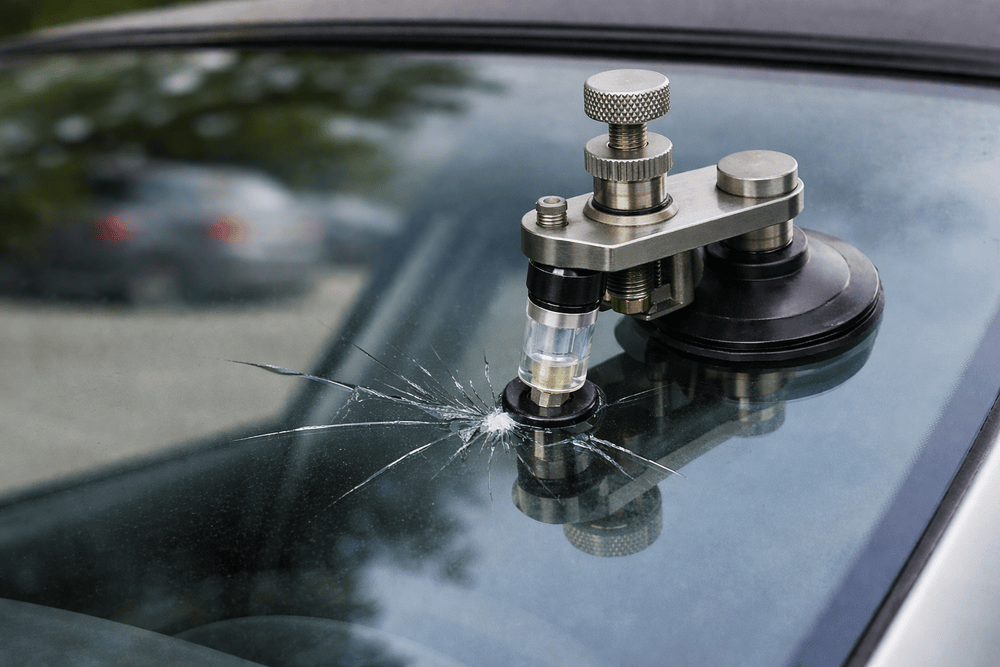
Injection: Using a device that alternates between vacuum (to remove air) and pressure (to push the resin in), a specialty resin is injected into the chip.
Curing: The resin is instantly hardened by exposure to ultraviolet (UV) radiation.
Polishing: The area is polished to match the surface of the glass after excess resin has been scraped off. The end effect is a windshield that is stronger than before. There is almost no chance of the crack widening, even though you might still notice a small scar where the rock struck.
Avoid the DIY Trap: For a small portion of the cost of a professional repair, you may find “do-it-yourself” windshield repair kits from auto parts stores. Despite their allure, these kits frequently result in disappointment.
Low-quality epoxy and streamlined delivery methods are used in consumer-grade kits, which frequently fall short of eliminating the air from the break. If you make a DIY fix go wrong, you usually only have one chance. A specialist cannot fix it if the resin cures incorrectly. It’s likely that you will require a complete replacement—exactly what you were hoping to avoid.
Frequently Asked Questions
After repair, will the chip fully vanish? Not totally. A windshield repair’s main objective is structural rather than aesthetic. Even though the damage’s visibility can increase by 70% to 90%, the area where the impact happened will probably still have a tiny imperfection or modest distortion.
After a repair, how long must I wait to drive? Usually, you can start driving right away. Expert stores employ premium UV-cured resins that solidify in a matter of minutes. After the technician is done, there is no “drying time” needed.
Does filing a glass claim increase my insurance premium? Most of the time, no. Insurance carriers typically view glass damage as a “no-fault” comprehensive claim, leaving your premiums unaffected. It is always advisable to review the specifics of your insurance, though.
What happens if the repair is immediately followed by rain? The resin is waterproof after it has dried. Rain, car washes, or windshield washer fluid won’t affect the repair.
Put Your Safety and Visibility First
Your windshield acts as a window to the outside world while you are driving. The laws of physics are against you, even if a tiny chip can seem like a bother you can ignore. Vibration, heat, and cold are always attempting to transform that small chip into a big break.
Avoid waiting for the damage to become visible. The best financial and safety choice you can make for your car is to look for “auto windshield repair near me” and make an appointment right now. It keeps your insurance company satisfied, saves you money on a complete replacement, and guarantees that your automobile will continue to be structurally sound for many miles to come.
It seems familiar: Why Windshield Repair Is a Race Against the Elements. A pebble that was thrown by the truck’s tires in front of you hits your windshield with a terrible thwack while you are driving down the highway.
You examine the damage. Just about the size of a cent, it’s a little bullseye. You may believe that you can overlook it and wait to address it until your next oil change or inspection. Sadly, physics doesn’t agree. You can exploit a windshield chip as a structural defect; it’s never just a cosmetic issue.
Temperature variations, moisture ingress, and road vibration are three unrelenting elements that your car’s glass is fighting against from the moment of impact. Together, these environmental elements can transform a simple twenty-minute fix into an expensive, comprehensive windshield replacement.
Maintaining the structural integrity of your car is more important than simply saving money when you understand how these factors affect your broken glass. Here are some reasons why the environment is the worst thing for your windshield.
Thermal Shock Science
Despite being a tough substance, glass is continuously growing and contracting. Heat causes glass to expand. It contracts as it cools. Such behavior occurs consistently in a spotless windshield, and the glass is able to withstand the strain. But that homogeneity vanishes as soon as a chip or crack compromises the structural integrity.
The Defroster and AC Dilemma: Your driveway is frequently the most hazardous location for a windshield, not necessarily a bumpy road. Unknowingly, we frequently expose our cars to “thermal shock”—sudden temperature swings that severely strain the glass.
Imagine a chilly winter morning. It is 20°F (-6°C), and there is frost on your windshield. Jumping in, you turn on the defroster. The exterior of the glass is still frozen, but all of a sudden, 80°F (26°C) air is hitting the inside surface.
The glass’s inner and outer layers become extremely tense as a result. If a chip is present, the tension causes a stress riser, which causes the chip to suddenly shatter into a lengthy crack.
In the summer, the same holds true. If you turn up the air conditioning after your automobile has been roasting in 90°F (32°C) heat, the inside glass layer may quickly cool down, leading to the same disastrous failure.
Implications for Repairs: Temperature also affects how repairs are carried out. A chemical substance called windshield repair resin is made to cure and fuse at particular temperatures. The resin could cure too rapidly and not fully fill the crack if the glass is overheated.
The resin becomes thick and sticky if it becomes too cold, making it impossible to get through the impact point’s microscopic microcracks. Before they can even try a remedy, professional technicians frequently need to warm or cool the glass to the ideal range.
Do you have a Question?
Get An Auto Glass Replacement Quote Now 866.278.7417
The Unspoken Risk of Moisture
The sneakiest foe of a broken windshield is probably water. In essence, a chip in the glass is an open wound. Water enters that crack when it rains or you wash your car. Delamination and hydraulic pressure are two different ways that your vehicle produces issues.
Hydraulic Pressure and Freezing: Water and debris are kicked up when tires roll over a wet road. Water turns to ice if it gets inside a chip and the temperature falls below freezing. Water expands when it freezes, as we discovered in science class in elementary school. That expansion functions like a hydraulic wedge inside the narrow confines of a glass crack, physically pushing the glass apart and widening the crack.
Laminated glass is used in modern windshields. It makes the safety layer less clear. With two layers of glass and a layer of Polyvinyl Butyral (PVB) plastic in between, this is basically a glass sandwich. In the event of an accident, this plastic coating prevents the glass from breaking into jagged pieces.
Moisture can seep down to this PVB layer if it remains inside a fissure for an extended period of time. The plastic eventually takes on a milky white hue as a result of the water’s reaction with it.
In addition to having a horrible appearance, this process, called delamination, weakens the link between the glass layers. Once the PVB layer weakens or obscures, a straightforward repair often becomes unfeasible, necessitating a complete replacement.
The Ongoing Stress of Vibration on the Road
Gravity and tension are still at play even if you parked your automobile in a garage with air conditioning. However, relatively few of us keep our automobiles parked all the time. We drive them, and vibration is a result of driving.
Structural Integrity: Your windshield is a crucial safety component that fortifies the interior of your vehicle in addition to offering wind protection. In a rollover collision, the windshield prevents the roof from being crushed. This condition implies that even when the car is not moving, the glass is constantly subject to mechanical stress.
The Zipper Effect: A shockwave is sent through the car’s structure and into the windshield as you drive over a pothole, a speed bump, or even merely textured pavement. This energy is effectively transferred by a solid piece of glass. On the other hand, a broken glass fragment has a “stress concentration point.”
Consider a piece of cloth. It is difficult to rip it by tugging at the hem. However, the fabric rips readily if you cut a little slit in it and then pull. That little slit is a rock chip.
Every road vibration pulls at that vulnerability. Either gradually or forcefully and unexpectedly, when driving at highway speeds, the glass eventually just gives out and the crack “runs.”
The Repairability Window
The window of opportunity for a windshield repair is narrow due to the trinity of temperature, moisture, and vibration.
A specialist resin is injected into the crack, a vacuum is created to remove air and moisture, and UV light is used to cure the resin. By doing this, the glass’s strength is restored, and the break is stopped from expanding. But this only functions if:
The injury is new; the crack hasn’t been plugged by dirt or debris.
The damage is dry because moisture keeps the glue from adhering to the glass.
The damage is minor: A chip that is less than a quarter in size is usually repairable. It generally has to be replaced if the crack is longer than a dollar bill. As you wait, additional dirt can get into the crack, the structure can be weakened by vibrations, and the glass can be stressed by temperature changes.
Don’t Wait Until It Shatters: You can’t “get around to it later” when it comes to vehicle glass. Your windshield’s integrity is being deliberately undermined by the surroundings you travel in. If neglected for even a few days of inclement weather, a $100 repair can quickly become a $500 to $1,000 replacement.
Check your glass right away if you hear that pebble strike it. If you notice damage, schedule a repair right once and cover it with clear tape to keep dirt out. You are competing with physics, and physics always prevails in the end.
Mobile Safe Auto Glass
14241 E Firestone blvd suite 400,
La Mirada, CA 90638
Phone: (562) 608-1154
Toll Free: 1 866 278 7417
Mail: sales@mobilesafeautoglass.com
Get a FREE QUOTE today! You can get a free quote and schedule 24/7 using this free quote wizard.
Mon – Fri 8am – 5pm
Saturday 8am – 1pm
Sunday Closed