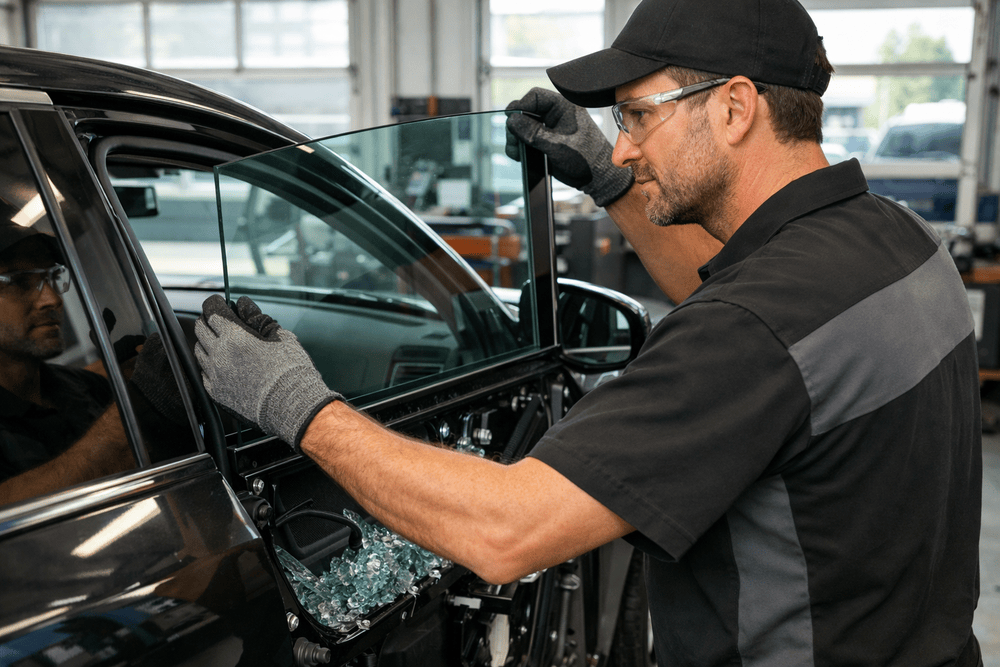
Cost of Replacing a Passenger Side Window
It’s depressing to approach your car and discover a heap of broken glass on the passenger seat. A damaged side window exposes your car to weather and theft, regardless of whether it was caused by a rock on the highway, a wayward baseball, or a break-in. It is an issue that needs to be resolved right away. The practical questions arise when the initial shock subsides. Could you please let us know how much time it might take to resolve this? More importantly, how much will the problem cost you financially? A side window is composed of tempered glass, as opposed to a windshield, which is frequently repairable if the chip is tiny enough.
Get An Auto Glass Replacement Quote Now 866.278.7417

Windshield Replacement & Repair
Our competitors push you into going to their shop to get your glass fixed-making it cheaper for them. We make it easier for YOU to get back on the road by offering free mobile repairs at your home or work. With our free mobile services servicing the entire Orange County & Los Angeles area, we can often handle your windscreen replacement the same day! So the next time you need a windshield replacement, give us a call.
Talk to a Windshield Replacement Specialist Now 866.278.7417

Calibration
Calibration is the process of returning a vehicle’s ADAS to OEM specifications. Calibration is necessary after a new glass installation, particularly a windshield with a camera mounted to it, to ensure that the ADAS features continue to function properly despite having been moved during installation. If a car’s ADAS is not properly calibrated, the system may not function safely. A misaligned camera could jeopardize the functionality of the system and lead to dangerous driving or accidents, so it is crucial that the cameras are aligned perfectly, which is what windshield calibration ensures.
Talk to a Calibration Specialist Now 866.278.7417

Fleet Auto Glass Repair
We provide expert auto glass repair and windshield replacement services for commercial fleets of all sizes. We are experienced with all manufacturers and machine types of domestic or foreign cars, trucks, vans, or commercial vehicles, including heavy equipment. Our same day mobile auto glass and windshield repair service will enable you to get back on the road faster and start saving you time and money instantly. Give us a call today! We are here to help!
Talk to a Fleet Auto Glass Specialist Now 866.278.7417
The Average Replacement Price Tag
For a rough estimate, most drivers should budget between $200 and $450 for a replacement passenger-side window. Usually, this sum covers the price of the glass as well as the labor needed to install it.
But this range is merely a starting point. You will probably be on the lower end of that spectrum if you drive a compact car or standard sedan.
Prices for owners of luxury cars, rare sports cars, or heavy-duty trucks frequently increase dramatically, occasionally rising to $800 or more. We must examine the factors that influence these expenses to determine precisely what you are paying for.
Important Factors Affecting the Price: Two separate drivers may visit the same shop for a side window replacement and leave with invoices that are hundreds of dollars different. This explains why the pricing varies so considerably.
The largest variable is your car’s make and model. A window for a 2015 Toyota Camry is inexpensive and readily accessible. A window for a 1960s Mustang or a brand-new Mercedes-Benz S-Class, on the other hand, needs specialist glass, which is more costly to produce and more difficult to locate.
The Type of Glass (Original Equipment Manufacturer vs. Aftermarket): There are typically two options available when replacing auto glass:
OEM (Original Equipment Manufacturer): This glass is produced by the same company that provided your car’s original glass. Everything about it, including the branding, is exactly as it arrived from the factory. It is the priciest choice.
Aftermarket: Third-party businesses make this glass. Despite meeting safety regulations and precisely fitting your automobile, it lacks the manufacturer’s emblem. It is typically just as safe and far less expensive.
Choosing aftermarket glass is one of the simplest ways to reduce your repair costs without compromising quality.
Features of Power Windows
There is a lot of technology in modern car doors. The replacement of older manual crank windows is a straightforward mechanical process. But the majority of contemporary automobiles have power windows.
The cost of repairs would increase if the incident that broke the glass also damaged the window regulator, which is the motor and mechanism that raises and lowers the glass. The overall cost may increase by $150 to $400 if a regulator needs to be replaced.
Glass is no longer just glass; thanks to specialized glass technology, Nowadays, a lot of passenger-side windows have technological features that raise material costs:
The purpose of acoustic glass is to make the cabin quieter by reducing road noise. Rain sensors are frequently incorporated into glass systems.
Heat Rejection: Unique coatings to maintain a cool cabin.
Privacy Tint: Compared to clear glass, factory-installed tinting is more costly.
The “Quarter Glass” Surprise: Thieves occasionally smash the small triangular glass at the side mirror or in the back door because they believe it will be less expensive to replace than the larger window. This is a widespread misunderstanding. Because it is glued to the frame and takes more work to remove and install, that little piece of glass, sometimes referred to as “quarter glass” or “vent glass,” is frequently far pricier.
Hidden Fees to Be Aware of: Find out if the quote you receive includes the “out-the-door” pricing. Additional charges frequently make their way onto the final invoice.
Cleaning up Debris: Tempered glass breaks and travels all throughout, even deep into the door panel, beneath the seats, and into the vents.
To shake out any loose shards, a reputable car glass shop will remove the door panel and vacuum the interior. While some stores charge a cleanup fee, others include this in the price.
Do you have a Question?
Get An Auto Glass Replacement Quote Now 866.278.7417
Fees for Mobile Services
Numerous auto glass businesses provide mobile service, which involves having them come to your house or place of business to fix your car. This is quite practical, particularly if driving your automobile is now dangerous. Smaller local stores might charge a convenience fee of $25 to $50 for the trip; however, some big chains provide this service for free.
Re-Tinting: The new piece of glass will be transparent if your car’s windows were tinted aftermarket, either by you or by a shop. To match the new window to the rest of the car, you will need to pay an extra $50 to $100 to a tint company.
Is Insurance Necessary? Your deductible determines whether or not you should submit an insurance claim for a broken side window.
The comprehensive section of your auto insurance policy covers the majority of windshield and glass claims. It makes no sense to submit a claim if the window replacement only costs $320 and your comprehensive deductible is $500. You run the danger of your premiums going up and having to pay more out of pocket than the repair is worth.
Some drivers, however, may have a “glass deductible” of $0 or $50. The prudent financial course of action in these situations is to file a claim. Prior to scheduling the repair, be sure to review your policy declarations page.
DIY vs. Professional Replacement: You may be tempted to acquire a piece of glass online and install it yourself to save money on labor because YouTube videos are accessible for everything.
Although it is feasible, changing a door’s glass is far more challenging than it may seem. The door panel must be disassembled, delicate electrical cabling for the speakers and locks must be disconnected, and the glass must be blindly manipulated into the regulator clips inside the door frame.
The glass will break if you drop it during installation; therefore, you will need to purchase a replacement. Additionally, you will always hear a “rattle” whenever you close your door if you don’t vacuum the broken glass out of the frame precisely. The labor savings of $100 to $150 are not worth the aggravation and potential harm for the majority of drivers.
Expert technicians can typically finish the task in an hour or so. Even though side windows require less glue than windshields, they might suggest that you wait an extra hour before driving to allow any adhesives to properly set.
It is not advised. Driving at high speeds with the window open alters the car’s aerodynamics and can be distracting, in addition to the danger of theft and rain damage. Make sure any loose glass is removed if you must drive to shield your eyes from flying glass fragments.
Instead of simply sitting in a track, the quarter glass is frequently affixed to the car using a powerful urethane glue. It takes more work to remove it because you have to cut the old glue and prepare the frame. Furthermore, as the number of broken quarter glasses decreases, the production of new ones also declines, which keeps costs high and supplies limited.
It will match exactly if you go with OEM glass. Although it won’t feature the car’s logo, aftermarket glass will probably look the same in terms of color and tint. You will need to have any aftermarket tint film reapplied separately.
Resuming Vehicle Operations
A damaged passenger-side window is a significant inconvenience and an unforeseen expense. Even if the average price is roughly $300, knowing the variables related to glass type and car model will help you plan your budget.
Don’t accept the first price you come across. Request bids from at least three nearby businesses that cover labor, glass, and cleanup. Examine your insurance deductible first, but if it’s big, be ready to pay out of pocket. To secure your automobile and resume driving securely, it is crucial to have the glass fixed as soon as possible.
The True Cost of Setting Up an EV Charger at Home Purchasing an electric car (EV) is a thrilling change. You are bidding adieu to noisy engines, oil changes, and petrol stations.
But when many first-time EV buyers discover they require an effective way to charge their vehicle at home, their enthusiasm quickly wanes. Although your car can technically be plugged into a regular wall outlet, the charging process is excruciatingly slow, and it frequently takes days for the battery to fully charge.
You need a Level 2 home charging station if you want to fully enjoy the ease of owning an EV. You may wake up every morning with a full “tank” thanks to this improvement, which turns your garage into a personal fueling station.
However, unlike purchasing a toaster, you can’t simply plug in a Level 2 charger and leave. Planning, budgeting, and electrical work are necessary.
You’re probably wondering how much this new car really costs if you’re attempting to figure it out. Why do quotes differ so much? What precisely takes place during the installation? The pricing elements, the detailed installation procedure, and the important information that every driver should be aware of before hiring an electrician are all broken down in this book.
The Two Principal Cost Elements
It’s helpful to break down the price of a home charging solution into two categories when creating a budget: the hardware, or the charger itself, and the installation, or the materials and labor required to power it. The Hardware Costs: The unit that mounts to your wall is called the Electric Vehicle Supply Equipment (EVSE), or charger.
Price Range: A high-quality, safety-certified Level 2 charger should cost between $400 and $800.
Smart vs. Dumb Chargers: Purchasing a “dumb” charger that merely supplies power to the vehicle can save you money. On the other hand, “smart” chargers—which are Wi-Fi-enabled—allow you to plan charging at off-peak times to track your energy usage, reduce utility costs, and work with solar power systems.
Tethered vs. Untethered: The majority of units have a 25-foot tethered wire attached. Certain European-style machines require you to plug in your own wire because they are untethered. Tethered is the norm and typically the most practical choice for the US market.
The installation costs are where things become complicated. The cost of installation can vary from $500 to more than $2,500, depending solely on the electrical capability and particular form of your house.
Important Elements That Affect Installation Cost: Why was your installation billed at $2,000, yet your neighbor’s cost $600? The task’s complexity, not the electrician’s hourly wage, usually determines the price.
The Electrical Panels Distance
This is the most significant variable. The charger requires a separate 240-volt circuit that runs from the main breaker panel to the garage or driveway, much like an electric dryer or oven.
In the best scenario, your panel is already in the garage, next to your parking space. The electrician will need to install a few feet of conduit and cable.
In the worst scenario, your panel is located on the other side of the house in the basement. To get to the garage, the electrician must fish heavy-gauge copper wire through completed ceilings, crawl spaces, or external conduit. In extended stretches, the price of copper wire alone might add hundreds of dollars.
Trenching for Detached Garages: The wire needs to run underground if you park in a detached garage or a driveway that isn’t attached to the house.
Trenching—digging a ditch to lay conduit—is necessary for this. Digging the trench yourself can save money, but if you need the electrician to dig by hand or bring in excavation equipment, the cost will likely increase dramatically.
Electrical Panel Capacity: The main service panel (100-amp or 200-amp service) typically determines how much electricity your house can handle at once. Connecting an EV charger to a 40-amp or 50-amp circuit places a significant load on the system.
You might require a service upgrade if your panel is already full or if your house only has 100-amp service. This entails swapping out the main panel and frequently the outdoor meter. The cost of this improvement alone may range from $2,000 to $4,000.
Permit Fees: Reputable electricians will obtain a work permit. This guarantees that the job will be examined by the city and found to be safe. Although they vary by municipality, permit fees typically fall between $50 and $200.
Detailed Installation Procedure: Being aware of the procedure will help you control expectations and prepare your house ready for the process.
Do you have a Question?
Get An Auto Glass Replacement Quote Now 866.278.7417
Evaluation of the Site and Calculation of Load
The electrician will calculate the load before lifting any tools. To determine whether your panel has “room” for an EV charger, they examine your existing appliances, including the air conditioner, oven, dryer, and hot tub. They will also talk about the location of the charger.
Pro Tip: Simulate plugging in your automobile while parking it normally. Make sure the cord can readily reach the charge port without creating a trip hazard.
Permitting: The electrician sends the designs to your local building department after defining the scope. Depending on how backlogged your local city government is, this administrative procedure may take several days to many weeks.
The actual process starts with wiring and mounting. The electrician will run the wire to the charging site and install a new dual-pole breaker in your panel. The unit will be mounted to either a masonry wall or a stud.
Hardwired versus Plug-in: The electrician can either install a NEMA 14-50 outlet (similar to a dryer plug) and plug the charger into it, or you can have the charger “hardwired” straight into the electrical connection. In general, hardwiring is favored for weather resistance, safety, and aesthetic appeal.
System Testing and Configuration: After the system is turned on, the installer will check the voltage levels and make sure the ground fault protection is operational. Now is the moment to download the manufacturer’s app and connect your smart charger to your Wi-Fi network.
City Inspection: A city inspector will come by once the installation is finished to make sure everything complies with the National Electrical Code (NEC). This is an essential safety measure to avoid fire risks.
Important Pointers for Drivers: To maximize your investment, you should make smart choices that go beyond the cost and the specifics of installation.
Look for Discounts and Incentives
If you don’t have to, never pay the entire price. Governments and utility companies frequently provide financial incentives to promote the adoption of EVs.
Federal Tax Credit: For qualifying areas, the Alternative Fuel Vehicle Refueling Property Credit in the US may reimburse up to $1,000, or 30% of the cost of hardware and installation.
Utility refunds: A lot of nearby electricity providers provide refunds for Level 2 charger installation or provide exclusive “Time of Use” rate plans that lower your nighttime electricity costs. Before purchasing a charger, visit the website of your power company, as they frequently provide a list of devices that qualify.
Future-Proof Your Setup: Your next vehicle may be a massive electric truck that can manage 48 amps or more, even though you currently drive a plug-in hybrid or a small EV that only uses 16 amps.
Installing the greatest amperage circuit your panel can handle—typically a 50-amp or 60-amp circuit—is generally advised if you are paying for the installation now. This guarantees that when you trade in your vehicle a few years later, you won’t have to pay for an upgrade.
Specific Hardware Is Needed for Outdoor Installations: Make sure the charger is NEMA-4 rated if you must install it outside without a garage. This indicates that the enclosure is impervious to rain, snow, and water directed by a hose. Hardwiring is also strongly advised for outdoor equipment to avoid corrosion that might occur with plug-in outlets over time.
Frequently Asked Questions: DIY installation is strongly advised unless you are a licensed electrician. There is a significant chance of serious harm, fire, or death when working with 240-volt electricity. Unauthorized do-it-yourself work may also void the charger’s warranty and your home insurance policy in the case of an electrical fire.
How much time does it take to install? It typically takes two to four hours to complete a regular installation when the panel is located close to the garage. It may become a full-day or multi-day activity if trenching or an update to the service panel is necessary.
Does adding a charger raise the value of a house? Indeed. Pre-wired homes for Level 2 charging are becoming more and more popular as EVs become more common. It conveys to potential purchasers that the house is “future-ready,” which could raise its marketability or resale value.
Simplifying the Switch
The home charger is the cornerstone of this new way of life. Making the switch to electric driving necessitates a mental adjustment.
Over the course of the vehicle’s life, the investment in hardware and installation may appear high up front, but it will pay off in convenience and fuel savings. You can guarantee a seamless procedure that keeps your batteries full and your house secure by being aware of the price considerations and thoroughly preparing your house.
Don’t accept the first quote you are given. To compare quotes and prepare your garage for the mobility of the future, get in touch with three certified electricians with EV experience.
Mobile Safe Auto Glass
14241 E Firestone blvd suite 400,
La Mirada, CA 90638
Phone: (562) 608-1154
Toll Free: 1 866 278 7417
Mail: sales@mobilesafeautoglass.com
Get a FREE QUOTE today! You can get a free quote and schedule 24/7 using this free quote wizard.
Mon – Fri 8am – 5pm
Saturday 8am – 1pm
Sunday Closed