Avoid Cracking Your Windshield After Minor Impact Damage
You are enjoying the drive as you speed down the interstate when all of a sudden you hear a loud thwack. It may not look like much at first, especially if it is out of your direct line of sight, but you scan the auto glass and find it: a tiny, star-shaped mark or a tiny pit known as a “bullseye.” It may even persuade you to put it off until your next scheduled servicing. It is a mistake to wait. That small flaw jeopardizes the structural integrity of the glass. Windshields are made of laminated safety glass, which is composed of two layers of glass with a layer of vinyl in between. The strain holding the glass together is broken when the outer layer breaks.
Get An Auto Glass Replacement Quote Now 866.278.7417

Windshield Replacement & Repair
Our competitors push you into going to their shop to get your glass fixed-making it cheaper for them. We make it easier for YOU to get back on the road by offering free mobile repairs at your home or work. With our free mobile services servicing the entire Orange County & Los Angeles area, we can often handle your windscreen replacement the same day! So the next time you need a windshield replacement, give us a call.
Talk to a Windshield Replacement Specialist Now 866.278.7417

Calibration
Calibration is the process of returning a vehicle’s ADAS to OEM specifications. Calibration is necessary after a new glass installation, particularly a windshield with a camera mounted to it, to ensure that the ADAS features continue to function properly despite having been moved during installation. If a car’s ADAS is not properly calibrated, the system may not function safely. A misaligned camera could jeopardize the functionality of the system and lead to dangerous driving or accidents, so it is crucial that the cameras are aligned perfectly, which is what windshield calibration ensures.
Talk to a Calibration Specialist Now 866.278.7417

Fleet Auto Glass Repair
We provide expert auto glass repair and windshield replacement services for commercial fleets of all sizes. We are experienced with all manufacturers and machine types of domestic or foreign cars, trucks, vans, or commercial vehicles, including heavy equipment. Our same day mobile auto glass and windshield repair service will enable you to get back on the road faster and start saving you time and money instantly. Give us a call today! We are here to help!
Talk to a Fleet Auto Glass Specialist Now 866.278.7417
Recognizing Why Chips Become Cracks
You must first comprehend the factors acting against your windshield to stop the spread. Despite its rigidity, glass is constantly stressed. A crack is produced when a rock chips its surface, creating a weak spot where the stress can be released. Three main elements accelerate this process:
Temperature variations: When heated, auto glass expands, and when cooled, it contracts. The damaged section will break if the glass moves too much or too quickly.
Physical strain and vibration: Every road bump causes shockwaves to go through the car’s frame and enter the glass.
Debris and moisture: Water may flow into the fissure. The water will expand and push the glass apart if it freezes. Additionally, dirt might become embedded in the resin layer, making a subsequent clean repair unfeasible.
First Aid for Your Windshield Right Away: Your objective is to stabilize the area as soon as you see damage so that a technician may inspect it. By doing a few simple things, you may buy yourself some time right now.
Make use of clear packing tape. This is a temporary fix, but it is effective. Put a piece of transparent packing tape over the chip. This method keeps water, debris, and washing fluid out of the crevice but does not offer structural support.
Repairing a clean chip is far simpler than a dirty one. The adhesive used by repair companies will bind better if the region is kept clean, making the completed repair nearly undetectable. Avoid using masking tape or duct tape since they can obstruct your view or leave a sticky residue that makes repairs more difficult.
Park in a garage or in the shade. Direct sunlight adversely affects damaged glass. The auto glass in the windshield expands as it gets hotter in the sun. Your car’s metal frame heats up as well, frequently more slowly than the glass.
This temperature discrepancy puts a great deal of strain on the windshield edges. You may maintain a consistent glass temperature by parking in a garage or a shaded spot.
Important Habits to Steer Clear Of
You must drive and operate your car differently while you wait for your repair appointment. Routine behaviors, which typically have no negative effects, can abruptly break a compromised windshield.
Avoid using the AC or defroster too much.: This is the most common cause of abrupt cracking. Envision a chilly winter’s morning. You turn the defroster up to high heat since your windshield is covered in frost.
Rapid, unequal expansion results from the hot air blast striking the icy auto glass. The chip is unable to withstand the strain and will most likely immediately encounter a lengthy crack.
In the summer, the same reasoning holds true. Thermal shock occurs when ice-cold air conditioning is blasted onto a windshield that has been frying in the 90-degree sun. If you have to utilize climate control, turn the vents away from the window and gradually change the temperature until the cabin temperature balances.
Give Up Slamming Doors: Cars nowadays are airtight. Slamming a car door produces an abrupt increase in cabin air pressure. This pressure pushes the auto glass and windshield outward.
The glass is stable in typical conditions. When there is a chip, the pressure looks for the weak place in the glass, which is the path with the least amount of resistance. To let the air pressure out, gently close your doors or roll down a window a little before doing so.
Do not go to the car wash. A high-pressure car wash is guaranteed to fail due to three factors:
Temperature: The glass and the water used are frequently at different temperatures.
Pressure: The water jets struck the auto glass quite forcefully.
Weight: The glass may flex as a result of heavy, wet automatic brushes pressing down on it.
You can either wait for the fix to cure or give your automobile a hand wash. Stay out of rough roads. Depending on where you live, this may be inevitable, but make an effort to stay on smooth, paved roads.
When the car hits a pothole or passes a speed bump too quickly, it shocks the chassis with kinetic energy. The windshield frame experiences this twisting motion as well. Steer clear of construction areas and dirt roads if at all possible.
Do you have a Question?
Get An Auto Glass Replacement Quote Now 866.278.7417
Evaluating the Damage
You can’t save every chip. Sometimes the effect is just too amazing. When you call the auto glass business, being aware of the difference can help you control your expectations.
The Size Test: If the chip or crack is smaller than a quarter, it may typically be repaired. The length of a dollar bill used to be the general rule of thumb if the damage was a long crack. But because of advancements in technology, certain cracks up to 12 or 14 inches can be fixed if they’re comparatively straight. Larger things typically require a complete replacement.
The Aspect of position: The impact position of the rock is equally significant as its force.
The Edge: The chip normally needs to be replaced if it is within two inches of the windshield’s edge. The most stress is concentrated along the auto glass’s edge. Here, cracks propagate quickly and weaken the roof support’s structural integrity.
The Driver’s Line of Sight: The glass is slightly distorted even after the greatest repairs. Most stores will advise replacement if the damage is directly in front of the driver to guarantee safety and a good view.
The Sensors: Advanced Driver Assistance Systems (ADAS) are installed in contemporary cars. Often located behind the windshield are cameras and sensors for automated braking and lane departure alerts. To make sure the system works properly, the glass usually needs to be replaced if the damage is directly over a sensor.
Reasons to Take Action Right Away
The cost difference between replacing a complete windshield and fixing a little chip is significant. A professional chip repair typically costs between $100 and $150, depending on the location and extent of the damage.
On the other hand, the cost of replacing a modern automobile’s entire windshield can vary from $400 to well over $1,500, and it can increase even more if your car has advanced driver-assistance systems (ADAS) that need to be recalibrated after installation.
Fortunately, many insurance policies encourage early repairs. Generally speaking, insurance companies would rather cover a reasonably priced chip repair than an expensive complete replacement.
This implies that you might have the chip professionally sealed for little to no out-of-pocket cost because many comprehensive insurance policies will waive the deductible for windshield repairs. In addition to saving money, taking immediate action stops more damage from spreading across the windshield.
It’s crucial to keep in mind that a windshield serves more purposes than just providing protection from the weather. It is an essential safety feature that supports appropriate passenger airbag deployment, maintains the proper operation of your car’s ADAS systems, and adds to the structural integrity of the cabin. If neglected, even a tiny chip or crack can jeopardize these features.
Don’t risk your money or your safety. Avoid subjecting it to high or low temperatures, take care of any little chips, and take it to a qualified expert right away. Early intervention keeps your windshield strong, clear, and protective, preventing a small flaw from becoming a big issue for your safety while driving as well as your finances.
Why Auto Glass Repair Shouldn’t Wait
It begins with a startling crack that makes you jump in your seat and sounds like a gunshot. As you look across the windshield, you notice a little, star-shaped flaw directly in front of you.
It appears to be small—perhaps the size of a dime. Later, you’ll take care of it, you tell yourself. A small blemish on the auto glass doesn’t seem like an emergency because life is so busy.
But that little chip can end up costing a lot of money. Your car’s windshields are structural elements designed to protect you in an accident and resist extreme pressure.
Physics takes over when such integrity is even slightly violated. Variations in temperature, vibrations from the road, or even slamming the car door can cause that small flaw to “run,” creating a web of cracks across the glass. A straightforward repair is no longer a possibility after that.
In this article, we’ll discuss the science underlying the spread of chips, the cost differential between repair and replacement, and why taking immediate action is the best financial decision you can make for your car.
The Windscreen’s Anatomy: You must first comprehend the construction of your windshield to comprehend why chips are dangerous. Your windshield is composed of laminated auto glass, rather than the tempered glass used in your side windows, which breaks into safe, dull cubes.
Laminated glass is made by sandwiching a layer of vinyl (PVB) between two layers of glass. Because of this design, in the event that glass breaks, the fragments will adhere to the vinyl instead of flying into the cabin and hurting occupants. In the case of a rollover, it also gives the car’s roof structural support.
A rock typically damages the outer layer of glass when it strikes your windshield. We refer to this as a “chip.” The structural integrity is severely compromised if the damage extends to the inner layer or the vinyl. However, even a chip at the surface produces a weak spot where tension is concentrated.
The Reasons Chips Don’t Remain Tiny
Windshields are always under stress. It is more than simply a window; it is a support for the frame of your car and a barrier from the weather. A little chip can develop into a large crack for a number of reasons.
First, Temperature Variations: Auto Glass expands in hot weather and contracts in cold weather. Extreme temperature changes are frequently applied to your windshield in a brief period of time.
Winter: On a chilly morning, you blast the defroster. The glass’s exterior stays frozen, while its interior quickly warms up. This thermal shock causes the glass to expand unevenly, severely straining any existing chips.
In the summer, the sun bakes the glass to scorching temperatures, prompting you to blast the air conditioner. The outcome of the abrupt cooling effect is the same.
According to a Motor Industry Research Association study, using a defroster increases the likelihood of windshield chips spreading by 80% at 14°F (-10°C).
Second, Potholes and Vibrations along the Road: The chassis of your automobile vibrates with each jolt, pothole, and speed bump, sending vibrations up to the windshield. This could be insignificant on a smooth highway.
However, the glass flexes on uneven or badly maintained roadways. A sturdy piece of auto glass handles this flexing well. A piece of broken glass doesn’t. Because the chip cannot sustain the tension, its weak point fractures into a lengthy crack.
Third, Intrusion of Moisture: Water has great power. Water can seep into the tiny fissures in the chip when it rains or you wash your automobile.If the temperature drops below freezing, that water freezes into ice. Water expands as it freezes, as we discovered in elementary science class. By pushing the glass apart and widening the crack, this expansion functions as a wedge.
The Cost Comparison
In terms of time and money, there is a significant difference between replacing a windshield and mending a chip.
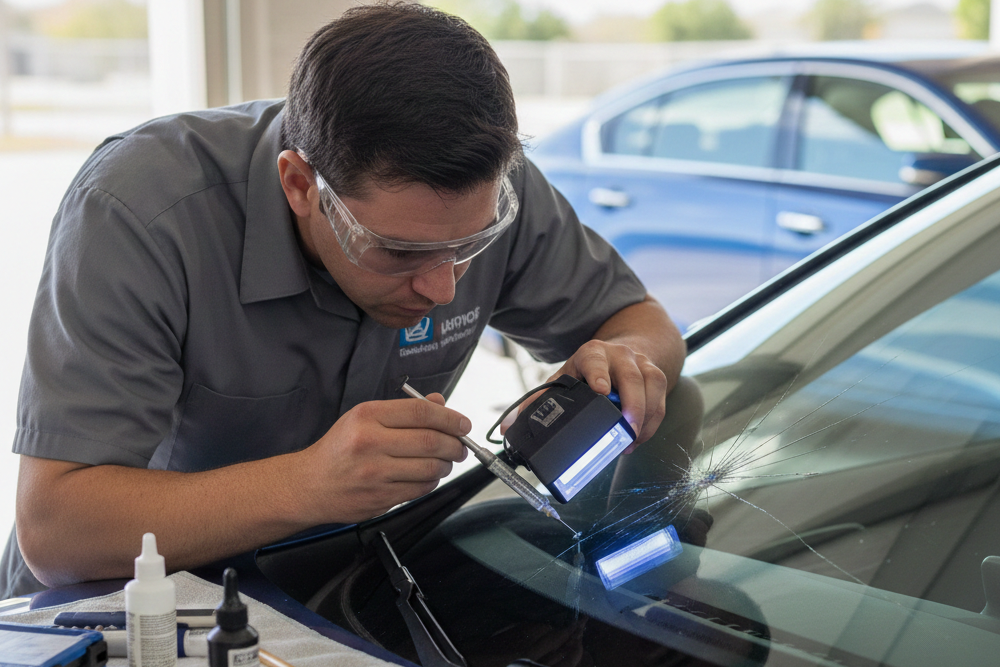
The Price of Repair: A unique clear resin is injected into the affected area to repair a chip. After the resin is cured using UV radiation, the auto glass is joined back together and its strength is restored.
Time: Typically, it takes no longer than half an hour.
Cost: Depending on your area and service provider, it usually runs between $50 and $150.
Insurance: Many comprehensive insurance plans with no deductible may cover chip repairs for free.
The Price of Replacing: The only safe solution is to fix a crack that is larger than a dollar bill or that is immediately in the driver’s line of sight, where resin could obstruct eyesight.
Time: Needs to be cleaned, the old auto glass must be removed, fresh urethane must be applied, the new glass must be set, and the adhesive must cure, which usually takes several hours before you can drive safely.
Cost: Between $300 and more than $1,000.
Calibration Costs: Cameras installed on the windshield are a feature of many modern cars with Advanced Driver Assistance Systems (ADAS), such as lane departure warning and automated emergency braking. When the glass is replaced, these cameras must be recalibrated. The bill may increase by an additional $300 to $600 as a result.
The Bottom Line: Ignoring a $100 or $0 issue today (if you have insurance) could easily result in a $1,500 expense tomorrow.
Do you have a Question?
Get An Auto Glass Replacement Quote Now 866.278.7417
The Unspoken Price of Contemporary Windshields
You probably have ADAS features if your vehicle was built within the last five to ten years. Accurate calibration is essential for these safety systems. The camera “looks” via the windshield. Replacing the auto glass could result in a modest shift in its angle or a modification in its optical characteristics.
Even a small amount of misalignment could impact the car’s perception of the road. This misalignment could cause your lane assist to drift or your automated brakes to activate prematurely.
This means that a straightforward “glass swap” is no longer feasible. To recalibrate the system, technicians require certain tools and training, which raises labor costs considerably. Repairing a chip eliminates this entire problem because it preserves the original manufacturer’s seal and glass placement.
Is Saving a Chip Too Late? Many chips are detected early, but not all can be fixed. In most cases, a technician can fix the damage if the chip is detected early enough. The chip is smaller than a quarter, with a diameter of roughly 1 inch.
No crack longer than three inches has been affected. The driver cannot see the chip immediately since repairs may cause a minor blur. The windshield’s edge, where structural tension is greatest, is not where the damage is located.
You must take immediate action if you see a chip. Even if the break hasn’t widened yet, the longer you wait, the more dirt and moisture enter inside, making an effective, tidy repair more challenging.
The Cost of Repairing a Pebble
Your windshield serves many essential functions in the protection system of your car, making it much more than just a straightforward wind and debris barrier. It guarantees that cutting-edge safety features function as intended, helps prevent your roof from collapsing in the case of a rollover, and offers structural support that enables airbags to deploy appropriately.
Even a small chip compromises this meticulously designed equilibrium, weakening the auto glass and jeopardizing your safety. The financial rationale is straightforward. Small chip repairs are quick, affordable (typically between $100 and $150), and frequently reimbursed by insurance with little to no out-of-pocket expenses.
In contrast, replacing the entire windshield on a modern car can cost anything from several hundred to over a thousand dollars, especially if ADAS recalibration is needed. Additionally, replacement takes a lot of time and requires specialized equipment, adhesives, and calibration procedures that, in contrast, make a straightforward repair seem simple.
Don’t dismiss it the next time you see a tiny chip growing or hear that horrible crack on the highway. Please consider scheduling an appointment for a professional repair at your earliest convenience.
Although covering the chip with clear tape to keep moisture and dirt out can be a short-term solution, it won’t stop the crack from growing over time. Road stress, heat, and vibration will all contribute to the damage’s growth until it becomes a serious safety and expensive issue.
Every chip should be handled as if it were an emergency. By fixing minor damage before it worsens, you can protect your safety, maintain the structural integrity of your car, and save money.
Your windshield’s strength, clarity, and functionality can be preserved with a little, prompt repair, guaranteeing that the glass you depend on for protection will continue to function as it should.
Mobile Safe Auto Glass
14241 E Firestone blvd suite 400,
La Mirada, CA 90638
Phone: (562) 608-1154
Toll Free: 1 866 278 7417
Mail: sales@mobilesafeautoglass.com
Get a FREE QUOTE today! You can get a free quote and schedule 24/7 using this free quote wizard.
Mon – Fri 8am – 5pm
Saturday 8am – 1pm
Sunday Closed