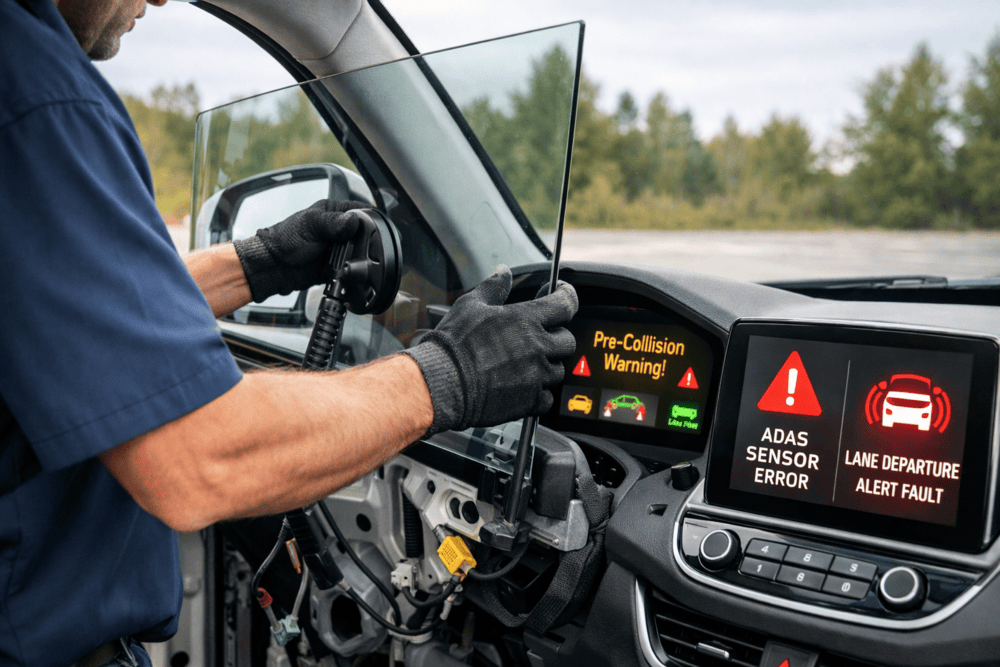
Driver Side Window Replacement Safety Sensor Issues
It seems to be simple to replace your driver-side window—until the safety sensor begins to malfunction. Halfway through, the window reverses as you roll it up. Or perhaps it won’t go up at all, exposing you to the weather and jeopardizing the security of your car. In order to prevent injuries to passengers, safety sensors—also known as anti-pinch sensors—are made to reverse the window in the event that they detect an obstacle. However, these sensors may turn a straightforward repair into a continuous hassle if they stop working after a window replacement. This tutorial explains the typical reasons why driver-side window safety sensors malfunction after being replaced and offers workable fixes to restore correct window operation.
Get An Auto Glass Replacement Quote Now 866.278.7417

Windshield Replacement & Repair
Our competitors push you into going to their shop to get your glass fixed-making it cheaper for them. We make it easier for YOU to get back on the road by offering free mobile repairs at your home or work. With our free mobile services servicing the entire Orange County & Los Angeles area, we can often handle your windscreen replacement the same day! So the next time you need a windshield replacement, give us a call.
Talk to a Windshield Replacement Specialist Now 866.278.7417

Calibration
Calibration is the process of returning a vehicle’s ADAS to OEM specifications. Calibration is necessary after a new glass installation, particularly a windshield with a camera mounted to it, to ensure that the ADAS features continue to function properly despite having been moved during installation. If a car’s ADAS is not properly calibrated, the system may not function safely. A misaligned camera could jeopardize the functionality of the system and lead to dangerous driving or accidents, so it is crucial that the cameras are aligned perfectly, which is what windshield calibration ensures.
Talk to a Calibration Specialist Now 866.278.7417

Fleet Auto Glass Repair
We provide expert auto glass repair and windshield replacement services for commercial fleets of all sizes. We are experienced with all manufacturers and machine types of domestic or foreign cars, trucks, vans, or commercial vehicles, including heavy equipment. Our same day mobile auto glass and windshield repair service will enable you to get back on the road faster and start saving you time and money instantly. Give us a call today! We are here to help!
Talk to a Fleet Auto Glass Specialist Now 866.278.7417
Why Safety Sensors Malfunction After Window Replacement
A number of things might cause the safety sensor to malfunction when a new window is installed. You can diagnose and resolve the issue more successfully if you are aware of these underlying reasons.
Inaccurate Window Calibration: Auto-up window functions in contemporary cars depend on accurate calibration. It is necessary for the window regulator motor to “learn” the window’s travel limitations, or where it should begin and end.
If the window is not recalibrated after replacement, the system is unaware of these limits. The window may reverse needlessly if the safety sensor perceives the typical resistance at the top of the window track as an impediment.
Misaligned Window Tracks: The glass is smoothly guided from bottom to top by window tracks. During installation, the window may bind or catch if these tracks are not aligned correctly.
The safety sensor is activated by this extra friction, mistaking the resistance for an item in the path of the window. Even a little misalignment might lead to sporadic issues that become worse over time.
Sensors that are defective or damaged: During the replacement procedure, the anti-pinch sensor itself may sustain damage. These sensors may be sensitive to harsh handling and are usually included into the door module or window regulator assembly.
It’s not always easy to see physical harm. Electrical problems or the breakdown of an internal component might cause a sensor to seem intact yet nonetheless malfunction.
Electrical Connection Issues: Several electrical connections are necessary for window safety systems to function. Connectors may become loose, rusted, or seated incorrectly during replacement.
Unpredictable sensor behavior is caused by poor electrical contact. Depending on how the connection changes while you’re driving, the window may function well one minute and then refuse to shut the next.
Body Control Module Software Issues: The window safety system is controlled by the body control module (BCM) of your car.
After replacing the window, the module sometimes has to be reset in order to reset sensor values or remove error codes. Even in cases when the physical installation is flawless, the BCM could continue to function on out-of-date data if this reset is not performed, leading to ongoing sensor problems.
How to Identify Issues with Safety Sensors
Determine the precise source of your window sensor issue before making fixes. These diagnostic procedures go from the most basic to the most intricate.
Press and hold the auto-up button after lowering your window all the way to test the auto-up feature. See where the window reverses or stops.
You may have a track alignment problem or a physical impediment if it reverses at the same spot every time. Consider electrical or calibration issues if the reversal point fluctuates.
Examine the Window Tracks: Look for damage, debris, or obvious misalignment in the window tracks. If required, remove the door panel to conduct a comprehensive examination.
To feel for obstacles or rough areas, run your finger down the tracks. Use a suitable lubricant made for automobiles to clean the tracks.
Examine Electrical Connections: Find the safety sensor and window motor connectors in your door panel. Make sure they click securely into place by disconnecting and reconnecting each one. Examine the pins for indications of corrosion. Use a little brush and electrical contact cleaner to clean it if it’s there.
Use an OBD-II scanner that can read body control module codes to look for error codes. Numerous safety sensor problems result in diagnostic trouble codes that identify the issue immediately.
Before clearing any codes, write them down. If you ever need to speak with a skilled technician, this information will be helpful.
Do you have a Question?
Get An Auto Glass Replacement Quote Now 866.278.7417
Detailed Fixes for Typical Sensor Problems
These fixes cover the most common safety sensor issues after driver-side window replacement, once the probable cause has been determined.
Recalibrating Your Window System: Following window replacement, the majority of cars need to go through a certain recalibration process. The overall procedure is as follows, albeit the specific stages differ depending on the make and model:
Without turning on the engine, set your ignition to the “ON” position.
Once the window is entirely down, hold down the button for two to three seconds.
When the window reaches the top, hold the button pressed for two to three seconds.
Check the auto-up feature.
If the window continues to malfunction, repeat these steps two or three times. Before the mechanism completely resets, some cars need the window to cycle up and down several times.
Fixing Misaligned Tracks: In the event that the tracks are not aligned correctly:
The window regulator assembly may be accessed by removing the door panel.
The fasteners holding the window to the regulator should be slightly loosened.
Find the smoothest route by manually moving the window up and down.
While maintaining the window’s correct alignment, tighten the bolts.
Test the window’s functionality after reinstalling the door panel.
Take your time making this change. The smoothness of the window’s operation is significantly affected by minor alignment adjustments.
Replacing a Faulty Sensor: The only option when the sensor itself is damaged is to replace it. This fix calls for:
Taking the door panel off
The window regulator assembly is disconnected.
changing the complete regulator assembly or removing the old sensor, if it is a stand-alone part.
Reconnecting all electrical connections and installing the new sensor
Adjusting the window system’s calibration
Because sensor replacement and position varies greatly across models, refer to your car’s service manual for detailed instructions.
Body Control Module Reset
Certain cars permit a basic BCM reset, which involves unplugging the battery for ten to fifteen minutes. This may fix software-related sensor problems and remove temporary error signals. You may need a professional-grade scan tool to do a deeper reset or reprogram the BCM with new software if the issue is more persistent.
When to Get Professional Help: Although a lot of safety sensor problems may be fixed at home, there are certain circumstances that call for expert help.
A skilled expert may save you time and save more harm if you’ve tried recalibration many times without success or if your diagnostic scan shows codes you don’t understand. Likewise, get in touch with the firm that did the repair if the sensor issue started just after a professional window replacement.
The majority of trustworthy installers provide warranties on their work and will fix sensor problems for free. Long-lasting electrical troubles that you can’t attribute to a loose connection might be a sign of more serious wiring problems in the door or a BCM breakdown that calls for expert diagnostic tools.
Preventing Future Sensor Issues: After windows are replaced, proper maintenance lowers the chance of safety sensor problems. Maintain the cleanliness and lubrication of your window tracks. Debris accumulation might cause the anti-pinch sensor to provide misleading indications and increase friction.
Select a skilled installer who is acquainted with the make and model of your car while getting windows changed. Particularly inquire as to whether they regularly tune the window safety system.
Any problems with window functionality should be fixed right away. A window that travels slowly or produces strange sounds is often a sign of impending issues that, if left unchecked, will become worse.
Restoring Your Window to Normal: After replacing a driver-side window, safety sensor issues might be annoying but are often resolvable. Before beginning more complicated repairs, start with the easiest fixes, such as electrical connection checks and calibration.
Rather than significant component failure, the majority of problems are caused by calibration errors or small installation mistakes. You may get your window operating normally again with perseverance and methodical troubleshooting.
Do not hesitate to seek expert assistance if you are uncomfortable doing repairs on your car’s electrical system or if the issue continues even after you have tried everything. The cost of professional diagnosis and repair is justified by your safety and security.
Why Side Window Calibration Matters More Than You Think
Replacing a side window looks simple enough. Send the client on their way after removing the shattered glass, replacing the window, and clearing the area. However, this previously straightforward repair has become a precise technological process that needs careful calibration due to newer cars.
The automobile industry has undergone a transformation because to advanced driver assistance systems (ADAS). The sensors and cameras used by these safety systems are placed all around the car, especially close to the side windows.
The repercussions of improper calibration during side window repair go far beyond aesthetic issues; they may jeopardize the safety mechanisms intended to protect drivers and passengers. Auto glass specialists can do high-quality work and preserve the integrity of car safety systems by being aware of these calibrating problems.
ADAS calibration: what is it? After repairs or replacements, ADAS calibration guarantees that a car’s safety sensors and cameras continue to operate as intended. These systems provide functions including parking assistance, lane departure alerts, and blind spot monitoring.
Sensors are often placed within or close to the side window region of contemporary cars. For rain sensors, 360-degree cameras, and blind spot detection modules to function properly, they must be precisely aligned. These systems may fail or emit warning lights if there is even a little misalignment.
Static calibration uses certain goals and equipment in a regulated shop setting. In order for the system to recalibrate itself, dynamic calibration necessitates driving the car under certain circumstances. After side window repair, some cars need both kinds of calibration.
Typical Calibration Issues When Replacing Side Windows
Sensor displacement: Sensors placed close to the window frame may inadvertently move when a side window is replaced. Sensors used for blind spot monitoring are especially susceptible. For these gadgets to reliably identify cars in neighboring lanes, they must maintain precise location.
Sensors may shift by a few millimeters when technicians remove and replace door panels or trim pieces, which might cause their calibration to be wrong. Drivers may not be aware that their blind spot monitoring has deteriorated since the car’s computer might not detect this problem right away.
Camera misalignment: Nowadays, a lot of cars have cameras built into the door pillars or side mirror assembly. These cameras provide ADAS features like as surround-view monitoring systems. Sometimes these parts need to be removed or adjusted in order to replace a side window.
The system’s picture gets distorted if cameras aren’t put back in exactly the same location and angle. This may lead to blind spots on the car’s surround-view display and impair the accuracy of parking assistance.
Electrical connection problems: Electrochromic (auto-dimming) elements, rain sensors, and defrosters are common features of contemporary side windows. Calibration drift may result from disconnecting and rejoining these electrical systems after replacement.
For instance, rain sensors must be calibrated correctly to differentiate between light mist and intense rain. Reconnecting the sensor incorrectly might make it too sensitive or unresponsive.
Integrity of Structure and Adhesive Curing
ADAS calibration is predicated on the car maintaining its original structural requirements. For side window glue to provide appropriate structural support, it must cure for a sufficient amount of time. Inaccurate results may arise if calibration is attempted before the glue has completely cured.
Curing periods are influenced by humidity and temperature. If this procedure is rushed, the calibration may seem accurate at first then change as the glue goes through its cure cycle.
False warnings and driver complacency are two ways that calibration issues impact vehicle safety. Inaccurate alerts are often caused by miscalibrated devices. Lane departure alerts may sound on straight highways, or a blind spot monitor may continuously alert drivers to nonexistent cars.
Drivers who often get false alerts sometimes disregard or completely eliminate these safety systems. As a result, even while the safety system seems to be working, it really becomes ineffective, creating a hazardous scenario.
Failure to identify real hazards: Even more dangerous is the converse issue, when systems do not sound an alarm when they need to. A motorbike in the opposite lane may be undetected by a blind spot detector that is not calibrated properly.
Improperly calibrated parking sensors may fail to detect impediments, resulting in crashes. Because drivers rely on these systems to provide correct information, these quiet failures are very risky.
Dashboard warning lights and system fault codes: Certain calibration problems cause dashboard warning lights to illuminate. Although this notifies the driver of an issue, it might be annoying if the root reason is incorrect window replacement rather than a real system malfunction. Multiple visits from customers might result in more effort and harm the store’s image.
Do you have a Question?
Get An Auto Glass Replacement Quote Now 866.278.7417
The Best Ways to Avoid Calibration Problems
Pre-replacement documentation: List all of the active ADAS features before beginning any side window replacement. Note any warning lights that are present and take pictures of the sensor locations. This baseline data aids in finding issues that arise during the replacement procedure.
For precise calibration specifications pertaining to side window operation, see the vehicle’s service manual. Protocols differ from manufacturer to manufacturer.
Electrical component handling best practices: Before removing any electrical connections, label them all. Use the right instruments to prevent breaking fragile connections. Certain cars need special protocols for turning off the power in order to avoid memory loss or system resets.
Never utilize improvised solutions or force connections. Instead of taking the chance of destroying a connection, check the service manual if it seems to be stuck.
Observing manufacturer guidelines: Make use of adhesives and materials that either match or surpass OEM guidelines. Although aftermarket devices may initially save money, unsuitable materials may cause calibration issues or impair sensor performance.
Observe the curing periods that are suggested by the glue manufacturer and the car manufacturer. Your shop’s environmental conditions may need to be adjusted during certain periods.
Procedures for Calibration After Replacement
Complete the necessary calibration steps after replacing the side window and letting it cure for the appropriate amount of time. This might consist of:
Static calibration using objectives provided by the manufacturer
Dynamic calibration using test drives that adhere to designated routes
System checks to confirm that every ADAS feature is operating as intended
Maintain and update calibrating equipment on a regular basis. Newer software versions or vehicle models may not be supported by outdated calibration tools.
Training and calibration equipment investment: Crucial instruments for contemporary side window replacement High-quality calibration work necessitates a substantial financial outlay. Systems for static calibration may run into the thousands. The cost is increased by diagnostic scan equipment that can read ADAS systems.
However, as more cars adopt cutting-edge safety features, this equipment becomes indispensable. Shops that can’t correctly calibrate ADAS after replacing a side window will lose business to those who can.
Continuous training is necessary since vehicle technology is developing quickly. Two years ago, ADAS systems were considered innovative; now, they are commonplace. To remain up to date with new calibration techniques and system types, technicians need frequent training.
Industry associations provide certification courses, and manufacturers offer training programs. Technicians are guaranteed to be able to manage the whole variety of automobiles that enter the shop thanks to this continuous education.
Documentation and Quality Control
Keep thorough records of every calibration task. Keep a record of the tools used, the processes followed, and the outcomes. This information safeguards the business in the event that further inquiries about the quality of the job are made.
Before returning cars to clients, carry out quality control inspections. Calibration problems may be detected by a last system scan before the client leaves.
When to suggest extra services: Complete ADAS inspection after major damage If an accident caused the side window damage, suggest a full ADAS examination. Sensors on other parts of the car may have been impacted by the impact forces that damaged the glass.
Giving clients this explanation shows professionalism and care for their security. Even if they choose not to accept the extra service, the majority of clients like the careful approach.
System resets and software upgrades: Following certain repairs, some cars need software updates. When replacing a side window, look for any active recalls or technical service advisories pertaining to ADAS systems. Notify clients of any updates that might enhance system functionality or fix known problems.
Future of Side Window Replacement and Calibration: To provide autonomous driving capabilities, automakers are keeping up the addition of sensors and cameras. As a result of this tendency, accurate calibration will become more and more important for even simple fixes like replacing side windows.
Shops will be prepared to handle the cars of the future if they make investments in tools, training, and protocols today. People will be unable to properly maintain modern cars if they see side window replacement as a simple glass exchange.
Avoiding warning lights and passing inspections are just two aspects of proper calibration. When these systems function properly, they save lives. To guarantee that ADAS features continue to safeguard drivers and passengers, every side window replacement project demands meticulous attention to detail.
Auto glass specialists can provide work that satisfies contemporary vehicle needs and preserves the safety systems that consumers rely on by comprehending calibrating issues and putting best practices into effect.
Mobile Safe Auto Glass
14241 E Firestone blvd suite 400,
La Mirada, CA 90638
Phone: (562) 608-1154
Toll Free: 1 866 278 7417
Mail: sales@mobilesafeautoglass.com
Get a FREE QUOTE today! You can get a free quote and schedule 24/7 using this free quote wizard.
Mon – Fri 8am – 5pm
Saturday 8am – 1pm
Sunday Closed