What Affects Small Chip in Windshield Repair Cost
Every motorist dreads that abrupt, stinging thwack while traveling on the highway. As soon as you look through the glass, you hope to see nothing. But there it is: a little, star-shaped chip right in your range of view. The practical questions start once the first annoyance passes. What will the price of this part be? Does the whole windshield need to be replaced? Can I simply ignore it? While a little chip may seem like a minor cosmetic concern, it is a structural weakness that can grow swiftly. There isn’t a single, flat charge for repairs. It varies substantially depending on numerous critical elements, ranging from the intensity of the hit to the technology included in your vehicle’s glass.
Get An Auto Glass Replacement Quote Now 866.278.7417

Windshield Replacement & Repair
Our competitors push you into going to their shop to get your glass fixed-making it cheaper for them. We make it easier for YOU to get back on the road by offering free mobile repairs at your home or work. With our free mobile services servicing the entire Orange County & Los Angeles area, we can often handle your windscreen replacement the same day! So the next time you need a windshield replacement, give us a call.
Talk to a Windshield Replacement Specialist Now 866.278.7417

Calibration
Calibration is the process of returning a vehicle’s ADAS to OEM specifications. Calibration is necessary after a new glass installation, particularly a windshield with a camera mounted to it, to ensure that the ADAS features continue to function properly despite having been moved during installation. If a car’s ADAS is not properly calibrated, the system may not function safely. A misaligned camera could jeopardize the functionality of the system and lead to dangerous driving or accidents, so it is crucial that the cameras are aligned perfectly, which is what windshield calibration ensures.
Talk to a Calibration Specialist Now 866.278.7417

Fleet Auto Glass Repair
We provide expert auto glass repair and windshield replacement services for commercial fleets of all sizes. We are experienced with all manufacturers and machine types of domestic or foreign cars, trucks, vans, or commercial vehicles, including heavy equipment. Our same day mobile auto glass and windshield repair service will enable you to get back on the road faster and start saving you time and money instantly. Give us a call today! We are here to help!
Talk to a Fleet Auto Glass Specialist Now 866.278.7417
The Severity and Size of the Damage
The most apparent aspect of determining cost is the physical form of the damage. Chips and cracks are the two categories into which auto glass experts often divide damage.
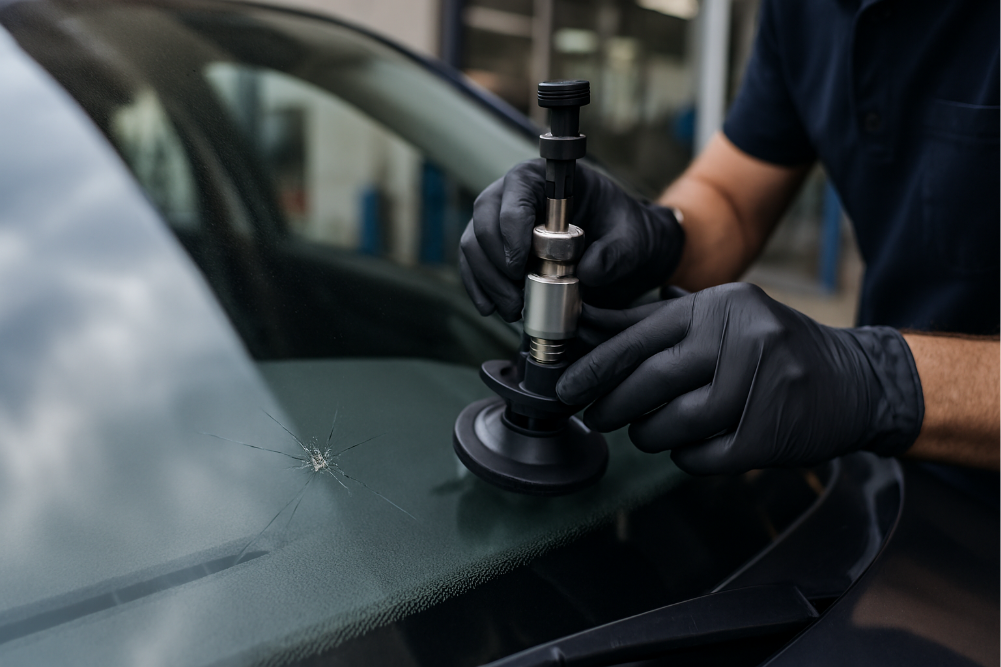
Stone Chips: These are circular or star-shaped fractures generated by impact. Generally, if a chip is less than a quarter (or around one inch in diameter), it is a candidate for repair.
The method includes injecting a transparent resin into the impact location, which binds the glass and inhibits spreading. These windshield repairs are the least expensive choice; depending on where you live, they usually cost between $50 and $150.
Cracks: Linear fractures are called cracks. If a break is less than three inches, it could be repairable, although this is frequently when expenses soar. Longer cracks generally demand a complete windshield replacement. Filling a basic bullseye chip requires less work and resources than stopping a fracture from widening.
Location: Where the pebble strikes your glass counts just as much as how hard it strikes. The damage’s location affects how difficult the repair is and, in some cases, whether the repair is legally or structurally possible.
Driver’s Line of Sight: Many stores may advise replacement rather than repair if the chip is directly in front of the driver. Even the greatest resin fixes leave a small deformation or imperfection.
Having a persistent smudge in your direct line of sight may be harmful, particularly in bright sunshine or at night when headlights generate glare. If safety rules necessitate a replacement, you are looking at a cost going from $100 to upwards of $400 or more.
The Edge of the Windshield: The perimeter of your windshield contributes up to 60% of the structural integrity of the cabin roof in a rollover accident. Chips or cracks placed near the edge (typically within two inches of the trim) decrease its strength greatly.
Because the load on the glass is highest around the margins, repairs here are prone to failing or spreading. Consequently, damage along the edge sometimes demands a complete replacement, raising the entire price.
Advanced Safety Systems
Modern automobiles are safer than ever, but that safety comes with a greater maintenance price tag. Your windshield probably has a number of sensors and cameras for Advanced Driver Assistance Systems (ADAS) if you drive a modern vehicle.
The camera systems need to be recalibrated if the damage is serious enough to need a replacement or if the repair interferes with a sensor. This is not a straightforward mechanic’s task; it calls for certain tools and instruction.
Calibration may be static (done at a shop with objectives) or dynamic (done by driving the vehicle). This procedure might add anywhere from $200 to $600 on top of the glass installation cost. If your premium car has a heads-up display (HUD), the glass itself is specialized and significantly more expensive than regular glass.
Insurance Coverage and Deductibles: A lot of drivers’ out-of-pocket expenses solely depend on their insurance coverage. Most insurance providers evaluate windshield repair differently than collision repair.
The “Free” Repair: Many comprehensive insurance plans will waive the deductible for windshield repairs (not replacements). Insurers prefer to pay the $70 for a chip repair now rather than $800 for a replacement later. In these situations, you will not incur any expenses.
Glass Deductibles: Your comprehensive deductible will probably need to be paid if a replacement is required. However, certain jurisdictions (including Florida, Kentucky, and South Carolina) have legislation mandating insurers to fund windshield repair with zero deductible if you have comprehensive coverage.
Check your insurance expressly for “full glass coverage. “If you don’t have it, and your deductible is $500, paying out of pocket for a $350 replacement could actually be cheaper than submitting a claim.
Do you have a Question?
Get An Auto Glass Replacement Quote Now 866.278.7417
DIY Kits vs Professional Service
You can get do-it-yourself windshield repair kits for less than $20 at any car parts shop. The price difference between a $15 kit and a $100 professional treatment is appealing, but it represents a difference in quality and danger.
DIY kits depend on basic syringes to generate pressure and utilize a lower-grade resin. The repair will fail if the chip isn’t fully deflated or the resin isn’t fully cured. An unsuccessful repair frequently results in a distributed crack, which leads to a complete replacement.
Professional stores also usually provide a warranty. If their repair fails and the crack widens, they will frequently credit the repair’s cost against the purchase of a new windshield.
The Price of Holding Out: When it comes to windshield repair, time is a hidden expense. A chip constantly ticks away, never remaining steady. Variations in temperature are detrimental to broken glass. In the winter, moisture might seep into the chip, freeze, expand, and fracture the glass.
In the summer, the heat causes the glass to expand, placing stress on the weak area. Even striking a pothole may convert a little chip into a jagged line across your dashboard.
You’ve switched from an inexpensive repair bracket to an expensive replacement bracket the instant a chip grows into a crack bigger than a dollar note. The greatest strategy to reduce expenses is to address the damage during the first few days.
Frequently Asked Questions: Will the chip be removed entirely after repair? No. The goal of a windshield repair is not to make the glass seem brand new but rather to restore structural integrity and stop spreading. While the optical acuity will improve significantly—often by 70% to 90%—you will likely still perceive a tiny hole or imperfection where the impact happened.
Does my insurance premium increase if I file a glass claim? Generally, no. Glass claims are covered under comprehensive coverage, which includes coverage for non-driving-related damage (such as weather, theft, or flying pebbles). Frequent claims of any sort may ultimately impact your rates, although most insurance companies do not raise charges for a single glass claim.
What is the duration of a professional repair? One of the advantages of repair versus replacement is quickness. It usually takes 30 minutes to fix a chip. The resin cures under UV light fast, so you may generally drive the automobile immediately after the treatment is completed.
Don’t Let a Minor Chip Become a Big Break: Repairing a minor chip in your windshield is almost always less expensive than the alternative. Whether you are paying $100 out of cash or having your insurance cover it, responding promptly safeguards the safety of your car and saves you money in the long run.
If you see damage, wrap it with a piece of transparent tape to keep debris out (this helps the resin adhere better later) and arrange an appointment with a reputable auto glass shop immediately. Investing a modest bit of time and money now can save you from a much greater charge down the line.
Hidden Factors That Spike the Price
A loud crack interrupts your music. A wayward boulder from the roadway has created a spiderweb fracture directly in your line of sight. It is an issue every motorist dreads, but the aggravation typically compounds when you finally receive the repair price.
For many years, changing a windshield was a simple, reasonably priced fix. It was essentially a sheet of curved glass kept in place by a rubber gasket. In less than an hour, you might often exchange it for several hundred dollars.
However, contemporary automobiles have changed the modest windshield into a complicated piece of engineering. It is no longer merely a wind deflector; it is a structural component and a lens for advanced technologies. When you obtain a quotation that appears unusually expensive, it isn’t always price gouging. Several unseen elements affect the ultimate figure on your invoice.
Understanding these hidden cost considerations will help you make sense of the quotation and guarantee you are receiving the proper glass for your vehicle’s safety and functionality.
The Hidden Cost of ADAS Calibration: The single largest factor pushing up windshield replacement prices recently is the widespread adoption of Advanced Driver Assistance Systems (ADAS).
If your automobile was constructed in the recent decade, it likely contains safety systems such as lane departure warning, automated emergency braking, or adaptive cruise control. These systems install sensors and cameras just below the windshield glass.
When you change the glass, you physically shift these cameras. Even a change of a single millimeter may throw off the sensor’s focus. If the camera is misaligned, the vehicle may drift out of its lane or fail to stop.
Technicians must carry out a procedure known as recalibration to correct this. This needs specialized equipment, highly skilled staff, and substantial time. There are two kinds of calibration:
Static Calibration: Requires a controlled setting with particular targets positioned at exact distances from the vehicle.
Dynamic Calibration: Requires the technician to drive the car at defined speeds on designated routes to “teach” the camera. This procedure is different from the installation of the glass itself and may add hundreds of dollars to your ultimate price.
Aftermarket Glass
Not all glass is made equal, and the windshield’s supplier has a big influence on the cost. You will commonly meet three varieties of glass:
OEM (Original Equipment Manufacturer): This glass is created by the same manufacturer that supplied the windshield when your automobile rolled off the manufacturing line. It carries the automaker’s logo (like Ford, BMW, or Toyota). It is similar to the original regarding thickness, durability, and hue. OEM glass is the most costly choice due to the branding and assured fit.
OEE (Original Equipment Equivalent): Although it lacks the automaker’s insignia, this glass is often produced by the same businesses that produce OEM glass, such as Pilkington or Saint-Gobain. It is manufactured to the same standards and requirements but costs less since you aren’t paying for the brand name.
Aftermarket Glass: This variant is a generic version made by third-party firms that reverse-engineer the design. It may not have the same level of quality control as OEM in terms of clarity, curvature, and noise reduction, even if it must adhere to basic safety requirements. Although this type of windshield is the least expensive choice, there is sometimes a chance of wind noise or optical distortion.
The Glass Integrated Technology
Beyond the cameras seeing through the glass, new windshields frequently feature electronics implanted into the glass. These characteristics increase production complexity and replacement costs.
Heated Elements: Look attentively at the bottom of your windshield where the wipers sit. If you observe little orange wires, you have a heated wiper park area. Some premium automobiles incorporate heating elements across the whole windshield to melt ice rapidly.
Rain Sensors: If your wipers switch on automatically when it showers, your windshield contains a rain sensor. Usually found next to the rearview mirror, this is a gel pad. If the gel pad is destroyed, the sensor must be gently moved or replaced completely.
Heads-Up Display (HUD): Cars that display speed and navigation info onto the windshield need specific glass. Standard glass consists of two layers.
A “ghosting” or double image will appear if you project an image onto regular glass. To guarantee that the projection appears clear, HUD windshields have a unique wedge-shaped connecting layer. Installing a non-HUD windshield on a HUD-equipped automobile will damage the display.
Acoustic Interlayers: Have you observed the increased quietness of modern automobile interiors compared to those from the 1990s? Much of the credit goes to acoustic windshields.
A conventional windshield consists of two panes of glass with a layer of vinyl (PVB) placed in between for safety. A thicker, altered vinyl coating is used in acoustic windshields to reduce sound waves. This muffles motor drone, wind hiss, and road noise.
The ride will be substantially noisier if you replace the factory-installed acoustic glass in your car with regular glass. But the cost of such sound-absorbing technology is high.
Do you have a Question?
Get An Auto Glass Replacement Quote Now 866.278.7417
Moldings Clips and Accessories
When a professional removes your old windshield, the glass isn’t the only item that comes off. The windshield is commonly encircled with cosmetic moldings, plastic cowls, and retention clips.
In many automobiles, these moldings are intended for single usage. The rubber molding expands and warps, or the plastic clips shatter as they are forced off. To provide a watertight seal and a clean appearance, these pieces must be replaced with new ones.
While a single clip could only cost a few dollars, a whole molding kit might vary from $20 to over $100 depending on the car type. A quality business will include them in the price to avoid leaks later, whereas a cheap shop could attempt to glue the old, broken molding back on.
Luxury and Convertible Complexity: The form and design of your car also determine its price. For instance, convertibles frequently rely on the windshield frame to ensure rollover safety. This type of car needs thicker, reinforced glass and more heavy-duty bonding chemicals (urethane).
Similarly, premium automobiles sometimes incorporate intricate curves or large panoramic windshields that reach into the roofline (like those found on certain Tesla models).
Manufacturing a single piece of glass with a dramatic curve without generating optical distortion is challenging and costly. Shipping and managing these enormous, delicate items also adds to the logistical expense, which is passed down to the customer.
Making an Informed Decision
Keep in mind that safety comes first while examining the bottom line of a replacement quotation. In the event of a rollover, the windshield guarantees that your airbags will deploy properly and supports the roof.
If you are making the payment yourself, you might be tempted to cut costs by skipping the ADAS calibration or opting for the least expensive aftermarket glass. However, doing so might damage the safety mechanisms your life relies on.
Verify your deductible if you have comprehensive insurance. The most sensible financial course of action is to file an insurance claim, as the cost of a good replacement with OEM-quality glass and complete calibration sometimes exceeds the deductible.
Knowing these underlying aspects allows you to ask the proper questions. Ask your technician whether the cost includes new moldings, if calibration is necessary, and what brand of glass they plan to use. This assures you aren’t simply paying for excellent vision but for safe driving.
Mobile Safe Auto Glass
14241 E Firestone blvd suite 400,
La Mirada, CA 90638
Phone: (562) 608-1154
Toll Free: 1 866 278 7417
Mail: sales@mobilesafeautoglass.com
Get a FREE QUOTE today! You can get a free quote and schedule 24/7 using this free quote wizard.
Mon – Fri 8am – 5pm
Saturday 8am – 1pm
Sunday Closed