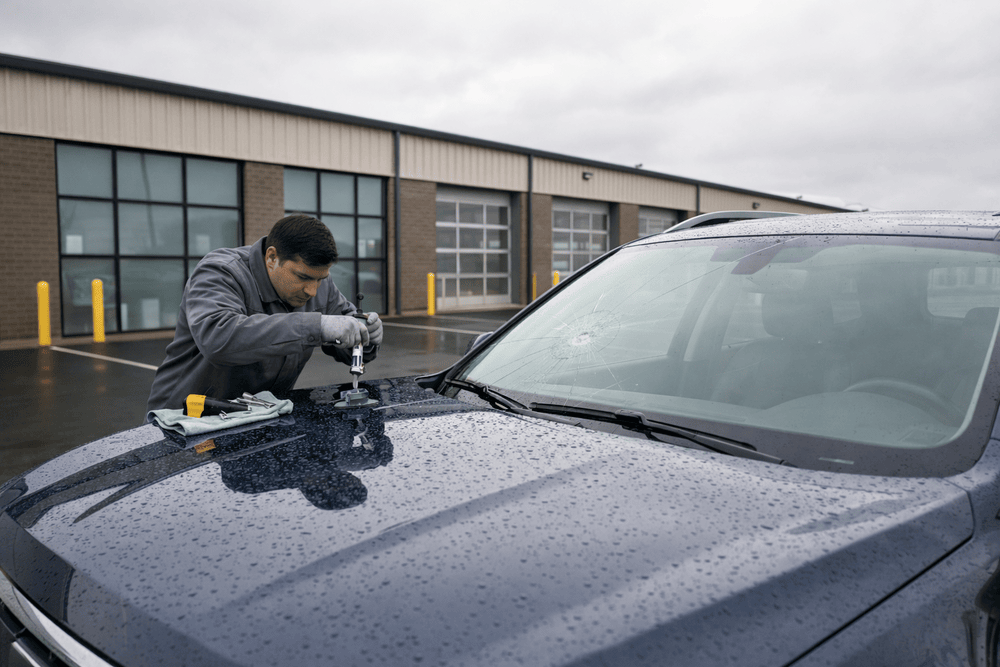
When Insurance Covers Broken Windshield Repair
Most often, it happens when you least anticipate it. A dump truck two lanes ahead of you hits a bump while you’re driving down the interstate and listening to your favorite podcast. A small rock shoots into the air and precisely arches in the direction of your car. It’s easy to recognize that unique, piercing sound of a hit. A star-shaped chip appears directly in front of you as you scan the glass. Panic strikes, but it’s not always related to the car’s safety. Financial concerns are the immediate concern. Your car’s structural integrity depends on its windshields, and replacing the current glass, often equipped with sensors for lane assistance and rain detection, is expensive.
Get An Auto Glass Replacement Quote Now 866.278.7417

Windshield Replacement & Repair
Our competitors push you into going to their shop to get your glass fixed-making it cheaper for them. We make it easier for YOU to get back on the road by offering free mobile repairs at your home or work. With our free mobile services servicing the entire Orange County & Los Angeles area, we can often handle your windscreen replacement the same day! So the next time you need a windshield replacement, give us a call.
Talk to a Windshield Replacement Specialist Now 866.278.7417

Calibration
Calibration is the process of returning a vehicle’s ADAS to OEM specifications. Calibration is necessary after a new glass installation, particularly a windshield with a camera mounted to it, to ensure that the ADAS features continue to function properly despite having been moved during installation. If a car’s ADAS is not properly calibrated, the system may not function safely. A misaligned camera could jeopardize the functionality of the system and lead to dangerous driving or accidents, so it is crucial that the cameras are aligned perfectly, which is what windshield calibration ensures.
Talk to a Calibration Specialist Now 866.278.7417

Fleet Auto Glass Repair
We provide expert auto glass repair and windshield replacement services for commercial fleets of all sizes. We are experienced with all manufacturers and machine types of domestic or foreign cars, trucks, vans, or commercial vehicles, including heavy equipment. Our same day mobile auto glass and windshield repair service will enable you to get back on the road faster and start saving you time and money instantly. Give us a call today! We are here to help!
Talk to a Fleet Auto Glass Specialist Now 866.278.7417
The Function of Extensive Coverage
The most widespread misperception regarding auto insurance is that “full coverage” entails free coverage. Your policy is actually divided into distinct groups. Comprehensive coverage is the most crucial category for windshields.
Comprehensive insurance covers damage to your car that doesn’t result from a collision with another vehicle. This comprises: Examples of flying items include rocks, gravel, or debris that have been kicked up by other tires.
Vandalism: When someone smashes your window on purpose.
Weather: A tree branch falling during a storm or damage from hail.
Animals: If a deer smashes the glass of your car by running into it.
If your policy includes comprehensive coverage, it likely covers your windshield damage. However, if you only have liability insurance, which covers harm you inflict on others, you will be responsible for covering the cost of the new glass.
Collision Coverage Scenarios: There is an exception to the comprehensive rule. Collision coverage applies if your windshield cracks as a result of colliding with another vehicle, a telephone pole, or a mailbox.
This distinction is important since filing a collision claim might have a greater effect on your future premium rates, and collision deductibles are frequently larger than comprehensive deductibles.
Insurance carriers typically favor repairs over replacements. Why? It’s just basic economics. It costs them between $50 and $100 to fill a chip with resin. It can cost up to $1,000 to replace the entire windshield and calibrate Advanced Driver Assistance Systems (ADAS).
Many insurance companies provide a glass deductible waiver for repairs due to this cost discrepancy. This is how it works: A technician can frequently inject a specific glue to seal the crack if it is small (typically smaller than a dollar note) and out of the driver’s direct line of sight.
Many insurers will completely waive your deductible if you select this option. They escape having to pay for a complete replacement, and you have your windshield fixed for nothing. However, you will require a complete replacement if the damage is serious, such as a long crack, a broken section, or damage that jeopardizes the glass’s structural integrity. Your regular deductible normally applies in this situation.
The Dilemma of Deductibility
You must perform some quick math before you call to submit a claim. The amount you agree to pay out-of-pocket prior to your insurance taking effect is known as your deductible. Suppose your windshield sustains a big crack from a rock impact, necessitating a complete replacement.
Scenario A: $400 is the cost of replacement. You have a $500 comprehensive deductible. It is useless to file a claim in this situation. In either case, you would have a claim on your record and pay the entire $400.
Scenario B: You operate a contemporary SUV equipped with rain sensors and heated glass. The cost of replacement is $1,200. You have a $250 deductible. In this case, it makes perfect financial sense to file a claim. The insurance pays the remaining $950 after you pay $250.
Zero-Deductible States: The math may be significantly simpler depending on where you live. Since broken glass is regarded as a safety problem, some jurisdictions have rules that encourage drivers to fix it without facing financial obstacles.
For a few more dollars per month, you can purchase a certain “Full Glass Coverage” add-on in other states, which eliminates your glass deductible. To find out whether this clause applies to you, review your local legislation and the policy declaration page that pertains to you.
Do you have a Question?
Get An Auto Glass Replacement Quote Now 866.278.7417
Original Equipment vs Aftermarket Glass
A fresh argument emerges if you move forward with a claim: What type of glass will be used?
OEM (Original Equipment Manufacturer): The company that produced the original glass for your vehicle is also the one that made this glass. Its thickness, hue, and specifications are all the same.
Aftermarket (OEE, or Original Equipment Equivalent): A third-party business manufactures this glass. Although it isn’t labeled by the carmaker, it is made to fit your vehicle.
Because aftermarket glass is less expensive, insurance companies usually cover the cost. To guarantee ideal calibration, you might pick OEM glass if you drive a high-end automobile or one with sophisticated safety sensors. Unless your policy specifies otherwise, you may be required to pay the difference between the OEM and aftermarket parts if you insist on OEM glass.
Will My Rates Increase Due to a Glass Claim? For drivers, this is their biggest dread. “It depends” is the response. Comprehensive claims (such as a rock striking your windshield) are typically regarded as “not-at-fault” situations. For a single glass claim, the majority of insurance companies won’t increase your rates.
They are aware that haphazard road debris is beyond your control. But frequency is important. If you file three windshield claims in a two-year period, an insurance can view you as high-risk.
They may opt not to renew your coverage, raise your deductible, or hike your premium. Furthermore, your rates will likely be affected by that claim if the damage occurred during a collision for which you were responsible.
How to Make a Windshield Claim
If the harm is covered and the math is on your side, the procedure is usually easy. Measure the crack to evaluate the damage. It may be repaired if it is less than six inches.
Assume replacement if it is bigger or blocking your view. Examine your policy to determine whether you have comprehensive coverage and what your deductible is.
Reach Your Insurance Company: You can usually do this by making a brief phone call or using a mobile app.
Select a Shop: You often have the legal right to decide who fixes your vehicle. You can insist on using a local store you trust, but your insurer may suggest a particular national chain because they have a deal with them.
Plan the Work: A lot of glass repair businesses provide mobile service, which means they will come to your house or place of business to replace the glass.
Frequently Asked Questions: Is a cracked windshield grounds for a ticket? Indeed. Driving with a cracked windshield is a safety infraction in several areas. Police may issue a citation if the crack compromises the vehicle’s structural integrity or the driver’s vision. This is still another justification for making the repair as soon as possible.
Are side mirrors and sunroofs covered by insurance? Yes, most of the time. The comprehensive component of your policy usually covers side windows and sunroofs in addition to windshields. However, collision insurance may occasionally cover side mirrors knocked off by colliding with a garage door or another vehicle.
What happens if I rent a car? Usually, lease agreements demand that you return the vehicle undamaged. At the conclusion of the lease, you will be billed for any cracks, frequently at a higher cost. Usually, it makes more sense to get it fixed by your insurer before submitting the car.
Clear Vision Ahead: Although a broken windshield can be annoying, it doesn’t have to be a major financial burden. Knowing your deductible and your comprehensive coverage is crucial.
Act quickly if the break is modest because early repairs are frequently free and prevent further harm. Compare the costs to your deductible to determine whether filing a claim is worthwhile if the glass needs to be replaced.
Ignoring the damage could result in a ticket and jeopardize your safety in addition to making your automobile appear awful. Please review your policy promptly to ensure you are prepared for any future incidents involving airborne debris.
Critical Things Drivers Must Check Now
The majority of drivers view their windshield as merely a window to the road. You may wipe it off when you pull over for gas, look through it, and then forget about it.
However, one of your car’s most important safety features is that big curved piece of glass. It offers the structural integrity required to keep you safe in an accident, supports the roof in the event of a rollover, and aids in the proper deployment of the passenger airbag.
Despite the importance of windshield maintenance, people often overlook it until a large crack forms or they lose all visibility during a storm. Ignoring little problems might result in costly repairs or, worse, hazardous driving circumstances.
You must take proactive measures to protect your vehicle and your pocketbook. In less than five minutes, a straightforward visual assessment can ultimately save you hundreds of dollars. Here are all the things you should be looking for on your windshield right now.
Check for Chips, Pits, and “Bullseyes”: Examining the glass for physical damage is the first and most evident step. Road debris, gravel, and tiny objects regularly hit windshields. Some strikes leave behind small chips, pits, or circular “bullseye” fissures, while others leave no impression at all.
Many drivers overlook these minor imperfections because they don’t appear to block their vision. This is an error. The beginning of a big crack is a tiny chip. The glass expands and contracts in response to temperature changes, such as when you blast your defroster on a frigid morning or wash your car on a hot day.
Eventually, the microscopic chip will be forced to expand over the entire pane by this tension. What to search for: Star breaks are tiny fissures that radiate outward from a central point.
Bullseyes: Rock-induced circular damage.
Pits: Tiny divots with missing glass that haven’t broken yet.
A qualified technician can frequently fill them with resin if they are discovered early. This inhibits the spread and strengthens the glass. However, if the break is larger than a dollar bill, you typically need to replace the entire windshield.
Check the Blades on Your Wiper
The first line of protection against mud, snow, and rain is your windshield wiper system. Paradoxically, they frequently result in windshield damage as well.
Rubber used to make wiper blades deteriorates over time as a result of exposure to UV light and temperature changes. The rubber may split or separate from the metal arm when it solidifies. When such an event occurs, the wiper arm’s harsh plastic or bare metal scrapes the glass directly with each sweep. The checklist
Raise the arms and carefully remove the wipers from the glass. Run your finger along the rubber edge to inspect it. It ought to be seamless. Replace it right away if there are any missing pieces or if it seems rough.
Listen: Your wipers are past their best if they squeak, chatter, or skip across the glass.
Check for streaks: The wipers are no longer safe to use if they spread debris or leave bands of water behind instead of removing it. Wiper replacement is a low-cost maintenance procedure that should be performed every six to twelve months.
Please examine the washer fluid system, as maintaining a clean windshield while driving is essential. Driving behind a vehicle on a muddy highway, pressing the washer lever, and hearing the dry buzz of an empty pump are some of the scariest things in the world. It’s easy to check your fluids, but it’s also crucial to verify how they are delivered. How to make sure:
Finally, make sure the reservoir is full by finding the blue cap beneath your hood. Water can freeze in the winter and cause cracks in the reservoir and lines; therefore, use the appropriate seasonal fluid.
To test the nozzles, have a buddy turn on the washer while you remain securely off to the side. A powerful spray should strike the center of the glass.
Remove the blockage: If the spray is weak or bouncing off the roof, it’s possible that dirt or wax has clogged the nozzles. Frequently, you can carefully clear them with a pin or sewing needle.
Do you have a Question?
Get An Auto Glass Replacement Quote Now 866.278.7417
Inspect the Molding and Seals
The windshield assembly consists of more than just the glass. One of the most important functions of the rubber molding (also known as weatherstripping) that surrounds the glass is to keep noise, water, and wind out of your cabin.
This rubber may dry out, crack, or separate from the frame over time. Water may seep into the car if the seal breaks. Water frequently rushes down below the dashboard, where it can corrode fuse boxes and delicate electrical components before you even notice a wet carpet, making such an incident very risky. A poor seal’s warning indications include:
Whistling noises: At highway speeds, a high-pitched sound frequently indicates air entering via a seal gap.
Moisture inside: Your seal is weakened if you see condensation on the inside of the glass or wet areas on the dashboard following a downpour.
Visible lifting: Professional assistance is required if the rubber trim appears wavy or is peeling off.
Remember the Inside of the Glass: Drivers frequently give the outside of the windshield a thorough cleaning, but they pay no attention to the inside. But the glass’s interior can become just as hazardous as its exterior.
On the inside glass, a murky, greasy layer accumulates over time. This is brought on by smoking or breath condensation, as well as “off-gassing” from the plastic components in your dashboard.
You may not see it during the day. However, this film produces a dazzling glare that can block out oncoming cars or pedestrians at night or while driving straight into the sun.
Scrub the interior thoroughly with a microfiber cloth and a glass cleaner designed especially for automotive usage (ammonia-based household cleaners might harm aftermarket tint).
Comprehending ADAS Adjustment
Your windshield is probably a component of a sophisticated technological network if your vehicle was manufactured during the previous several years. Many contemporary cars feature Advanced Driver Assistance Systems (ADAS). These include functions like adaptive cruise control, automated emergency braking, and lane-keeping assistance.
These systems often utilize sensors and cameras situated directly behind the windshield, usually near the rearview mirror. You must make sure these cameras are calibrated if you see a crack in this particular region or if your windshield needs to be replaced.
If the glass is slightly altered or the camera is moved by even a millimeter, the car may “think” it’s in the lane’s center while drifting into oncoming traffic. Make sure the area in front of these cameras is spotless and clear of trash or stickers when inspecting your windshield.
Drive Clearly: Your windshield does a fantastic job of shielding you from the road and the weather. You can make sure it can perform its duties efficiently by including these checks in your monthly routine.
Avoid letting a crack ruin your day. Five minutes prior to your next journey, check your wipers, fill up your fluid, and examine the glass. The most crucial safety aspect in your car is a clear vision of the road ahead.
Mobile Safe Auto Glass
14241 E Firestone blvd suite 400,
La Mirada, CA 90638
Phone: (562) 608-1154
Toll Free: 1 866 278 7417
Mail: sales@mobilesafeautoglass.com
Get a FREE QUOTE today! You can get a free quote and schedule 24/7 using this free quote wizard.
Mon – Fri 8am – 5pm
Saturday 8am – 1pm
Sunday Closed