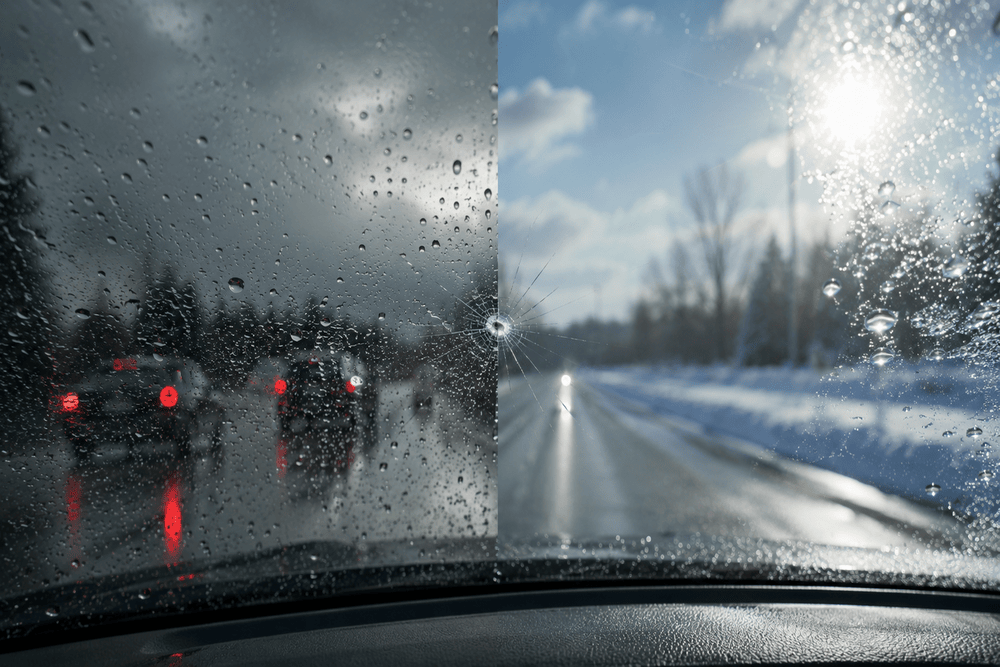
How Weather Affects Car Fix Cracked Windshield Results
Even on their own, cracked windshields are annoying. However, when should the repair be made? It becomes difficult at that point. Rain, humidity, and temperature can all affect how long a windshield repair lasts, sometimes making the difference between a repair that lasts for years and one that breaks down in a matter of weeks. This article explains how various weather conditions impact windshield crack replacement and repair, as well as what you can do to achieve the best outcomes year-round. In order to repair a windshield, a transparent resin must be injected into the chip or fracture. The entire procedure may be jeopardized before the technician even packs up their equipment if the weather is unsuitable—too hot, too cold, or too wet.
Get An Auto Glass Replacement Quote Now 866.278.7417

Windshield Replacement & Repair
Our competitors push you into going to their shop to get your glass fixed-making it cheaper for them. We make it easier for YOU to get back on the road by offering free mobile repairs at your home or work. With our free mobile services servicing the entire Orange County & Los Angeles area, we can often handle your windscreen replacement the same day! So the next time you need a windshield replacement, give us a call.
Talk to a Windshield Replacement Specialist Now 866.278.7417

Calibration
Calibration is the process of returning a vehicle’s ADAS to OEM specifications. Calibration is necessary after a new glass installation, particularly a windshield with a camera mounted to it, to ensure that the ADAS features continue to function properly despite having been moved during installation. If a car’s ADAS is not properly calibrated, the system may not function safely. A misaligned camera could jeopardize the functionality of the system and lead to dangerous driving or accidents, so it is crucial that the cameras are aligned perfectly, which is what windshield calibration ensures.
Talk to a Calibration Specialist Now 866.278.7417

Fleet Auto Glass Repair
We provide expert auto glass repair and windshield replacement services for commercial fleets of all sizes. We are experienced with all manufacturers and machine types of domestic or foreign cars, trucks, vans, or commercial vehicles, including heavy equipment. Our same day mobile auto glass and windshield repair service will enable you to get back on the road faster and start saving you time and money instantly. Give us a call today! We are here to help!
Talk to a Fleet Auto Glass Specialist Now 866.278.7417
Why Weather Is More Important Than Most People Know
For complete replacements, the same reasoning holds true. Urethane adhesive, which is used to attach modern windshields to car frames, is extremely sensitive to moisture and temperature during the curing process.
If the circumstances are incorrect, you run the danger of leaks, wind noise, or, in extreme situations, a windshield that fails in an accident. It is not necessary to have a degree in chemistry to comprehend the function of the weather. However, a few important details may prevent an unsuccessful repair and needless investment.
The Impact of Cold Weather on Windshield Crack Repair: One of the most challenging weather conditions for windshield repair is cold. Glass contracts as it becomes cold.
An existing crack may close slightly as a result of this contraction, making it more difficult for resin to enter and completely fill the damage. The majority of repair resins are best suited for temperatures between 50°F and 90°F (10°C and 32°C).
Resin can’t reach the deepest areas of a crack below that range because it gets thicker and flows more slowly. Before beginning, a technician may be able to use a heat gun to reheat the glass, but this presents additional concerns since sudden temperature fluctuations can actually widen a break.
In freezing temperatures, what happens to cracks? When water freezes, it expands. When temperatures fall below freezing and moisture seeps into a crack prior to repair, the water can expand and greatly widen the damage. If left ignored in cold, damp circumstances, a little chip may grow into a full-length fracture overnight.
The useful lesson: don’t put off fixing your windshield if it’s cracked and winter is coming. The likelihood that the injury may spread increases with time.
Effects of Heat and Direct Sunlight on Repair Quality
Extreme heat, on the other hand, causes a different set of issues. Glass expands at high temperatures. When combined with direct UV exposure, this can have an impact on the resin’s curing process, sometimes leading to excessive surface hardening and inadequate bonding underneath.
It is not advised to park a vehicle in direct sunlight just before or after a windshield repair. Before and after servicing, experts usually recommend leaving the car in a covered place for at least an hour.
Technicians must precisely control when the curing process starts because some resins are UV-activated, which means they cure when exposed to UV light. Incomplete fills or air bubbles may be trapped by unintentional UV exposure during application.
Glass that is overheated also becomes more pliable and vulnerable to stress fractures. When a chip repair is done under controlled circumstances, the bond may be more clean than when it is done on a glass surface that is already under heat stress.
Rain, Humidity, and Why Wet Conditions Make Repairs Difficult: Water and windshield resin simply do not mix well. The resin is displaced or diluted by moisture in a fracture, which hinders the resin’s ability to effectively bind with the glass. Repairs made to a windshield that has recently rained or is moist are likely to break down more quickly than those made to dry glass.
A more subtle issue is humidity. Even when the glass seems dry, high ambient humidity (over 70–80%) may transfer enough moisture into the fracture to impact adhesion. This is especially important in coastal areas or in humid climates during the summer.
Moisture poses a much greater risk to the urethane adhesive in complete windshield restorations. For the adhesive to create a full seal, the surface must be dry. Moisture-displacement primers are often used by technicians working in damp environments, although dry glass and regulated humidity are necessary for the best results.
Is It Possible to Repair Windshields in the Rain? In a nutshell, they shouldn’t be. In the event of rain, the majority of trustworthy repair services will either reschedule or move the work indoors.
For this reason, portable shelters are frequently carried by mobile repair technicians. It’s a warning sign to take note of if a technician is eager to fix a broken windshield in the rain without any safety gear.
Do you have a Question?
Get An Auto Glass Replacement Quote Now 866.278.7417
Which Weather Is Ideal for Windshield Repair
The following circumstances are appropriate for fixing windshield cracks:
Temperature: 15°C to 27°C (60°F to 80°F).
Humidity: less than 60%
Sky: Not in direct sunlight, but cloudy or shaded
Rain is not anticipated for at least a few hours after the repair. The optimum natural circumstances are usually seen on mild spring or autumn days.
However, a lot of professional repair shops operate year-round in climate-controlled settings, so weather is essentially eliminated. The resin will have the greatest chance of bonding properly if you can plan a repair for a time of mild weather.
How to Protect Your Windshield Until It may Be Repaired: You may take the following actions to avoid more damage if the weather is preventing an urgent repair:
Until the fracture can be fixed, cover it with transparent tape to keep moisture and debris out. Steer clear of opaque or colored tape as this may reduce visibility.
Parking your automobile in a garage or other covered space lowers the chance that the fracture may expand owing to thermal expansion or moisture intrusion.
Steer clear of vehicle washes since pressurized water may find its way into the fracture and complicate the final repair.
Avoid blasting heat or air conditioning directly at the windshield because sudden temperature changes put additional strain on already-damaged glass. Instead, gradually warm or cool the room. These steps can buy time without making the situation much worse, but they won’t solve the crack.
Weather Has a Different Effect on Windshield Replacement and Repairs
Yes—and perhaps more so in some respects. In order to replace a windshield, the whole glass panel must be removed and a new one must be adhered using urethane.
Before the car is safe to drive, this glue has to cure for a certain amount of time—usually at least an hour in ideal circumstances, but sometimes longer in cold or humid weather. Urethane adhesive cures much more slowly in cold weather.
The structural integrity of the windshield may be jeopardized if you drive before the glue has completely cured. Inadequately bonded windshields have the potential to eject upon airbag deployment and fail to hold the roof in a rollover collision, both of which are major safety risks. When determining the suggested safe drive-away time after a replacement, always ask your technician to take the current weather into account.
Choosing the Correct Time for a Long-Term Windshield Repair: The weather doesn’t have to ruin a windshield repair, but neglecting it may turn a straightforward solution into a persistent issue.
Moisture undermines adhesion at every level, heat speeds curing in unexpected ways, and cold glass delays resin flow. When light, humidity, and temperature are under control or at their ideal levels, the finest repairs take place.
A mild, dry day is ideal when scheduling a repair, and you should think about whether the work will be done indoors or outdoors. Find out how the technician handles weather variables.
Additionally, waiting a day or two is almost always preferable to taking a chance on a repair that won’t last if the circumstances aren’t right. A well-done windshield repair should last the car’s whole life. The first step in achieving that result is to set the right conditions.
Common Questions
In cold weather, is it possible to fix a broken windshield? Although repairs can be done in cold weather, if the glass is below 50°F (10°C), quality may be compromised.
Low temperatures cause resin to thicken and may prevent it from completely penetrating the fracture. Heat guns may be used by technicians to pre-warm the glass, but care must be taken to prevent the fracture from becoming wider.
In cold weather, how long should I wait to drive after replacing my windshield? The urethane glue used to repair windshields cures more slowly in cold weather than it does in warm weather.
In ideal circumstances, the standard safe drive-away time is approximately one hour, but in cold weather, this can be greatly extended. Based on the circumstances at the time of installation, ask your expert for particular advice.
Can a windshield repair be ruined by rain? Rain during or right after a repair may hinder the resin’s ability to adhere to the glass. The resin is displaced or diluted by moisture, making the fix weaker and perhaps more prone to failure. Clean, dry glass should always be used for repairs, and the car should be kept dry for a minimum of one to two hours thereafter.
When is it too hot to fix a windshield? UV-activated resins may cure too quickly and unevenly at temperatures above 90°F (32°C), particularly when exposed to direct sunlight. This could lead to incomplete fills or air bubbles. Technicians usually operate in shaded places and modify their procedures when it’s hot outside.
Does humidity have an impact on fixing windshield cracks? Indeed. Even though the glass seems dry, high humidity—typically around 70–80%—can bring enough moisture into a fracture to prevent resin adherence. Over time, repairs made in very humid conditions without adequate moisture control are more likely to fail.
Is it preferable to fix a windshield indoors? In most situations, indoor repairs are preferred because they provide more control over temperature, humidity, and UV exposure. On a bad day, if you may choose between a mobile outside repair and a shop-based repair, the inside alternative is probably going to provide a more long-lasting outcome.
Why Temperature Variations Make a Cracked Windscreen Critical
The structural integrity of your automobile is jeopardized by temperature variations that cause fractured windshields to expand and compress, transforming little chips into complete splits. You may save hundreds of dollars and maintain your safety on the road by promptly fixing a broken windshield before seasonal temperature fluctuations occur.
You may not think much of that tiny chip in your windshield. However, whether you expose it to a cold snap or a scorching summer afternoon, what began as a little imperfection may develop more quickly than you may think over your whole field of vision.
The majority of drivers are aware that they should ultimately repair a broken windshield. A $50 chip fix may quickly become a $400 complete replacement due to temperature fluctuations, which many people are unaware of. You may save actual money and drive far more safely if you know why this occurs and when to take action.
What Impact Does Temperature Have on a Windshield Crack? Glass shrinks as it cools and expands when it warms up. Modern car glass can easily accommodate this movement under normal circumstances.
However, if you add a chip or crack, you’ve created a weak spot that is unable to equally absorb this stress. Tension concentrates at the crack when one portion of the glass expands more quickly than another, such as the cooler inner layer versus the sun-facing outer layer.
The split widens as a result of the stress pulling the glass apart at its weakest spot. The damage accumulates rapidly if this cycle is repeated throughout the seasons or even within a single day with a significant temperature variation.
In cold weather, what happens to a cracked windshield? Glass contracts in cold weather. An existing crack expands by about 9% when moisture from rain, snow, or morning dew seeps into it and freezes overnight, forcing the crack wider from the inside. In colder climates, drivers frequently observe that a crack that was hardly noticeable in the fall has grown considerably by the end of the winter.
This is made worse by blasting your car’s defroster on a frozen windshield. An existing crack serves as a fault line along which the glass splits, and the quick transition from freezing to warm air creates a strong thermal gradient across the glass.
In hot temperatures, what happens to a cracked windshield? Heat is just as dangerous. The temperature inside a parked automobile may rise far beyond 130°F on a hot summer day. Particularly if you turn on the air conditioner as soon as you enter, the windshield collects direct sunshine on one side while the inside air cools the other.
The glass expands unevenly as a result of this abrupt temperature change, and a fracture spreads along the route of least resistance. In a single afternoon, a hairline fracture may expand several inches.
Do you have a Question?
Get An Auto Glass Replacement Quote Now 866.278.7417
Why a Windshield Crack Is More Than Just a Cosmetic Problem
Beyond protecting your face from wind and rain, a windshield has several other purposes. It contributes up to 30% of the structural stiffness of contemporary cars and is essential to the deployment of airbags. The windshield aids in directing the passenger-side airbag toward the person rather than outward in the event of a frontal accident.
This protection is greatly diminished when a damaged windshield breaks or deforms under impact. The other main issue is visibility.
Particularly at night or in intense sunshine, glare, distorted depth perception, and difficulty reacting to risks are all caused by cracks in your line of sight. Even the windshield’s edge fractures weaken the glass to the point where it is more vulnerable to breaking from flying debris.
How Fast Can Temperature Changes Cause a Crack to Spread? The size and location of the initial damage, the temperature differential involved, and whether moisture has penetrated the crack are the three main factors that determine how quickly a crack propagates.
When repaired promptly, a chip smaller than a quarter usually holds well and stops spreading. That same chip can develop into a crack that spans the width of the windshield in a matter of weeks if it is left untreated during a full season of temperature fluctuations. Generally speaking, cracks larger than six inches are irreparable and need replacing the whole windshield.
Particularly dangerous are edge cracks, or those that begin close to the windshield’s edge. They tend to spread more quickly and widely than fractures in the center of the glass because they have less surrounding glass to withstand the stress from thermal expansion.
When Should a Cracked Windshield Be Repaired
The quick response is as soon as possible, preferably before the next significant change in temperature. As winter or summer approaches, regard any chips or cracks you find as urgent repairs.
Many mobile repair firms will travel to your place, and the majority of vehicle glass professionals can fill a chip or small break in less than thirty minutes. Many comprehensive motor insurance plans include chip repairs with no out-of-pocket costs, and they are usually significantly less expensive than complete replacements.
Is It Possible to Drive Despite a Cracked Windshield? The solution differs both practically and legally. Driving with damage that blocks the driver’s view is illegal in many states, and law enforcement may issue citations in accordance with these laws. Driving with a developing crack in varying temperatures not only puts you at legal danger, but the damage may become worse with each mile you go.
Quick visits to a repair shop? In general, things are OK. Prolonged travel through varying temperatures and elevations? When you get there, a tiny crack could turn into a major issue.
Maintain a Clear View and a structurally sound vehicle.
Seldom does a cracked windshield remain the same size. Temperature fluctuations, such as a scorching summer afternoon or a brutal winter frost, provide the precise circumstances that lead to the growth of cracks.
You have fewer alternatives and pay more the longer you wait. One of the simplest and most economical car maintenance choices you can make is to have a chip or tiny crack promptly fixed.
It protects your visibility, maintains the structural integrity of your automobile, and, if you have comprehensive insurance, usually costs you nothing. Don’t let the next heat wave or cold snap dictate your course of action.
Frequently Asked Questions: Can temperature changes alone cause a cracked windshield to shatter? Temperature variations seldom cause a completely intact windshield to crack.
A windshield that already has a chip or crack, however, is much more susceptible. Rapid temperature changes have the potential to accelerate the propagation of a fracture and, in severe circumstances, shatter the glass.
What is the price of fixing a windshield crack? The average cost of chip repairs is between $50 and $150. Depending on the car and kind of glass, complete windshield repairs often cost between $200 and $500 or more. Chip repair is often covered at no cost to the driver by comprehensive vehicle insurance coverage.
Does windshield damage increase in cold or hot weather? Both are dangerous, but because of the freezing and growth of fluids within the gap, cold weather is often more harmful. However, abrupt heat can accelerate the spread of cracks, especially from air conditioning after parking in the sun.
How long is it possible to drive with a broken windshield before it becomes worse? Because it relies on factors including temperature, moisture, road vibration, and fracture size, there is no set period. A tiny chip may remain contained for weeks under stable circumstances. The same chip may spread in a matter of hours or days with severe temperatures.
Will windshield crack repair be covered by insurance? Since it’s less expensive for insurers than replacing an entire windshield, comprehensive auto insurance policies usually cover windshield chip repairs with no deductible. Before making an appointment for a repair, check your particular policy or get in touch with your insurer to confirm your coverage.
Mobile Safe Auto Glass
14241 E Firestone blvd suite 400,
La Mirada, CA 90638
Phone: (562) 608-1154
Toll Free: 1 866 278 7417
Mail: sales@mobilesafeautoglass.com
Get a FREE QUOTE today! You can get a free quote and schedule 24/7 using this free quote wizard.
Mon – Fri 8am – 5pm
Saturday 8am – 1pm
Sunday Closed