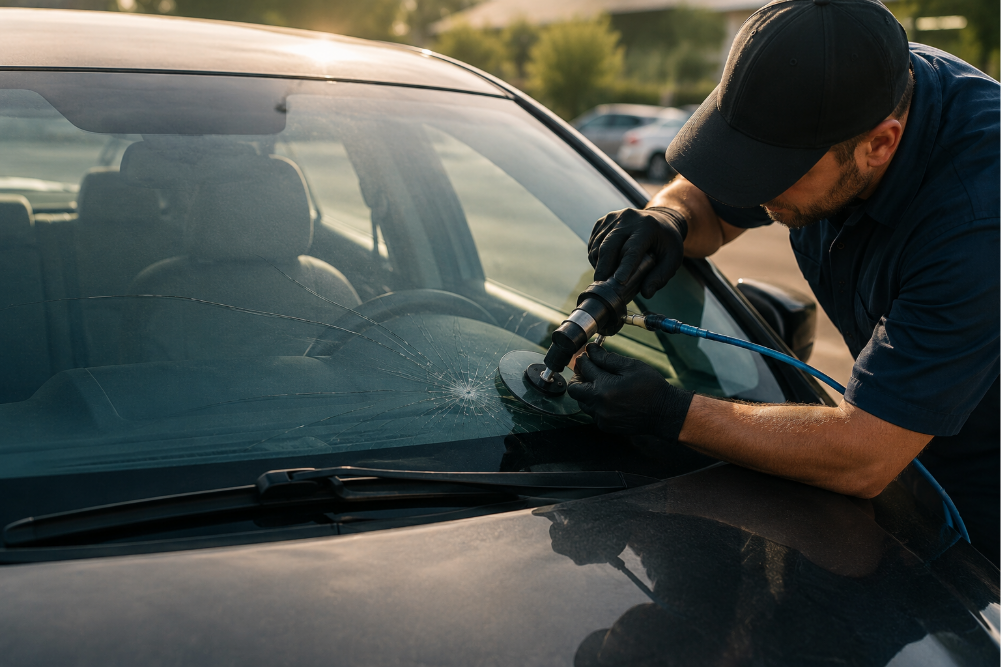
Fix Cracked Windshield After Parking in Extreme Heat
By forcing the glass to expand unevenly, extreme heat may cause a windshield to shatter or exacerbate pre-existing chips. Larger or deeper damage usually necessitates a complete windshield replacement, however little cracks (less than 6 inches) may sometimes be fixed using a resin kit. After a hard day, you return to your vehicle and see a crack in your windshield that wasn’t there this morning. No rock chip, no effect. Just the merciless July heat and a scorching parking lot. Most drivers are unaware of the prevalence of heat-related windshield cracks. When the temperature rises, laminated car glass expands, and when it falls, it shrinks.
Get An Auto Glass Replacement Quote Now 866.278.7417

Windshield Replacement & Repair
Our competitors push you into going to their shop to get your glass fixed-making it cheaper for them. We make it easier for YOU to get back on the road by offering free mobile repairs at your home or work. With our free mobile services servicing the entire Orange County & Los Angeles area, we can often handle your windscreen replacement the same day! So the next time you need a windshield replacement, give us a call.
Talk to a Windshield Replacement Specialist Now 866.278.7417

Calibration
Calibration is the process of returning a vehicle’s ADAS to OEM specifications. Calibration is necessary after a new glass installation, particularly a windshield with a camera mounted to it, to ensure that the ADAS features continue to function properly despite having been moved during installation. If a car’s ADAS is not properly calibrated, the system may not function safely. A misaligned camera could jeopardize the functionality of the system and lead to dangerous driving or accidents, so it is crucial that the cameras are aligned perfectly, which is what windshield calibration ensures.
Talk to a Calibration Specialist Now 866.278.7417

Fleet Auto Glass Repair
We provide expert auto glass repair and windshield replacement services for commercial fleets of all sizes. We are experienced with all manufacturers and machine types of domestic or foreign cars, trucks, vans, or commercial vehicles, including heavy equipment. Our same day mobile auto glass and windshield repair service will enable you to get back on the road faster and start saving you time and money instantly. Give us a call today! We are here to help!
Talk to a Fleet Auto Glass Specialist Now 866.278.7417
Why Do Windshields Crack in Extreme Heat
Laminated safety glass, which consists of two layers of tempered glass joined by a plastic interlayer, is used to make windshields. They are robust under impact due to their structure, but heat stress poses a distinct sort of risk.
When a parked car’s surface temperature rises beyond 170°F on a hot day, the outside layer of glass quickly absorbs heat while the sealed and shaded corners stay cooler. Uneven expansion results from this temperature difference.
Internal tension as a consequence may cause a spontaneous break, particularly if the glass already has a tiny chip or surface imperfection. Thermal cracking is more probable due to a few factors:
Pre-existing chips or nicks: Heat may take advantage of even the smallest nick caused by road debris.
Direct sunlight exposure: Cars with dark colors and those without windshield sunshades absorb a lot more heat.
Abrupt temperature changes: After getting in the vehicle, blasting cold air conditioning over a sun-baked windshield is a quick way to transform a chip into a crack.
Old or badly installed windshields: Glass is more susceptible to heat movement due to aging seals and poor installation.
How to Evaluate the Damage Before Taking Any Further Action: Examine the damage thoroughly before grabbing a repair kit or contacting your insurance provider.
What kind of crack do you have? Stress cracks are nearly often brought on by temperature fluctuations and begin at the windshield’s edge before moving within. A circular impact point known as a chip or bullseye is very repairable if discovered early.
Floater crack: Usually brought on by impact or heat stress, it begins in the center of the glass and moves away from the edges.
Repair a Heat Cracked Windshield on Your Own
A do-it-yourself windshield repair kit may be a useful temporary solution for minor chips and tiny fractures that haven’t expanded to the margins. These kits, which cost between $10 and $25 at most auto parts shops, work by injecting a transparent epoxy into the damage to restore some structural integrity and stop it from spreading further.
Step-by-step instructions for using a windshield repair kit: Park in the shade and let the glass cool fully. Never try to repair hot glass since the resin won’t cure correctly.
Use the alcohol wipe that comes with the kit to clean the damaged area, then use the pin tool to get rid of any broken glass. Place the suction cup applicator in the exact center of the chip or fracture. Inject the resin by carefully following the kit’s instructions; most of them call for creating a vacuum before applying pressure to force the resin in.
Cure in sunshine: Since most resins need UV light to cure, cover the area with a curing strip and leave it in indirect sunlight for the specified amount of time.
Scrape and polish: After the resin has dried, use the included razor blade to buff the surface and remove any extra resin. Although the fix won’t be apparent, it should prevent the fracture from becoming worse and provide some clarity. Nevertheless, DIY kits won’t work on cracks longer than a few inches and aren’t a long-term solution for structural damage.
Do you have a Question?
Get An Auto Glass Replacement Quote Now 866.278.7417
Obtain a Professional Windshield Replacement or Repair
Professional servicing is the best option if the fracture is more than six inches long, in your line of sight, approaches the edge of the glass, or has pierced both laminate layers. A qualified vehicle glass specialist can determine if a complete replacement or repair is necessary.
A new OEM or aftermarket glass panel must be installed, the old windshield must be removed, the frame must be cleaned, fresh glue must be applied, and the replacement process usually takes one to two hours.
Select repair if: The damage is a tiny chip or crack that is less than six inches in size and is situated away from the edges and the driver’s line of sight.
If the fracture is long, structural, near the edge, or makes it difficult to see, replace it. Because the windshield facilitates airbag deployment and adds to the car’s structural stiffness, driving with impaired windshield integrity poses a safety concern.
Does Heat-Related Windshield Damage Get Covered by Auto Insurance? Yes, in a lot of situations. Since it doesn’t come under collision damage, comprehensive vehicle insurance usually covers windshield damage brought on by environmental conditions, such as heat stress.
For details on glass coverage, see your insurance. Some states mandate that insurers pay for windshield replacement at no expense to the policyholder, and many insurers provide complete glass coverage as an add-on with no deductible. Before making an out-of-pocket payment, it’s worthwhile to give your provider a call.
Avoid Heat Related Windshield Damage
Repair is much more expensive than prevention. Throughout the summer, you can preserve your windshield with a few easy habits:
Use a windshield sunshade. Reflective sunshades may drop interior temperatures by as much as 40°F, which will lessen the glass’s thermal stress.
Parking in a garage or in the shade is obvious, yet it works every time. Before turning on the air conditioning, let the vehicle air out for 30 to 60 seconds. Don’t blast cold air right away.
Quickly fix chips: Today, a minor chip repair will cost between $20 and $50. The same chip may cost $300 to $500 if it is neglected for a month in the summer heat. One of the quickest ways to create an instantaneous thermal crack on a heated windshield is to avoid splashing cold water on it.
What to Do Immediately If Your Windshield Just Cracked: Don’t wait, but also don’t panic. This is your quick action plan:
To regulate the glass temperature, move the vehicle into the shade and switch off the air conditioning. Take a good picture of the damage for your insurance records.
Do not bang doors as vibrations may exacerbate the fracture. Cover the crack with a little piece of transparent tape to temporarily keep moisture and debris out.
Within 24 to 48 hours, get in touch with a car glass business or your insurance company. A crack becomes more difficult to fix and more prone to spread the longer it is exposed to moisture, dirt, and heat cycling.
Common Questions
Can a windshield that hasn’t been damaged before be cracked by heat alone? Yes, although it’s not as prevalent. If the temperature difference between the center and the borders is large enough, extreme heat may cause a windshield to shatter even if it doesn’t already have a chip. Aging seals or manufacturing flaws make windshields more susceptible.
How quickly can a heat fracture propagate? Under some circumstances, a heat crack may expand in a matter of hours, especially if the automobile is left in bright sunlight or if the driver blows cold air over the heated glass. Repairing a fracture is impossible once it reaches the windshield’s edge.
Is it safe to operate a vehicle with a cracked windshield? The location and size are key factors. In the near term, a little chip that is out of the driver’s line of sight is usually safe. Any crack that blocks the driver’s vision or is more than a few inches jeopardizes structural integrity and sight, making it dangerous and perhaps illegal in many places.
Can a heat crack be fixed with a do-it-yourself kit? DIY kits are most effective for tiny cracks and chips less than three inches. Stress cracks caused by heat that start near the glass’s edge are usually not suitable for do-it-yourself fixes and should be evaluated by an expert.
What is the cost of replacing a windshield? Depending on the car’s make, model, and kind of glass, prices might vary significantly. The average cost of replacing a windshield for most cars is between $200 and $450, according to RepairPal, while premium cars or cars with integrated sensors (such ADAS cameras) may cost much more.
Is Heat a Faster Fix for a Cracked Windshield
Windshield cracks may widen quickly in hot weather, which makes timely repair more important rather than less. Heat hastens the structural deterioration of automobile glass, but expert resin-based repairs may still be successful provided the break is treated promptly before it becomes too large to be repaired.
On a hot summer’s day, you go outside to your vehicle and discover that a little chip on your windshield has grown into a six-inch crack overnight. Does it sound familiar?
Until the heat causes them to worry, many drivers believe that a little chip is unimportant. The behavior of windshield damage is significantly influenced by temperature.
On a hot day, a little flaw might grow into a major structural issue in a matter of hours. You may avoid an expensive complete windshield replacement by knowing why this occurs and how to fix it. This article explains the connection between high temperatures and windshield cracks, what the research says, and what you should do in practice as the temperature rises.
How Does Heat Impact a Windshield Crack? Laminated safety glass, which consists of two layers of tempered glass joined by a polyvinyl butyral (PVB) interlayer, is used to make windshields. They are quite resilient in normal circumstances due to their design, but they are also susceptible to abrupt or irregular temperature fluctuations.
The glass expands as the temperature rises. The expansion stresses the damaged region if there is already a fracture or chip. The fracture has a natural course to follow when the surrounding glass pushes outward since the fissure’s edges are structurally weak. As a consequence, a little chip often grows into a lengthy fracture in only one day.
The temperature differential between the vehicle’s inside and outside exacerbates this impact. Thermal stress is created across the windshield as a result of the outer and inner glass surfaces heating at different rates. The glass is far more susceptible to the stress if it already has damage.
Need for Windshield Repair Is Accelerated by High Heat
Yes—and in a big way. A broken windshield cannot be repaired by heat. It makes addressing it more urgent. Professional resin injection, which fills the damaged region and restores structural integrity, is often able to fix a chip smaller than a quarter or a fracture shorter than three inches. However, most car glass specialists would advise a complete replacement if a crack extends more than 12 inches or approaches the border of the windshield.
The window of opportunity for a repair rather than a replacement is reduced by high temperatures. During a heat wave, a chip that could have remained stable in colder conditions might pass that barrier in a few hours.
Which kinds of cracks are most susceptible to heat damage? Different types of windshield damage react differently to heat. The most prevalent kinds act as follows:
Bullseye and Star Cracks: These are impact cracks brought on by gravel or other debris. Under heat pressure, they are more likely to expand outward despite their initial tendency to remain isolated due to the circular stress pattern. If a bullseye crack is not fixed during the summer heat, it may grow many “legs,” requiring a replacement instead of a straightforward repair.
Edge Cracks: In extreme temperatures, edge cracks—those that begin within two inches of the windshield’s perimeter—become especially troublesome. Thermal expansion is especially noticeable along a windshield’s margins, where fractures grow swiftly. Regardless of length, the majority of professionals consider edge fractures to be irreparable due to the structural danger they provide.
Stress Cracks: Temperature variations are the only source of stress cracks, which happen without any impact. Pouring cold water on a sun-baked windscreen or blasting cold air conditioning over a heated windshield might cause enough thermal shock to fracture the glass. Usually beginning tiny and running in a curved line, these fractures often show up suddenly during the hottest summer months.
Do you have a Question?
Get An Auto Glass Replacement Quote Now 866.278.7417
Temporarily Reduce the Spread of Heat-Related Cracks
While you wait for an appointment, there are a few things you can do to slow down the pace of damage, even though expert repair is always the best option. Park in the shade. The main cause of heat-related fracture growth is direct sun exposure.
The heat load on the glass is much reduced when you move your car out of direct sunshine. Avoid running your air conditioner at full blast just after you’ve driven.
Crack propagation is often caused by the abrupt temperature difference between hot outside glass and cold inner air. Instead, gradually chill the room. Avoid defrosting the windshield with hot water.
This is particularly true in colder areas, but it’s important to remember that broken glass is stressed by sudden temperature swings in any direction. Do not bang doors.
When doors are violently closed, the vibration may pass through the frame and widen an existing fracture, particularly if the crack has already been weakened by heat stress. These actions do not replace expert repair; rather, they buy time.
When Should a Heat-Damaged Windshield Be Repaired or Replaced? The size, position, and depth of cracks determine the usual industry criteria for repair vs replacement:
Damage that is not in the driver’s direct line of sight, damage that hasn’t pierced the inner layer of the glass, chips less than one inch in diameter, and cracks shorter than twelve inches are all repairable.
Chips or cracks in the driver’s sightline, damage at the edge of the windshield, cracks longer than 12 inches, and damage compromising the PVB interlayer all need replacement.
The change from the first to the second category is accelerated by heat. A less expensive repair is more likely to be feasible the sooner damage is evaluated and addressed.
Depending on the extent and kind of damage, most vehicle glass repairs take less than an hour and cost between $50 and $150. Depending on the type and model of the car, a complete windshield repair might cost anywhere from $200 to $500 or more.
In Hot Weather Your Windshield Cracks
Take immediate action. The most crucial thing to do is to get the harm evaluated as soon as you become aware of it. Numerous auto glass firms provide mobile repair services, which eliminate the need to drive a damaged windshield to a shop by having a specialist come to your place.
Mention that the car has been subjected to extreme temperatures when scheduling a repair. Before injecting resin into an expanding crack, a reliable technician will determine if the fracture has stabilized or is still actively spreading. This is because putting resin to an expanding crack might trap air and lower the quality of the repair.
Before making an out-of-pocket payment, review your auto insurance policy. Windshield repair is sometimes covered by comprehensive insurance policies at no cost to the policyholder, especially for cracks that may still be fixed. Glass damage is one of the most often reported vehicle insurance claims in the US, according to the Insurance Information Institute.
Final Thoughts on Heat and Windshield Cracks
The mix of heat and windshield cracks is not good. Rising temperatures put stress on the glass and hasten the growth of fractures that would otherwise be tolerable for weeks in colder weather; they do not stabilize or “seal” existing damage.
The obvious practical lesson is to treat every chip or crack as urgent, and to fix it much more urgently in warm weather. A little fix now is almost always quicker, less expensive, and safer than a complete windshield replacement the following week.
Get in touch with a qualified car glass expert right away if you’ve detected windshield damage and the temperature is rising. Waiting is seldom worth it, both financially and in terms of safety.
Frequently Asked Questions: Can a windshield break on its own in hot weather? Indeed. When glass is subjected to high or uneven heat, such as when a vehicle sitting in full sunlight is abruptly chilled by air conditioning, stress fractures may develop without any impact. The glass’s existing tiny flaws are the most susceptible.
In hot heat, how fast can a crack spread? On an extremely hot day, especially if the car is parked in full sunshine, a little chip may grow into a lengthy fracture in a matter of hours. Under heat stress, edge fractures and star cracks are more likely to propagate quickly.
In the summer, is it safe to drive with a cracked windshield? For a brief while, a little chip out of the driver’s line of sight could be safe, but a growing fracture jeopardizes the windshield’s structural integrity and may make it difficult to see. Driving with obscured or severely damaged windshields is illegal in the majority of countries.
Will heat-damaged cracks be repaired by do-it-yourself windshield repair kits? For extremely little chips (less than half an inch) that haven’t spread, do-it-yourself kits may work.
Professional resin injection utilizing pressured equipment is more dependable for bigger or actively growing heat-damaged cracks. When DIY resin is applied to an unstable fracture, air bubbles may be trapped, lowering the quality of the repair.
Does heat-related windshield damage get covered by auto insurance? Your insurance will determine this. Glass damage from external factors, such as temperature-related stress fractures, is usually covered by comprehensive vehicle insurance. Before paying for repairs out of pocket, review your insurance or get in touch with your insurer.
Mobile Safe Auto Glass
14241 E Firestone blvd suite 400,
La Mirada, CA 90638
Phone: (562) 608-1154
Toll Free: 1 866 278 7417
Mail: sales@mobilesafeautoglass.com
Get a FREE QUOTE today! You can get a free quote and schedule 24/7 using this free quote wizard.
Mon – Fri 8am – 5pm
Saturday 8am – 1pm
Sunday Closed