Driving Laws Related to Broken Windshield Repair
Every driver fears the sound of a rock hitting their glass with a crisp snap. A small starburst appears on your windshield, and you observe it closely. Many people’s first response is to disregard it. After all, is it really an issue if the automobile is still operational and the road is visible? Even while a little chip can appear to be a cosmetic annoyance, it frequently falls into a gray area legally. Driving regulations pertaining to windshield damage differ greatly depending on your location, the extent of the damage, and the precise location of the damage on the glass. Ignoring a “minor” crack could lead to a traffic fine, a failed safety inspection, or compromised safety in an accident.
Get An Auto Glass Replacement Quote Now 866.278.7417

Windshield Replacement & Repair
Our competitors push you into going to their shop to get your glass fixed-making it cheaper for them. We make it easier for YOU to get back on the road by offering free mobile repairs at your home or work. With our free mobile services servicing the entire Orange County & Los Angeles area, we can often handle your windscreen replacement the same day! So the next time you need a windshield replacement, give us a call.
Talk to a Windshield Replacement Specialist Now 866.278.7417

Calibration
Calibration is the process of returning a vehicle’s ADAS to OEM specifications. Calibration is necessary after a new glass installation, particularly a windshield with a camera mounted to it, to ensure that the ADAS features continue to function properly despite having been moved during installation. If a car’s ADAS is not properly calibrated, the system may not function safely. A misaligned camera could jeopardize the functionality of the system and lead to dangerous driving or accidents, so it is crucial that the cameras are aligned perfectly, which is what windshield calibration ensures.
Talk to a Calibration Specialist Now 866.278.7417

Fleet Auto Glass Repair
We provide expert auto glass repair and windshield replacement services for commercial fleets of all sizes. We are experienced with all manufacturers and machine types of domestic or foreign cars, trucks, vans, or commercial vehicles, including heavy equipment. Our same day mobile auto glass and windshield repair service will enable you to get back on the road faster and start saving you time and money instantly. Give us a call today! We are here to help!
Talk to a Fleet Auto Glass Specialist Now 866.278.7417
The Safety Logic Behind the Laws
It is useful to know why certain restrictions are in place before examining them in detail. Since the windshield is an essential safety feature of contemporary cars, lawmakers don’t create regulations to irritate drivers; they enforce them.
There is much more to a windshield than just keeping out the wind and insects. In a front-end collision, it can preserve up to 45% of the car’s cabin’s structural integrity; in a rollover, it can preserve up to 60%. If the glass weakens in a rollover, it increases the likelihood of the roof falling. Additionally, the windshield serves as a backstop for the passenger-side airbag’s proper deployment.
If the glass is weak, the airbag’s impact could break it, making the safety feature ineffective. Laws mandate that windshields be free of damage that could cause them to break or fail under stress because of these structural obligations.
Federal vs. State Regulations: Because federal regulations and state-level enforcement interact, navigating windshield laws can be challenging.
Federal Standards: Under the Federal Motor Carrier Safety Administration, the U.S. Department of Transportation (DOT) establishes general rules.
According to these regulations, the windshield of a car must be free of damage or discoloration in the particular area that the windshield wipers sweep. However, commercial vehicles are the main target of federal rules.
State Enforcement: State rules take precedence over federal regulations for the majority of passenger cars. Every state has traffic laws that forbid operating a vehicle in an “unsafe condition,” but what constitutes an unsafe condition differs from state to state. While some states set precise standards for what qualifies as an illegal crack, others let police officers make that decision alone.
When Does a Crack Become Illegal
When determining whether to issue a ticket for a shattered windshield, law enforcement officials often consider three primary factors: size, location, and form.
The Critical Vision Area: The driver’s line of sight is the most frequently used legal criterion. This region, which extends the width of the windshield wipers, is frequently described as the space right over the steering wheel.
In practically every jurisdiction, it is prohibited to have a crack, chip, or starburst in this “acute area” (often an 8.5-inch by 11-inch box in front of the driver). Obstacles in this area may distort your perspective of the road, pedestrians, or traffic lights. Even an expertly fixed break may still be unlawful if the resin leaves a hazy residue that obstructs vision.
Size of the Damage: Size restrictions often dictate whether you can repair the glass or need to replace it completely.
Chips: As long as it is out of the driver’s direct line of sight, damage under a quarter, or about an inch in diameter, is typically acceptable.
Cracks: In several states, it is illegal to drive with a crack longer than a dollar note (about 6 inches). Certain states are more forgiving than others, provided the structural integrity remains intact.
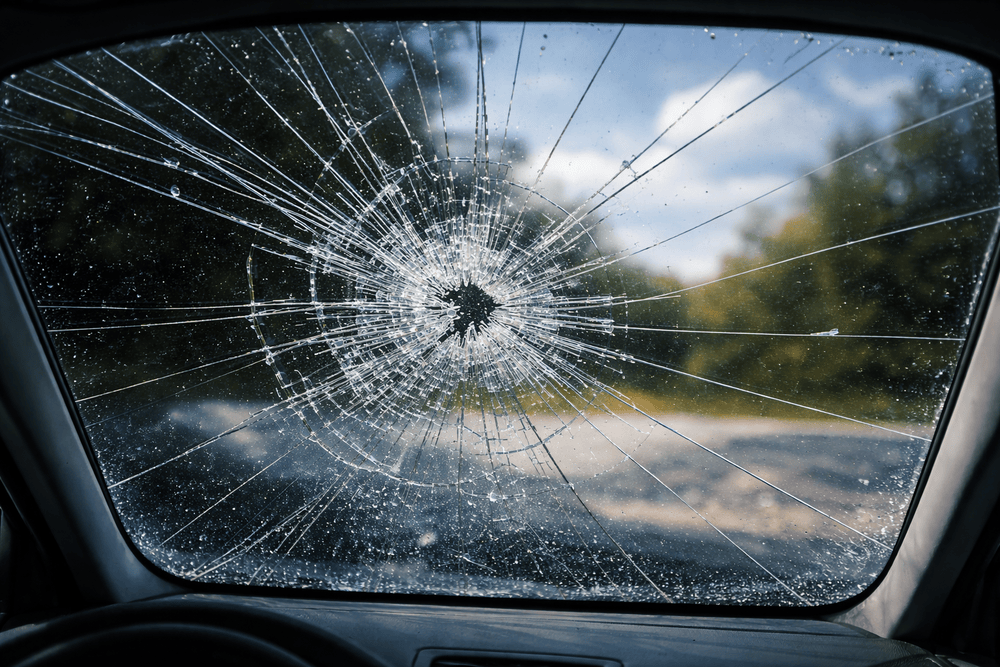
The “Spiderweb” Effect: A citation is nearly always warranted for damage that produces a spiderweb pattern. This type of breaking indicates a serious compromise in the glass’s structural integrity, significantly impairing vision beyond a single linear crack. The glass would probably collapse if something struck that location once more.
Do you have a Question?
Get An Auto Glass Replacement Quote Now 866.278.7417
State Specific Considerations
Just as significant as the traffic laws themselves are the laws governing who is responsible for paying for the repairs. Legislators in several places have eliminated the cost barrier to mending shattered glass after realizing the dangers it poses to public safety.
The states of Florida, Kentucky, and South Carolina mandate that insurance companies forgo the deductible for windshield repair if you have comprehensive insurance. This implies that there will be no out-of-pocket expenses for a replacement windshield.
Some jurisdictions, such as Arizona, Connecticut, Massachusetts, Minnesota, and New York, have regulations that encourage insurers to provide low-deductible glass alternatives, or they permit you to purchase separate glass coverage with no deductible.
Vehicle Inspections: A broken windshield is an automatic failure if you live in a state like Pennsylvania, Texas, New York, or Virginia that mandates yearly safety inspections. In these states, inspectors must inspect the glazing for any damage that could impair the view or jeopardize the integrity of the glass. Until the repair is completed, you will not be able to renew your registration.
The Repercussions of Ignoring the Harm
It’s risky to drive while your windshield is damaged. Even though you might pass a police officer today without a stop, the crack won’t remain the same size forever.
Traffic Citations: State-specific penalties for operating a vehicle with a damaged windshield normally range from $50 to $150. In certain jurisdictions, you could receive a “fix-it ticket,” which provides you a predetermined amount of time to mend the glass and provide proof to the court to have the fine waived.
Probable reason: A crack provides the police probable reason to pull you over, even if they don’t plan to issue a ticket for the glass. This enables them to look for additional violations, such as expired tags or failure to wear seatbelts.
Damage Expansion: A little chip may ultimately grow throughout the entire windshield due to temperature changes, driving vibrations, and collisions with potholes. Typically, repairing a crack larger than six inches becomes unfeasible, necessitating a full replacement.
Frequently Asked Questions: If I make a glass claim, will my insurance rates increase? Most of the time, the answer is no. Comprehensive insurance, which is distinct from collision insurance, usually covers windshield repairs. Filing a claim rarely affects your premium because glass damage is frequently regarded as “no-fault” (like a rock flying off a vehicle). Checking your particular insurance is always the best course of action, though.
Is it possible to receive a ticket for a passenger-side chip? Although unlikely, it is feasible. Regardless of the location of the crack, an officer may issue a citation for driving an unsafe vehicle if the damage is significant enough to jeopardize the vehicle’s structural integrity. On the passenger side, tiny chips are usually OK, though.
How can I tell if I need a replacement or a repair? Resin can usually be used to fix cracks that can be fully filled by a $1 bill, according to the “dollar bill test.” To maintain safety regulations, a complete replacement is necessary if it is longer than a dollar note or extends to the edge of the windshield.
Do Not Wait Until Its Too Late
The purpose of the legislation pertaining to damaged windshields is to ensure the safety of all drivers. Although it may be tempting to put off paying for a repair, the risks to your safety and legal status far exceed the cost.
A small rock chip can often be fixed in less than 30 minutes for a fraction of the price of a new windshield. However, you risk a required replacement and possibly a traffic penalty if that chip expands into a long crack or a spiderweb. Examine your insurance policy, check your local state legislation, and take immediate action to repair the harm.
Don’t Get Cracked: The Real Cost of Auto Glass Repair Non-Compliance: Repairing a windshield can sometimes seem like a small mechanical problem or a merely aesthetic one. You get it fixed when a rock strikes the glass and causes a crack.
Owners and technicians of car glass shops must, however, navigate a complicated web of federal rules and safety standards. Ignoring these regulations puts the company at serious financial risk in addition to posing a risk to the passengers in the car.
The replacement of a windshield is no longer a straightforward process. Contemporary windshields are essential to the vehicle’s sophisticated safety features and structural soundness.
As a result, authorities are enforcing stricter penalties for non-compliance. The stakes have never been higher, from liability lawsuits that might force a store to close to bankruptcy to hefty fines imposed by the Occupational Safety and Health Administration (OSHA).
This handbook examines the crucial nexus of safety, compliance, and financial liability in the windshield repair sector. We will expose the hidden costs of shortcuts and provide practical solutions to maintain your store’s profitability, safety, and compliance.
The Role of the Windshield in Vehicle Safety
One must first comprehend the engineering behind contemporary auto glass to comprehend why fines are so high. Like seatbelts and airbags, the windshield serves as a fundamental safety restraint mechanism.
Structural Integrity: In a rollover accident, the windshield prevents the roof from crushing the occupants. It contributes up to 60% of the structural strength of the cabin in the event of a rollover and 45% in the event of a head-on collision. If the glue fails or the installation is incorrect, the roof may collapse, leading to catastrophic injuries or fatalities.
Airbag Deployment: The windshield serves as a backstop for the passenger-side airbag. It hits the window at about 200 miles per hour as it deploys and then cushions the passenger.
If the windshield is poorly glued or made of subpar urethane, the airbag’s force may shatter it. As a result, the airbag becomes ineffective, and the passenger is left vulnerable.
The new frontier of liability is ADAS calibration. Advanced Driver Assistance Systems (ADAS), which include rain sensors, automated emergency braking, and lane departure warning, frequently use cameras positioned behind the glass to peer through the windshield.
These systems may underestimate distances or fail to identify obstructions if a windshield is replaced without being properly recalibrated, leading to accidents even after the vehicle has left the shop.
The Regulatory Environment
Compliance is about following certain legal requirements, not just performing a good job. Several bodies govern the vehicle glass business, and failure to meet their standards can result in harsh penalties.
The National Highway Traffic Safety Administration (NHTSA) establishes Federal Motor Vehicle Safety Standards, or FMVSS. In particular, FMVSS 216 (Roof Crush Resistance) and FMVSS 212 (Windshield Mounting) specify how a windshield must function in an accident.
When repair shops modify a safety system, they essentially become manufacturers, even though the NHTSA primarily targets automakers. A business is subject to severe legal liability if they install a windshield that does not adhere to these statutory retention standards during an accident.
The Auto Glass Safety Council (AGSC) created the Auto Glass Replacement Safety Standard, or AGRSS. This is the standard for correct installation practices in the business.
Courts frequently employ AGRSS as the “standard of care” in cases, even though it is optional in some ways. A shop is virtually certain to lose a liability lawsuit if they are unable to demonstrate that they adhered to these guidelines, which include utilizing the appropriate primers, urethane, and drive-away durations.
Do you have a Question?
Get An Auto Glass Replacement Quote Now 866.278.7417
The ADAS Difficulty
The complexity of compliance has increased due to the incorporation of ADAS. Over 40% of cars currently on the road have some kind of ADAS, and that percentage is rising, according to industry estimates.
The “Opt-Out” Myth: Some stores encourage clients to sign agreements promising to get the calibration done at a dealership later to avoid liability. Legal professionals caution that these waivers probably won’t stand up in court.
In the event of an accident, a safety professional (the mechanic) who delivers a car to a customer knowing it is hazardous (uncured) is probably still responsible.
Costs of Equipment and Training: Investment is necessary for compliance. These days, shops have to spend tens of thousands of dollars on calibration equipment, which includes targets, lasers, and software. But the cost of the equipment is greatly outweighed by the penalty for performing it incorrectly, which might lead to a malfunction and an accident.
Steps to Guarantee Safety and Reduce Fines: Proactive compliance is necessary to safeguard your company. This information is a guide to staying law-abiding and safe.
Follow AGRSS Strictly: Make the Auto Glass Replacement Safety Standard the guide for your shop. Make certain that each technician has received training on these techniques.
This training covers the differences between the “Full Cut” and “Close Cut” techniques, how to properly prime scratches, and how closely to follow the adhesive manufacturer’s directions.
Record Everything
In the legal field, undocumented actions are considered nonexistent. Establish a digital documentation system that keeps track of:
pre-inspection of the car (looking for damage that may already be there).
Lot numbers for the primer and urethane used.
Temperature and humidity measurements (which impact curing time).
Calculate the safe drive-away time.
The results of the post-scan indicate the status of ADAS calibration.
Invest in Appropriate Training: Technicians ought to hold an AGSC certification. To meet OSHA regulations, they also require ongoing training on handling dangerous products. Maintain a record of every training session. This documentation serves as your primary defense in the event of an OSHA inspection.
Use OEM-Equivalent Materials: Adhesive costs should never be reduced. Bond failure may result from using a generic or inappropriate primer/urethane system. Make sure you are utilizing the appropriate high-modulus, non-conductive urethanes needed for contemporary cars and stick to reliable solutions (such as Sika or Dow).
Master ADAS Calibration: You need a reliable sublease partner if you can’t afford the equipment to calibrate internally. Before returning the keys to the customer, you must make sure the calibration is completed and recorded. The safety tactic of “We told them to go to the dealer” is no longer appropriate.
Frequently Asked Questions
Is it possible for a client to forfeit their right to a secure windshield installation? No. A client cannot agree to carelessness. Because the consumer is not an expert in the field, the shop is still responsible even if they sign a paper stating that they want a less expensive, non-standard installation or that they want to forgo calibration. Before the car leaves the shop, the shop has an obligation to make sure it satisfies federal safety regulations.
Safe Drive-Away Time (SDAT): What is it? The amount of time a car must wait following windshield installation before it is safe to drive is known as SDAT. This process makes it possible for the urethane adhesive to cure enough to survive a collision. Temperature, humidity, and adhesive brand all affect SDAT. There is a significant liability risk when a car is released before the SDAT has passed.
Are mobile glass repair companies subject to the same penalties as physical stores? Indeed. The same FMVSS, OSHA, and liability regulations apply to mobile operators.
In actuality, mobile operators have particular difficulties, like regulating humidity and temperature for appropriate curing, which calls for extra attention to maintain compliance.
Protecting the Future of Your Business: The windshield repair industry has developed from a straightforward craft into a sophisticated, technical profession entwined with cutting-edge safety features.
Although there is a chance of fines and legal action, it is also controllable. Shop owners can protect themselves from financial collapse by reorienting their attention from speed and volume to safety and compliance.
Compliance is about the moral duty to make sure every client leaves in a car that will protect them when it matters most, not merely about avoiding OSHA penalties or winning litigation. The best insurance policy your company can purchase is to invest in standards, training, and documentation.
Mobile Safe Auto Glass
14241 E Firestone blvd suite 400,
La Mirada, CA 90638
Phone: (562) 608-1154
Toll Free: 1 866 278 7417
Mail: sales@mobilesafeautoglass.com
Get a FREE QUOTE today! You can get a free quote and schedule 24/7 using this free quote wizard.
Mon – Fri 8am – 5pm
Saturday 8am – 1pm
Sunday Closed