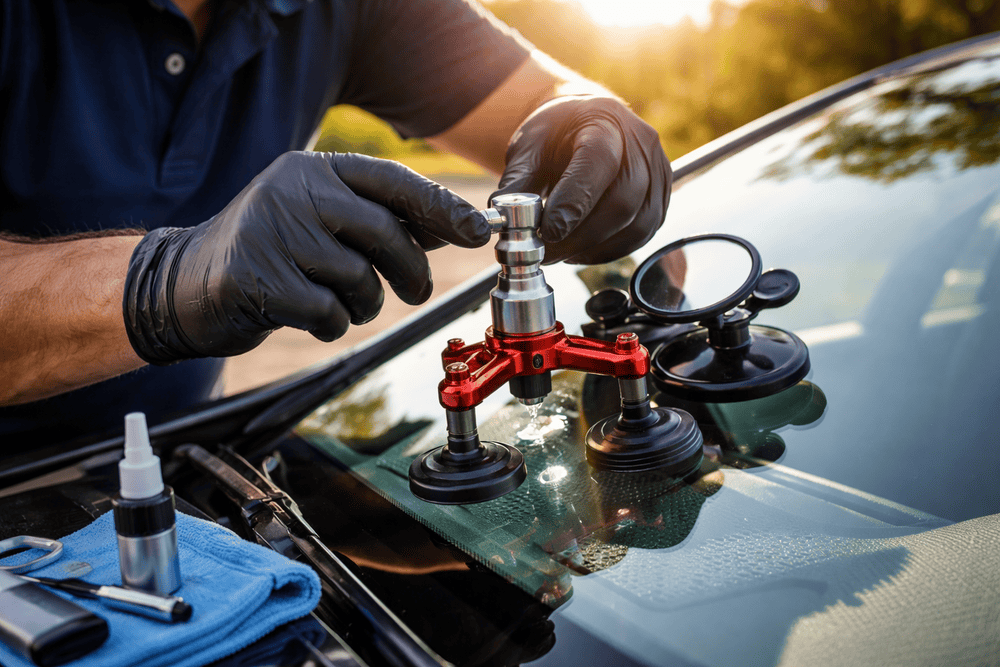
At Home Windshield Repair for City Drivers
There are many benefits to living in the city, such as delicious food, nonstop entertainment, and easy access to everything you need. However, urban living poses a special set of difficulties for car owners. Traffic is never-ending, parking is a problem, and your car’s wear and tear increases dramatically. The dreaded chip or crack in the windshield is one of the most frequent headaches. City driving is dangerous for auto glass, whether it’s from vandalism, a stray pebble from a construction site, or debris kicked up on a busy roadway. When you have a busy schedule, it may seem like the easiest option to ignore a minor chip, but that small imperfection can quickly grow into a spiderweb crack that requires a whole windshield replacement.
Get An Auto Glass Replacement Quote Now 866.278.7417

Windshield Replacement & Repair
Our competitors push you into going to their shop to get your glass fixed-making it cheaper for them. We make it easier for YOU to get back on the road by offering free mobile repairs at your home or work. With our free mobile services servicing the entire Orange County & Los Angeles area, we can often handle your windscreen replacement the same day! So the next time you need a windshield replacement, give us a call.
Talk to a Windshield Replacement Specialist Now 866.278.7417

Calibration
Calibration is the process of returning a vehicle’s ADAS to OEM specifications. Calibration is necessary after a new glass installation, particularly a windshield with a camera mounted to it, to ensure that the ADAS features continue to function properly despite having been moved during installation. If a car’s ADAS is not properly calibrated, the system may not function safely. A misaligned camera could jeopardize the functionality of the system and lead to dangerous driving or accidents, so it is crucial that the cameras are aligned perfectly, which is what windshield calibration ensures.
Talk to a Calibration Specialist Now 866.278.7417

Fleet Auto Glass Repair
We provide expert auto glass repair and windshield replacement services for commercial fleets of all sizes. We are experienced with all manufacturers and machine types of domestic or foreign cars, trucks, vans, or commercial vehicles, including heavy equipment. Our same day mobile auto glass and windshield repair service will enable you to get back on the road faster and start saving you time and money instantly. Give us a call today! We are here to help!
Talk to a Fleet Auto Glass Specialist Now 866.278.7417
The Unique Risks for City Windshields
Driving in cities is a high-risk activity. Environmental elements constantly assault your windshield, a threat that rural or suburban drivers encounter less frequently.
Construction debris: Urban centers are in a perpetual state of regeneration. Construction zones are omnipresent, and with them comes loose gravel, dust, and debris. When a truck carrying rubble encounters a bump or a rock falls off, it can result in a visible crack.
Temperature fluctuations: Cities produce their own microclimates. The “urban heat island” effect can make city streets much hotter than neighboring locations.
The heat load on your glass is enormous when you mix blasting air conditioning in your automobile with sweltering summer pavement. Conversely, a chilly winter night followed by a rapid defrost can cause existing small chips to expand instantly.
Vandalism and theft: Unfortunately, city parking typically means leaving your car exposed on the street. A broken window from a break-in cannot be repaired, but minor vandalism, such as scratches or tiny impact marks, is frequent and should be fixed before it jeopardizes the structural integrity of the glass.
Why mobile repair is appropriate for the urban lifestyle: Time is the most precious commodity for the busy urbanite. Conventional repair shops follow a model that is out of step with the pace of the city. You have to wait in line, drive there (which increases the chance of damage), and frequently leave your car for hours at a time. At-home, mobile repair changes everything.
Unmatched convenience: The most obvious benefit is that they come to you. The technician comes to your workplace, whether your car is in the company lot, on the street, or in your apartment garage. This feature means you can continue your Zoom calls, do your laundry, or just rest while the work gets done.
Preventing Traffic and Additional Damage
Driving a car with a compromised windshield is unsafe. Vibrations from potholes and speed bumps—plentiful in any city—can cause a minor crack to spread fast. By picking a mobile service, you minimize the need to drive the vehicle, keeping the damage contained until it’s fixed.
Flexible scheduling: A 9–5 workday isn’t usually the norm in the city. You may schedule a time window that works with your hectic schedule thanks to the longer hours and weekend appointments offered by several mobile repair services.
How the at-home repair process works: If you’ve never utilized a mobile car glass service, the process is surprisingly straightforward. In essence, it delivers the workshop right to your door.
Evaluation: The technician shows up and examines the damage. They evaluate the size, depth, and placement of the chip or fracture to guarantee it’s repairable. In most cases, even if the damage is less than the size of a dollar note and is not immediately in the line of sight of the driver, it is possible to repair it.
The location is meticulously cleaned in order to get rid of any dampness, filth, and glass dust that may have appeared. In order for the resin to attach in the right manner, this is required.
Resin Injection: A specialized tool attaches to the windshield over the break. After sucking air out of the crack with a vacuum, a specially made liquid resin is injected.
Curing: The resin is exposed to ultraviolet (UV) light, which causes it to solidify and fuse with the surrounding glass. This brings the windshield’s structural strength back to its previous level.
During the polishing process, any excess resin is removed by scraping it off, and then the region is polished. The damage will not be totally imperceptible after a repair
Do you have a Question?
Get An Auto Glass Replacement Quote Now 866.278.7417
When to Replace vs Repair
You can’t save everything. Having an awareness of the difference may help you protect yourself and save money at the same time. Repair is likely to occur if: In the case of chips, the chip or crack is less than a quarter, and in the case of cracks, larger than six inches.
Less than three chips are present. The windshield’s edge is not damaged because cracks there might spread swiftly and jeopardize the seal.
Replacement is necessary if the glass is tempered, not laminated (side and rear windows are normally tempered and will shatter, needing replacement).
The crack is large or intricate. Damage immediately affects the driver’s line of sight (repairs may cause a small distortion that could be distracting). The inner layer of the glass has shattered.
Does insurance cover mobile repair? For drivers, the answer to this frequently asked question is typically positive. Because insurers know that a $100 repair is significantly cheaper than a $500 replacement, they routinely waive the deductible for windshield repairs.
Many mobile repair firms work directly with insurance providers. They can handle the claim paperwork for you on-site. In many circumstances, the repair ends up being completely free for the driver. However, policies vary, so it’s always important to check with your provider or ask the repair business to verify coverage before they start.
The structural importance of your windshield: It’s easy to think of a windshield as just a wind-blocker, but in modern cars, it’s an essential safety component.
In the case of a rollover accident, the windshield is responsible for contributing up to sixty percent of the car’s structural integrity. This is because it prevents the roof from falling on the passengers of the vehicle.
Airbag Deployment: The passenger-side airbags properly deploy when they bounce off the windshield. If a break weakens the glass, the airbag’s force may shatter it, preventing the airbag from protecting the passenger.
Driving with broken glass is a safety risk in addition to being an aesthetic concern. By removing the obstacles to fixing it, mobile repair guarantees that your car will continue to be a secure haven in the bustling city.
Take Control of Your Car Maintenance
Ignoring a windshield chip never works in your favor. The vibrations of city driving, the slamming of car doors, and drastic temperature swings will eventually convert that chip into a crack.
Avoid waiting for the harm to get worse. Utilizing an at-home windshield repair service is a sensible, efficient method to manage vehicle maintenance without disrupting your urban lifestyle. It saves you time, keeps you safe, and prevents a slight nuisance from becoming a significant expense.
Why Your Commute Is Ruining Your DIY Windshield Repair: On the roadway, it begins with a jarring thwack. You wince, scan the glass, and notice it: a tiny bullseye breaks right in your line of sight.
Being a proactive automobile owner, you pick up a DIY windshield repair kit at the auto parts store. You follow the directions, fill the crack with resin, and pat yourself on the back for saving a hundred dollars.
But three days later, when you’re heading to the grocery store, the crack reappears. Even worse, it begins to spread across the passenger side like a spiderweb. What went wrong? You did as instructed. You used the small syringe. You let it dry.
The kit or your skill might not be the fault. Your regular routine often contributes to the problem. Local driving puts windshield resin in a harsh environment because of the stop-and-go, pothole-avoiding, and door-slamming nature of running errands.
While these repair kits can be effective, they require stability and time that the average daily driver simply doesn’t have. Here’s why your everyday commute may have contributed to the failure of your do-it-yourself windshield repair.
The Chemistry of the Cure
You must comprehend how repairs operate to comprehend why they don’t function. Anaerobic resin is used in windshield repair kits. Superglue, on the other hand, dries instantly when it comes into contact with air. Two things are necessary for windshield resin to function:
Penetration: It needs to permeate every tiny gap in the fracture.
Curing: To solidify and fuse the glass pieces together, ultraviolet (UV) light is needed.
It takes time to complete this process. The phrase “cures in 15 minutes,” even if stated in the instructions, usually refers to the surface layer.
The resin deep inside the crack can take much longer to acquire complete structural integrity. Interfering with this process before the bond has completely formed jeopardizes the repair.
The Vibration Factor: Why “Local” is Worse than Highway: You might believe highway driving is tougher on a car, but for windshield repair, city driving is actually more traumatic.
The road surface is usually constant when you are cruising on a highway. The vibration is steady but low-frequency as the chassis settles. Local driving is violent by comparison.
The Twist and Flex: The body of your car flexes whenever you turn a corner. As a structural element, the windshield contributes up to 60% of the cabin’s structural integrity in a rollover and up to 45% in a front-end collision. This action indicates that there is continuous tension on the glass.
You are bending the car’s frame when you parallel park, pull into an inclined driveway, or drive through a residential area with 90-degree curves. This torque transfers directly to the glass.
That flexing motion will tear the glass apart and squeeze it back together if the crack is filled with fresh, semi-cured resin. This action creates air pockets that weaken the repair by forcing the liquid resin out of the crack before it has a chance to solidify.
Potholes and Speed Bumps
Local roads are infamous for flaws. Hitting a speed bump or a pothole causes waves to travel through the vehicle’s suspension and against the glass. For a cemented windshield, such impact is fine. For a windshield with a “healing” wound, such a shockwave can rupture the frail first bond of the repair glue.
The Temperature Rollercoaster: Glass expands in hot weather and compresses in cold weather. The integrity of the windshield is naturally threatened by this thermal expansion, but daily local driving makes the problem worse due to quick temperature swings.
If you leave your car in the driveway all night, the glass becomes chilly. You probably turn on the heater or the defroster as you get in for your morning commute. This procedure blows hot air straight onto the bottom of the windshield. The center of the glass heats up while the edges stay chilly due to uneven heating.
This method greatly exacerbates any damage that already exists. The resin may not have enough flexibility to withstand this quick expansion if you did a do-it-yourself repair the day before. The outcome is sometimes a “run,” where a little chip suddenly bursts out into a long crack across the glass.
In the summer, the same holds true. The glass of an automobile heats up when it is left outside in the sun. A thermal shock is produced when the air conditioner is turned on.
Before injecting resin, professional repair businesses frequently regulate the glass’s temperature to make sure the crack is stable enough to hold the fluid while still being open enough to take it. In a DIY driveway scenario, the weather conditions are unpredictable.
Do you have a Question?
Get An Auto Glass Replacement Quote Now 866.278.7417
The Contamination Trap
For adhesives, a clean surface is a must. An unclean cut should always be cleaned before being bandaged. Your windshield follows the same reasoning.
Your car is exposed to various pollutants on a daily basis:
Brine and road salt
residue from oily exhaust
Tree sap and pollen
Washing liquid (including dyes and methanol)
A rough, jagged crater is left behind when a rock cracks your glass. That crater gets filled with microscopic road grime if you keep driving the car for a few days before trying to fix it.
Many DIY kits come with a small razor blade and an alcohol wipe, but they often lack the high-pressure cleaning instruments that experts employ. If you seal debris, moisture, or washer fluid inside the crack, the resin cannot adhere to the glass laminate. It’s like attempting to stick tape to a dusty floor.
The vibration from daily driving pulls this debris deeper into the crack, making it impossible to clean out with basic consumer-grade equipment. The fix is doomed to fail once the pollution is locked in.
The most often disregarded reason why repairs don’t work is the Door Slam Effect. To keep the cabin quiet, modern cars are airtight. When you slam your automobile door, you cause a quick surge in cabin air pressure. This pressure pushes outward against the glass—the route of least resistance.
If you slam the door after a DIY repair, the resin may be forced out of the pit. To equalize this pressure, professional technicians frequently leave a window slightly broken during the repair procedure; this advice is rarely found on the back of a $15 repair kit box.
Is Do It Yourself Worth the Risk
Does this mean you should never use a DIY kit? Not necessarily. They can be beneficial for tiny, surface-level chips if you catch them soon.
You must be realistic about the conditions, though, if your car is your everyday workhorse. A do-it-yourself kit is a risk if you can’t leave the car in a temperature-controlled garage for a full day to allow the resin to dry without vibration or thermal shock. Try to reduce the hazards if you choose to move forward with a home repair:
Wait for the weekend: Do the repair when you don’t need to drive the automobile for at least 12 hours.
Park in the shade: Avoid direct sunlight during the application, but let it cure in the sun thereafter.
Steer clear of the car wash: until the break is completely sealed, keep chemicals and water away from it.
Overall, if the repair is unsuccessful and a complete windshield replacement is necessary, the money you save on a kit can be lost. A professional repair, frequently covered by insurance, is typically the safer option for daily drivers who are subjected to the rigors of local roads to guarantee that the glass maintains its structural strength.
Mobile Safe Auto Glass
14241 E Firestone blvd suite 400,
La Mirada, CA 90638
Phone: (562) 608-1154
Toll Free: 1 866 278 7417
Mail: sales@mobilesafeautoglass.com
Get a FREE QUOTE today! You can get a free quote and schedule 24/7 using this free quote wizard.
Mon – Fri 8am – 5pm
Saturday 8am – 1pm
Sunday Closed