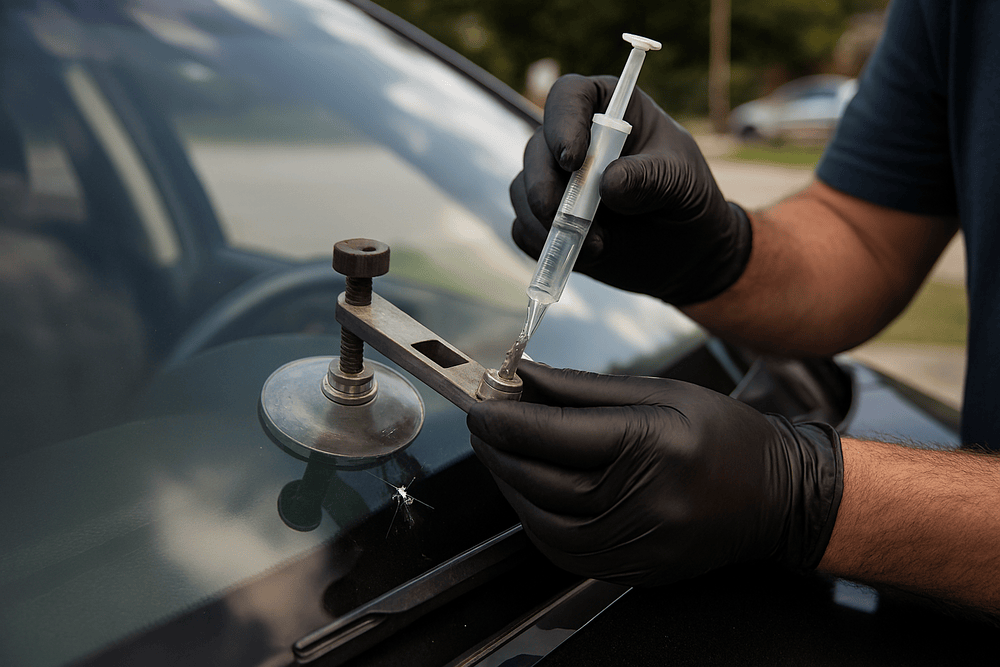
At Home Windshield Repair Before Vehicle Inspection
The annual car inspection is a cause of anxiety for many drivers. You give your keys, wait in line, and hope the mechanic doesn’t return with a clipboard full of pricey fixes. While brake light and tire wear checks are common pre-inspection procedures, many automobile owners fail to notice a serious problem that is right in front of them: the windshield. A cracked or chipped windshield is one of the most typical reasons for a failed safety inspection. Beyond the esthetic inconvenience, a damaged windshield undermines the structural integrity of your vehicle and can hamper your visibility while driving. You may believe that a pricey expert replacement is your only choice if you’ve detected a rock chip or a tiny crack.
Get An Auto Glass Replacement Quote Now 866.278.7417

Windshield Replacement & Repair
Our competitors push you into going to their shop to get your glass fixed-making it cheaper for them. We make it easier for YOU to get back on the road by offering free mobile repairs at your home or work. With our free mobile services servicing the entire Orange County & Los Angeles area, we can often handle your windscreen replacement the same day! So the next time you need a windshield replacement, give us a call.
Talk to a Windshield Replacement Specialist Now 866.278.7417

Calibration
Calibration is the process of returning a vehicle’s ADAS to OEM specifications. Calibration is necessary after a new glass installation, particularly a windshield with a camera mounted to it, to ensure that the ADAS features continue to function properly despite having been moved during installation. If a car’s ADAS is not properly calibrated, the system may not function safely. A misaligned camera could jeopardize the functionality of the system and lead to dangerous driving or accidents, so it is crucial that the cameras are aligned perfectly, which is what windshield calibration ensures.
Talk to a Calibration Specialist Now 866.278.7417

Fleet Auto Glass Repair
We provide expert auto glass repair and windshield replacement services for commercial fleets of all sizes. We are experienced with all manufacturers and machine types of domestic or foreign cars, trucks, vans, or commercial vehicles, including heavy equipment. Our same day mobile auto glass and windshield repair service will enable you to get back on the road faster and start saving you time and money instantly. Give us a call today! We are here to help!
Talk to a Fleet Auto Glass Specialist Now 866.278.7417
Why Windshields Matter in Inspections
It’s important to learn why inspectors are so stringent regarding glass before purchasing a repair kit. Your windshield serves more than just keeping insects out of your teeth. It works as a crucial safety component of the vehicle.
In the event of a rollover accident, the windshield supplies up to 45% of the cabin’s structural strength. The likelihood of the roof collapsing increases if there is a crack in the glass.
Furthermore, in a front-end accident, the windshield acts as the backstop for the passenger-side airbag. If the glass fails, the airbag may not deploy appropriately. Inspectors generally search for:
Obstruction of Vision: Any damage within the “critical area” (typically the sweep of the windshield wipers) that could distract the driver.
Structural Integrity: Large cracks that extend to the edge of the glass or interact with other cracks.
Pitting: Severe pitting from sand or road debris that generates glare from sunlight or headlights.
Assessing the Damage: DIY or Professional?: Not every chip can be repaired in your driveway. Attempting to repair damage that is too severe can waste time and potentially aggravate the safety risk. Before buying a kit, undertake a short examination.
When to DIY: You are likely a suitable candidate for at-home repair if the following conditions are met:
The chip is small: generally, if the damage can be covered by a quarter (approximately 1 inch in diameter), it is repairable.
The types of cracks contained are bullseyes (circular chips), stars (short cracks spreading from a core), and little flowers, which are frequently fixable.
The harm is recent: Fresh chips are cleaner. Older gaps sometimes fill with dirt and road filth, making the glue impossible to attach.
When to Call a Pro
You ought to consider hiring a professional replacement if. The crack is long: glass typically commits structural suicide if a crack is longer than a dollar bill.
It’s in the driver’s line of sight: even a perfect repair leaves a tiny imperfection. If this defect is squarely in your range of view, an inspector may still fail the vehicle.
The harm is deep: if the damage has reached both layers of glass (the inner and outer layers), a DIY kit will not work.
It’s near the edge: Cracks that originate at or extend to the edge of the windshield weaken the seal and strength of the glass.
How DIY Repair Kits Work: Most at-home repair kits rely on a certain type of resin. This resin is anaerobic (cures in the absence of air) and responds to ultraviolet (UV) radiation.
The procedure entails producing a vacuum over the chip to suck away air bubbles and then pressing the resin into the minuscule gaps. Once the resin fills the void, it is cured using sunlight or a UV lamp. The outcome is a connection that stops the break from expanding and restores clarity to the glass.
Step-by-Step Guide to At-Home Repair: If you have determined your windshield is a candidate for DIY repair, follow these procedures carefully. The essential concepts are the same, while exact instructions may differ significantly depending on the brand (Rain-X, Permatex, and Blue Star are popular possibilities).
Prep the Surface: Maintaining cleanliness is essential. Use a glass cleaner or alcohol pad to clean the area around the chip. Do not spray cleaner straight into the crack; you want the interior of the damage to remain dry. Use a safety pin or a thumbtack to gently pick out any loose shards of glass from the impact point.
Do you have a Question?
Get An Auto Glass Replacement Quote Now 866.278.7417
Set Up the Bridge or Pedestal
Most kits come with an adhesive pedestal or a suction cup bridge. Place the pedestal’s opening exactly over the chip’s impact point. The positioning aligns the injection tool with the damage. Ensure the seal is firm against the glass to prevent resin from leaking out.
Inject the Resin: Attach the resin tube to the pedestal. Depending on the kit, you may need to squeeze resin in or screw down a plunger. This step provides pressure that drives the fluid into the fissures. You might need to alternate between pressure and vacuum (unscrewing and rescrewing) to get stubborn air bubbles out of the glass.
Advice: Examine the crack from the car’s inside. There is trapped air inside if you continue to observe dark areas. Continue the pressure/vacuum cycle until the dark patches disappear.
Apply the Curing Film: Once the crack is filled, remove the bridge or pedestal. Immediately place a drop of resin on the impact location and cover it with the little clear plastic curing strip provided with the package. This holds the resin in place and creates a level surface.
Cure with UV Light: Move your vehicle into direct sunshine. The UV rays will harden the resin. This method normally takes 15 to 30 minutes depending on the intensity of the sun. If it is a cloudy day, the process will take substantially longer. The curing strip should not be disturbed throughout this period.
Cleanup: Remove the curing strip after the resin has solidified. The glass will have a lump of dried resin on it. Hold a razor blade (typically included in the kit) at a 90-degree angle and scrape away the extra resin until it is flush with the glass. Clean the windshield with glass cleaner, and appreciate your effort.
Common Mistakes to Avoid
Even though these kits are user-friendly, mistakes are common. To guarantee that you pass your inspection, stay away from these traps.
Repairs should not be made in direct sunlight at first. You need the sun to cure the resin, but you don’t want it to harden while injecting. Perform the prep and injection processes in the shade or a garage. Only move the car into the sun for the last curing step.
Do not mend a wet windshield. The resin will not bond if there is moisture inside the break. Wait for the glass to fully dry if you have cleaned your car or if it has rained. A hair dryer (applied properly from a distance) can assist in removing moisture.
The pressure cycles should not be hurried. The resin is thick. Flowing into the smallest cracks in a star takes time. Please allow the resin sufficient time to work its way in before assuming the job is complete.
Commonly Asked Questions: Will the crack totally vanish? No. A DIY repair is structural, not cosmetic. Even though the visibility of the crack typically diminishes by 80–90%, a faint outline or imperfection typically persists. This condition is usual and typically okay for inspection unless it is directly in the driver’s line of sight.
Does auto insurance cover windshield repair? Yes, many comprehensive insurance policies cover chip repair with no deductible. Insurers prefer to pay $50 for a repair rather than $400 for a replacement. However, some drivers would rather avoid involving insurance for minor concerns, and initiating a claim could be more difficult than purchasing a $15 kit.
Is it possible to fix a long crack? Some specialized kits claim to mend cracks up to 12 inches long, although the success rate is lower. Long cracks frequently indicate structural instability that needs to be completely replaced to pass a state inspection.
What is the duration of the repair? It takes fifteen to twenty minutes to complete the vigorous work. The curing procedure adds another 15 to 30 minutes. You may easily complete the project in under an hour.
Make Safety Your Priority: Passing your car inspection is the immediate aim, but safety is the long-term priority. A correctly restored windshield guarantees that your car preserves its structural integrity and that you have a clear view of the road.
If you have completed the repair and the crack still looks large, or if you feel doubtful about the strength of the bond, consult a professional auto glass expert. It is better to invest in a replacement now than to fail your inspection or endanger your safety on the road.
What Local Windshield Inspectors Actually Look For
When you take your vehicle in for a safety inspection, there’s always a moment of minor worry. Will the brakes pass? Are the emissions okay? However, drivers often underestimate the windshield. It’s more than simply a piece of glass; it’s a key structural component of your car that contributes to roof strength and airbag activation.
Local windshield examiners aren’t only searching for visible spiderweb fractures. They follow a precise set of criteria to ensure your view is unhindered and the structural integrity of the car remains intact. You can avoid the inconvenience of a failed inspection as well as save time and money by being aware of these requirements. Here is exactly what inspectors check for when they analyze your auto glass.
The Critical Vision Area: The most crucial part of your windshield is the area directly in front of the driver, frequently referred to as the “acute area” or “critical vision area.” This zone is commonly defined as the space covered by the sweep of the driver’s side wiper blade, specifically appearing about 8.5 inches broad and centered on your line of sight.
Inspectors are particularly rigorous about this zone. Failure here can result from even small damage to the glass that might be acceptable elsewhere.
Why this place matters: If you have a chip, crack, or significant pitting in this zone, it distorts your perspective of the road. At night, incoming headlights can refract through these defects, creating bright starbursts that temporarily blind you. Inspectors will fail a vehicle if there is any damage in this area greater than a pinpoint, or if there is a cluster of small pits that form a haze.
Crack Size and Location
Outside the crucial visual region, inspectors are a bit more tolerant, but there are still hard limits. Any cracks will be measured for length, and their location in relation to the glass’s edges will be evaluated.
Star breaks and bullseyes: modest impact damages, often called “star breaks” or “bullseyes,” are normally allowed if they are modest (often under one inch in diameter) and not in the driver’s direct line of sight. However, if these chips have started to expand into longer fissures, they pose a big hazard.
Inspectors closely monitor cracks that come into contact with the windshield’s edge or intersect with the frame. These are risky because they jeopardize the glass’s structural integrity.
A windshield contributes up to 45% of the structural integrity of the car cabin in a front-end collision and up to 60% in a rollover. If the glass edge or seal weakens in an accident, the roof may collapse more easily.
Wiper Blade Functionality and Glass Condition: It’s not just about the glass itself; it’s about how the glass interacts with other systems. Inspectors will test your windshield wipers to verify they clear the glass adequately.
If your wiper blades are damaged, ripped, or brittle, they won’t pass inspection. Additionally, failure may result if the wipers have generated “scoring” or deep scratches on the glass surface as a result of metal-on-glass contact. These scratches weaken the glass and, like chips, can generate harmful glare in sunshine or at night.
The Washer System: Many drivers overlook the fact that the examination includes the washer fluid system. If your nozzles are clogged, the pump is malfunctioning, or the reservoir is leaking, you could fail. The inspector needs to verify that you can clear mud, snow, or debris from your view while driving.
Do you have a Question?
Get An Auto Glass Replacement Quote Now 866.278.7417
Tinting and Obstructions
Aftermarket changes frequently cause inspection failure. Local laws are strict about where and how much tint can be applied, even if you like tinted windshields.
The AS-1 Line: Most windshields feature a little hash mark or the initials “AS-1” printed near the top corner. This line marks the permissible limit for tinting.
A certain percentage of light must be able to flow through any tint applied below this line (often 70% or greater). If you have a dark tint covering the entire windshield or a “visor strip” that goes too far down, the inspector will flag it.
Stickers and Mounts: Inspectors also examine non-permanent obstacles. GPS mounts, dash cams, and fuzzy dice can legally be deemed safety risks if they impede your view. While you can normally merely remove these on the spot they pass, stickers put in the wrong corner of the window might need to be scraped off.
Safety Glazing and Laminate Integrity
Windshields are built of laminated glass—two layers of glass with a layer of plastic (PVB) in between. This design prevents the glass from shattering into sharp pieces upon impact.
Inspectors look for signs that the laminate is breaking down. This commonly shows up as “delamination,” as the glass layers detach from the plastic, providing a milky or foggy look around the borders. If this delamination goes too far into the viewing area, or if it undermines the strength of the windshield, the car will not pass.
Don’t Wait for the Inspection to Fix it! If you discover damage on your windshield, the best method is preventive repair. For a fraction of the price of a complete replacement, small chips can frequently be filled with resin. Replacement is the sole choice, though, if a crack spreads or the damage is visible to the driver.
Before your next inspection, take a good look at your glass. Check your wipers, top off your fluid, and measure any cracks. You can avoid the headache of a rejected safety sticker by taking a few minutes to examine yourself.
Mobile Safe Auto Glass
14241 E Firestone blvd suite 400,
La Mirada, CA 90638
Phone: (562) 608-1154
Toll Free: 1 866 278 7417
Mail: sales@mobilesafeautoglass.com
Get a FREE QUOTE today! You can get a free quote and schedule 24/7 using this free quote wizard.
Mon – Fri 8am – 5pm
Saturday 8am – 1pm
Sunday Closed