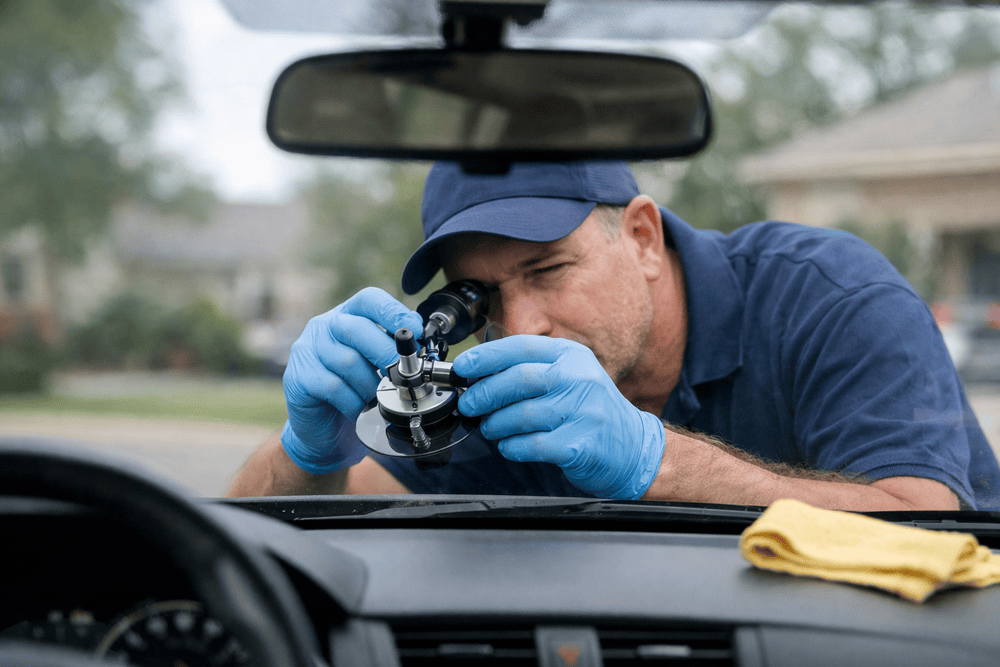
Why New Cars Raise Cracked Windshield Repair
If you were an automobile owner in the 1990s or early 2000s, you most likely recall windshield replacement as a small inconvenience. Fixing a rock chip might have cost $50, and a complete replacement often costs between $200 and $300. Without going over budget, you could pull into a store, wait an hour, then leave. The story is very different in the present day. Modern car owners are frequently surprised to learn that, depending on the make and model, fixing a cracked windshield can cost up to $1,000, sometimes even $2,000 or more. What caused the price to soar? Is there something more intricate at play, or is it just inflation?
Get An Auto Glass Replacement Quote Now 866.278.7417

Windshield Replacement & Repair
Our competitors push you into going to their shop to get your glass fixed-making it cheaper for them. We make it easier for YOU to get back on the road by offering free mobile repairs at your home or work. With our free mobile services servicing the entire Orange County & Los Angeles area, we can often handle your windscreen replacement the same day! So the next time you need a windshield replacement, give us a call.
Talk to a Windshield Replacement Specialist Now 866.278.7417

Calibration
Calibration is the process of returning a vehicle’s ADAS to OEM specifications. Calibration is necessary after a new glass installation, particularly a windshield with a camera mounted to it, to ensure that the ADAS features continue to function properly despite having been moved during installation. If a car’s ADAS is not properly calibrated, the system may not function safely. A misaligned camera could jeopardize the functionality of the system and lead to dangerous driving or accidents, so it is crucial that the cameras are aligned perfectly, which is what windshield calibration ensures.
Talk to a Calibration Specialist Now 866.278.7417

Fleet Auto Glass Repair
We provide expert auto glass repair and windshield replacement services for commercial fleets of all sizes. We are experienced with all manufacturers and machine types of domestic or foreign cars, trucks, vans, or commercial vehicles, including heavy equipment. Our same day mobile auto glass and windshield repair service will enable you to get back on the road faster and start saving you time and money instantly. Give us a call today! We are here to help!
Talk to a Fleet Auto Glass Specialist Now 866.278.7417
The Development of Auto Glass
We must compare what a windshield used to be with what it is today to comprehend the price increase. In the past, safety glass for cars was either laminated or tempered, with the main goals being visibility and structural stability.
A crucial component of modern cars’ digital architecture is the windshield. Cameras, lasers, and sensors can be mounted on it and viewed through it. When you replace the glass, you pay for the material and the technology’s exact calibration.
An explanation of advanced driver assistance systems, or ADAS: ADAS is the main cause of rising repair expenses. The majority of new cars now come equipped with advanced driver assistance systems as standard safety features. Among them are;
If you stray from your lane, a lane departure warning will alert you. The automobile is automatically guided back into the center of the lane using Lane Keep Assist.
To avoid collisions, automatic emergency braking senses barriers and applies the brakes. Adaptive cruise control keeps you at a predetermined distance from the vehicle ahead of you.
Traffic Sign Recognition: Shows speed limit signs on your dashboard after reading them.
Most of these systems are based on a forward-facing camera mounted directly to the inside of the windshield, usually behind the rearview mirror. This camera needs to have perfect clarity and accuracy when looking through the glass. Even slight misalignment can cause the system to miscalculate distances, leading to accidents or failure when you need it most.
The Unstated Expenses of Replacing
Compared to earlier times, replacing a windshield with ADAS technology is far more labor-intensive. Three categories typically comprise the cost breakdown: calibration, specialized labor, and OEM glass needs.
Glass: OEM vs. Aftermarket Third-party (aftermarket) glass used to be a more affordable and acceptable substitute for Original Equipment Manufacturer (OEM) glass. That decision is more difficult now.
For cars with ADAS, several automakers advise—or even mandate—OEM glass. This is due to the glass’s need to adhere to stringent optical requirements. The ADAS camera may become confused if the aftermarket glass has minor flaws, waves, or varying tint levels. OEM glass is more expensive since it is made to higher standards and is proprietary.
The majority of the “hidden” cost is associated with static and dynamic calibration. You can’t just put a new windshield on and go.
To make sure the ADAS camera is pointing precisely where the vehicle’s computer believes it should, it needs to be recalibrated. One or both of the two types of calibration may be necessary for your vehicle:
Static Calibration: This is done in a controlled shop environment. Specialized targets are placed at exact angles and distances from the car, which is parked on an exact level floor.
The technician instructs the vehicle to locate the targets and modify its camera settings via a computer. This process is expensive, time-consuming, and space-intensive.
Driving the car on public roads at particular speeds for a predetermined period of time is necessary for dynamic calibration. By watching lane markers and other cars, the camera “learns” how to position itself. While it may appear simpler, removing the automobile increases labor expenses, often requiring a second person to monitor the computer.
Do you have a Question?
Get An Auto Glass Replacement Quote Now 866.278.7417
Expert Technicians
Your windshield replacement specialist should be a hybrid of a computer engineer and a glazier. They need instruction on particular car software and calibration equipment. The hourly labor wage rises in tandem with the skill set needed to perform the job.
Is High-Tech Windshield Repair Covered by Insurance? Many drivers are using their insurance plans as a result of the increased expenses. Depending on your particular coverage and deductible, your insurance may or may not pay the entire amount.
Comprehensive insurance often provides complete coverage for windshield damage. When the amount is $1,500, it makes sense to file a claim if your deductible is modest (for example, $100 or $250). However, if your deductible is $1,000, you might still be responsible for covering the majority of the expense yourself.
Waivers for glass: Certain insurance plans and states provide “full glass coverage” with no deductible. Even though insurance slightly increases your monthly premium, adding this endorsement to your policy is frequently a prudent financial decision if you drive a modern vehicle equipped with ADAS.
The Risk of “Claims”: Be advised that submitting a claim, even one for glass that has no deductible, is recorded in your insurance file. A single glass claim usually does not greatly increase rates, but several claims may indicate that you are at greater risk.
Is It Possible to Fix Rather Than Replace? Chip repair is more appealing than ever because replacement is so expensive. In the past, it was generally accepted that a crack could be fixed if it was less than a dollar note.
But placement is important when it comes to ADAS cameras. Most shops won’t fix a rock chip if it falls right in the “line of sight” of the driver-assist camera or sensors. A small optical distortion may be produced by the resin used to fill the chip.
The camera might detect the damage even before your eyes do, rendering safety measures unreliable. Usually, the only safe solution is a complete replacement if the damage is visible to the camera.
The Prospects for Auto Glass
Windshields will probably get much more complicated as vehicles grow more autonomous. Heads-Up Displays (HUD), which show navigation and speed straight onto the windshield, are already being integrated. To avoid “ghosting” or multiple images, specific coatings and wedges must be incorporated into the glass layers.
Additionally, several automakers are experimenting with substitutes for “Gorilla Glass,” which is a type of glass that is stronger, lighter, and thinner, thereby improving fuel economy, but it is also far more expensive to produce.
Protect Your Investment: Rock chips are an unavoidable aspect of driving. However, understanding the high expenditures can help you formulate better plans.
Verify Your Policy: Examine your auto insurance right now. Find out your comprehensive claims deductible and whether you have glass coverage.
Avoid tailgating: Debris kicked up by the car in front of you, particularly trucks, is the most frequent cause of broken windshields. The best precaution is to leave additional room.
Make repairs as soon as possible: Please promptly address any small chips that are outside the camera’s field of view. Overnight, temperature variations can transform a $100 chip repair into a $1,500 replacement.
The days of affordable windshield replacements are largely over. The expense of maintaining our cars increases as they get more intelligent. However, the trade-off is a car that is far safer and better able to keep you and your family safe while driving.
Windshield Replacement Is More Complex
It was simple to replace a damaged windshield a few decades ago. You drove to a shop, had the old glass removed, the new one cemented, and were on your way in an hour. It was easy, quick, and reasonably priced.
However, you may have observed that a simple windshield crack is no longer merely a glass issue if you drive a car made in the previous ten years. It has to do with technology. Modern automobiles come equipped with Advanced Driver Assistance Systems (ADAS).
Adaptive cruise control, automatic emergency braking, and lane departure warning are just a few of the life-saving features that rely mostly on cameras and sensors mounted directly behind your windshield. Replacing that glass upsets the delicate sensor ecosystem, requiring a meticulous calibration procedure.
Every driver must comprehend the connection between their car’s safety systems and windshield. Everything you need to know about camera sensors, calibration, and modern windshield repair is covered in this article.
Behind Your Rearview Mirror: The Undiscovered Technology The majority of what you see when you look at your windshield is glass. However, pay more attention to the area where your rearview mirror is mounted.
The majority of contemporary automobiles have a tiny, trapezoidal or triangular housing. This command center controls the forward-facing ADAS cameras in your car.
Your car’s eyes are these cameras. They keep an eye out for lane markers, traffic signs, pedestrians, and other vehicles on the road. These cameras feed information to the vehicle’s computer, enabling it to make quick decisions to safeguard you.
These windshield-mounted cameras frequently have the following features: If you stray from your lane without indicating, Lane Keep Assist will nudge your steering wheel.
Forward Collision Alert: Alerts you when you are getting too close to a car. When an accident is about to occur and you haven’t responded, automated emergency braking will apply the brakes.
Traffic Sign Recognition: Shows speed limit signs on your dashboard after reading them. Adaptive cruise control keeps you at a predetermined distance from the vehicle ahead of you.
The quality, angle, and location of the glass are mathematically crucial because these cameras view through the windshield. Even a few millimeters in the glass’s position can distort the camera’s angle.
Why ADAS Is Affected by Windshield Replacement
“Why does the camera matter if they just replace the glass?” you may ask. The camera won’t be replaced. The camera’s “lens”—the windshield—has altered, but the camera itself typically remains inside the car.
The shape and optical clarity of each piece of glass vary somewhat. The glass’s location in relation to the camera may somewhat change when a new windshield is installed. Consider it similar to donning a brand-new pair of prescription glasses.
If the lenses are slightly off-center or the frame rests unevenly on your nose, it will affect your vision. This could result in a headache for someone. It can mean that a car’s computer miscalculates the distance to the automobile in front of it or doesn’t notice a lane marker until it’s too late.
The camera’s focal point could be many feet off down the road if it is only one degree off. When traveling at highway speeds, such a margin of error is risky.
The Significance of Calibration This leads to the topic of calibration. Calibration is the process of electronically targeting and testing the camera sensors to ensure they correctly read the road through the new glass. Depending on the manufacturer’s criteria, your car may need one or both of the two primary types of calibration.
Static Adjustment
This procedure is carried out in a controlled shop setting. The car is parked on a flat floor. Targets and patterns are placed at precise heights and separations from the car.
Using a diagnostic instrument, technicians instruct the vehicle’s computer to switch to “learning mode.” The camera seeks these targets. Once it detects them at the correct geometry, the system automatically aligns itself. This approach necessitates accuracy and a clutter-free workspace.
Dynamic Calibration: This procedure takes place while driving. A technician connects a portable diagnostic tablet to the car and drives it on approved roads at a set pace.
The system calibrates the camera in real-time using environmental data and visible lane markings. This can be challenging because it requires clear road lines and favorable weather (no rain or snow).
Dual Calibration: To guarantee optimal safety, some manufacturers, especially for more recent or expensive models, demand both static and dynamic calibration.
Do you have a Question?
Get An Auto Glass Replacement Quote Now 866.278.7417
What Takes Place If Calibration Is Ignored
After a windshield replacement, skipping calibration poses a major safety risk. In most cases, the car’s computer won’t “know” it’s misaligned. If its vision is flawless, it will keep running. The following are the effects of miscalibrated sensors:
Delayed Braking: The vehicle may apply the emergency brakes too late to prevent a collision because it misjudges how close an object is.
False Alarms: When there is no threat, the system may identify “ghost” impediments and brake abruptly.
Drifting: If Lane Keep Assist believes the lane is in a different location, it may forcefully guide you off the road or toward the center line.
System Failure: Occasionally, the system may identify a problem and completely shut down, causing warning lights to appear on your dashboard.
The majority of trustworthy auto glass businesses won’t replace the windshield on an ADAS-equipped vehicle without first calibrating it. It is both a safety need and a liability problem.
The Expense Aspect
The cost of replacing a windshield does go up when calibration is included. A windshield used to cost between $200 and $400. These days, the cost can range from $700 to more than $1,000 when OEM (Original Equipment Manufacturer) grade glass is used, which is frequently necessary for optimal sensor performance, and calibration work is added.
Fortunately, the majority of comprehensive insurance plans pay for the whole cost of replacing a windshield, including any required calibration. Restoring the car to its pre-loss state is considered a component of the restoration. To find out your exact coverage and deductible, always consult your insurance company.
Upholding the Safety Standards of Your Car: The relationship between auto glass and technology will only get stronger as cars become more self-sufficient. The windshield now serves as a lens for the sophisticated artificial intelligence that keeps you and your family safe, not merely a barrier against the wind and insects.
When it’s time for a replacement, please prioritize safety over speed or cost. Make sure the shop you select has the right tools and certified personnel to conduct ADAS calibration. Your automobile is intelligent enough to assist you with driving; just make sure its eyes are sharp enough to perform the task correctly.
Mobile Safe Auto Glass
14241 E Firestone blvd suite 400,
La Mirada, CA 90638
Phone: (562) 608-1154
Toll Free: 1 866 278 7417
Mail: sales@mobilesafeautoglass.com
Get a FREE QUOTE today! You can get a free quote and schedule 24/7 using this free quote wizard.
Mon – Fri 8am – 5pm
Saturday 8am – 1pm
Sunday Closed