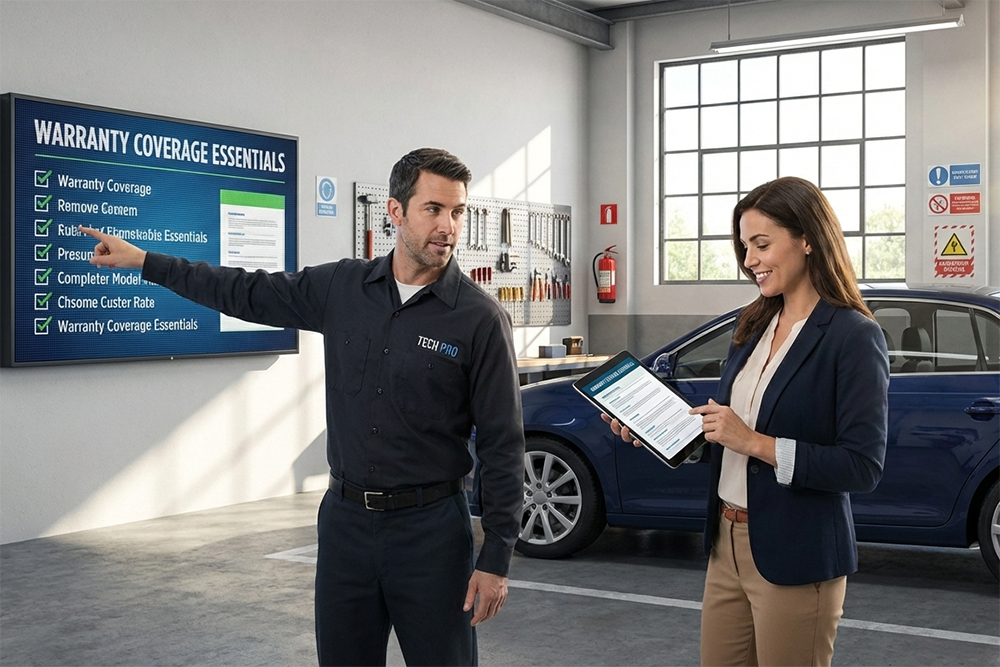
Warranty Coverage Essentials for Smart Vehicle Owners
When you hear a mystery rattling coming from beneath the hood of your automobile, it is one of the most unnerving sounds you could ever hear. It is the sound of uncertainty and, worse, the possibility of a very hefty bill for repairs. The safety net that protects that investment is frequently a mystery, despite the fact that a car is the second greatest purchase that many drivers will ever make in their lifetime. The small print of a car warranty can be difficult to understand and can be rather complex. The purpose of a car warranty is to protect your pocketbook against mechanical failures and problems.
Get An Auto Glass Replacement Quote Now 866.278.7417

Windshield Replacement & Repair
Our competitors push you into going to their shop to get your glass fixed-making it cheaper for them. We make it easier for YOU to get back on the road by offering free mobile repairs at your home or work. With our free mobile services servicing the entire Orange County & Los Angeles area, we can often handle your windscreen replacement the same day! So the next time you need a windshield replacement, give us a call.
Talk to a Windshield Replacement Specialist Now 866.278.7417

Calibration
Calibration is the process of returning a vehicle’s ADAS to OEM specifications. Calibration is necessary after a new glass installation, particularly a windshield with a camera mounted to it, to ensure that the ADAS features continue to function properly despite having been moved during installation. If a car’s ADAS is not properly calibrated, the system may not function safely. A misaligned camera could jeopardize the functionality of the system and lead to dangerous driving or accidents, so it is crucial that the cameras are aligned perfectly, which is what windshield calibration ensures.
Talk to a Calibration Specialist Now 866.278.7417

Fleet Auto Glass Repair
We provide expert auto glass repair and windshield replacement services for commercial fleets of all sizes. We are experienced with all manufacturers and machine types of domestic or foreign cars, trucks, vans, or commercial vehicles, including heavy equipment. Our same day mobile auto glass and windshield repair service will enable you to get back on the road faster and start saving you time and money instantly. Give us a call today! We are here to help!
Talk to a Fleet Auto Glass Specialist Now 866.278.7417
The Two Primary Categories of Warranties are
Before delving into particular components, it is essential to have a solid understanding of the two basic kinds of warranty coverage. At various points in the vehicle’s life, they cover the vehicle in a manner that is distinct from one another. The coverage that is provided with the purchase of a new car is referred to as the manufacturer’s warranty, sometimes abbreviated as the factory warranty. The quality of the automobile is guaranteed to be free of flaws in both the materials and the craftsmanship by the manufacturer. The company will pay to repair a component that breaks prematurely as a result of a manufacturing fault. Generally speaking, this coverage is non-negotiable and is transferred to future owners in the event that the vehicle is sold within the coverage term period.
In the legal sense, this is not a warranty; rather, it is a service contract. Extended Warranty (Vehicle Service Contract): Technically speaking, this is not a warranty. Depending on your preference, you can acquire this coverage individually from the dealership or from a third-party source. Once the warranty from the manufacturer has expired, it will become active. Plans like this are intended to cover the expenses that may arise as a result of unforeseen repairs (including parts and labor) for a certain amount of time or miles. These guarantees, in contrast to manufacturing warranties, are extremely customizable and frequently open to negotiation.
Comparing Bumper-to-Bumper and Powertrain
When an individual examines a window sticker or a service contract, they will almost always see that the coverage is divided into two primary categories. The single most critical aspect of being a wise owner is having a solid understanding of the distinction between these two. The most thorough and broad protection that is provided is known as bumper-to-bumper coverage, which is also sometimes referred to as “comprehensive” or “exclusionary” coverage. However, contrary to what the name suggests, it does not cover the bumpers themselves, which are considered to be body parts; rather, it covers practically all of the mechanical and electrical systems that are placed between the bumpers.
High-tech systems, including navigation displays, infotainment units, and backup cameras, are often included in this section. Air conditioning compressors and heating cores are the components that govern the climate. Electrical components include motors for the sunroof, door locks, and power windows. Both airbags and seatbelt systems are included as safety measures. As a result of the extensive nature of this coverage, it often has a shorter lifespan, typically lasting for three years or around 36,000 miles, but some manufacturers provide longer durations. The powertrain warranty protects the components of the vehicle that are responsible for its movement, sometimes known as the “muscles” of the vehicle.
In most cases, this coverage is substantially longer than the bumper-to-bumper warranty, often extending to a period of five years or sixty thousand miles (and in certain cases, even up to ten years or one hundred thousand miles). The engine, including the pistons, cylinder block, heads, and oil pump, is the sole subject of concern for this coverage. “Transmission” refers to the gears, transfer case, and torque converter for the vehicle. The drive systems consist of things like driveshafts, differentials, and axles. Even though it is essential, a powertrain warranty leaves you susceptible in the event that your air conditioning stops working or your touchscreen stops working.
The “Wear and Tear” Traps to Avoid
One of the most prevalent causes of contention between automobile owners and warranty providers is the idea of “wear and tear.” Warranties are intended to repair flaws, and they are not intended to cover the typical expense of owning a machine that deteriorates over time. Components that are consumable are typically not covered by warranties. For friction materials, such as brake pads, rotors, and clutch linings, you should anticipate having to pay for them out of your own cash.
Tires and windshield wiper blades are both made of rubber. The following are examples of fluids and filters: air filters, transmission flushes, and oil changes. The batteries are standard 12-volt batteries; however, electric vehicle batteries typically come with supplementary warranties that are more specialized. The likelihood is that your claim will be rejected if a component breaks due to the fact that it simply wore out as a result of regular use. These maintenance things should be budgeted for independently from the warranty protection, according to knowledgeable owners.
Do you have a Question?
Get An Auto Glass Replacement Quote Now 866.278.7417
Contrasted with Third-Party Providers
In the event that you make the decision to extend your coverage beyond the periods stipulated by the manufacturer, you will be presented with a choice: either continue working with the manufacturer or go with an independent firm. Remaining with the Manufacturer: Purchasing an extended warranty from the manufacturer (for example, Ford Protect or Toyota Care) provides a straightforward shopping experience. Authentic original equipment manufacturer (OEM) parts will be utilized, and any dealership within the network of that brand will be able to conduct the repairs without any complications. These plans, on the other hand, are often more expensive and must be acquired before the expiration of the first manufacturing warranty.
When selecting a third-party provider, it is important to note that independent companies such as CarShield or Endurance give greater freedom. The majority of the time, you are able to acquire these plans for older vehicles that have greater mileage, and you are not restricted to a particular dealership network. In general, you are able to employ any ASE-certified technician without restriction. One of the drawbacks is the load of administrative work. Prior to the beginning of the repair process, you can be required to wait for authorization, and certain service providers have a history of rejecting claims on the basis of technicalities. Before you sign anything, you should always check the provider’s rating with the Better Business Bureau.
The Step-by-Step Guide to Voiding Your Warranty (How to Avoid It)
Being in possession of warranty paperwork in your glovebox does not ensure that you are covered. The contract may be null and void if the owner takes certain acts or does not take certain measures, leaving you accountable for the cost. The most typical cause for the denial of a claim is that the claimant neglected to perform routine maintenance. In the event that your engine becomes unresponsive due to low oil levels, the warranty provider will request evidence of your previous maintenance history. They will not pay for the engine replacement if you are unable to provide evidence that you changed the oil in accordance with the timetable provided by the manufacturer. You should keep every receipt, even if you are the one who did the labor. Inappropriate Use: If you use a regular passenger car for commercial activities (such as ride-sharing or delivery), or if you use it for off-roading and racing, conventional warranties might not apply to your vehicle.
It is important to be honest about how you use the vehicle because many service providers provide specialized add-ons for business activities. Making modifications to your car through aftermarket modifications might result in issues. In the United States, the Magnuson-Moss Guarantee Act prohibits a manufacturer from nullifying your whole guarantee simply due to the fact that you added an aftermarket component. If, on the other hand, that component is the cause of a failure—for instance, if a suspension raise kit is responsible for your axle snapping—they have the ability to refuse coverage for that particular repair.
Frequent Questions Regarding the Warranty
It is possible to transfer a warranty if I sell my vehicle. The majority of the time, the answer is yes. It is the Vehicle Identification Number (VIN) that remains associated with the manufacturer’s warranty. It is possible to transfer extended warranties to a private buyer for a nominal administrative cost, which can actually result in an increase in the value of your vehicle when it is put up for sale thereafter. Exactly what is a deductible? Extended warranties typically come with a deductible that is comparable to that of health or auto insurance. It is the amount that you spend out of pocket for each visit to the repair shop. In most cases, it can range anywhere from zero to two hundred dollars. In most cases, the initial cost of the plan is reduced when the deductible is increased.
What if I rent a car? Does my warranty cover that? It is fully dependent on the particular contract in question. There are a lot of bumper-to-bumper and extended warranties that include payment for rental cars while your vehicle is in the shop for a repair that is covered by the warranty. On the other hand, this benefit is typically not included in the standard powertrain warranties. Is it possible to terminate an extended warranty? Indeed. A cancellation policy is included in the majority of car service contracts. You may be eligible for a full refund if you cancel your reservation within a particular window of time, which is often thirty days. After that, you will normally be given a reimbursement that is proportional to the amount of time or mileage that you have utilized.
Proceed With Self-Assurance
However, despite the fact that it is a strong instrument for financial predictability, a car warranty is not a magic wand that cures everything for free. It is possible to guarantee that you are adequately insured by first gaining an awareness of the differences between powertrain coverage and comprehensive coverage, then rigorously maintaining your vehicle, and then reading the fine print detailing the exclusions within the policy. When it comes to your coverage, you shouldn’t wait for the check engine light to start flashing before you explore it. Get out your owner’s handbook or your contract right now, go over the conditions, and then get behind the wheel with the self-assurance that comes from knowing precisely how carefully you are covered.
Auto Glass Insurance
While driving on the highway, the sound of a rock hitting your windshield with a quick and abrupt thwack is something that every motorist dreads hearing. Instantaneously, your eyes will dart to the area of impact, searching for any signs of harm. Every once in a while, you get lucky, and it will bounce off without any injury. On other occasions, you may be left with a chip that looks like a starburst or a crack that appears to be getting longer by the minute. After the first feeling of annoyance has subsided, the next step is to ask useful questions.
If I have insurance, does it cover this? Do I have to pay for it out of my own pocket? If I file a claim, would my monthly rates increase to an unimaginable level? Many people have a misunderstanding about auto glass insurance. Drivers frequently make the mistake of assuming that “full coverage” means that everything is free, only to be surprised by a large deductible and a subsequent unexpected payment. When your vehicle requires repairs, having a thorough understanding of the precise terms, restrictions, and safeguards that are included in your policy may alleviate a substantial amount of worry and save you hundreds of dollars.
Comparing Different Types of Coverage
Before we go into the specifics of the policy, it is necessary to have a clear understanding of which section of your vehicle insurance policy truly covers damage to the glass. Typically, it may be classified into either of two groups. When it comes to the vast majority of windshield claims, comprehensive coverage is the most important factor to consider. Coverage for damage to your vehicle that is not the result of a collision with another vehicle is provided by this. Examples include a rock that is thrown from the road and flies upward. Your parked automobile was hit by a tree limb that fell on it. There were efforts at theft or vandalism.
The occurrence of weather phenomena such as hail. Glass repair or replacement is typically not covered by “liability only” insurance, which is the type of insurance that you hold. All of the expenses will be paid for by you out of your own pocket. Insurance for Collisions: This coverage applies in the event that your car’s glass is broken as a result of an accident involving another vehicle or if you collide with an object such as a mailbox or guardrail. The glass repair is included in the package of bodywork repairs that you are entitled to get under your accident claim in this particular instance.
The Predicament of Deductibles
The vehicle glass deductible is the component of the claims process that causes the greatest confusion. The amount of money that you agree to pay toward repairs before your insurance company begins to pay for them is known as a deductible. In the event that the cost of replacing your windshield is $400, but your comprehensive deductible is $500, your insurance company will not pay for the repair. You are accountable for paying the total amount due to the fact that the cost has not gone beyond the level for your existing deductible.
When it comes to glass coverage, however, many insurance companies provide a particular endorsement called “Full Glass Coverage” or a glass waiver with no deductible. In the event that you file a claim for glass, this add-on to your insurance will waive the deductible. Certain states in the United States, including Florida, Kentucky, and South Carolina, have legislation that requires insurance companies to waive the deductible for windshield replacement services that fall under the umbrella of comprehensive coverage.
Choosing Between Repair and Replacement
The fact that repairs are much less expensive than replacements is one reason why insurers favor them. Injecting a specialized glue into a chip or small fracture in order to seal it and prevent it from spreading is the process that is used to repair it. When it comes to repairs, the majority of insurance carriers will completely waive your deductible. This indicates that if you notice a chip at an early stage, it is often free for you to get it rectified.
Replacement of the glass is required in the event that the damage is too severe. If the crack is longer than a dollar bill or if it is directly in the line of sight of the driver, a replacement is often required for safety concerns. This guideline is a widespread industry standard that is commonly referred to as the “dollar bill rule.” To the extent that you do not have the particular glass waiver described previously, your deductible will be applied to the cost of replacement.
ADAS Calibration
Cars are more intelligent than they were in the past. ADAS, which stands for advanced driver assistance systems, are standard equipment in modern automobiles. Features like as lane departure warning, automatic emergency braking, rain-sensing wipers, and adaptive cruise control are included in this category. It is common practice to put the cameras and sensors that are a part of these systems just behind the windshield. By replacing the glass, you are causing these sensors to be displaced from their original positions. A movement of even a single millimeter might throw off the system, leading the vehicle to incorrectly estimate the distance between two points.
Consequently, when it comes to changing the glass on a contemporary automobile, it is not only about the glass; it is also about calibration. To guarantee that the safety systems function appropriately, it is necessary for a technician to readjust the cameras. This technique can cost as much as the glass itself and is sometimes much more expensive than that. It is important to check if your insurance company will pay for the cost of ADAS calibration as part of the windshield claim while you are assessing your coverage. There are a number of large carriers that do, but it is an essential fact to check.
Do you have a Question?
Get An Auto Glass Replacement Quote Now 866.278.7417
OEM vs. Aftermarket Glass
The kind of glass that is being utilized is another major source of contention throughout the claims process. This glass is manufactured by the same company that produced the original glass in your vehicle, which is referred to as an OEM (original equipment manufacturer). Everything about it, even the branding stamp (for example, Ford or Toyota), is exactly the same as what was shipped from the factory. This type of glass is manufactured by third-party firms and is referred to as OEE (Original Equipment Equivalent) or Aftermarket.
Despite the fact that it is made to suit the automobile and adhere to safety regulations, it may not include the brand of the carmaker and may have subtle differences in color or thickness. Aftermarket glass is often the only type of glass that is covered by conventional insurance plans since it is more affordable. Check to see whether your policy includes a rider known as “OEM Endorsement.” If you do not have this rider, you may be responsible for paying the price difference between the aftermarket glass and the OEM glass on your own. If you drive a luxury vehicle or if you are leasing a car that needs OEM parts upon return, you should check to see if your policy contains.
Restrictions and Exclusions in the Common Policy
In general, the coverage is extensive; nonetheless, there are restrictions. With an understanding of these exclusions, expectations may be better managed. Moonroofs and Sunroofs: Windshields and side windows are common, however sunroofs can be difficult to install. There are certain glass insurances that may not cover them or may handle them differently in terms of deductibles, despite the fact that comprehensive policies normally cover covered glass.
The term “wear and tear” refers to the kind of damage that is covered by insurance. Scratches that are produced by outdated windshield wipers or the typical pitting of glass that occurs over the course of years of driving on the highway are not covered by this policy. This means that your insurance company will not repair your windshield if it is just difficult to see through because it is old.
Your Right to Choose: Be wary of “steering.” When you call to submit a claim, your insurance may aggressively promote a certain repair shop. This is your right to choose. In the majority of countries, you have the legal right to pick who works on your car, even though it is quite likely that they have negotiated a favorable pricing with that business. It is possible that you will be responsible for paying the difference if the shop that you have chosen charges a higher rate than the standard rate that the insurance charges.
Questions That Are Frequently Asked
If I file a claim for glass, would my insurance premiums go up? No, in the majority of instances. In most cases, comprehensive claims, which include glass, are considered to be “not-at-fault” accidents. On the other hand, if you make many glass claims within a short period of time, your insurer may consider you to be a high-risk customer, which may have an impact on your premium when it comes time to renew it. Would you mind if I ignored a little chip? A gamble is made when a chip is ignored. Changes in temperature, such as blasting the defroster on a chilly morning or washing a heated car with cold water, have the potential to immediately transform a little chip into a large break across the surface.
As soon as it cracks, the possibility of a free or inexpensive repair is no longer available, and you will be forced to replace it entirely. Does the tint on my window get reset? Unless you have “custom parts and equipment” coverage, normal glass coverage might not pay to re-tint the new window if you have aftermarket window tinting that you paid for separately. This is the case if you have purchased the tinting separately. Glass is coated with a factory tint that is incorporated into the glass itself.
Before The Crack Appears, You Should Review Your Policy
Protection for auto glass is one of those things that the majority of people tend to overlook until they are looking through a web of broken glass from their vehicle. Review the page of your policy declaration today, and give yourself five minutes to do so. Additionally, check to see if there are any particular class exemptions and look for the comprehensive deductible. A reduction in your comprehensive deductible or the addition of full glass coverage might be a financially prudent choice for you if you live in an area that is constantly undergoing road construction or if you drive a car that is equipped with sophisticated safety sensors. It transforms a pain that may cost $1,000 into a straightforward consultation that is free of tension.
Mobile Safe Auto Glass
14241 E Firestone blvd suite 400,
La Mirada, CA 90638
Phone: (562) 608-1154
Toll Free: 1 866 278 7417
Mail: sales@mobilesafeautoglass.com
Get a FREE QUOTE today! You can get a free quote and schedule 24/7 using this free quote wizard.
Mon – Fri 8am – 5pm
Saturday 8am – 1pm
Sunday Closed