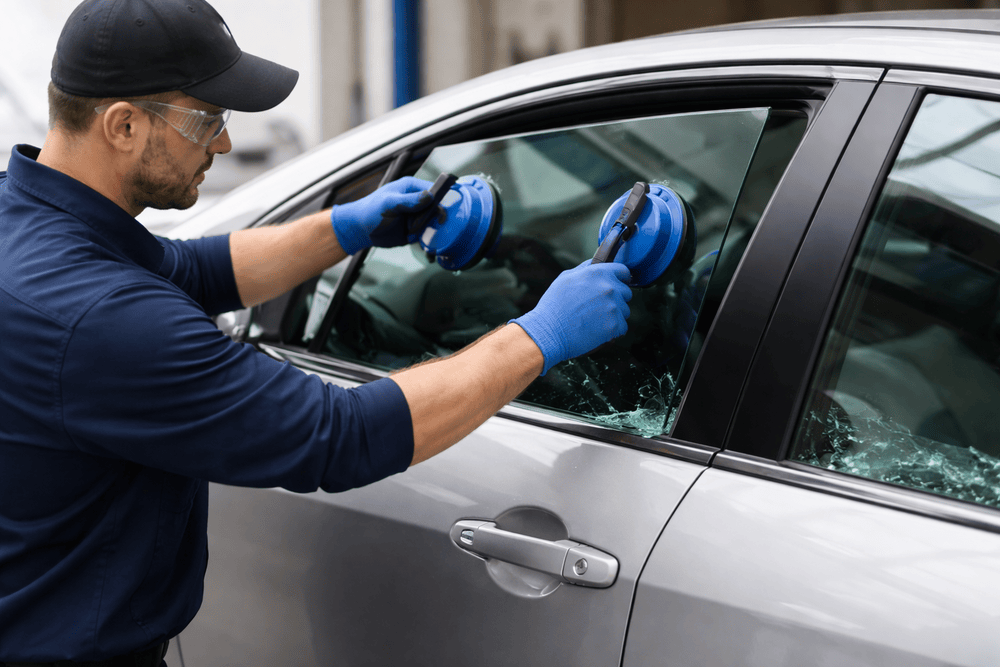
Passenger Side Window Replacement Cost Breakdown
As you approach your car, the sight of a mound of broken glass on the sidewalk makes you feel uneasy. A damaged passenger-side window exposes your car to weather, theft, and vermin, regardless of the cause—a break-in, a wayward baseball, or a car accident. The urgent question, “How much is this going to cost me?” frequently follows the first panic. A side window nearly always needs to be replaced entirely, in contrast to a windshield, which may frequently be fixed if the damage is modest. The glass in door windows behaves differently than that in windshields, affecting repair costs and procedures.
Get An Auto Glass Replacement Quote Now 866.278.7417

Windshield Replacement & Repair
Our competitors push you into going to their shop to get your glass fixed-making it cheaper for them. We make it easier for YOU to get back on the road by offering free mobile repairs at your home or work. With our free mobile services servicing the entire Orange County & Los Angeles area, we can often handle your windscreen replacement the same day! So the next time you need a windshield replacement, give us a call.
Talk to a Windshield Replacement Specialist Now 866.278.7417

Calibration
Calibration is the process of returning a vehicle’s ADAS to OEM specifications. Calibration is necessary after a new glass installation, particularly a windshield with a camera mounted to it, to ensure that the ADAS features continue to function properly despite having been moved during installation. If a car’s ADAS is not properly calibrated, the system may not function safely. A misaligned camera could jeopardize the functionality of the system and lead to dangerous driving or accidents, so it is crucial that the cameras are aligned perfectly, which is what windshield calibration ensures.
Talk to a Calibration Specialist Now 866.278.7417

Fleet Auto Glass Repair
We provide expert auto glass repair and windshield replacement services for commercial fleets of all sizes. We are experienced with all manufacturers and machine types of domestic or foreign cars, trucks, vans, or commercial vehicles, including heavy equipment. Our same day mobile auto glass and windshield repair service will enable you to get back on the road faster and start saving you time and money instantly. Give us a call today! We are here to help!
Talk to a Fleet Auto Glass Specialist Now 866.278.7417
The Mean Replacement Cost
The national average for replacing a passenger-side window usually falls between $200 and $550, if you’re just searching for a rough estimate. Typically, this cost covers both labor and parts.
This is a rough approximation, though. Prices may be on the lower end of the range if you drive an older sedan. On the other hand, the price can easily increase to $800 or more if you own a high-end SUV or a car with cutting-edge sensors built into the glass.
An approximate breakdown of what you could anticipate paying is provided below:
Older or Economy Cars: $150 to $300
SUVs & Mid-Range Sedans: $250 to $450
High-tech and luxury cars: $500 to $900+
Price-Influencing Factors: What causes the wide price variations? A piece of glass could appear straightforward, but the auto glass shop’s final quote depends on several factors.
The primary factor influencing price is the vehicle’s make and model. Parts for common cars, such as the Ford F-150 or Toyota Camry, are accessible, which keeps prices down.
Special ordering is frequently necessary for rare, imported, or expensive cars, which raises the glass’s actual cost. Additionally, laminated glass (also known as acoustic glass), which is somewhat more costly than regular tempered glass, is frequently used on side windows of newer cars for soundproofing.
OEM vs. Aftermarket Glass: For the glass itself, you typically have two options:
OEM (Original Equipment Manufacturer): The company that produced your car’s original window also makes this glass. It is guaranteed to fit correctly and will bear the automaker’s branding. It is the priciest choice.
Aftermarket (OEE, Original Equipment Equivalent): Third-party businesses manufacture this glass in accordance with the same specifications as the original. Although it doesn’t have the brand logo, it fits and works the same. Often 20% to 40% less expensive than OEM, this is a secure approach to saving money.
Motors and Power Window Regulators
The glass falls into the door panel when a window breaks. Occasionally, the motor or window regulator—the mechanical arm that moves the window—is harmed by the impact or debris. If the technician finds a bent or broken mechanism after opening the door panel, you must pay for the parts and glass replacement.
Labor Complexity: To replace a side window, you must take out the inner door panel, vacuum damaged glass from the door cavity, and then fix the window seal. Complex car doors, such as those with side airbags, sophisticated sound systems, or elaborate trim, need more labor, which raises the total cost.
Why Side Windows Can’t Be “Repaired”: Drivers look for a similar, less expensive solution for their side windows because they are accustomed to seeing advertisements for windshield chip repair. Sadly, this is rarely a choice.
Laminated glass, which is composed of two glass layers separated by a plastic layer, is used to make windshields. It holds together but fractures when struck.
Tempered glass is commonly used for side windows. Although this glass has been heat-treated to make it extremely robust, it is made to break into thousands of tiny, dull cubes rather than sharp, jagged shards when subjected to severe impact.
This safety element is intended to shield victims from serious cuts in the event of an accident. The entire pane needs to be replaced because the instant the glass fractures, its structural integrity is jeopardized.
DIY vs. Expert Replacement: Some car owners think of going to a junkyard or ordering a part online to conduct the work themselves to save money. Even while purchasing the glass could only cost $50 to $100, there are risks associated with doing it yourself.
Do you have a Question?
Get An Auto Glass Replacement Quote Now 866.278.7417
The Unspoken Difficulties of Do It Yourself
Broken Clips: Several plastic retention clips must be removed in order to remove a door panel. These are readily broken. Your door panel will hang loose or rattle if you don’t have replacements.
Glass Debris: Cleaning up the old glass is more time-consuming than installing the new one. Shards tumble deep into the doorframe’s base. Your car will sound like a maraca every time you close the door or drive over a bump if you don’t vacuum everything out.
The Regulator: It can be challenging to align the new glass onto the regulator track. If done poorly, the window might not seal completely, which could result in water leaks and wind noise. The additional $100 to $200 for expert labor is worthwhile for the majority of drivers because it ensures that the door won’t rattle and the window will seal tightly.
Insurance: Is It Time to Make a Claim? Examine your auto insurance policy before using your credit card. Typically, window replacement is covered by your insurance’s comprehensive coverage. But that doesn’t imply you should file a claim just because you can. You should check your deductible.
Scenario A: $300 is the replacement cost. You have a $500 deductible. Insurance won’t cover anything in this situation, and you may still have a claim on file. Make your own payment.
Scenario B: $400 is the replacement cost. You have a $50 deductible. It is obvious that a claim should be made. Certain insurance plans and states provide “full glass coverage” with no deductible. You should be able to get the repair for free if you have this add-on.
What to Do Right Away After a Break
You must secure the car if you are unable to visit a business right away. Take pictures to record the damage for police or insurance reports.
Clear the large pieces: Take out the last of the loose glass from the frame while wearing thick gloves.
Vacuum: Give the floor mats and seats a thorough cleaning. It’s easy for glass cubes to hide and then cut you.
If “crash wrap” (an adhesive plastic film) is available, use it to cover the opening. If not, you can use masking tape and a sturdy garbage bag. Avoid applying duct tape directly to your car’s paint since it might harm the clear coat and create a residue that is difficult to remove.
Frequently Asked Questions: A qualified expert typically completes the task in 60 to 90 minutes. This involves removing the door panel, vacuuming the area, installing the new glass, and inspecting the regulator.
The new glass will have the same faint tint as the factory glass. You won’t get the new glass, though, if you have a darker, aftermarket window tint installed. After the replacement, you will need to drive the vehicle to a tint business so that the film can be put on to match the rest of the vehicle.
Can a side window be replaced by a mobile service? Mobile auto glass professionals can easily replace side windows at your house or place of business. There is no need for a shoplift, and the procedure is clean. But make sure you have a room where they can fully open the door to work.
Is there a warranty on the replaced glass? Reputable stores provide an installation (workmanship) warranty. This guarantee protects you from creaking noises, water leaks, and air leaks. The glass itself is usually not covered by their warranty against future breaking.
Returning to the Road
A broken passenger window is a significant annoyance and an unforeseen expense. The best course of action is always to check your insurance policy for glass coverage, even though the typical cost is between $200 and $500.
Look for more than simply the best deal when selecting a repair service. Seek out a professional who uses premium glass and places a high priority on cleaning the inside of the door panel. When installed correctly, the recollection of that broken glass is put behind you, and your automobile is safe, dry, and quiet.
Why Windshield Replacement Prices Differ by Model, Glass, and Location: A sharp crack is the first sign. A spiderweb fracture appears on your windshield as a result of a stray rock that a truck kicked up as you were traveling down the highway. Your thoughts instantly turn from the initial frustration to the next issue: How much will this cost?
You’ll probably get three quite different responses if you ask three different friends how much they paid for a windshield replacement. While some gripe about a charge that is more like $1,500, others would suggest $250. This pricing difference isn’t arbitrary. It is influenced by particular factors that alter the repair’s intricacy.
Replacing a pane of glass is no longer the only thing involved in auto glass replacement. Logistical decisions, safety regulations, and complex technologies are all involved. When that quotation finally arrives in your inbox, knowing the three primary factors that affect cost—your car model, the type of glass you select, and the location of the service—will help you make an informed choice.
The Effect of Your Vehicle Model: The car you drive has the biggest influence on auto glass replacement costs. A windshield used to be just a layer of defense against the rain and wind. It is now an essential feature of the car’s safety system and a structural element.
The Development of ADAS Technology
Modern cars, especially those built within the last ten years, frequently feature Advanced Driver Assistance Systems (ADAS). Rain-sensing wipers, automated emergency braking, and lane departure warnings are some of these features.
Often installed right behind the windshield are the cameras and sensors that drive these systems. Changing the glass disrupts these delicate instruments. To make sure they work properly, they need to be carefully recalibrated.
You are paying for more than just the glass and installation fees if your car model has these amenities. The cost of calibrating is also your responsibility.
This procedure necessitates skilled professionals and sophisticated equipment, which frequently raises the ultimate cost by hundreds of dollars. It will always be less expensive to service a 2015 budget vehicle with no sensors than a 2024 luxury SUV loaded with autonomous driving technology.
Luxury vs. Economy Makes: In addition to technology, the vehicle’s make affects part availability and price. High-end luxury cars (like Mercedes-Benz, Lexus, or Land Rover) frequently have heads-up displays (HUDs), integrated heating systems, or windshields with particular acoustic qualities.
Because there are fewer manufacturers making these particular models, sourcing glass for them can be challenging. On the other hand, parts for well-known models like the Ford F-150 and Toyota Camry are readily accessible and mass-produced, which keeps costs down.
Glass Quality: OEM vs. Aftermarket: After determining what your vehicle requires, you frequently have a choice in terms of the glass’s quality. Usually, your options can be divided into two groups: OEM and aftermarket.
Original Manufacturer of Equipment
OEM glass is made by the same company that provided your car’s original glass when it came off the assembly line. Its thickness, tint, form, and durability are all exactly the same as those of the original windshield. The automaker’s branding will also be on it.
Advantages: We guarantee a flawless fit and finish. It satisfies all of the first safety and noise-canceling requirements established by the automaker.
Cons: The price difference is substantial.
Ideal for: Newer cars if you wish to preserve the original factory specs, luxury cars, or leased cars (where the contract may call for OEM parts). Aftermarket glass, often known as OEE (Original Equipment Equivalent), is produced by other businesses that do not directly supply the automaker.
Reputable aftermarket glass, however, is manufactured in accordance with the same specifications as the original. It won’t feature the car brand’s badge, but it must legally adhere to the same safety regulations.
Advantages: It is far less expensive, frequently saving clients hundreds of dollars.
Cons: Although this is uncommon with premium aftermarket manufacturers, there may be minute variances in hue or thickness that could lead to slightly more wind noise.
Ideal for: Regular daily commuters, drivers on a tight budget, and older cars.
Do you have a Question?
Get An Auto Glass Replacement Quote Now 866.278.7417
The Safety Discussion
The idea that aftermarket glass is dangerous is a frequent one. As long as you stick to reliable installers and well-known glass brands (like Pilkington or PGW), this is usually untrue.
All windshields sold in the United States must adhere to strict safety regulations set by the Department of Transportation. The difference typically lies in the acoustic quality and fitment accuracy, not collision safety.
The final piece of the puzzle is the service location and type. Surprisingly, geography and the type of shop you choose heavily influence the final invoice.
Dealerships vs. Independent Shops: Bringing your car to a dealership is typically the most costly choice. Dealerships usually only utilize OEM glass and have more overhead. For their in-depth brand understanding, they demand premium labor rates.
Auto glass shops that operate independently focus only on glass. They can frequently find parts (both OEM and aftermarket) at lower prices and do the job more quickly because this is their primary business. When it comes to out-of-pocket repairs, they are typically the most economical choice.
Mobile vs. In-Shop Service: Many businesses provide mobile service, in which a technician visits your house or place of business. Although convenient, depending on the weather, this can occasionally affect the installation’s quality.
In-store: The setting is regulated. Two important variables that affect how well the urethane glue cures are controlled: temperature and humidity. This system guarantees a steady relationship.
High humidity, rain, or extremely cold temperatures can complicate a mobile installation. Taking the automobile to a shop could result in a safer, more durable installation and possibly save you money on future repairs if you reside in a region with severe weather.
Labor Rates by Geography
The cost of mechanical labor is lower in rural locations than in major cities, much like rent. For no other reason than the cost of doing business, a windshield repair in downtown San Francisco or New York City will cost more than the identical service done in rural Ohio.
Is replacing a windshield covered by my insurance? Indeed, this is often the case. Auto glass is frequently included in comprehensive coverage. Insurance companies are required by law in certain areas to waive the deductible for windshield repairs, but not always for complete replacements. To find out if the repair will cost more than your deductible, check your policy.
Can I save money by forgoing the ADAS calibration? The answer is no. Ignoring calibration might be risky. If your lane departure camera is even a millimeter off, it may fail to warn you of danger or, worse, trigger emergency braking when there is no obstruction. A windshield that is not calibrated jeopardizes the precise data that safety systems depend on.
What is the duration required for a replacement? It typically takes an hour to complete the physical replacement. To enable the glue to dry safely, the vehicle must sit for a further hour or longer (the “safe drive-away time”). It will take an additional one to two hours if your car needs its ADAS calibrated.
What distinguishes a tiny chip repair from a replacement? Indeed. Resin can frequently be injected into the chip to fix damage smaller than a dollar bill and out of the driver’s direct line of sight. This treatment is far less expensive than a complete replacement and stops the fracture from widening.
Making the Correct Choice for Your Vehicle: Naturally, the cost of a cracked windshield is your top priority. However, focusing only on the lowest number can be deceptive. A quote that appears excessively low could suggest that the store is neglecting crucial safety precautions or is using subpar glass.
Think about your budget and the age of your car. Purchasing premium aftermarket glass from a separate store is a wise financial decision if you drive a car that is 10 years old. Purchasing OEM glass and having the car professionally calibrated are essential if you drive a brand-new luxury automobile with sophisticated safety sensors.
Always request a comprehensive price that includes labor, parts, and calibration costs broken down. If you know how the price is affected by the type of car, the quality of the glass, and the shop’s location, you can leave with peace of mind and good eyesight.
Mobile Safe Auto Glass
14241 E Firestone blvd suite 400,
La Mirada, CA 90638
Phone: (562) 608-1154
Toll Free: 1 866 278 7417
Mail: sales@mobilesafeautoglass.com
Get a FREE QUOTE today! You can get a free quote and schedule 24/7 using this free quote wizard.
Mon – Fri 8am – 5pm
Saturday 8am – 1pm
Sunday Closed