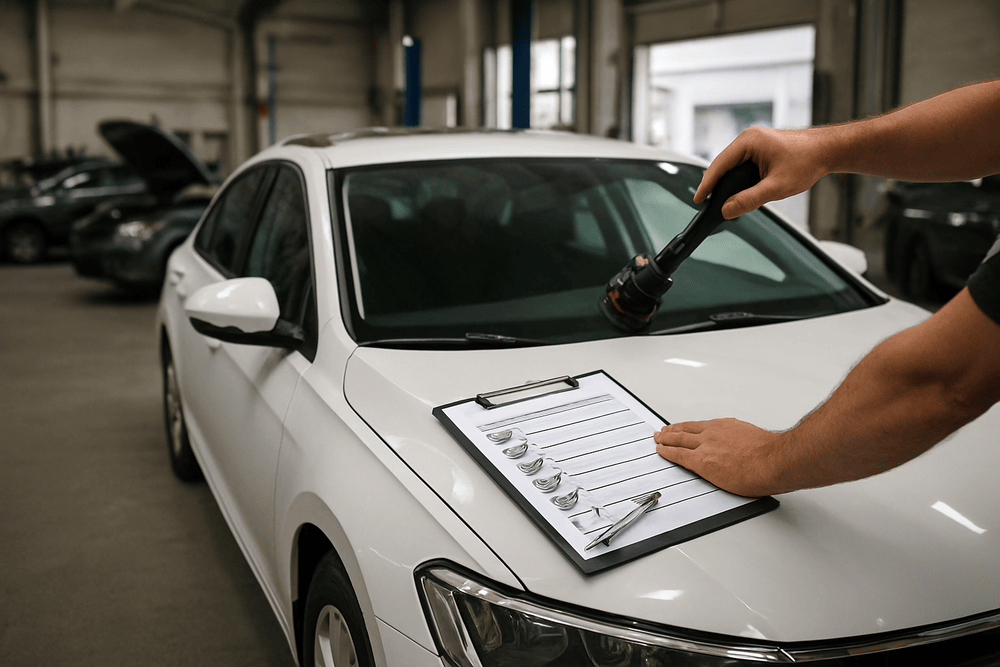
Detailed Checklist for Auto Glass Chip Repair Near Me
A tiny chip in your windshield might seem like a little inconvenience. Ignoring it, however, might result in more serious issues, such as a crack that covers the entire glass. Finding a reliable “auto glass chip repair near me” is the first step, but knowing what to look for in a service provider is important. This comprehensive checklist will walk you through the windshield chip repair procedure. We’ll go over everything, from determining the extent of the damage to comprehending repair procedure and posing queries. By the end, you’ll feel confident choosing a service that gets the job done right, ensuring your safety and saving you money down the line.
Get An Auto Glass Replacement Quote Now 866.278.7417

Windshield Replacement & Repair
Our competitors push you into going to their shop to get your glass fixed-making it cheaper for them. We make it easier for YOU to get back on the road by offering free mobile repairs at your home or work. With our free mobile services servicing the entire Orange County & Los Angeles area, we can often handle your windscreen replacement the same day! So the next time you need a windshield replacement, give us a call.
Talk to a Windshield Replacement Specialist Now 866.278.7417

Calibration
Calibration is the process of returning a vehicle’s ADAS to OEM specifications. Calibration is necessary after a new glass installation, particularly a windshield with a camera mounted to it, to ensure that the ADAS features continue to function properly despite having been moved during installation. If a car’s ADAS is not properly calibrated, the system may not function safely. A misaligned camera could jeopardize the functionality of the system and lead to dangerous driving or accidents, so it is crucial that the cameras are aligned perfectly, which is what windshield calibration ensures.
Talk to a Calibration Specialist Now 866.278.7417

Fleet Auto Glass Repair
We provide expert auto glass repair and windshield replacement services for commercial fleets of all sizes. We are experienced with all manufacturers and machine types of domestic or foreign cars, trucks, vans, or commercial vehicles, including heavy equipment. Our same day mobile auto glass and windshield repair service will enable you to get back on the road faster and start saving you time and money instantly. Give us a call today! We are here to help!
Talk to a Fleet Auto Glass Specialist Now 866.278.7417
Determine the Damage
Look at the chip on your windshield for a second before you even pick up the phone. Some chips could need a complete windshield replacement, while others can be fixed. You can have a more fruitful discussion with a repair professional if you are aware of the type and extent of the damage.
Is It Possible to Fix Your Chipped Windshield?
Generally speaking, a chip can be mended if it meets the following criteria:
The size of the chip is smaller than a quarter. This is a decent general rule of thumb, although some experts are capable of repairing somewhat larger damage.
Placement: The driver cannot see the chip directly. Minor distortion from repairs may cause vision impairment. Additionally, it shouldn’t be too near the windshield’s edge because its proximity could weaken the structure.
Depth: Neither of the car’s glass layers has been damaged. A windshield is made up of two layers of glass with a layer of plastic (PVB) positioned in between. It is normally required to replace the chip if it has completely worn out.
Damage Type: The easiest breaks to fix are simple, clean ones, like a bullseye (a circular break) or a star break (small cracks radiating from the impact site). It could be more difficult to fix complex breaks with several cracks.
Replacement is nearly always advised if the damage to your windshield is a large crack rather than a chip. Quick action is essential because temperature fluctuations or vibrations from the road can quickly transform a small, repairable chip into an irreparable crack.
Locate a Reputable Repair Facility
It’s time to locate a trained specialist when you’ve concluded that the chip is probably repairable. You can find several possibilities by doing a fast search for “auto glass chip repair near me,” but how do you pick the best one?
Characteristics of excellent service:
Look for these indicators of a reliable and skilled auto glass repair company:
Technicians with certification: Find out if the Auto Glass Safety Council (AGSC) or other organizations have certified their technicians. Certification demonstrates a dedication to safety and industry best practices.
Positive Customer Reviews: Examine internet reviews on sites like Google, Yelp, and the Better Business Bureau. Positive comments are a reliable sign of high-quality client service and contentment. Seek feedback regarding the repair’s quality, punctuality, and professionalism.
Utilizing Superior Materials: High-quality resin is essential for a successful repair. Ask the store what sort of resin they use. A high-quality resin will strengthen the bond, stop the chip from spreading, and produce a repair that is less obvious and more transparent.
Options for Mobile Services: Numerous leading auto glass firms come to your house or place of business to provide mobile repair services. Because of this convenience, you can get the chip fixed without interfering with your day and save time.
Workmanship Warranty: A respectable store will guarantee the quality of its products. Inquire about their warranty policy. For as long as you own the car, the majority will provide a lifetime warranty that ensures the repair won’t spread or discolor.
Do you have a Question?
Get An Auto Glass Replacement Quote Now 866.278.7417
Questions to Consider Before Making a Commitment
Before scheduling your appointment, don’t be scared to ask questions. A qualified specialist will be pleased to offer precise responses.
Your Questionnaire for Pre-Repair: The following are some crucial inquiries to make:
“What is the aggregate expense of the repair?” To minimize any unforeseen costs, obtain a clear, upfront quote.
“How long will the repair process take?” Although it’s advisable to confirm the estimate, most chip repairs may be completed in less than an hour.
“Is there a waiting period before I can drive the car or wash it?” The expert will recommend how long the resin needs to cure. Usually, you can proceed immediately, but a high-pressure car wash might necessitate a day or two of waiting.
“Will the chip be completely invisible after the repair?” Be practical. Although a repair will restore the strength of the windshield and greatly enhance the chip’s look, the damage might not be completely imperceptible. A competent technician will control your expectations.
“Do you work with my insurance company?” Many insurance policies cover windshield chip repair in full and have no deductible. A reputable store will manage your insurance claim, ensuring a smooth and easy process.
Recognize the Repair Procedure
You can feel more at ease knowing what to anticipate throughout the repair. Although the procedure is basic, it calls for accuracy and expertise.
Procedure for Repairing a Windshield Chip:
Preparation: The expert will start by cleaning the damaged area to get rid of any glass shards or debris.
Creating a Pathway: A small hole may be drilled into the center of the chip to allow the repair glue to reach every part of the break.
Using a Vacuum: The chip is covered by a specialized instrument. This tool creates a suction to remove any trapped air inside the crack.
Resin Injection: After removing the air, the technician injects the chip with a clear, curable resin. The glass is bonded back together by the resin, which fills the gap.
Curing the Resin: The repair area is subjected to ultraviolet (UV) light in order to cure the resin. In a few minutes, the UV light hardens and cures the resin, forming a robust, long-lasting connection.
Final Touches: To provide a clean, transparent finish, the technician polishes the windshield after scraping off any extra resin.
Next Steps for a Safer Drive
Repairing a small windshield chip is one of the quickest, least expensive, and most important aspects of car maintenance. It keeps your line of sight unobstructed, stops the damage from spreading, and repairs the structural integrity of your windshield. You may confidently manage the repair procedure and select a service provider who produces high-quality outcomes by using this checklist.
Don’t wait for that little chip to become a major problem. Get your windshield fixed right now by using the information provided here to locate a reputable local auto glass specialist. It’s worth it for your road safety.
Repair Windshield Chips for Visibility and Road Safety
Everybody has had that depressing feeling when traveling on a highway. You see a tiny, star-shaped mark on your windshield as soon as you hear a loud thwack. Your initial reaction might be to sigh, see if it’s in your direct line of sight, and decide to ignore it until later.
It is simple to consider a windshield chip to be a small aesthetic irritation, similar to a scratch on the bumper or a coffee stain on the upholstery. But your windshield does more than just prevent wind. It is an advanced safety engineering device that is intended to keep you and your passengers safe in the event of an accident.
Ignoring a tiny chip can seriously impair visibility when you need it most, conflict with contemporary driver aid systems, and jeopardize the structural integrity of your car. Knowing how auto glass repair works helps you see why fixing that minor flaw right away is one of the most crucial safety choices a driver can make.
The Function of Auto Glass in Structure
You must first comprehend what your windshield does to appreciate why chip repair is essential. The windshield, which frequently contributes up to 60% of the roof’s crush strength in a rollover accident, is a major structural element of the cabin of modern cars.
Auto glass is made using laminated safety glass, which is a “sandwich” of two glass layers with a layer of polyvinyl butyral (PVB) plastic in the center. The outer layer of the glass breaks when a rock strikes it. The entire windshield’s structural network is at risk if the damage spreads.
Protection Against Roof Crush: The windshield and the car’s pillars work together to keep the roof from collapsing into the passenger cabin in the case of a rollover. The weight of the car may cause a windshield that has a crack or a big chip to weaken and fail. Early chip repair restores the structural strength required to safeguard the cabin area in the case of a disaster by injecting a specific glue that fuses the glass back together.
The Airbag Backstop: The windshield plays a major role in the proper operation of passenger-side airbags. Instead of launching directly at the passenger, a front passenger airbag shoots upward, bounces against the windshield, and then expands in the passenger’s direction.
The backboard is made of glass. The force of the airbag deployment, which happens at explosive speeds, can shatter the windshield or pop it out of the frame if a chip has become a crack or seriously compromised the glass. The airbag may inflate through the opening instead of toward the passenger if the glass fails, making this crucial safety element ineffective. The surface tension needed to resist this force is restored when chips are repaired.
Do you have a Question?
Get An Auto Glass Replacement Quote Now 866.278.7417
Both Optical Distortion and Clarity
Safety is about preventing the disaster in the first place, not only about the dynamics of the impact. The most important element in preventing accidents is visibility, and even a small chip can produce harmful visual illusions.
The Prism Effect and Glare: An uneven surface is produced by a chip in the glass. Light does not flow through this fractured surface clearly; instead, it refracts. We call this the “prism effect.”
This defect could merely be inconvenient during the day. However, that tiny chip can collect light and produce a dazzling glare when driving in direct sunlight or at night. Oncoming traffic’s headlights may scatter across the chip, producing a starburst effect that momentarily blinds the driver. Fixing the chip removes the glare and restores a clear view of the road by filling the gap with a resin that has the same optical refractive index as glass.
Visual Distraction: Flaws are inherently appealing to the human eye. Even if you make an effort to ignore a chip, your eyes will unconsciously try to focus on the glass defect rather than the path ahead. Eye strain and exhaustion result from this continuous shifting of focus. More significantly, it diverts your focus from potential road risks. Driving can be calm and concentrated when the windshield is clear and repaired.
The Effect on Cutting Edge Driver Support Systems
Advanced Driver Assistance Systems (ADAS) are common in cars manufactured during the last ten years. These include features like autonomous emergency braking, adaptive cruise control, and lane departure warnings.
Forward-facing cameras installed on the inside of the windshield, typically behind the rearview mirror, are the foundation of many of these systems. For these cameras to work, the road must be obvious.
Interference with Sensors: The system may become confused if a chip or crack appears in the camera’s field of view. The camera may interpret light refraction through the chip as an obstruction or lane marking. As a result, the system may malfunction, leading to false alerts or, even more critically, an inability to brake when necessary.
Problems with Calibration: The placement is important even if the chip is fixed. The tiny distortion caused by a repair may occasionally still have an impact on the ADAS calibration if a chip is right in front of a camera lens. But letting it break is much worse because changing the windshield necessitates a costly and thorough recalibration of all safety cameras. By addressing chips right away, you may stop them from spreading into the camera’s field of view and maintain the integrity of your car’s “eyes.”
Why Tiny Chips Turn Into Serious Issues
Chips’ propensity to develop into irreversible fissures is one of the main safety hazards they pose. Although a chip is a stable break, it is constantly stressed.
Thermal shock occurs when glass expands when heated and compresses when cold. Extreme temperature swings occur frequently in your windshield. Even though the glass is chilly in the winter, you force the defroster on the interior surface. You turn on the air conditioner in the summer because the glass is hot from the sun.
Stress is produced by this thermal push and pull. It can be handled by a perfect windshield. A chipped windshield has a vulnerability. The chip will eventually “run,” creating a long crack across the driver’s field of vision due to the stress. The windshield usually cannot be fixed and needs to be replaced after a crack is larger than a dollar note.
Physical Stress: Driving causes vibration all the time. Physical pressure is applied to the glass by potholes, speed bumps, and even the inherent tension of the car chassis while cornering. A chip represents a surface tension break. The break spreads farther across the glass with each bump in the road, which functions like a hammer striking a chisel.
Putting Safety Back
A marvel of chemical engineering, chip mending is intended to address both safety and visibility. Usually, there are four essential phases involved:
Cleaning: The technician cleans the impact location of any moisture or glass dust. If moisture becomes trapped, it can swell and eventually break the glass, making it the adversary of a successful repair.
Vacuuming: To produce a vacuum over the chip and remove the air from the break, a specific tool is fastened to the glass.
Injection: After the air has been removed, a high-quality acrylic resin is injected into the area. The purpose of this resin is to form a molecular link with the glass.
Curing: Ultraviolet (UV) light is used to instantly harden the resin.
As a result, the windshield keeps its original factory seal. The strongest bond your windshield will ever have is the original seal. By fixing a chip instead of replacing the windshield, you preserve the integrity of the original installation, avoiding leaks and wind noise while guaranteeing that the glass stays securely in place in the event of an accident.
Do not Bet on Glass Safety
A chipped windshield is a sneaky threat. Despite its modest and manageable appearance, a chipped windshield seriously compromises the safety architecture of your car. It jeopardizes the roof’s structural integrity, airbag performance, safety sensor accuracy, and the driver’s field of vision.
It can be as thin as a sheet of glass between a safe drive and a hazardous circumstance. Fixing chips as soon as they occur can ensure your car maintains its intended protective shell.
Mobile Safe Auto Glass
14241 E Firestone blvd suite 400,
La Mirada, CA 90638
Phone: (562) 608-1154
Toll Free: 1 866 278 7417
Mail: sales@mobilesafeautoglass.com
Get a FREE QUOTE today! You can get a free quote and schedule 24/7 using this free quote wizard.
Mon – Fri 8am – 5pm
Saturday 8am – 1pm
Sunday Closed