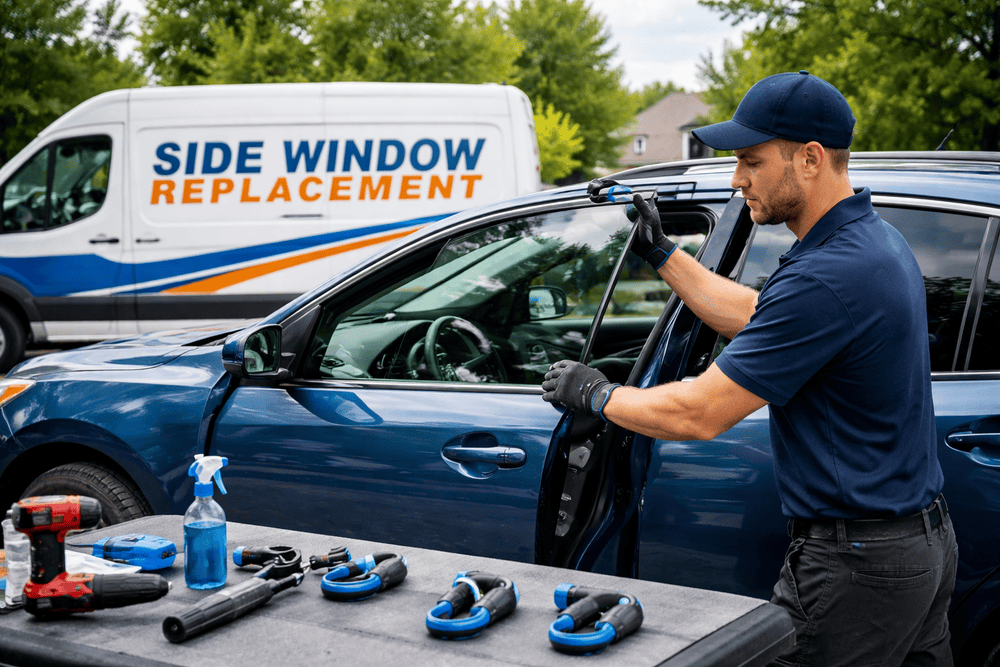
Complete Guide to Car Side Window Replacement
It is disheartening to approach your car and discover a heap of shimmering fragments on the driver’s seat. A broken side window is more than just a bother, regardless of whether the damage was brought on by a collision, a stray baseball, or a break-in attempt. It increases the risk of driving, exposes the interior of your car to the elements, and compromises the security of your vehicle. A broken side window needs to be fixed right away, while a cracked windshield can let you put off repairs for a few days. Without it, you cannot drive at high speeds or securely fasten your car.
Get An Auto Glass Replacement Quote Now 866.278.7417

Windshield Replacement & Repair
Our competitors push you into going to their shop to get your glass fixed-making it cheaper for them. We make it easier for YOU to get back on the road by offering free mobile repairs at your home or work. With our free mobile services servicing the entire Orange County & Los Angeles area, we can often handle your windscreen replacement the same day! So the next time you need a windshield replacement, give us a call.
Talk to a Windshield Replacement Specialist Now 866.278.7417

Calibration
Calibration is the process of returning a vehicle’s ADAS to OEM specifications. Calibration is necessary after a new glass installation, particularly a windshield with a camera mounted to it, to ensure that the ADAS features continue to function properly despite having been moved during installation. If a car’s ADAS is not properly calibrated, the system may not function safely. A misaligned camera could jeopardize the functionality of the system and lead to dangerous driving or accidents, so it is crucial that the cameras are aligned perfectly, which is what windshield calibration ensures.
Talk to a Calibration Specialist Now 866.278.7417

Fleet Auto Glass Repair
We provide expert auto glass repair and windshield replacement services for commercial fleets of all sizes. We are experienced with all manufacturers and machine types of domestic or foreign cars, trucks, vans, or commercial vehicles, including heavy equipment. Our same day mobile auto glass and windshield repair service will enable you to get back on the road faster and start saving you time and money instantly. Give us a call today! We are here to help!
Talk to a Fleet Auto Glass Specialist Now 866.278.7417
Understanding Your Cars Glass
You must first comprehend the material to comprehend the repair procedure. You may have noticed that, unlike mirrors, side windows do not shatter into big, sharp pieces.
Rather, it bursts into thousands of tiny, pebble-like fragments. This is because tempered glass is used for the majority of side and rear windows. Heat treatment makes tempered glass far stronger than regular glass.
One important safety element is internal tension, which is produced throughout the production process. That strain is released when the glass breaks, turning it from sharp spikes that could injure someone fatally in an accident to dull cubes.
On the other hand, laminated glass is used for side windows in some contemporary luxury cars. This resembles windshield glass, which has two layers of glass separated by a layer of plastic vinyl. Although laminated glass is pricier to replace, it is also quieter and more difficult to break.
What to Do Right Away When Your Window Breaks: You may not be able to see a repair service right away. If you are away from home or on a weekend and your car has a broken window, you should secure it to avoid theft or additional interior damage.
Safety First: Put on heavy-duty work gloves before handling anything. Tempered glass is supposed to be “safe,” but the fragments are still sharp enough to cut skin, and tiny shards can pierce your fingers.
Get Rid of the Junk
Before you drive, you should take out as much glass as you can. giant pieces: Gently pick up giant chunks by hand and put them in a thick garbage bag or box.
Vacuum: Clean the dashboard, floor mats, and seats using a powerful shop vacuum. To get rid of loose bits, run the vacuum over the window channel, where the glass moves up and down.
Remember the vents: Glass frequently flies into the air conditioning or defrost vents. To prevent rattling sounds later, thoroughly inspect these.
Put a Temporary Cover on It: Avoid putting duct tape directly on your car’s paint because it may create a slippery residue or possibly cause the clear coat to peel.
The ideal choice is a specific collision wrap, which is a sticky plastic sheet that can be purchased at auto parts stores. It is weatherproof and has a tight seal.
The Do-It-Yourself Approach: Use a clear plastic trash bag in place of crash wrap. From the inside, pull it taut over the window frame. To attach it to the inside of the door frame and the remaining glass, use painter’s tape or masking tape; if at all possible, stay away from the exterior paint.
Why It’s Not Possible to “Repair” a Side Window: People frequently inquire as to whether they can fix a chip in their side window in the same manner that they would a windshield. Almost invariably, the response is no.
Surface tension is necessary to maintain the structural integrity of the entire pane because side windows are typically tempered. The entire piece of glass will eventually break once a chip or crack compromises that tension. The strength of tempered glass cannot be restored by resin injection. The only safe course of action if it is damaged is to replace it completely.
Do you have a Question?
Get An Auto Glass Replacement Quote Now 866.278.7417
The Process of Professional Replacement
The mechanical complexity of replacing a side window is higher than that of replacing a windshield. The windshield is adhered to the vehicle’s frame. However, a side window is a movable component that is incorporated into the intricate workings of your car door.
Here is what usually occurs when you bring your car to a qualified auto glass technician:
Removal of the Inner Door Panel: The technician is required to remove the “door card” or inner door panel. This entails popping off plastic clips without breaking them and unscrewing concealed fasteners under door handles.
The most crucial aspect of the task is debris cleanup, sometimes known as the “hidden step.” The shattered tempered glass falls into the door frame. It will rattle each time you close the door if this glass is left in place, or worse, it may clog the window motor. To verify that it is clear, technicians suction out the bottom of the door cavity.
Window Regulator Check: The glass is supported by a motor-driven mechanical track known as a regulator. The impact that broke the glass frequently causes damage to the regulator as well. This mechanism will be tested by the technician to ensure that it still moves freely.
Reassembling and installation
The new glass is fastened onto the regulator track after being carefully oriented into the door frame. To make sure the window closes tightly against the weather stripping and rolls up and down smoothly, the technician tests it. Lastly, all switches (locks, windows, mirror controls) are tested, and the door panel is reattached.
Cost Factors: What to Expect: A number of factors influence how much a side window replacement will cost. You should budget between $200 and $500 on average.
The following factors influence price changes:
Year, Make, and Model of Vehicle: A window for a Mercedes-Benz will cost more than one for a typical Honda Civic. Additionally, older vehicles with rare parts may be pricier.
OEM vs. Aftermarket Glass: Original Equipment Manufacturer (OEM) glass bears the automaker’s brand and is sourced from the same facility that produced your car’s original windows. Third-party businesses produce aftermarket glass (OEE) to the same specs, but it is typically less expensive.
Features: Is there a factory tint on your glass? For soundproofing, is it laminated? Does it incorporate heating components, a common feature in windows located on the back side? These features contribute to the price increase.
Labor: Side windows often have higher labor costs than fixed glass panes because the mechanic must disassemble the door.
Coverage and Deductibles for Insurance
The comprehensive section of your auto insurance policy usually covers glass damage. This encompasses damage resulting from theft, falling objects, and non-collision-related vandalism.
However, it is your responsibility to determine this coverage. Filing a claim won’t help you if your replacement cost is about $300 but your comprehensive deductible is $500; you would still have to pay the full amount out of pocket. Furthermore, submitting a claim may result in future premium increases.
Certain policies have a zero-deductible provision for glass or a special “full glass coverage” rider. Before making the repair appointment, consult your policy documentation or give your representative a call.
DIY vs. Professional Installation: Astute automobile owners may think about purchasing a replacement pane from a scrapyard or internet vendor and doing the installation themselves. This has risks even though it can save money.
Do it yourself only if:
You have the right equipment (Torx drivers, socket sets, and trim removal tools).
You don’t mind breaking plastic clips when you take out interior trim.
You understand how to align and handle heavy glass safely.
Employ a specialist if
Because poor installs frequently result in leaks, you want a warranty on the work. The side airbags in the door of your automobile are harmful if they accidentally deploy. There is no safe way for you to get rid of the old shattered glass.
Common Questions
How much time does it take to replace it? A qualified specialist can often complete the task in 60 to 90 minutes. But it could take a whole day to make the appointment and place the order for the specific glass for your vehicle.
Will my old tint match the new glass? Replacement glass typically has a factory tint, which is a light shade of blue or green. The replacement glass will not match if your windows have an aftermarket dark tint. After the replacement is fitted, you will need to drive the car to a tint business so that film can be placed on the new window.
After installation, can I drive the car right away? Indeed. Side windows are mechanically fastened, in contrast to windshields, which need urethane adhesive to set for many hours. Once the repair is complete, you can drive the car and roll the window up and down.
After the repair, what if I hear rattling? If you encounter bumps and hear a rattling sound within your door, it’s likely due to an overlooked piece of shattered glass during the cleanup process. Return the car to the shop so they may vacuum out any residual fragments by removing the door panel once again.
Restore Your Security: Although a shattered side window leaves you exposed, it is typically easy and cheap to replace. Understanding the procedure and your glass options can guarantee a correct repair.
Avoid leaving your car covered in plastic tape for weeks at a time. Your car’s electrical systems and interior upholstery are too vulnerable to water damage. Make contact with a licensed auto glass specialist, verify your insurance deductible, and restore your car’s security and roadworthiness.
Beyond the High End
Purchasing insurance frequently resembles picking up a new language. With terminology like “deductibles,” “aggregate limits,” and “riders,” you are looking at a paper and attempting to determine whether you are truly protected or only wasting your money.
It is stressful, and regrettably, many people base their choices only on the cost of the monthly premium. It’s a financial trap to merely concentrate on the monthly expense.
In the event of an accident or medical emergency, a cheap premium could save you fifty dollars a month, but it could cost you thousands. On the other hand, you might be overpaying for a premium plan that offers protection you are unlikely to use.
Understanding the three pillars of any insurance policy—the standard coverage, your out-of-pocket expenses, and the extra add-ons that cover the gaps—will help you make an informed choice. To truly catch you when you fall, a safety net must be created by comprehending how these components interact.
The Basis: Comprehending Base Coverage The foundation of your insurance is base coverage. In return for your premium, the insurance company promises to pay for a certain set of risks. For health, auto, or house insurance, the base coverage describes the “what” and the “how much.”
But “coverage” is rarely a catch-all. Limits and exclusions are the two essential limitations that define it.
Liability Limits
There is a ceiling on every policy. The maximum sum that the insurer will cover for an insured loss is known as the limit of liability. If you unintentionally total a luxury car worth $80,000 and your insurance coverage has a $25,000 property damage limit, you will be held personally liable for the remaining $55,000.
Think about your assets when evaluating base coverage. Carrying minimum liability limits exposes your personal wealth to lawsuits if you own a home and have substantial funds. Although higher coverage limits increase your premium, they act as a barrier between your assets and potential legal action.
Exclusions are crucial: What is not covered is just as significant as what is. Your exclusions are as follows.
A typical home insurance policy covers theft and fire, but it nearly always does not cover flood and earthquake damage. Preventative treatment may be covered under a basic health plan, but brand-name medications and out-of-network specialists are not.
Never underestimate the risks involved. Always review the list of exclusions. Sticking with regular base coverage could result in a giant payment if you live in a flood zone or depend on a certain medical specialist.
Out-of-pocket expenses: The premium is the price of having insurance. These are the “hidden” costs. The amount you pay to use the insurance is known as the out-of-pocket cost.
This term is when a lot of policyholders are taken aback by the complex calculations. When it comes to your premium, these expenses typically follow a similar pattern: a higher monthly payment results in lower usage costs, and vice versa.
Do you have a Question?
Get An Auto Glass Replacement Quote Now 866.278.7417
The Deductible
The deductible is the amount you have to pay for a loss before the insurance company pays anything. Think of it as your “skin in the game.” If you do $3,000 worth of damage and your auto insurance has a $1,000 deductible, you pay the first $1,000, and the insurance company covers the remaining $2,000 in damages.
Choosing the appropriate deductible puts your savings account to the test. A high deductible significantly lowers your monthly premium.
If you have an emergency fund on hand to pay for that expense at any time, this is a terrific plan. You would be better off paying a slightly higher premium for a lower deductible if a $1,000 unexpected payment ruined your month.
The phrases “copays” and “coinsurance,” which are most frequently used in health insurance, refer to your portion of the premiums once your deductible has been satisfied.
Copays are one-time charges. A doctor’s appointment costs $20, and a prescription costs $15. They are straightforward to budget for and predictable.
The percentage is known as coinsurance. The insurer covers 80% of the amount, while you pay 20%. Costs may skyrocket at this point. Your 20% share is $10,000 if the operation costs $50,000.
When evaluating plans, pay special attention to the coinsurance rates for expensive services like ER visits or hospital stays. A high coinsurance rate for surgery poses a financial risk, yet a low cost for a general practitioner is beneficial.
The most crucial figure in your insurance for catastrophic protection is the out-of-pocket maximum. The out-of-pocket limit is the maximum amount you can spend on covered services in a single year.
The insurance provider pays 100% of your permitted expenses once you reach this threshold, which includes your deductible, copays, and coinsurance. A smaller out-of-pocket maximum is frequently worth a greater premium if you have a chronic condition or engage in high-risk activities.
Customizing Your Plan: The Power of Add-Ons: The “average” person is the target of standard policies. Insurance companies provide add-ons, sometimes referred to as riders or endorsements, because nobody is exactly average.
With these, you may tailor your coverage to your unique way of life. In addition to being upsells, add-ons frequently fill up the gaps left by normal exclusions.
Typical Extras to Take Into Account
Auto Gap Insurance: Standard coverage pays the current market value of your car if it’s wrecked, which may be less than your loan amount. You don’t have to pay for a car you can’t drive anymore since gap insurance makes up the difference.
Sewer Backup (Home): Water bursting from pipes or pouring from the sky (rain) is covered by standard home policies; however, water rising from the drain is rarely covered. Many homeowners, especially those who have finished their basements, find this rider invaluable.
Auto Rental Automobile Reimbursement: The expense of a rental automobile quickly mounts if your vehicle is in the shop for two weeks following an accident. You can stay mobile without going over budget with this inexpensive add-on.
Scheduled Personal Property (Home/Renters): Valuables such as jewelry, artwork, or technology are subject to minimal limits under standard insurance. “Scheduling” these items ensures that insurance covers their entire appraised worth.
The Balancing Act: How to Compare Plans: How do you pick the best combination now that you know what the components are? You must balance your risk tolerance with your budget.
The Prioritization of Safety
A low deductible/high premium plan is typically the better option if you drive in a busy city, have small children, or frequently visit the doctor.
Advantages: Cost predictability. Your financial impact when something occurs is low.
Cons: Whether or not you file a claim, your monthly payment increases.
Ideal for: Those who are prepared to pay a monthly “convenience fee” in exchange for the peace of mind that comes with avoiding big, unforeseen costs.
The “Self-Insured” Approach: A high deductible/low premium plan may save you money if you are generally healthy, have a sizable emergency savings, and don’t often submit claims.
Advantages: Considerable monthly savings. Over a few years, the premium savings may outweigh the deductible expense.
Cons: Maintaining the deductible amount in savings requires self-control. You’re in trouble if a disaster happens when you don’t have enough money.Ideal for risk-tolerant, frugal people.
Common Questions: Which is preferable, a cheaper premium or a smaller deductible? No single “better” alternative exists. It is contingent upon your financial flow.
Choose the greater deductible and benefit from the lower monthly premium if you can write a check for $1,000 or $2,000 now without any worries. Stick to a lower deductible and pay the higher premium if a $500 emergency expenditure would require you to utilize a credit card.
Do add-ons raise my deductible? Generally, the answer is no. Most add-ons, like roadside assistance, either have no deductible or fall under your regular policy deductible. However, certain specialized riders, like storm coverage on a home policy, may trigger a different, larger deductible. Read the fine print at all times.
Does out-of-network care fall under the out-of-pocket maximum? Generally speaking, no. Your out-of-pocket maximum in health insurance usually only applies to providers who are in your network. You can be liable for limitless expenses if you leave the network because there might be a different, much higher limit or none at all.
Mobile Safe Auto Glass
14241 E Firestone blvd suite 400,
La Mirada, CA 90638
Phone: (562) 608-1154
Toll Free: 1 866 278 7417
Mail: sales@mobilesafeautoglass.com
Get a FREE QUOTE today! You can get a free quote and schedule 24/7 using this free quote wizard.
Mon – Fri 8am – 5pm
Saturday 8am – 1pm
Sunday Closed