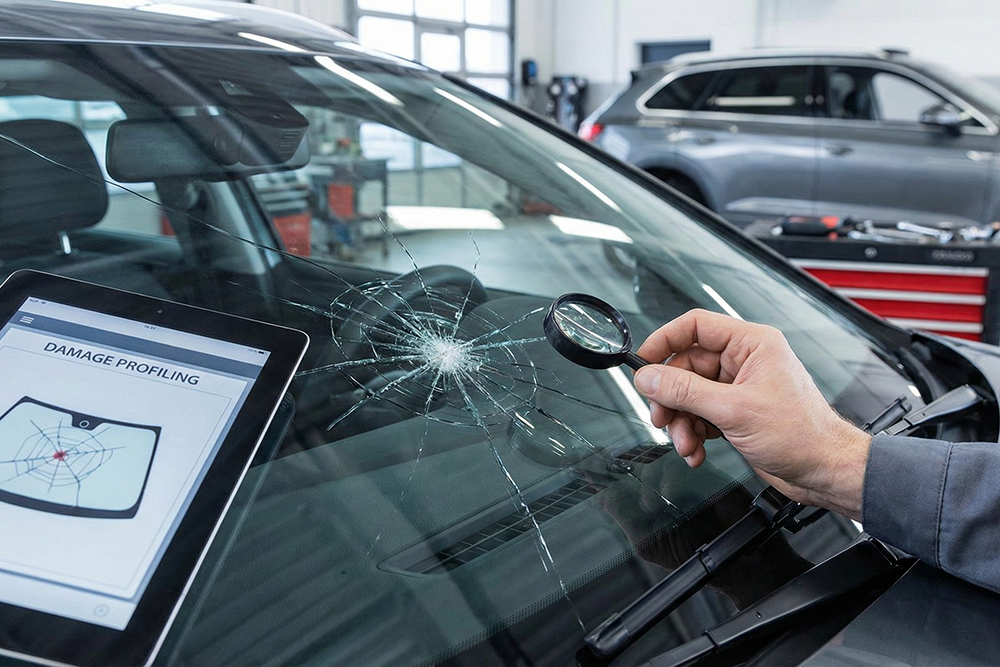
Car Windshield Crack Repair Damage Profiling
You’re driving down the highway, enjoying the open road, when suddenly crack. A stray pebble kicks up from a truck in front of you and hits your windshield with a sickening snap. Your heart sinks as you spot the damage: a tiny, jagged mark right in your line of sight. Panic sets in. Do you need to replace the entire windshield? Is it safe to keep driving? Will it spread? Windshield damage is frustrating, but not all cracks are created equal. Understanding the specific type of damage your glass has sustained is the first step toward fixing it. This process, known as damage profiling, helps repair technicians and car owners like you determine whether a quick repair will suffice or if a full replacement is necessary.
Get An Auto Glass Replacement Quote Now 866.278.7417

Windshield Replacement & Repair
Our competitors push you into going to their shop to get your glass fixed-making it cheaper for them. We make it easier for YOU to get back on the road by offering free mobile repairs at your home or work. With our free mobile services servicing the entire Orange County & Los Angeles area, we can often handle your windscreen replacement the same day! So the next time you need a windshield replacement, give us a call.
Talk to a Windshield Replacement Specialist Now 866.278.7417

Calibration
Calibration is the process of returning a vehicle’s ADAS to OEM specifications. Calibration is necessary after a new glass installation, particularly a windshield with a camera mounted to it, to ensure that the ADAS features continue to function properly despite having been moved during installation. If a car’s ADAS is not properly calibrated, the system may not function safely. A misaligned camera could jeopardize the functionality of the system and lead to dangerous driving or accidents, so it is crucial that the cameras are aligned perfectly, which is what windshield calibration ensures.
Talk to a Calibration Specialist Now 866.278.7417

Fleet Auto Glass Repair
We provide expert auto glass repair and windshield replacement services for commercial fleets of all sizes. We are experienced with all manufacturers and machine types of domestic or foreign cars, trucks, vans, or commercial vehicles, including heavy equipment. Our same day mobile auto glass and windshield repair service will enable you to get back on the road faster and start saving you time and money instantly. Give us a call today! We are here to help!
Talk to a Fleet Auto Glass Specialist Now 866.278.7417
Why Windshield Damage Profiling Matters
Your car’s windshield does more than just block the wind. It is a critical structural component of your vehicle, contributing to the roof’s integrity in a rollover and ensuring your airbags deploy correctly. Even minor damage can compromise this safety system.
Profiling the damage isn’t just technical jargon; it’s a diagnostic tool. By identifying the shape, depth, and size of the break, you can: Save Money: Repairs are significantly cheaper than replacements. Save Time: A repair often takes less than 30 minutes, whereas a replacement can take hours and requires curing time. Ensure Safety: Knowing when a crack is too dangerous to repair prevents future accidents.
Common Types of Windshield Chips and Cracks
Damage usually falls into two categories: chips (impact damage) and cracks (stress or spreading damage). Here is how to spot the difference. The Bullseye: As the name suggests, this damage looks like a dartboard target. It is circular with a distinct impact point in the center, surrounded by concentric circles.
Repairability: High. Because the damage is contained within a circle, it usually doesn’t spread quickly. If it’s smaller than a quarter (approx. 1 inch), it is almost always repairable. The Star Break: This looks like a starburst or an asterisk. It has a central impact point with short cracks radiating outward.
Repairability: Moderate. These are trickier than bullseyes. If the “legs” of the star are short, it can be filled with resin. However, star breaks are notorious for spreading if the vehicle hits a bump or experiences extreme temperature changes. Speed is key here—get it fixed immediately. The Half-Moon (or Partial Bullseye): This is similar to a bullseye but isn’t completely circular. It looks like a semi-circle or a half-moon shape.
Repairability: High. These are generally easy for technicians to fill and smooth out, provided the damage hasn’t penetrated the inner layer of glass. The Combination Break: This is the “worst of both worlds” scenario—typically a bullseye with star break legs radiating from it.
Repairability: Low to Moderate. Because there is extensive damage to the glass structure, these are harder to repair cleanly. If the diameter is small (under an inch), a skilled technician might be able to save it, but a replacement is often recommended to ensure structural integrity.
The Stress Crack: Unlike chips, stress cracks often appear without a rock hitting the glass. They occur due to extreme temperature fluctuations (like pouring hot water on an icy windshield) or structural stress from the car frame. Repairability: Very Low. Stress cracks usually start at the edge of the windshield and can grow up to 12 inches very quickly. Because they affect the structural strength of the glass significantly, replacement is almost always the only safe option.
Do you have a Question?
Get An Auto Glass Replacement Quote Now 866.278.7417
The Dollar Bill Rule of Thumb
If you are standing in a parking lot trying to guess if you need a repair or a replacement, try the Dollar Bill Rule. Take a standard US dollar bill. If the chip or crack can be completely covered by the bill (roughly 6 inches long for a crack, or the size of the president’s portrait for a chip), there is a good chance it can be repaired.
However, location matters just as much as size. Even a small crack might require a full windshield replacement if: It is directly in the driver’s line of sight (repairs can leave a slight distortion). It is at the very edge of the windshield (this compromises the structural bond). It has penetrated the inner layer of the glass (deep damage).
Preventing the Spread of Damage
You’ve profiled your crack, and you have an appointment scheduled. What do you do in the meantime? To keep the damage from getting worse: Avoid Temperature Shocks: Don’t blast the defroster on a frozen windshield, and avoid parking in direct, scorching sunlight if possible.
Keep it Clean: Cover the chip with a piece of clear packing tape. This keeps dirt and moisture out of the crack, which makes the eventual repair cleaner and stronger. Note: This is a temporary measure, not a fix! Drive Gently: Avoid potholes and slamming car doors, as the vibrations can cause a small chip to “run” into a massive crack instantly.
Do not Ignore the Small Stuff
It is easy to ignore a tiny chip, especially if it is on the passenger side. But a windshield is under constant stress. Wind pressure, chassis flex, and thermal expansion are working against that glass every time you drive. A $50 repair job today can easily turn into a $400 replacement job next week if left unattended.
By understanding the type of damage your windshield has sustained, you can make an informed decision. Check the shape, measure the size, and assess the location. When in doubt, consult a professional auto glass technician immediately. Your safety—and your wallet—will thank you.
Windshield Chips and Why Shape Matters
A small rock flicks up from the road and strikes your windshield. The result is a tiny, star-shaped chip. It doesn’t seem like a big deal, so you put off getting it fixed. A week later, you hit a pothole, and that small chip spreads into a long crack across the entire glass. Now you’re facing a full windshield replacement, which is far more expensive and time-consuming than a simple repair would have been.
This scenario is all too common for drivers. What many don’t realize is that the shape of the initial damage is a critical factor in determining whether a windshield can be repaired. Not all chips are created equal. Understanding how different impact shapes affect the structural integrity of your windshield can help you make informed decisions, save money, and ensure your safety on the road.
This post will explore the different types of windshield damage, explain why the shape of the impact is so crucial, and outline which types of chips are generally repairable.
The Anatomy of a Windshield
To understand why impact shape is so important, it helps to know how a windshield is constructed. Modern car windshields are made of laminated safety glass. This consists of two layers of glass with a thin, flexible layer of polyvinyl butyral (PVB) sandwiched between them.
This three-layer design is a key safety feature. If the windshield is struck, the outer layer of glass may break, but the PVB layer holds the pieces together, preventing them from shattering into the car and injuring occupants. This middle layer also provides structural support to the vehicle, particularly in a rollover accident, and ensures the airbags deploy correctly.
When a rock or other debris hits your windshield, it usually only damages the outer layer of glass. The shape and size of this damage determine the stress points and the likelihood of the crack spreading.
Common Types of Windshield Damage
Auto glass technicians classify windshield damage by its shape. Each type has unique characteristics that affect its stability and reparability.
Bullseye: A bullseye chip is one of the most common and easily repairable types of damage. It’s circular, with a cone-shaped chunk missing from the outer layer of glass. It looks like a small, dark circle with a clear impact point. Bullseyes are relatively stable because their circular shape distributes stress evenly, reducing the chances of cracks spreading from the impact zone.
Star Break: A star break is characterized by a central impact point with several small cracks, or “legs,” radiating outward. This pattern resembles a star, hence the name. These legs are weak points where stress can concentrate, making star breaks more likely to spread than bullseyes, especially with changes in temperature or road vibrations. Prompt repair is crucial to stop the legs from growing longer.
Combination Break: As the name suggests, a combination break is a mix of a bullseye and a star break. It features a central dark circle with cracks radiating from its perimeter. This type of damage is more complex and has a higher risk of spreading due to the multiple stress points created by both the circular break and the radiating cracks.
Half-Moon (Partial Bullseye): A half-moon is similar to a bullseye but is crescent-shaped rather than a full circle. Like a bullseye, it is generally stable and can often be repaired successfully if it’s not too large.
Crack: A crack is a single line in the glass, which can be short or long. Cracks can form on their own or spread from another type of chip. Long cracks are particularly problematic because they severely compromise the windshield’s structural integrity. Even a small crack can quickly lengthen when subjected to stress.
Do you have a Question?
Get An Auto Glass Replacement Quote Now 866.278.7417
Why Impact Shape Determines Repairability
The shape of the damage is a primary factor for repair technicians because it dictates how the repair resin will fill the void and bond with the glass. A successful repair depends on the resin completely penetrating the damaged area to restore strength and clarity.
Resin Flow and Adhesion: For a repair to be effective, the technician must inject a special resin into the chip. This resin needs to flow into every crevice of the break. Simple shapes like a bullseye or half-moon have a clear, contained pocket that the resin can easily fill. The smooth, curved edges allow for strong adhesion, restoring the structural integrity of the glass.
In contrast, complex shapes like a star break or a combination break have multiple fine cracks radiating from the center. It’s more difficult for the resin to penetrate these tiny legs completely. If any air pockets are left behind, the repair can fail, and the cracks may continue to spread.
Stress Points and Spreading Risk: The geometry of the impact directly influences how stress is distributed across the glass. The sharp points at the end of a star break’s legs are areas of high stress concentration. Temperature fluctuations, road vibrations, or even the force of wind against the windshield can cause these points to extend, turning a small chip into a large, unrepairable crack.
A circular bullseye lacks these sharp stress points. The force is distributed more evenly around its perimeter, making it inherently more stable and less likely to spread. Repairing it reinforces this stability.
Size and Location Limitations: While shape is critical, the overall size and location of the damage also play a role. Generally, a bullseye chip is repairable up to about one inch in diameter, and a star break is repairable if the total diameter (including legs) is less than three inches. A single crack can often be repaired if it’s shorter than six inches.
However, if any damage is in the driver’s direct line of sight, replacement is often recommended. Even a successful repair can leave a minor distortion, which could impair the driver’s vision. Damage near the edge of the windshield is also more likely to spread and weaken the entire structure, often necessitating a replacement.
Your Next Steps
Understanding the nuances of windshield damage can save you from a costly replacement. The key takeaway is to act quickly. A small, repairable chip can become a major problem if neglected. The shape of the impact is the best initial indicator of its severity, but only a professional technician can make the final call.
If your windshield has been chipped, don’t wait for it to get worse. Have it inspected by a certified auto glass professional as soon as possible. They can assess the shape, size, and location of the damage to determine if a repair is a safe and viable option. A timely repair not only restores the strength of your windshield but also ensures your safety on the road.
Mobile Safe Auto Glass
14241 E Firestone blvd suite 400,
La Mirada, CA 90638
Phone: (562) 608-1154
Toll Free: 1 866 278 7417
Mail: sales@mobilesafeautoglass.com
Get a FREE QUOTE today! You can get a free quote and schedule 24/7 using this free quote wizard.
Mon – Fri 8am – 5pm
Saturday 8am – 1pm
Sunday Closed