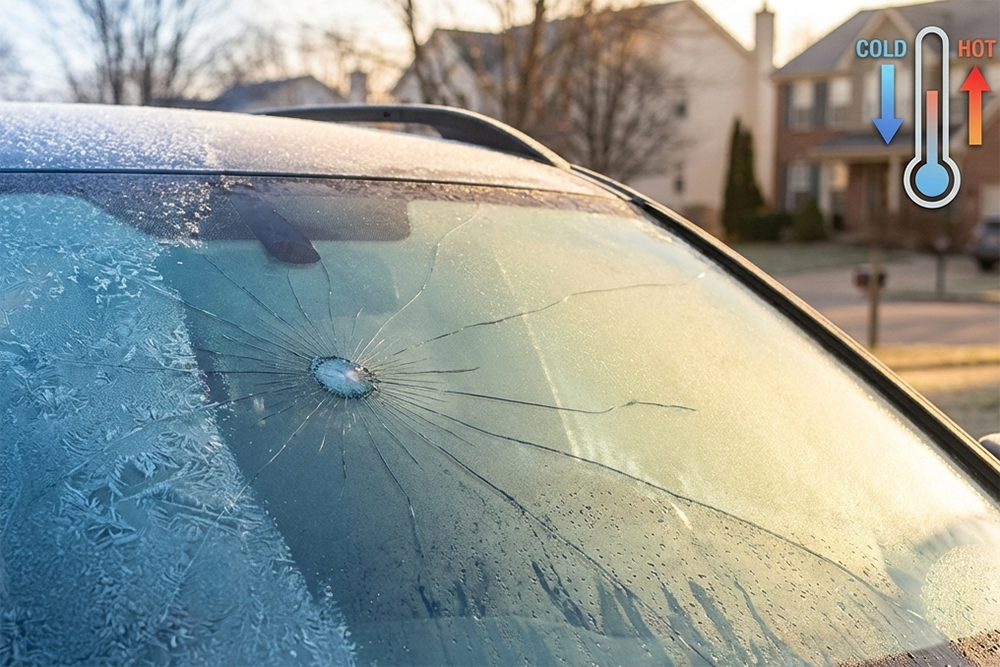
Avoid Cracking Auto Glass During Sudden Temperature Shifts
Every single driver dreads hearing that sound. You are doing nothing except sitting in your car on a chilly morning or a sweltering afternoon when all of a sudden, you crack. It’s not like you hit a rock. No, you were not involved in a mishap. You have just activated the air conditioner or the defroster in your dwelling. It is tension that is responsible for this phenomena, but not the type of stress that you experience during rush hour traffic. Thermal stress is a physical response that takes place when materials are subjected to high temperature changes.
Get An Auto Glass Replacement Quote Now 866.278.7417

Windshield Replacement & Repair
Our competitors push you into going to their shop to get your glass fixed-making it cheaper for them. We make it easier for YOU to get back on the road by offering free mobile repairs at your home or work. With our free mobile services servicing the entire Orange County & Los Angeles area, we can often handle your windscreen replacement the same day! So the next time you need a windshield replacement, give us a call.
Talk to a Windshield Replacement Specialist Now 866.278.7417

Calibration
Calibration is the process of returning a vehicle’s ADAS to OEM specifications. Calibration is necessary after a new glass installation, particularly a windshield with a camera mounted to it, to ensure that the ADAS features continue to function properly despite having been moved during installation. If a car’s ADAS is not properly calibrated, the system may not function safely. A misaligned camera could jeopardize the functionality of the system and lead to dangerous driving or accidents, so it is crucial that the cameras are aligned perfectly, which is what windshield calibration ensures.
Talk to a Calibration Specialist Now 866.278.7417

Fleet Auto Glass Repair
We provide expert auto glass repair and windshield replacement services for commercial fleets of all sizes. We are experienced with all manufacturers and machine types of domestic or foreign cars, trucks, vans, or commercial vehicles, including heavy equipment. Our same day mobile auto glass and windshield repair service will enable you to get back on the road faster and start saving you time and money instantly. Give us a call today! We are here to help!
Talk to a Fleet Auto Glass Specialist Now 866.278.7417
Realizing the Effects of Thermal Shock on Automobile Glass
In order to safeguard your car, you must first get an understanding of the workings of the glass surface itself. Unlike the windows in your house, the windshield of your vehicle is not made up of a single pane of glass. In the event of a collision, the protection provided by this laminated construction prevents the auto glass from breaking into sharp fragments. The glass in your automobile will expand if it is left out in the sun throughout the summer. When it is positioned in a snowstorm, it loses its shape.
The risk comes when these shifts take place at an excessively rapid pace or in an uneven manner. In the event that the exterior layer of the glass is very cold and the inner layer is subjected to intense heat, the two layers will attempt to coexist in two distinct physical states at the same time. The inner layer experiences fast expansion, whilst the outer layer continues to experience contraction. As a result of this conflict, the structure of the windshield comes under a tremendous amount of strain. Over time, the glass will be unable to withstand the strain, and it will eventually break in order to escape the pressure.
The Danger of Winter: Defrosting Done Without Proper Care
Thermal stress cracks are most likely to appear during the winter months. It is common for drivers to be in a hurry to get to work or to drop off their children at school, which can result in hurried decisions that put their cars in unnecessary danger. The Myth of Boiling Water The belief that you can de-ice a windshield by pouring boiling water over it is one of the most pervasive and harmful fallacies in the field of automobile repair. It is common for social media “hacks” to spread this information, although mechanics always advise against doing so.
If you pour boiling water or even hot water onto a windshield that is already at temperatures below zero, you will immediately and violently create a temperature difference between the two surfaces. Many times, the shock occurs instantly. In addition to cracking, the auto glass has the potential to shatter. Use water to defrost your windows at no point in time. In all honesty, the danger is not worth taking. Utilization of an Aggressive Defroster: The majority of contemporary automobiles are equipped with strong heating systems. Instantly after getting into a vehicle that is frozen, the first thing that comes to mind is to instantly turn the heat up to its highest level and start the defroster.
These quick blasts of hot air against the ice-cold glazing cause a tremendous amount of stress, despite the fact that they are designed to clear the glass. To ensure the highest level of safety, it is recommended that you activate the defroster as soon as you start the vehicle, while maintaining a moderate temperature setting and a low fan speed. As the engine heats up, the air that hits the windshield will gradually get warmer.
The AC Blast, the Prevalent Danger of Summer
Although the majority of emphasis is focused on winter, the heat of summer is just as hazardous to the glass of automobiles. The temperature inside of a car may reach well over 140 degrees Fahrenheit (60 degrees Celsius) when exposed to bright sunshine, and the glass itself can get far hotter than that. The “Ice Cold” Shock: When you enter a hot car, your first instinct is typically to crank the air conditioning to “Max Cool.” If the vents are pointed directly at the windshield, you are blasting air that is around 40 degrees Fahrenheit into auto glass that is 150 degrees Fahrenheit. A stress crack may be caused by a variation of 110 degrees, and this is especially true if the glass already has any defects.
In order to prevent this from happening, during the initial few minutes of your journey, divert the vents of your air conditioning system toward the passengers or downward, rather than directing them directly at the glass. Before relying only on the air conditioner, roll down the windows to let the air that has been overheated to leave. Because of this, the temperature within the automobile is able to be more gradually equalized. Automobile Washes on Hot Days Although washing your automobile may appear to be a sensible maintenance activity, doing so in the midst of a heatwave can be a perilous endeavor.
When you hit your automobile with cold water from a hose after it has been roasting in the driveway for some time, you are essentially reproducing the impact of thermal shock if you do this. This is because the temperature outside is lower and the glass has not been exposed to high levels of solar radiation for a significant amount of time. Alternatively, before spraying the glass directly, you might first run the water over the body of the vehicle to assist in lowering the temperature of the vehicle as a whole.
Do you have a Question?
Get An Auto Glass Replacement Quote Now 866.278.7417
The Threat Posed by Chips Buried Away
It is not necessarily necessary for a significant temperature change to for a windshield to crack due to thermal stress. A major reduction in the structural integrity of the glass is caused by the presence of small stone chips, pits, or “bullseyes” generated by road debris. Keep in mind that a windshield is similar to a piece of fabric. It is a strong fabric if it is complete in every way. If you tug on both ends of the cloth and there is a little tear in the middle of it, the fabric will begin to split apart at the precise point where the tear is located.
The tension that you are experiencing is centered on a chip in your windshield. The stress is concentrated around the flaw that occurs as the auto glass begins to expand or compress. With only a modest change in temperature, what was once a very little and scarcely apparent dent can quickly grow into a crack that is almost a foot long. Because of this, rapid repair is quite important. If you choose to disregard a chip, you are not only putting up with a superficial imperfection; you are also leaving your windshield open to more damage from the elements.
The Most Effective Methods for Preventing
Protecting the glass on your vehicle involves a combination of routine maintenance and thoughtful behaviors. You will be able to extend the life of your windshield if you incorporate these ideas into your regular practice for maintenance. As a result, the temperature of the glass remains closer to the temperature of the surrounding air, which lessens the magnitude of the change that occurs when the climate control is activated.
Utilize Your Remote Start Resource Wisely: If you have a remote starter, you should make the most of it. The automobile is able to gradually warm up or cool down before you get in it thanks to this feature. It is important to check that the settings are not set to “Max” before you turn off the automobile the night before. In the summer, it is recommended that you leave your side windows cracked open by an inch. This will enable heat to escape, which will ensure that the interior temperature remains lower and will reduce the strain that is placed on the windshield.
Utilize a Sunshade: A reflecting sunshade for the windshield is one of the most cost-effective insurance plans against the effects of thermal stress at the time. The auto glass and the dashboard are kept much cooler as a result of its ability to filter direct ultraviolet radiation. Make Sure to Clean Your Wiper Blades: Wiper blades that are worn out can produce micro-abrasions on the surface of the glass. These scratches aren’t particularly deep, but they have the potential to cause weakening over time.
Questions That Are Frequently Asked:
Is it possible to defrost my car using water that is lukewarm? It is still dangerous to drink water that is lukewarm, even though it is safer than boiling water. Although the term “lukewarm” is open to interpretation, it is important to note that if the air temperature is exceedingly low, even water from the tap might produce a temperature disparity that is potentially hazardous. Using a de-icing spray that is specifically designed for the purpose or the defrosting system that is built into the vehicle is the safer option.
Would a thermal fracture cause the glass to break and fall over my lap? It has a very low probability. Due to the fact that windshields are laminated, the vinyl layer functions to keep the auto glass intact even in the event that it fractures. There may be a significant break visible, but the glass should continue to be intact, so ensuring the safety of the people within. Nevertheless, the integrity of the car’s structure has been affected, and as a result, you should drive cautiously to a professional repair shop.
Does the insurance policy cover cracks caused by heat stress? In many instances, the answer is yes. Certain plans even include terms that eliminate the deductible for the cost of replacing glass. Thermal stress fractures, on the other hand, tend to be lengthy and grow rapidly, but little cracks, which are typically less than six inches in width, can occasionally be fixed. In many cases, the only safe alternative available after the appearance of a stress crack is to replace the whole windshield.
Maintain An Unobstructed And Secure View
The windshield of your car is responsible for more than simply providing a view of the road; in the case of an accident, it contributes up to thirty percent of the structural strength of your vehicle. Giving it the attention it deserves is not only about reducing the amount of money you spend on maintenance; it is also about ensuring that your vehicle remains safe. It is possible to ensure that your auto glass will last the coldest winters and the hottest summers by avoiding sudden fluctuations in temperature, repairing chips as soon as they appear, and exercising patience with your climate control system settings. Instead of allowing the weather to determine how long your automobile will last, take charge of the situation and drive cautiously.
Why Your Air Conditioner Can Cause Your Windshield to Shatter by Thermal Shock
The afternoon of July is quite hot and humid. The moment you open the door to your vehicle, you are instantly assaulted with a wave of heat that is more reminiscent of a warmed oven than it is of a vehicle. The steering wheel is too hot to grip, and the leather seats in your vehicle are so heated that they are burning to the touch. If you want to chill the cabin as quickly as possible, your initial inclination is to start the engine and blast the air conditioning to its maximum setting. You point the vents squarely at the windshield in order to do this.
However, a loud pop may be heard throughout the vehicle a few seconds later. The rock chip that you disregarded last week, which was so little that it was scarcely perceptible, has now shot across the glass, causing a repair that would have cost fifty dollars to become a replacement that costs five hundred dollars. The majority of motorists believe that flying debris or crashes are the most likely causes of windshield damage; nevertheless, temperature variations are a hidden killer of vehicle auto glass. A smashed windshield and a costly trip to the repair shop are both things that might be avoided if you had a better understanding of the physics that underlies this response.
What Makes Up Contemporary Automobile Glass
First, you need to have an understanding of how your windshield is constructed in order to comprehend why it breaks when subjected to temperature stress. The outer layer is a sheet of treated glass that is exposed to a variety of environmental conditions. A thin film of polyvinyl butyral (PVB) plastic at the middle of the interlayer is referred to as the interlayer. An additional sheet of glass that is facing the cabin is referred to as the inner layer.
When the glass breaks, the fragments will adhere to the plastic interlayer rather than flying into the face of the driver. This is an important safety function that the plastic interlayer fulfills very well. Despite the fact that this construction makes the windshield extremely resistant to blunt force, it also provides a particular vulnerability with regard to temperature. Expansion and contraction of the glass layers and the plastic interlayer occur at different speeds, which results in the creation of internal tension even under ideal circumstances.
Thermal Expansion From A Physics Perspective
No matter the temperature, every substance reacts differently. As the temperature of matter increases, the molecules inside it vibrate at a quicker rate and take up more space, which results in the substance expanding. It experiences a contraction when it cools down. It is difficult to transfer heat through auto glass. If you heat one side of a thick piece of glass, it will take a significant amount of time for the heat to move to the opposite side of the glass from the side that was heated.
Your vehicle’s metal frame is another factor that comes into play here. The heated metal frame conducts heat into the margins of the windshield, which causes the outside perimeter of the glass to expand more than the center of the glass. Consequently, a ring of tension is created around the glass even before you switch on the ignition of the vehicle.
The Process By Which The “AC Blast” Causes Failure
When a quick cooling agent, such as your air conditioner, is introduced into an atmosphere that is already extremely hot, the damage occurs. When you blow cold air (which may be as low as 40 degrees Fahrenheit or 4 degrees Celsius) into the interior surface of a windshield that is 150 degrees Fahrenheit, you produce a significant temperature difference. Because of the cold air, the inner layer of auto glass instantly makes an effort to make itself smaller and more compact. The outer layer, on the other hand, is still being baked in the sun, and it continues to be enlarged and stiff.
The outer layer exerts a pulling force on the inner layer, which is contracting. Under typical conditions, a windshield that has not been damaged is robust enough to withstand the tensile stress that is being applied. The glass is designed to be able to accommodate a substantial amount of pressure.
Why Weakened Glass Is Unable to Contain
It is the surface tension that is responsible for the structural integrity of a windshield. To put it another way, a rock chip, a little fracture, or even a severe scrape might serve as a “stress concentrator.” Consider the act of shredding a massive piece of fabric. Attempting to tear the cloth by pulling at the hem may prove to be rather challenging. On the other hand, if you create a very little cut with scissors and then pull through it, the cloth will easily tear open. Because of the incision, all of your pulling energy is concentrated into a single, very small location.
The tension seeks for the weakest spot as soon as the thermal stress begins, which is when the inner glass begins to shrink while the outside auto glass continues to expand. The chip is located by it. The entirety of the mechanical energy is concentrated on the termination of that brief pause. Failure occurs very immediately as a consequence. A fracture appears in the glass as a result of the tension exceeding the strength of the glass. It is possible for this to occur with such force that it results in a popping sound that may be heard. When the fracture becomes more extensive, the structural integrity of the unit is endangered, and it is necessary to replace the windshield rather than attempt to patch it and repair it.
Do you have a Question?
Get An Auto Glass Replacement Quote Now 866.278.7417
Additional Thermal Shock Triggers That Are Common
Despite the fact that the air conditioner is the most prevalent cause of windshield damage, it is not the only method that your auto glass may be damaged by shock. The use of cold water for car washes may appear to be a responsible activity, but washing your vehicle on a hot Saturday afternoon may be quite damaging to the glass on your vehicle. Through the use of a garden hose, cool water may be sprayed over a heated windshield to provide the same kind of thermal shock as the air conditioning system, but from the outside.
At the same time as the inner layer continues to be heated, the outer layer quickly compresses. You should wash your car in the early morning or evening while the glass is cold, or park it in the shade for thirty minutes before you begin the process. If you have to wash your car during the summer, you should do it. The idea is applied in reverse during the winter months, however the mechanics are slightly different. Defrosting occurs during this time of year. It is a typical but awful “life hack” to pour hot water on your windshield when it is coated in ice.
This causes the outside layer to expand quickly, while the interior layer continues to remain frozen. It is high probability that this will cause the auto glass to break. In a similar manner, if you blast the defroster on high heat against a windshield that is frozen, it can cause existing chips to spread, although this is often a less rapid occurrence than the situation with the summer auto air conditioning.
Cracks Caused by Thermal Stress: How to Prevent Them
The weather is something that you cannot control, but you can influence how your car responds to the weather. A combination of routine maintenance and behavioral adjustments is required to protect your windshield. Cracks should be repaired as soon as possible since the most effective method of prevention is to eliminate the susceptibility. A minor chip that looks like a “bullseye” or a “star” may typically be filled with resin by a professional at a relatively low cost compared to the expense of replacing the chip.
Additionally, the structural integrity of the glass is restored by this resin, which also prevents stress from collecting at that particular place. It is not a good idea to wait until the weekend if you have a chip. Fix it as soon as possible. When you get into a heated automobile, you should avoid directing the airflow directly toward the windshield. There is a “Defrost/Floor” setting that divides the air in the majority of automobiles, as well as a dashboard vent setting. This results in the auto glass being progressively cooled rather than being shocked.
Make Use of the Doors and Windows: Before you even turn on the air conditioning, you should roll down the windows or open the doors for a duration of one minute. This makes it possible for the superheated air that is confined within the vehicle to escape, which serves as an insulator and keeps the glass at a high temperature. The cabin will be cooled more quickly, and your glass will be protected from damage.
You should park your vehicle in the shade or under a parasol that reflects light whenever it is practicable to do so. It is possible to drastically lower the temperature of the dashboard and the glass by placing a sunshade on the inside of the windshield. This will reflect sunlight back out of the window. As a result, the temperature of the glass remains closer to the temperature of the surrounding air, which lessens the impact of the shock that occurs when the air conditioner is turned on.
Don’t Give in to the Pressure!
There is more to a cracked windshield than just a visual inconvenience; it is a potential threat to the driver’s safety. Although thermal shock is a straightforward physical phenomenon, the harm it does is both real and costly. It is possible to maintain a clear view of the road and to keep your pocketbook undamaged if you respect the boundaries of the auto glass and fix tiny chips before they become major problems.
Mobile Safe Auto Glass
14241 E Firestone blvd suite 400,
La Mirada, CA 90638
Phone: (562) 608-1154
Toll Free: 1 866 278 7417
Mail: sales@mobilesafeautoglass.com
Get a FREE QUOTE today! You can get a free quote and schedule 24/7 using this free quote wizard.
Mon – Fri 8am – 5pm
Saturday 8am – 1pm
Sunday Closed