Auto Windshield Repair Near Me What Pros Check First
The thunderous thwack of a pebble striking your windshield while you’re traveling down the highway is one of the most depressing sounds. You recoil, look at the glass, and see it: a thin, silvery line beginning to form, or a chip the shape of a star. It’s a good idea for your initial inclination to pick up your phone and look for “auto windshield repair near me.” Dealing with auto glass damage requires speed. But not every chip or crack can be easily fixed. Sometimes the only safe course of action is a complete replacement. Professional auto glass technicians do more than just apply resin and UV rays when you bring your car to them.
Get An Auto Glass Replacement Quote Now 866.278.7417

Windshield Replacement & Repair
Our competitors push you into going to their shop to get your glass fixed-making it cheaper for them. We make it easier for YOU to get back on the road by offering free mobile repairs at your home or work. With our free mobile services servicing the entire Orange County & Los Angeles area, we can often handle your windscreen replacement the same day! So the next time you need a windshield replacement, give us a call.
Talk to a Windshield Replacement Specialist Now 866.278.7417

Calibration
Calibration is the process of returning a vehicle’s ADAS to OEM specifications. Calibration is necessary after a new glass installation, particularly a windshield with a camera mounted to it, to ensure that the ADAS features continue to function properly despite having been moved during installation. If a car’s ADAS is not properly calibrated, the system may not function safely. A misaligned camera could jeopardize the functionality of the system and lead to dangerous driving or accidents, so it is crucial that the cameras are aligned perfectly, which is what windshield calibration ensures.
Talk to a Calibration Specialist Now 866.278.7417

Fleet Auto Glass Repair
We provide expert auto glass repair and windshield replacement services for commercial fleets of all sizes. We are experienced with all manufacturers and machine types of domestic or foreign cars, trucks, vans, or commercial vehicles, including heavy equipment. Our same day mobile auto glass and windshield repair service will enable you to get back on the road faster and start saving you time and money instantly. Give us a call today! We are here to help!
Talk to a Fleet Auto Glass Specialist Now 866.278.7417
The Size of the Damage
The physical extent of the damage is the first thing a technician measures. This is frequently the fastest method of ruling out a repair. The industry norm generally adheres to the “dollar bill rule.”
If a crack exceeds the length of a dollar bill, approximately six inches, it likely undermines the structural integrity of the windshield, making a repair less successful. The conventional rule is that chips (such as a bullseye or star break) are often repairable if the damage is small enough to be covered by a quarter.
But technology is becoming better. Depending on the shop’s capabilities and the precise position of the break, some sophisticated repair techniques can handle breaks up to 12 or 14 inches long.
Depth and Severity: There is more than one piece of glass in your windshield. It is a laminated sandwich with two glass layers and a polyvinyl butyral (PVB) layer in the center. When the glass is struck, this layer of vinyl prevents it from breaking into sharp pieces. A professional inspecting your windshield is determining the depth:
Surface Pit: It is simple to repair if the damage is limited to a tiny pit on the surface that hasn’t sunk deeply into the glass.
Outer Layer Break: The majority of repairs deal with glass damage to the outer layer.
Inner Layer Penetration: The windshield is typically irreparable if the rock strikes the inner layer of glass—the side inside the cabin—hard enough to cause damage.
They also consider how complicated the break is. A clean “bullseye” (a circular impact) is much simpler to fill with resin than a complex “star break” that has numerous tiny legs spreading outward.
The Line of Sight of the Driver
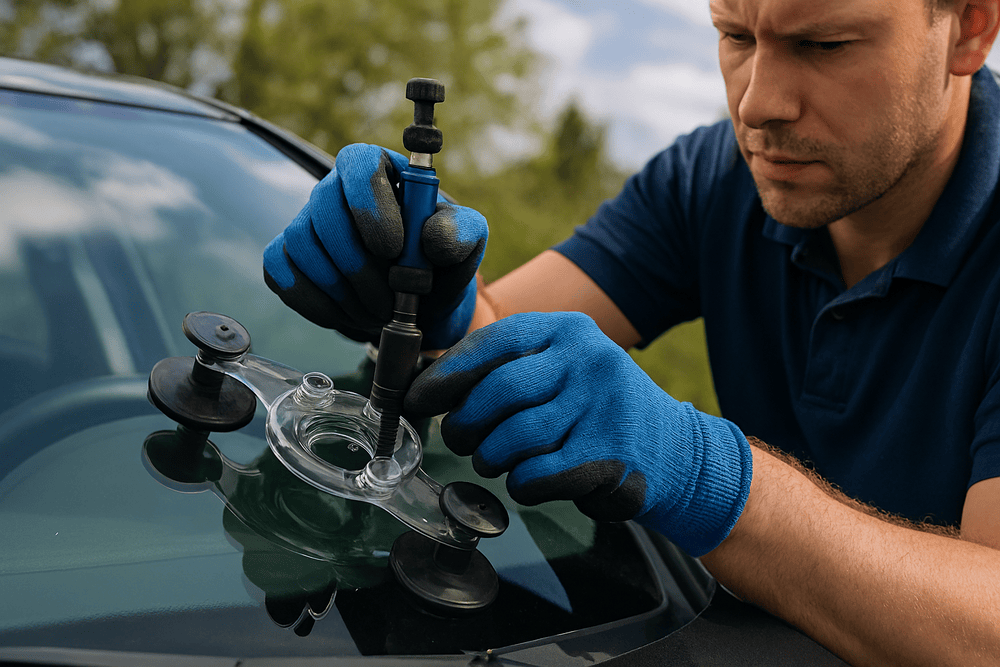
The position of a chip may necessitate replacement even if it is small enough to be fixed. A clear resin is injected into the fracture and cured by UV radiation as part of the repair procedure.
This procedure does not totally eliminate the damage, but it does restore strength and stop the crack from spreading. It frequently leaves a faint imperfection, resembling a smudge or a dried water stain.
Most respectable businesses won’t fix a flaw that is right in front of the steering wheel and in the driver’s line of sight (a patch of glass about the size of a regular piece of paper). Distractions in your crucial viewing area can be hazardous, particularly when there is sun or headlamp glare.
The “Danger Zone” at the Edges: Your windshield’s edge is probably its most vulnerable part. This part is commonly known as the “frit”—the black ceramic paint band that surrounds the glass’s edge.
Repairing cracks that begin at the edge or continue into the edge is very challenging. Near the car’s structure, the glass is under more tension. As the car chassis flexes during regular driving, repairs in this area are likely to reopen or spread. To protect the vehicle’s structural integrity, most specialists would advise a complete replacement if the damage is only a few inches from the windshield’s edge.
Do you have a Question?
Get An Auto Glass Replacement Quote Now 866.278.7417
The Age of the Damage
If you’re looking for “auto windshield repair near me,” do it as quickly as possible. For a technician, the age of the crack is crucial.
Road grime, washer fluid, wax, and rain eventually fill a chip. This material becomes lodged in the glass’s tiny fissures. This dirt can prevent the repair glue from reaching the extreme tips of the fracture when a professional tries to inject it.
The repair will fail and the crack will keep spreading if the glue is unable to completely seal the gap. Additionally, filthy breaks lead to dreadfully ugly “cloudy” repairs. If you are unable to visit a shop right away, you can keep the chip clean for a few days until you find an expert by covering it with transparent packaging tape (on the exterior).
Advanced Driver Assistance Systems (ADAS): The auto glass business has undergone a transformation due to modern automobiles. You probably have cameras and sensors installed right behind the windshield if your car has technologies like rain-sensing wipers, automated emergency braking, or lane departure warning.
Technicians must determine whether the damage has blocked these sensors. Repairs directly in front of a camera lens can confuse the system and lead to malfunctioning safety measures.
The technician must additionally account for ADAS calibration if the damage necessitates a complete replacement. This guarantees that after the new glass is placed, your cameras will be looking precisely where they should.
The Significance of Professional Evaluation
At an auto parts store, you might be tempted to purchase a DIY repair kit. These frequently fail on large chips, although they can work on tiny surface pits.
You only get one chance with DIY kits, which is the biggest danger. The consumer-grade resin hardens once it is injected into the chip. An expert cannot return to mend the crack later if it is not adequately filled. The route is obstructed. Attempting the repair on your own might turn a $60 fix into a $400 replacement.
A competent shop will have vacuum-cycle equipment that removes air from the brake before applying pressure to inject premium resin. This guarantees a full connection, restoring the strength of the glass.
Frequently Asked Questions: Is windshield repair covered by insurance? Indeed, this is often the case. Many comprehensive policies eliminate the deductible for glass repairs because insurance companies would prefer to cover a low-cost repair over an expensive replacement. This implies that you might be able to use the service for free.
After repair, will the chip fully vanish? No. Restoring structural integrity and preventing the crack from spreading are the two main objectives of a repair. Even though the damage can become 70% to 90% more visible, there will probably still be a tiny mark where the impact happened.
What is the duration of a professional repair? Speed is one of the main advantages of repair over replacement. Usually, a repair takes half an hour. After the treatment is complete, you can typically drive the automobile right away because the resin cures under UV light in a matter of minutes.
Is it possible to halt a long crack by drilling a hole? Some technicians still employ the antiquated method of drilling a “stop hole” at the end of a fracture to release surface tension. It is rarely a stand-alone solution, though. Usually, it’s a step in the fill process. Ask the technician about their special procedure and warranty if your crack is long.
Avoid Waiting for the Crack to Widen
Similar to a dental cavity, a windshield chip cannot be fixed on its own, and neglecting it will simply increase the cost of the final repair. When you hit a pothole or use your defroster on a chilly morning, for example, temperature fluctuations can quickly transform a chip that can be fixed into an irreparable crack.
If your glass is damaged, please consider consulting a certified expert at your earliest convenience. You may have a better-informed discussion and safely get your car back on the road if you know what they look for—size, depth, location, and cleanliness.
Broken Glass? Here’s How Experts Evaluate Windshield Damage: Every driver fears that abrupt, crisp crack. A rock bounces off the pavement and hits your windshield as you’re driving down the highway, possibly too closely following a dump truck. Your heart drops. You examine the damage: a tiny pit or a tiny starburst. You may be inclined to overlook it because it appears unimportant.
A chip is merely an aesthetic irritant to the typical motorist. However, that tiny blemish reveals a complicated tale about physics, safety regulations, and structural integrity to a qualified auto glass specialist.
When you bring your car in for a windshield inspection, the technician does more than just measure the crack’s size. The technician conducts a thorough diagnostic assessment to determine whether the glass is salvageable or has become a safety hazard.
In a rollover accident, the windshield contributes up to 60% of the car cabin’s structural integrity; therefore, the stakes are far greater than just having a clear view of the road. Here’s a behind-the-scenes look at what goes into a professional windshield damage evaluation.
The Anatomy of the Assessment
You must comprehend the canvas the technician is working on before you can comprehend the inspection. Your windshield is unlike your typical windowpane. This type of safety glass is laminated, with two glass layers encasing a polyvinyl butyral (PVB) layer.
In the case of an accident, this “sandwich” construction helps safeguard occupants inside the car by preventing the glass from breaking into sharp fragments. A technician is mainly examining the condition of these three layers when evaluating damage.
The evaluation ends there if the damage has reached the inner layer of glass through the PVB and outer layers: the windshield is compromised and needs to be replaced right away.
Cleaning and Stress Testing: Prior to the measuring tape being released, the evaluation starts. The glass surrounding the impact point will be completely cleaned by a specialist.
Road grit, wax, and dirt can mask the true extent of the damage. Under a covering of dust, what appears to be a straightforward chip may actually have microscopic “legs”—tiny fissures extending outward.
The technician may do a mild stress test after cleaning. They can determine whether the glass flexes or whether the crack widens by lightly pressing the region around the injury. The structural integrity of the glass is probably too damaged to be repaired if it is unsteady or creaks when pressure is applied.
Sorting the Damage Type: Not every fracture is made equally. Since different shapes react differently to repair resin, determining the precise geometry of the hit is a major component of the assessment.
The most prevalent and possibly the “best” kind of damage is the bullseye. The impact removed a cone of glass, resulting in a clean, circular crack. If detected early, these are typically very repairable because there are no radiating cracks.
The Star Break: This damage has short cracks that radiate out from the main impact point, as the name suggests. Technicians are wary of these. The glue used for repair may not cover every small crack if the star’s “legs” are too long or numerous, which could lead to the glass subsequently spreading.
The Combination Break lies at the intersection of a star break and a bullseye. The glass surface is severely damaged, and windshield repair calls for a competent hand. Whether the center pit is too big to adequately hold the repair resin is the main focus of this evaluation.
Do you have a Question?
Get An Auto Glass Replacement Quote Now 866.278.7417
The Dollar Bill Rule and Accurate Measurement
You may have heard that a crack can be fixed if it is less than a dollar bill. Although this is a useful general guideline for consumers, experts employ more accurate measurements derived from the Repair of Laminated Automotive Glass Standard (ROLAGS).
A technician will typically authorize a repair if:
A chip or bullseye is about the size of a quarter and has a diameter of less than one inch.
A crack can be separated by less than six inches, which is the same length as a $1 bill.
These guidelines are not infallible, though. While a somewhat larger, clean break might be tried, a three-inch crack that is deep and unclean might be denied for repair. If the impact point is too wide, the final restoration will leave an untidy, opaque splotch that appears worse than the initial damage. The technician assesses the depth of the pit.
Location and the “Critical Zone”: For many drivers, the most unexpected aspect of a professional evaluation is discovering that the location of the damage is more important than its extent. Positioning a small, fixable chip incorrectly may necessitate a complete replacement of the windshield.
Technicians see a piece of paper, about 8.5 by 11 inches, placed just above the steering wheel as the Driver’s Primary Viewing Area (DPVA). The DPVA is this. A small distortion or “water spot” impression may remain after even the greatest windshield repairs.
This distortion can cause eye confusion or harmful glare from headlights or sunshine if it is directly in the driver’s line of sight. For safety and liability considerations, the majority of respectable stores won’t fix damage in this crucial area.
The Periphery of the Edge
The frit, a black ceramic strip that borders the windshield, is something that technicians focus on. This is a weak point in the structure. There is a lot of stress on this glass.
The force of the car twisting during a turn or colliding with a pothole can cause a fracture or chip that is only a few inches from the metal frame to expand out instantly. The majority of damage close to the edge triggers an automatic replacement suggestion.
The ADAS Factor: Advanced Driver Assistance Systems (ADAS) have made windshield evaluations considerably more difficult over the past ten years.
Cameras and sensors are installed directly behind the windshield in modern cars, frequently next to the rearview mirror. These sensors manage rain-sensing wipers, automated emergency braking, and lane-departure alerts. The technician must ascertain whether the damage—or possible repair—will interfere with these sensors during an assessment.
Camera obstruction: It is not possible to repair a chip that is in front of a camera lens. The automobile may brake or turn erratically if the resin produces a blur that the camera misinterprets as a lane marking or barrier.
Calibration requirements: Checking the manufacturer’s recalibration requirements is part of the assessment if the windshield has to be changed. The precise alignment of the new glass, necessary for the safety systems to function, escalates the service time and cost.
The Age and Condition of the Glass
Lastly, the technician takes a comprehensive examination at the windshield. Does the glass have a lot of pitting? After years of driving, thousands of small sand and road debris particles erode the glass, causing pitting. Despite not being cracks, these can be blinding at sunrise or sunset because of the way they scatter light and produce a “sparkle” look.
If a windshield has a repairable chip but also heavily pitted, an honest technician will often recommend replacing it. For the car owner, fixing a single chip on already visually degrading glass is often a bad investment.
Don’t Wait for the Assessment: The behind-the-scenes windshield assessment procedure combines safety regulations, engineering expertise, and visual inspection. The process is far more comprehensive than simply examining a crack and making assumptions about its durability.
However, time is the most crucial element in this entire process. Temperature changes, such as running the defroster on a chilly morning or using cold water to wash a heated car, can quickly transform a windshield chip that can be fixed into an irreparable break.
The greatest approach to save money if you have damage is to seek a professional examination right away. It guarantees that you detect the damage while it is still in the “repair” category, protecting your car’s structural integrity and your ability to see the road.
Mobile Safe Auto Glass
14241 E Firestone blvd suite 400,
La Mirada, CA 90638
Phone: (562) 608-1154
Toll Free: 1 866 278 7417
Mail: sales@mobilesafeautoglass.com
Get a FREE QUOTE today! You can get a free quote and schedule 24/7 using this free quote wizard.
Mon – Fri 8am – 5pm
Saturday 8am – 1pm
Sunday Closed