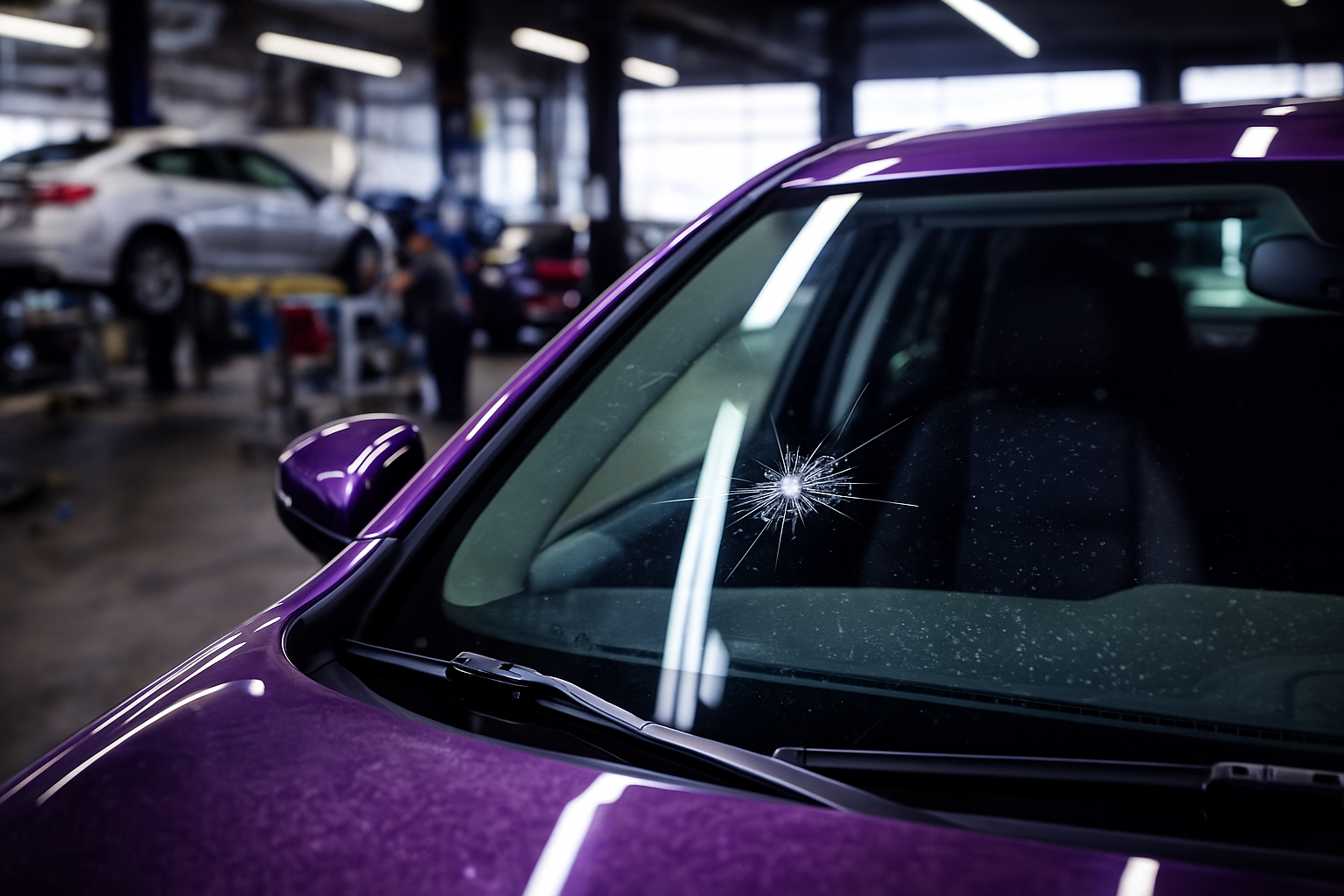
Auto Chip Repair Tips to Maximize Windshield Life
That windshield smack is a terror shared by all drivers. When you scan the glass, a little chip and starburst emerge on it. A rock chip, despite its small size, is more than just ornamental. If ignored, it can quickly develop into a large, blinding crack that requires windshield replacement. Fortunately, prompt treatment can often prevent this expensive result. You can avoid a big repair, save money, and save time if you know how to manage a new chip. This guide covers windshield chip repair, including when to call professionals and on-the-go fixes. You can keep yourself safe and prolong the life of your windshield by following these measures.
Get An Auto Glass Replacement Quote Now 866.278.7417

Windshield Replacement & Repair
Our competitors push you into going to their shop to get your glass fixed-making it cheaper for them. We make it easier for YOU to get back on the road by offering free mobile repairs at your home or work. With our free mobile services servicing the entire Orange County & Los Angeles area, we can often handle your windscreen replacement the same day! So the next time you need a windshield replacement, give us a call.
Talk to a Windshield Replacement Specialist Now 866.278.7417

Calibration
Calibration is the process of returning a vehicle’s ADAS to OEM specifications. Calibration is necessary after a new glass installation, particularly a windshield with a camera mounted to it, to ensure that the ADAS features continue to function properly despite having been moved during installation. If a car’s ADAS is not properly calibrated, the system may not function safely. A misaligned camera could jeopardize the functionality of the system and lead to dangerous driving or accidents, so it is crucial that the cameras are aligned perfectly, which is what windshield calibration ensures.
Talk to a Calibration Specialist Now 866.278.7417

Fleet Auto Glass Repair
We provide expert auto glass repair and windshield replacement services for commercial fleets of all sizes. We are experienced with all manufacturers and machine types of domestic or foreign cars, trucks, vans, or commercial vehicles, including heavy equipment. Our same day mobile auto glass and windshield repair service will enable you to get back on the road faster and start saving you time and money instantly. Give us a call today! We are here to help!
Talk to a Fleet Auto Glass Specialist Now 866.278.7417
Reasons to Pay Attention to Windshield Chips
It’s simple to ignore a minor setback, particularly when life becomes hectic. However, a windshield is a crucial component of your car’s structural integrity. It keeps the roof from collapsing in the event of a rollover accident by providing support. Additionally, it is necessary for the proper airbag deployment. An apparently small chip can compromise this structural strength.
A little chip may grow into a huge crack for several reasons:
Temperature Variations: The main reason is extreme heat or cold. When you use your defroster on a cold morning or put on the air conditioner on a hot day, a significant temperature differential is formed between the inside and exterior, causing the glass to expand or contract. A chip can quickly become a crack due to this stress.
Moisture: Rain, snow, or simply humidity can cause the chip to absorb moisture. This moisture expands and pushes the glass apart if it freezes, worsening the damage. The chip may become contaminated by dirt and debris, making a clean repair more difficult.
Bumps and vibrations: Your windshield experiences stress from regular driving. A chip can spread simply by hitting a pothole, going over a speed bump, or even just the typical vibrations from the road.
For a small portion of the price of a complete replacement, you can repair a chip in your windshield and restore its strength and clarity.
What to Do Immediately Following a Chip
What you do in the days and hours following a chipped windshield can have a significant impact. To save the affected region and stop the chip from spreading, do these quick actions.
Cover the Chip Right Away: It’s critical to cover the chip as soon as you can pull over securely. By doing this, you prevent moisture, dirt, and other contaminants from getting to the damaged area. A technician can mend a chip much more readily if it is clean.
An effective short-term fix is a piece of clear packing tape. To form a seal, just lay it over the chip smoothly. Steer clear of colored or opaque tapes, such as duct tape, as they can make it difficult to see and leave a sticky residue. For this reason, some drivers have a special windshield repair patch in their glove box.
Prevent Severe Temperature Changes: Heat stress is one of the quickest ways to transform a chip into a crack in glass. Keep an eye on the temperature inside and outside the vehicle.
Hot Days: Avoid parking in direct sunlight whenever possible. Avoid directing the air conditioner straight onto the windshield. Allow the vehicle to cool gradually.
Cold Days: Avoid de-icing your windshield with hot water. To ensure that the glass warms up uniformly, put your defroster on gently and start with a low temperature.
Drive carefully: steer clear of any maneuvers that can strain the windshield further. Avoid potholes, speed bumps, and uneven roadways by driving carefully. Additionally, slamming your car’s doors can cause vibrations that could propagate a chip through the frame of the automobile. Until the chip is fixed, treat your car with care.
Do you have a Question?
Get An Auto Glass Replacement Quote Now 866.278.7417
When to Repair vs When to Replace
Damage to windshields varies. Many chips can be successfully fixed, but in certain cases, a complete replacement is necessary. Typically, technicians base this decision on a few essential factors.
Windshield Repair Scenarios: Chips can typically be fixed if they meet the following criteria:
Dimensions: The chip is smaller than a quarter in diameter. The length of the crack, if any, should not exceed that of a dollar bill (6 inches).
Location: The chip is not readily visible to the driver. A minor distortion may remain after even the best restoration, which could be dangerous and distracting. Additionally, damage to the windshield’s margins is more prone to spread and weaken the glass, frequently requiring a replacement.
Depth: The chip has not broken through the laminated glass of the windshield’s two layers. The majority of windshields are composed of two glass layers with a plastic interlayer (PVB); only if the inner layer is still intact can the windshield be repaired.
Windshield Replacement Scenarios: Generally, a complete replacement is required if:
The Damage Is Too Big: Generally speaking, chips larger than a quarter or cracks longer than six inches cannot be safely repaired.
It’s in the Driver’s Line of Sight: Any damage that blocks the driver’s vital field of vision is dangerous and needs to be replaced.
Chip on the Edge: Damage close to the windshield’s edge weakens the overall structure and has a tendency to spread quickly.
Multiple Chips: If your windshield has three or more chips, replacing it is typically the safer and most cost-effective option.
The Expert Repair Method
When you bring your car to an auto glass specialist, they will fix the chip using a methodical procedure.
Cleaning and Preparation: To begin, the technician will carefully remove any debris, moisture, or glass shards from the chip by cleaning the affected region.
Creating a Vacuum: To produce a vacuum, a specialized equipment is put over the chip. To ensure that the repair glue can fill the entire cavity, this procedure eliminates any trapped air inside the breach.
Resin Injection: A high-quality, clear resin is poured into the chip. Because this resin has the same optical properties as glass, a good fix is almost impossible to spot.
Curing the Resin: An ultraviolet (UV) light is used to set the resin and make it solid. Bonding the resin to the surrounding glass restores the strength and structural integrity of the windshield in a matter of minutes.
Finally, the technician will polish the surface to ensure its clarity and smoothness.
Your car is safe to drive right away after the procedure is finished, which often takes less than 30 minutes.
Safeguard Your Investment
An expensive replacement is not always necessary, though, if there is a chip in the windshield. You can successfully stop the damage in its tracks and stop it from further deteriorating by acting quickly, shielding the chip from stress and contamination, and consulting an expert. In addition to saving money, following these straightforward measures will guarantee that your car will remain safe and maintain its structural integrity. To prolong the life of your windshield, you should take care of the chip as soon as feasible rather than waiting for a little issue to grow into a major one. By doing this, you will be able to avoid dealing with a more significant issue.
Guide for Auto Owners
You’re speeding down the highway when a loose rock hits your windshield. There’s a loud crack. Your heart drops even though it’s a tiny chip. A little crack has the potential to grow rapidly, transforming a minor inconvenience into an expensive windshield replacement. Good news: not all damage needs to be completely replaced. Fixing a lot of small chips at once will save you time, money, and trouble.
Anyone who owns a car should be able to spot and fix window chips. Knowing the difference between a small problem and a big one will help you keep your car safe and stop any more damage from happening. This tutorial will explain the various kinds of windshield chips, the numerous repair methods, and how to choose between hiring a professional or using a do-it-yourself kit. In conclusion, you’ll know enough to confidently tackle this frequent problem.
A Windshield Chip
windshield chip is a tiny patch of damage on the outside of your car’s windshield glass. It usually happens when a tiny pebble, gravel fragment, or other item of road debris hits the glass quickly. Chips weaken the windshield’s structural integrity, despite their apparent insignificance. A small chip can grow into a giant crack that blocks your view and makes driving dangerous due to various factors like temperature fluctuations, road vibrations, and even washing your car.
Laminated safety glass, which is used to make windshields, is composed of two layers of glass with a thin film of vinyl (also known as polyvinyl butyral, or PVB) positioned in between. This structure is intended to keep the glass from breaking into jagged fragments when it is struck. Typically, only the outer layer of glass is impacted when a chip occurs. As long as the damage is fixed before it spreads or gets deeper, the structure makes repair possible.
Do you have a Question?
Get An Auto Glass Replacement Quote Now 866.278.7417
Typical Windshield Chip Types
Chips are not all made equal. You can assess the damage and the best course of action by identifying your chip type.
Bull’s-Eye Chip: One of the most frequent kinds of windshield damage is a bull’s-eye chip. It has a black, cone-shaped impact point and is round in shape. Repairing this kind of chip is frequently simple, particularly if it is tiny and hasn’t accumulated a lot of dirt or debris. The clean glass separation makes it perfect for resin injection; thus, it’s important to have it rectified as soon as possible.
As the name suggests, a star break has a center point of impact with many small cracks that spread out in the shape of a star. Repairing them can be more difficult than fixing a bull’s-eye because, if not adequately sealed, the fissures may continue to expand. To fix the star, the technician must inject resin into each “leg.”
Combination Break: This type of break takes parts from both a star break and a bull’s-eye break. In the middle, there is a round spot of damage from which cracks spread outward. This is a worse kind of damage that might be hard to fully fix. If the chip is bigger than a quarter, you should probably get a new windshield.
A half-moon chip, also known as a partial bull’s-eye, resembles a bull’s-eye but is not entirely round, giving the impression that it is a semicircle on the glass. These are usually easy to fix if they are handled as soon as possible, and the repair procedure is comparable to that of a complete bull’s-eye.
Techniques for Windshield Repair
Injecting a transparent, curable glue into the damaged region is the conventional technique for fixing a windshield chip. Through this procedure, the chip is filled, the windshield’s structural integrity is restored, and its look is enhanced.
The Procedure for Repair:
Cleaning the Area: To get rid of any glass shards, grime, or dampness, the technician first cleans the chip. Because any debris left behind could jeopardize the repair, this step is crucial.
Creating a Vacuum: A special tool is used to cover the chip. This machine makes a vacuum that pulls air out of the damaged area so that the glue can stick to it.
glue Injection: An expert blows a high-quality glue into the chip. The resin is drawn deeply into all of the broken glass’s nooks and crannies by the suction.
Setting the Resin: Once the chip is full, an ultraviolet (UV) light is used to set the resin and make it hard. In just a few minutes, this process bonds the glue to the glass, making a strong seal that will last.
Last touches: Any extra glue is scraped off the surface and polished to make it smooth and clear again. The glass will be fixed, and the repaired area may still be visible, but it will be much less noticeable.
Service from a Professional vs Repair Kits You Can Use Yourself
When you find a chip in your windshield, you may either hire a professional car glass expert or use a do-it-yourself (DIY) repair kit.
DIY Repair Kits: For tiny chips, DIY windshield repair kits can be a cost-effective solution and are offered at the majority of auto parts retailers. Usually, these kits come with an applicator tool and resin that you can inject into the affected region.
Benefits of do-it-yourself kits:
Cost-effective: Compared to a professional repair service, they are far less expensive.
Convenience: You can do the repair whenever it’s convenient for you.
Drawbacks of do-it-yourself kits:
Skill Required: A steady hand and close attention to the instructions are necessary for a favorable outcome. If you don’t fix the problem properly, it might get worse or become hard for a professional to fix in the future.
Lower Quality Outcomes: In general, DIY kits’ resins and tools are of lower quality than those used by experts. The repair might not be as obvious or robust.
Risk of Failure: The chip may continue to spread if the repair is unsuccessful, necessitating a complete windshield replacement.
Professional Repair Service: An auto glass mechanic needs certain tools, training, and knowledge to do a good job of fixing things.
Benefits of Expert Service:
Expertise and Experience: Technicians possess the knowledge to accurately repair a variety of chip types.
Superior Materials: Experts use industrial-grade resins and equipment to create repairs that are more robust, long-lasting, and transparent.
Work Guaranteed: To ensure your peace of mind, most reputable auto glass businesses offer a warranty on their repairs.
Insurance Coverage: The cost of windshield repair is often covered by auto insurance policies with no deductible, making it a free service for the owner of the vehicle.
Cons of Professional Services: It costs more. If your insurance doesn’t cover it, a professional fix will cost you more than a do-it-yourself kit.
Scheduling: Although many businesses now provide handy mobile services, you might need to schedule an appointment and bring your car to a shop.
Keep your Safety and Windshield in Good Shape
A small chip in your window might not seem like a big deal, but it could become a major safety risk. It’s important to handle it quickly and correctly. Knowing the types of chips and repair options will help you make a smart choice that protects your car and your money.
If you are confident in your skills, a DIY kit might be adequate for small, basic chips. However, getting expert assistance is usually the best option, particularly when dealing with complicated star or combo breaks. By restoring the windshield’s structural integrity, a skilled repair keeps you and your passengers safe while driving. There’s no need to wait for that small chip to become a big problem before you drive.
Mobile Safe Auto Glass
14241 E Firestone blvd suite 400,
La Mirada, CA 90638
Phone: (562) 608-1154
Toll Free: 1 866 278 7417
Mail: sales@mobilesafeautoglass.com
Get a FREE QUOTE today! You can get a free quote and schedule 24/7 using this free quote wizard.
Mon – Fri 8am – 5pm
Saturday 8am – 1pm
Sunday Closed