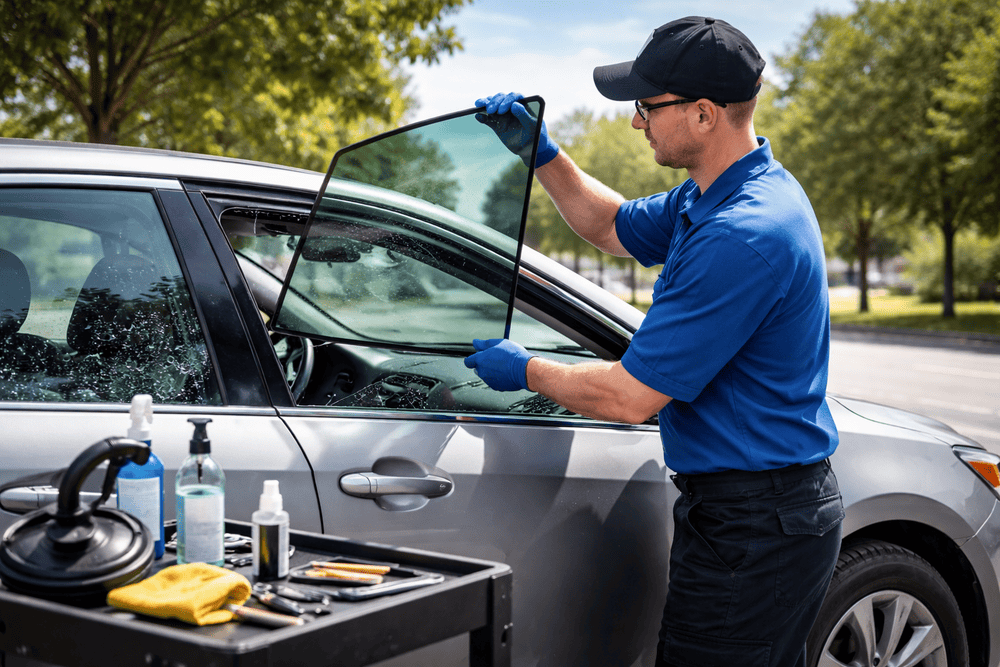
Analyzing Car Side Window Replacement Costs
It’s depressing to approach your car and find a stack of glittering cubes on the seat. Whether it’s due to a storm, a break-in, or a wayward baseball, a cracked side window exposes your automobile to weather and theft. It needs to be addressed right away. After the initial shock, most drivers ask a practical question: “How much is the repair going to cost me?” Side windows are made of tempered glass, unlike windshields, which frequently chip and may be fixed. For safety, they are made to break completely, so replacement is typically the only choice.
Get An Auto Glass Replacement Quote Now 866.278.7417

Windshield Replacement & Repair
Our competitors push you into going to their shop to get your glass fixed-making it cheaper for them. We make it easier for YOU to get back on the road by offering free mobile repairs at your home or work. With our free mobile services servicing the entire Orange County & Los Angeles area, we can often handle your windscreen replacement the same day! So the next time you need a windshield replacement, give us a call.
Talk to a Windshield Replacement Specialist Now 866.278.7417

Calibration
Calibration is the process of returning a vehicle’s ADAS to OEM specifications. Calibration is necessary after a new glass installation, particularly a windshield with a camera mounted to it, to ensure that the ADAS features continue to function properly despite having been moved during installation. If a car’s ADAS is not properly calibrated, the system may not function safely. A misaligned camera could jeopardize the functionality of the system and lead to dangerous driving or accidents, so it is crucial that the cameras are aligned perfectly, which is what windshield calibration ensures.
Talk to a Calibration Specialist Now 866.278.7417

Fleet Auto Glass Repair
We provide expert auto glass repair and windshield replacement services for commercial fleets of all sizes. We are experienced with all manufacturers and machine types of domestic or foreign cars, trucks, vans, or commercial vehicles, including heavy equipment. Our same day mobile auto glass and windshield repair service will enable you to get back on the road faster and start saving you time and money instantly. Give us a call today! We are here to help!
Talk to a Fleet Auto Glass Specialist Now 866.278.7417
The Average Replacement Price Tag
Let’s examine the figures. The average cost of replacing a car side window is between $200 and $550. This estimate includes both the cost of the glass and the labor required for its installation.
This price range is a baseline, though. You may be able to find a repair business that can fix manual crank windows on an older vehicle for less than $200. On the other hand, if you drive a brand-new luxury SUV with built-in sensors and noise-reducing acoustic glass, the bill may easily exceed $800 or even $1,000.
The general distribution of that money is as follows:
Depending on the type and manufacturer, the glass might cost anywhere from $100 to $400.
Labor: $70 to $150 per hour. It usually takes between one and ninety minutes to replace a side window.
Extra Parts: Adhesives, seals, and clips cost between $20 and $50.
A Few Crucial Elements That Affect Your Quote: Why does one driver pay $250 and another $700? The ultimate invoice depends on several factors. By being aware of these factors, you can find a fair quote and avoid overcharging.
Model and Make
The complexity and rarity of your car are the main factors influencing its cost. Mass-produced cars like the Ford F-150 or Toyota Camry have easily accessible parts, which keeps prices low. Obtaining specialized glass for luxury or foreign cars often increases the cost and prolongs the wait time.
OEM vs. Aftermarket Glass: When it comes to the actual glass, you have two primary options:
OEM (Original Equipment Manufacturer): The company that created your car’s original window also makes this glass. Its durability, hue, and thickness are all the same. It is also the most costly choice.
Aftermarket (OEE, or Original Equipment Equivalent): Third-party businesses manufacture this glass to fit your car. Although some drivers complain that the fit or noise reduction isn’t nearly as good as OEM, it is typically far less expensive and satisfies safety regulations.
OEM is frequently chosen for a brand-new vehicle or a lease return. Aftermarket glass is a wise approach to save money for a daily commuter whose car is a few years old.
Power Window Regulators and Motors: Occasionally, the window-breaking object affects the door’s interior machinery. The motor and regulator—the scissor-like device that raises and lowers the window—will also need to be replaced if the heavy glass had an effect on them. Your overall cost may increase by $100 to $400 if you switch regulators.
Do you have a Question?
Get An Auto Glass Replacement Quote Now 866.278.7417
Advanced Functionalities
Most modern automobile windows are more than just glass sheets. They are integrated parts of the comfort and safety systems of the car. You should budget more for a replacement if your side window has any of the following:
Acoustic Glass: Laminate made to lessen noise on highways. Glass that is stained during production as opposed to having a film put on afterwards is known as “factory tint.” Antennas or rain sensors: Some cars have technology built right into the glass.
The Repair’s Hidden Complexity: Many auto owners are perplexed as to why labor expenses are required for what appears to be a straightforward swap. In actuality, repairing a side window involves more complicated mechanics than replacing a windshield.
A technician must unscrew the inside door panel to replace a side window. This entails taking out armrests, door handles, and delicate electrical window and lock controls.
You will hear rattling every time you close your door for the duration of the car if they don’t thoroughly vacuum out all the broken glass from inside the door frame.
After the debris is removed, they must rebuild the door panel without breaking any of the plastic retention clips, insert the new glass into the regulator tracks, and make sure it rolls up and down smoothly without binding. It’s a process that calls for patience and certain equipment.
Should I Make a Claim or Not? Should the shattered window be covered by your auto insurance? Usually, the answer is determined by your deductible.
Check your policy to see if you have “comprehensive” coverage, which includes coverage for non-collision damage, such as weather, theft, and vandalism. It makes no financial sense to file a claim if the repair is $350 and your deductible is $500. You’d have to pay for everything yourself, and your rates might rise.
A zero-deductible provision for glass repair or particular “full glass coverage” is a feature of certain policies, nevertheless. The replacement should be free or extremely inexpensive if you already have this add-on. Before approving the repair work, always give your agent a call to confirm the specifics of your coverage.
DIY vs. Professional Installation: Many automobile owners think of doing their own window repairs to save money on labor in the era of YouTube instructions. Although it is feasible, it is not usually recommended for the typical car owner.
The Argument for Do It Yourself
For a fraction of the price ($50 to $150), you may purchase a replacement window from a salvage yard or internet seller if you have a basic car and are mechanically inclined. You can save a lot of money if you install it effectively.
Door Panel Damage: Hidden clips on contemporary door panels are prone to snapping. If you break these, your door panel may become loose and start to rattle.
Safety Risks: There is a lot of strain on the window regulator. Your fingertips could be in danger if you make a single mistake because the device could slam shut like a guillotine.
Water Leaks: Rain can enter your car’s cabin through an improperly sealed vapor barrier under the door, which can result in mold growth and electrical problems. For the majority of drivers, the additional labor expense is justified by the warranty and peace of mind that a professional installation offers.
Common Questions
Can mobile glass services fix my side window? Yes, the majority of auto glass businesses provide mobile service. The automobile can typically be driven right away after the repair is complete since the side window uses a mechanical attachment instead of the urethane adhesive used on windshields.
Will the technician clean up the damaged glass? Cleaning is part of the services provided by professional car glass businesses. The carpet, the seats, and—most importantly—the interior of the door panel will all be vacuumed.
You might find little fragments for a few weeks following the repair, though, as it is very impossible to obtain all of the tiny shards. Is window tint included with the new glass? If the original “privacy dip” was part of the vehicle, factory replacement glass typically includes it.
The new glass won’t have any aftermarket tint, though, if it was darker than the permitted manufacturer limit. A few days after installation, you will need to take the vehicle to a tint business so that the new window matches the rest of the vehicle.
Choosing the Correct Option for Your Car: A damaged side window is a significant annoyance and an unforeseen cost. Cost and quality should be balanced, even though there is a strong desire to pick the least expensive solution.
Every time you drive, a badly installed window that rattles in the track or loses air will be annoying. Obtain quotations from a minimum of three local stores, contrasting locally owned companies with national chains.
Inquire especially about whether they utilize OEM or aftermarket glass and what is covered by their warranty in terms of mechanical failure and air leakage. You can make sure your automobile is safe, weatherproof, and back on the road without going over budget by conducting this quick investigation.
National Chains vs Local Auto Glass Stores
The harsh crack of a pebble striking a windshield is one of the most depressing noises for a driver. At that moment, a normal commute transforms into a logistical nightmare.
The practical questions start once the initial frustration subsides. To what extent is the damage? Does it require a complete replacement, or can it be fixed? And maybe most crucially, what will the price of this repair be?
The large, nationally known auto glass chains and the smaller, independent local businesses are the two primary types of service providers you will probably come across when you begin browsing for estimates. You will frequently notice that the quotes are inconsistent. Local stores usually have lower prices than their big rivals.
This pricing disparity naturally sparks mistrust. We’ve been trained as customers to think that “you receive what you pay for.” Does cheaper glass really indicate lesser quality? Do the technicians have less training? Are you paying a higher price for a brand name without receiving any additional benefits?
Knowing where your money is going when you replace your windshield can help you decide whether going local is a safer or more cost-effective alternative.
Breaking Down the Cost Difference: You must first comprehend the reasons behind the wide variations in the figures to determine whether the price is reasonable. It is rare for a national business to quote you much more than a local store because the glass itself is pricier.
In actuality, big chains frequently have more negotiating leverage with producers. Overhead is typically the cause of the price discrepancy. National chains support large-scale advertising campaigns, costly call centers, and corporate management tiers.
These operating expenses are part of the cost of replacing a windshield. The overhead of local car glass shops is usually substantially lower.
Instead of national TV advertisements, they rely on local reputation and word-of-mouth advertising. They can frequently pass those savings on to the client while keeping solid profit margins because their operating expenses are lower. In this case, a cheaper price indicates a lack of corporate bloat rather than a drop in quality.
The Inferior Glass Myth
When driving to a less costly neighborhood store, one of the most frequent concerns is that the glass would be of poor quality. A vital structural element of your car, the windshield supports the roof in the event of a rollover and enables proper airbag deployment. You cannot afford to cut corners when it comes to materials.
However, the myth that neighborhood stores use “cheap” glass is largely false. Pilkington, PGW, and Saint-Gobain are just a few of the world’s leading glassmakers. These producers supply the aftermarket glass industry as well as automakers.
OEM vs. OEE vs. Aftermarket: Find out what kind of glass the shop plans to use to assess value.
OEM (Original Equipment Manufacturer): The glass is produced by the same company that created the original windshield. It is exactly the same as what was shipped from the factory, frequently with the carmaker’s emblem on it. The most costly choice is this one.
Original Equipment Equivalent (OEE): This glass is manufactured to the same exacting standards as the original, but it lacks the emblem of the vehicle manufacturer. The same factory frequently produces it, but glass retailers purchase it directly.
Aftermarket: Businesses that did not provide the original glass manufactured this one. It may differ somewhat in thickness or color, but it must adhere to federal safety regulations.
Unless you specifically request (and pay for) OEM, both national chains and local stores typically default to OEE or premium aftermarket glass. The value proposition is evident if a local store quotes you for OEE glass from a respectable brand like Pilkington and their pricing is $100 less than that of a chain selling the same item.
Do you have a Question?
Get An Auto Glass Replacement Quote Now 866.278.7417
Experience and Workmanship of Technicians
Materials alone do not solve the problem. Perhaps more significant is the technician’s ability in putting the glass in place. In an accident, a badly installed windshield may leak, make wind noise, or come off.
Local stores frequently have a clear advantage in this area. Large national chains frequently depend on excellent volume and quickness in their business models. As a result, they might concentrate on quick turnover and employ entry-level technicians.
Owners frequently run independent stores or hire professionals with decades of experience. Their local reputation is the only thing that keeps them in business.
The entire town finds out if they make a mistake during an installation. Therefore, compared to a junior tech at a national chain, the technician working on your automobile at a local shop is frequently more experienced and more committed to the result.
The ADAS Factor: Contemporary automobiles make the “worth it” determination more challenging. If you purchased your automobile within the last several years, it likely has Advanced Driver Assistance Systems (ADAS).
These systems include rain-sensing wipers, automatic emergency braking, and lane departure warning. Directly placed cameras on the windshield are the foundation of these systems.
These cameras need to be calibrated after the glass is changed. Your safety systems could malfunction if they are even a millimeter off.
The Chain Advantage: The costly equipment needed for in-house recalibration is nearly always available at national chains. It comes with their regular package.
The Local Challenge: Smaller stores may not have invested in calibrating equipment for all makes and models. Some will either not offer this stage at all or outsource it to a dealership, which can add delay.
You need to question the local shop, particularly about their calibration procedure, if your car is newer and has ADAS. If they include calibration in their discounted quote, it’s an excellent offer. If they advise you to “go to the dealer afterward,” once you pay the dealership’s calibration cost, the initial savings may disappear.
Guarantee and Assistance
What happens if something goes wrong is the last piece of the puzzle. A national chain provides a nationwide warranty. If you receive a rock chip while traveling three states away, you can likely visit a branch of that chain for repairs.
Local stores usually provide warranties as well, frequently with lifetime assurances against flaws or leakage. But typically, that warranty is only valid at their particular location.
A local warranty is more than sufficient for the majority of drivers who mostly travel inside their home area. The nationwide network of a chain may provide the peace of mind that warrants a higher price tag if you travel frequently for work.
Managing Insurance: Many drivers just let their insurance provider take care of the claim, trusting that they will be directed to the most suitable location.
It’s crucial to understand that a lot of big insurance companies use “third-party administrators” to manage their glass claims, and these administrators are frequently controlled by the same parent company as the big chains of glass repair shops.
This directs you toward the large chains by creating a funnel. Nonetheless, you are entitled to select the person who fixes your car in the majority of states.
You might urge that your insurance company deal with a local shop that you trust and that has a favorable reputation. Numerous nearby businesses are skilled at managing these insurance claims and will even take care of the paperwork.
Choosing the Best Option for Your Car: Is it worth the money to have your car’s glass repaired locally? The answer is usually a resounding “yes.”
Local stores usually provide a “Goldilocks” solution: highly skilled experts who personally care about the outcome, together with lower prices because of minimal overhead.
Choosing the local underdog is not only a method to save money, but it’s also frequently the way to receive superior service, provided you can confirm that they use high-quality glass and can perform the essential safety system calibrations.
Verify their warranty terms, inquire about the technician’s credentials (search for AGSC certification), and read internet reviews before making a reservation. Selecting those boxes ensures you are getting better value, not just a lower price.
Mobile Safe Auto Glass
14241 E Firestone blvd suite 400,
La Mirada, CA 90638
Phone: (562) 608-1154
Toll Free: 1 866 278 7417
Mail: sales@mobilesafeautoglass.com
Get a FREE QUOTE today! You can get a free quote and schedule 24/7 using this free quote wizard.
Mon – Fri 8am – 5pm
Saturday 8am – 1pm
Sunday Closed