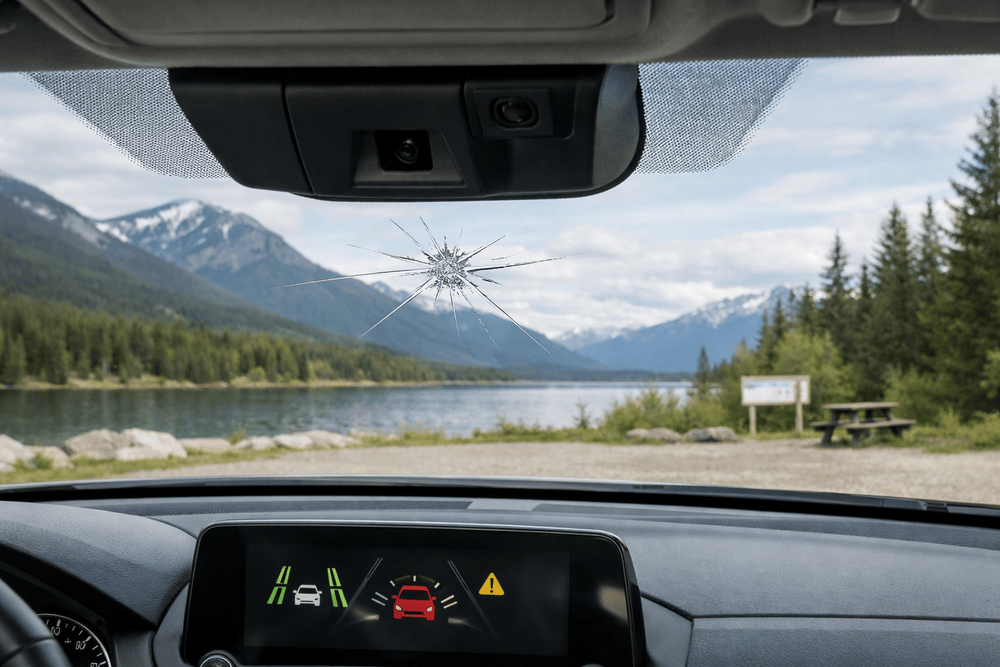
ADAS Vehicles and Broken Windshield Repair Safety
Usually, the first thing that comes to mind when you notice a crack in your windshield is the expense or inconvenience of having it fixed. However, beneath the glass of modern cars lies a much more serious issue: your safety systems. These systems, which include adaptive cruise control, automated emergency braking, and lane departure warnings, mostly rely on cameras and sensors installed right behind your windshield. It’s a technological problem as well as a cosmetic one when the glass needs to be changed or damaged. You can be operating a vehicle that believes it sees the road perfectly but, in fact, its vision is distorted if you don’t handle repairs properly.
Get An Auto Glass Replacement Quote Now 866.278.7417

Windshield Replacement & Repair
Our competitors push you into going to their shop to get your glass fixed-making it cheaper for them. We make it easier for YOU to get back on the road by offering free mobile repairs at your home or work. With our free mobile services servicing the entire Orange County & Los Angeles area, we can often handle your windscreen replacement the same day! So the next time you need a windshield replacement, give us a call.
Talk to a Windshield Replacement Specialist Now 866.278.7417

Calibration
Calibration is the process of returning a vehicle’s ADAS to OEM specifications. Calibration is necessary after a new glass installation, particularly a windshield with a camera mounted to it, to ensure that the ADAS features continue to function properly despite having been moved during installation. If a car’s ADAS is not properly calibrated, the system may not function safely. A misaligned camera could jeopardize the functionality of the system and lead to dangerous driving or accidents, so it is crucial that the cameras are aligned perfectly, which is what windshield calibration ensures.
Talk to a Calibration Specialist Now 866.278.7417

Fleet Auto Glass Repair
We provide expert auto glass repair and windshield replacement services for commercial fleets of all sizes. We are experienced with all manufacturers and machine types of domestic or foreign cars, trucks, vans, or commercial vehicles, including heavy equipment. Our same day mobile auto glass and windshield repair service will enable you to get back on the road faster and start saving you time and money instantly. Give us a call today! We are here to help!
Talk to a Fleet Auto Glass Specialist Now 866.278.7417
Knowing ADAS Is Not Just a Convenience
Advanced driver assistance systems are electronic gadgets that assist drivers with driving and parking. By offering a safe human-machine interface, ADAS increases vehicle and road safety.
These systems react appropriately when they identify surrounding barriers or driver faults using automated technologies, such as sensors and cameras. The “eyes” of these devices are often installed on the windshield of contemporary cars. Typical ADAS Functions Associated with Windshields
Lane Keep Assist: To keep the car centered, cameras scan for lane lines.
Forward Collision Alert: To alert drivers to possible collisions, sensors track the distance to the car in front of them.
Automatic Emergency Braking: Should the driver fail to react promptly, the system will automatically apply the brakes.Cameras are able to recognize traffic signs, including speed limits.
Why Windshield Damage Affects Safety Systems: The windshield now serves as a lens for your car’s advanced computer vision in addition to being a barrier against wind and debris.
The ADAS cameras may move—even by a millimeter—when a windshield is changed, chipped, or broken. A single degree of deviation might provide a substantial blind spot or error in judgment for a camera viewing hundreds of feet down the road, even if this could appear insignificant to the unaided eye.
Consider peering through a pair of glasses to understand the geometry of safety. You see the world correctly if the lenses are clear and in perfect alignment with your eyes. Imagine now that the prescription is incorrect or that those glasses are slightly slanted. Your sense of depth shifts. You may miss a cup when you reach for it.
Your vehicle has the same issue. The “eyes” of the car are jeopardized if the windshield glass differs optically from the original (OEM) glass or if the camera bracket isn’t installed precisely during replacement.
The Crucial Function of Calibration
To ensure that in-car ADAS systems receive precise and trustworthy data, calibration is the process of modifying the camera lens to take a full picture of the automobile and the road.
Static and dynamic calibration are the two primary forms. You may require one or both, depending on the manufacturer’s specifications for your car.
Static Calibration: Usually a specialized shop, the calibration is done in a controlled setting.
The car is parked on a level area.
Technicians position precise targets and patterns at specific heights and distances from the vehicle.
The system uses these targets to position the cameras.
It needs a regulated environment free of obstacles and with constant lighting.
Driving the car on the road is necessary for dynamic calibration.
A technician plugs a portable gadget into the vehicle’s computer.
They operate the car for a predetermined period of time on clearly defined roads at a predetermined pace. The technology aligns itself with the environment and actual road markings. Road conditions (faded lines) and weather conditions (rain, snow) can impact this process.
The Dangers of Ignoring Calibration: It’s risky to forego calibration following a windshield replacement. Your ADAS features could malfunction in dangerous ways if they are not properly aligned.
False Negatives: When a danger is not detected by the system. For instance, if a car stops abruptly in front of you, your automated emergency braking may not activate because the sensor is aimed too high or too low.
False Positives: The system detects a danger that is not present. If you see a shadow or a metal plate on the road, your automobile may use the brakes violently, which could result in a rear-end collision.
Drivers frequently disable these safety functions completely, negating their benefits. “Nuisance Alerts: Your Lane Keep Assist may beep at you continuously, believing you are straying from your lane when you are properly centered.
Do you have a Question?
Get An Auto Glass Replacement Quote Now 866.278.7417
Selecting the Best Repair Shop
Not all auto glass businesses are made equal. You need a technician who knows the technology, not just the glass, when your ADAS-equipped car requires a new windshield. Things to Know Before Making a Reservation
Do you use OEM (Original Equipment Manufacturer) glass? Aftermarket glass may have small distortions that deceive cameras. Do you execute ADAS calibration internally? Some stores outsource this, which can add time and expense.
Will you confirm the calibration? You should obtain a report verifying the sensors were tested and passed. Are your technicians certified? Look for certifications from groups such as the Auto Glass Safety Council (AGSC).
OEM vs. Aftermarket Glass: Does It Matter? The industry consensus strongly favors OEM glass for ADAS vehicles, whereas aftermarket glass is typically acceptable for older automobiles.
Although aftermarket glass satisfies impact safety standards, it may not have the precise optical quality needed for sensitive cameras; a slight wave or distortion in the glass, invisible to the driver, can confuse a camera sensor. Auto manufacturers design their cameras and software to work with specific glass clarity, thickness, and curvature.
Please refer to your owner’s manual, as some manufacturers specifically require OEM glass for replacements. Many manufacturers claim that they cannot guarantee the correct operation of the ADAS systems if aftermarket glass is used.
The Safety of Auto Glass in the Future
The windshield will become even more crucial as cars get closer to complete autonomy; we are going toward sensors that require 100% uptime to drive the car safely and heads-up displays (HUD) that project information across the entire windshield.
As a result of this progression, “simple” repairs will become more complicated. For modern car owners, safety and accuracy are becoming more important than speed and affordability, and the days of replacing a piece of glass in a driveway in 30 minutes are fading.
Prioritizing Safety Over Savings: Replacing a windshield on a modern car is a technical process, not just a structural one. Although it may be tempting to get the best deal or forgo the “extra” calibration fee, the proper operation of that technology is essential to you and your passengers’ safety.
Your car’s ability to protect you depends on it, so you must ensure it sees the road as clearly as you do when you leave the repair shop. Always insist on appropriate calibration and high-quality glass.
The Hidden Tech in Your Windshield: Sensor Accuracy Explained When you get behind the wheel of a modern car, you’re entering a command center driven by advanced technology. Although we usually think of the engine or transmission as the car’s heart, the windshield is increasingly determining safety.
Nowadays, a windshield serves as a vital lens for the car’s “eyes.” Gone are the days when a windshield was just a piece of laminated glass meant to keep wind out of your hair and bugs out of your teeth.
Advanced Driver Assistance Systems (ADAS), a complex network of cameras, radar, and laser sensors that continuously monitor the road environment, depend on perfect accuracy to operate.
If you’ve ever wondered why replacing a windshield has become so expensive or why technicians spend hours calibrating a piece of glass, the answer is sensor accuracy. Any car owner who prioritizes safety must understand how these sensors operate and how the glass affects their performance.
The Transition from Safety Glass to Smart Glass For many years, a windshield’s main function was to maintain structural integrity, which prevented the roof from collapsing in the event of a rollover and made sure the airbags functioned as intended.
Although these tasks are still essential, the glass’s role has grown, and manufacturers now put technology on brackets that are fixed to the inside surface or embed it directly into the windshield.
The most important sensors nowadays are the forward-facing cameras installed behind the rearview mirror. This transition started with basic comforts like rain sensors, which sense wetness and activate the windshield wipers automatically. It swiftly progressed to light sensors for automated headlights.
These cameras are in charge of the following life-saving functions:
If you stray from lane markers, Lane Departure Warning (LDW) will notify you.
The car is automatically steered back into the lane with Lane Keep Assist (LKA).
ACC, or adaptive cruise control, keeps a safe distance from the vehicle in front of you.
The Forward Collision Alert (FCA) alerts you to an approaching collision.
Automatic Emergency Braking (AEB) applies the brakes if the driver doesn’t respond.
The windshield serves as the window through which these systems view the world to make split-second choices, such as applying the brakes when a pedestrian walks outside.
Using the Windshield as an Optical Lens
In cameras or eyeglasses, we usually conceive of lenses as curved pieces of glass, but ADAS cameras work just like your windshield, with the camera looking through the glass to detect impediments, traffic signs, and lane markings.
The optical characteristics of the glass are crucial because the camera is calibrated to a precise position and angle; even a tiny distortion in the glass alters the direction of light entering the camera, a phenomenon known as refraction error.
Ghosting and Distortion: Poorer glass can cause distortion, which makes the view look distorted or wavy. A computer cannot ignore a small wave in the glass, but a human driver can. Distortion causes an ADAS computer to move items in the digital image.
Another optical problem known as “ghosting” is the appearance of a duplicate image, which can confuse the software and make it difficult for the system to discern between a phantom reflection and a real lane sign.
Light Transmission and Tint: Because ADAS cameras are calibrated to particular light frequencies, sensor accuracy is also impacted by the color and light transmission levels of the glass.
The camera’s low-light performance may suffer if a replacement windshield has a slightly darker tint or produces a color shift that deviates from the factory requirements. This could result in your automatic emergency braking functioning flawlessly at noon but failing at dusk.
The Misalignment Mathematics
A millimeter can make all the difference when it comes to sensor calibration, so you may be wondering how much a small flaw actually matters.
Triangulation is the foundation of ADAS geometry, where a camera at the top of the windshield is calculating information about objects hundreds of feet away, creating a lever effect in terms of precision.
Even a single degree of misalignment, which is sometimes undetectable to the unaided eye, can cause a camera’s focus area to be several feet off after it is 50 or 100 meters down the roadway.
If the windshield bracket was glued on a fraction of an inch too low, or the glass curvature is slightly different, the camera may misalign the sensor, causing the car to “think” it is centered when it is actually drifting onto the shoulder or into oncoming traffic.
This is the case with lane keep assist systems, which rely on the camera to determine the precise center of the lane. When Is Calibration Required? Manufacturers require recalibration of these sensors whenever their position or view changes due to the delicate nature of precision.
This is a necessity for the vehicle’s safe operation, not a recommendation. In general, sensor accuracy needs to be addressed in the following situations:
The most frequent reason for recalibration is windshield replacement; even with high-quality new glass, minor variations are introduced by the removal of the old glass and camera mount and the subsequent installation of new ones, which requires the camera to be “taught” its new position in relation to the road.
Collisions: If the mounting bracket moves or the car’s body twists significantly, the sensor angle changes, and even a small fender bender can throw the sensors out of alignment.
Suspension Adjustments: Adjusting the ride height of your truck or sports car changes the camera’s view of the road, which causes the car to underestimate distances if it isn’t recalibrated.
Dashboard Warning Lights: The ADAS computer will frequently turn off the safety features and turn on a warning light on your dash if it finds a problem or discovers it can’t reliably track lane lines.
Do you have a Question?
Get An Auto Glass Replacement Quote Now 866.278.7417
The Method of Calibration
You need specialized tools and expertise to restore sensor accuracy. Technicians employ two primary techniques, and your particular vehicle will dictate which one—or both—is needed.
Static Calibration: The car is parked on a level surface, the tires are inflated to the proper pressure, and the technician places extremely accurate target boards at predetermined heights and distances from the vehicle in a controlled shop setting.
After that, the car’s computer is set to go into “learning mode.” To orient itself, it searches for patterns on the target boards, which calls for a roomy, clear area with steady illumination because reflections or shadows can interfere.
Dynamic Calibration: In this technique, the technician drives the vehicle on designated roads at a certain speed while plugging in a diagnostic computer. The system uses the roadside objects and actual lane lines to calibrate the camera.
This form of calibration may seem easier, but it can be difficult; it needs well-painted lane lines and clear weather (no snow or severe rain), and if the roads are not in good shape, the system may not calibrate.
Original Equipment Manufacturer (OEM) vs. Aftermarket Glass: The Quality Debate: The usage of OEM versus Aftermarket or Original Equipment Equivalent (OEE) glass is one of the most contentious issues in the car glass industry.
OEM glass satisfies the exacting requirements of the carmaker for thickness, optical clarity, and bracket placement and is produced by the same manufacturer that provided the glass for the vehicle when it came off the assembly line.
Third-party firms manufacture aftermarket glass, which is subject to less stringent regulations for optical clarity in relation to ADAS sensors, but it still needs to exceed federal safety criteria for impact resistance.
The brackets on OEM glass are often pre-attached at the factory with robotic precision, whereas brackets on some aftermarket glass may be glued on by hand or have slightly different tolerances. When sensor accuracy is measured in fractions of a millimeter, these manufacturing differences can result in calibration failures or erratic system behavior. For vehicles with complex ADAS features, many experts and manufacturers advise sticking with OEM glass.
Why That Rock Chip Is Important
A rock chip that falls squarely in the ADAS camera’s field of vision produces a blind spot. It is simple to brush off a windshield crack as a cosmetic inconvenience, but neglecting it can jeopardize your safety systems.
In many cases, if a chip is within the “swept area” of the wipers or near the camera housing, repair is not an option; replacement is required to ensure the camera has an unobstructed view. The camera is unable to focus past the crack, and it may interpret it as an object in the road or simply fail to see the lane lines altogether.
Putting Safety First: The modern windshield is an engineering marvel that bridges the gap between analog driving and autonomous safety by providing the precise data that the advanced computer systems that are meant to keep you safe need to make life-saving judgments.
Your car’s ability to keep you safe depends on its ability to see the world clearly, and that begins with the windshield. Treat your car’s glass with the same care as your brakes or tires. If you require a replacement, enquire about the calibration process and the quality of the glass.
Mobile Safe Auto Glass
14241 E Firestone blvd suite 400,
La Mirada, CA 90638
Phone: (562) 608-1154
Toll Free: 1 866 278 7417
Mail: sales@mobilesafeautoglass.com
Get a FREE QUOTE today! You can get a free quote and schedule 24/7 using this free quote wizard.
Mon – Fri 8am – 5pm
Saturday 8am – 1pm
Sunday Closed