Windshield Crack Repair Timing That Prevents Replacement
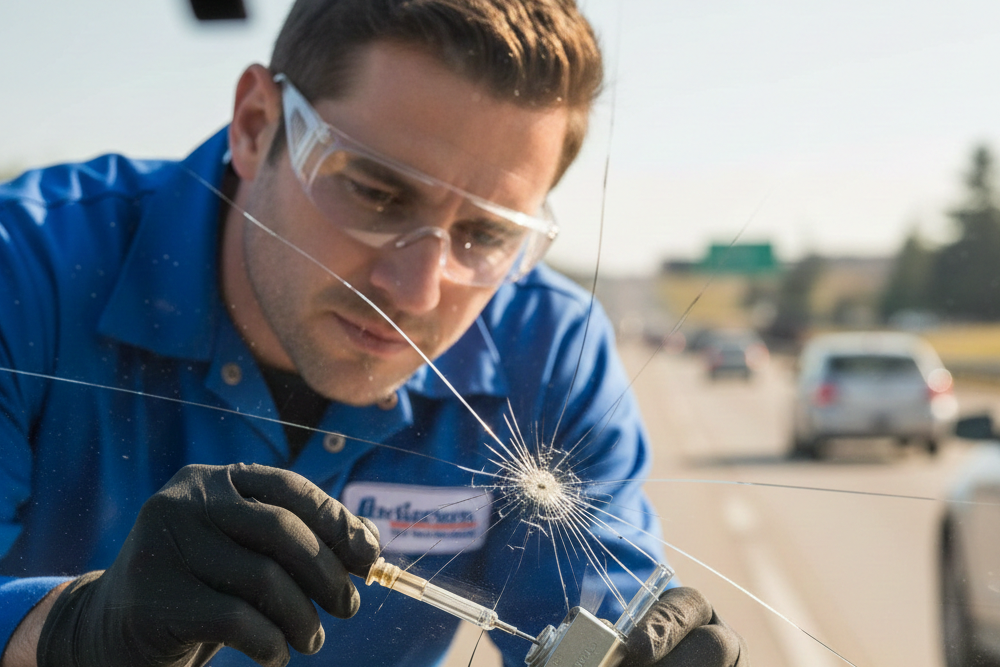
Usually, it begins with a loud crack that reverberates throughout the cabin. A rock has found its target after being kicked up by the truck’s tires in front of you. You feel sick to your stomach when you see the small starburst or bullseye on your glass. Then the haggling starts. You may convince yourself that it’s insignificant and that you’ll take care of it “next week.” The biggest error that car owners make when it comes to auto glass is to put things off. That minor flaw is a structural vulnerability that is just waiting to get worse. A twenty-minute, inexpensive repair work can become a complete windshield replacement that costs hundreds of dollars and necessitates sophisticated safety system calibration due to a combination of temperature changes, road vibrations, and cabin pressure.
Get An Auto Glass Replacement Quote Now 866.278.7417

Windshield Replacement & Repair
Our competitors push you into going to their shop to get your glass fixed-making it cheaper for them. We make it easier for YOU to get back on the road by offering free mobile repairs at your home or work. With our free mobile services servicing the entire Orange County & Los Angeles area, we can often handle your windscreen replacement the same day! So the next time you need a windshield replacement, give us a call.
Talk to a Windshield Replacement Specialist Now 866.278.7417

Calibration
Calibration is the process of returning a vehicle’s ADAS to OEM specifications. Calibration is necessary after a new glass installation, particularly a windshield with a camera mounted to it, to ensure that the ADAS features continue to function properly despite having been moved during installation. If a car’s ADAS is not properly calibrated, the system may not function safely. A misaligned camera could jeopardize the functionality of the system and lead to dangerous driving or accidents, so it is crucial that the cameras are aligned perfectly, which is what windshield calibration ensures.
Talk to a Calibration Specialist Now 866.278.7417

Fleet Auto Glass Repair
We provide expert auto glass repair and windshield replacement services for commercial fleets of all sizes. We are experienced with all manufacturers and machine types of domestic or foreign cars, trucks, vans, or commercial vehicles, including heavy equipment. Our same day mobile auto glass and windshield repair service will enable you to get back on the road faster and start saving you time and money instantly. Give us a call today! We are here to help!
Talk to a Fleet Auto Glass Specialist Now 866.278.7417
Why Waiting Is Your Windshield’s Enemy
Despite its seeming rigidity, glass is constantly under stress. Your windshield not only shields you from the wind, but it also supports the roof and makes sure that your airbags deploy in the correct manner. The clock starts running as soon as a chip compromises the integrity of the glass.
The two panes of glass that comprise a windshield are separated by a layer of vinyl resin (PVB), which is in accordance with the principles of the science of dissemination. Whenever a rock collides with something, the outer layer is often destroyed. For the time being, the structural integrity is mostly unaffected if the damage is minor.
However, kinetic energy is produced when driving. The vehicle frame flexes a little when your automobile passes over potholes, bumps, or even level roads. The glass is under pressure from this twisting motion. This is readily handled by a clean windshield. The crack runs because all of the tension is placed on the weak spot, which causes it to run when one of them is chipped.
The Effects of Weather: The main factor that accelerates glass damage is temperature fluctuations. Glass undergoes a process of expansion when heated, and a contraction when cooled. The quick heating of the cold glass produced by blasting your defroster on a chilly morning causes severe thermal stress.
When you turn on the air conditioner in the summer after your automobile has been scorching in the sun, the same thing happens. A quarter-inch chip may suddenly dart across your field of vision due to these abrupt changes. A crack is frequently too big to properly fix once it is more than six inches long, or the length of a dollar bill.
How to Determine Whether It Can Be Repaired
Not every type of damage is bad for your windshield. To decide whether to trash the glass or use resin to repair the damage, auto glass experts employ a set of criteria. Understanding these criteria aids in determining the urgency.
The Test of Dollar Bills: Size is the most often used rule of thumb. Repair is usually an option if the damage can be covered by a typical dollar note, which is roughly six inches long. Beyond that point, the structural integrity is probably too damaged by the crack. While fixing a large crack may keep the glass intact, it can cause optical distortion that could divert the driver’s attention.
Location Is Crucial: The location of the damage is just as important as the magnitude of the harm. Driver’s Line of Sight: A minor imperfection or distortion remains even after a flawless correction. Most shops will advise replacing the chip if it is right in front of the driver in order to guarantee 100% visibility.
In this case, the region of danger is the perimeter of the glass. The stress is greatest around the windshield’s edge. The link between the glass and the metal frame is compromised when a crack begins at or reaches the edge because it spreads significantly more quickly. Long-term success is difficult for repairs close to the margin.
Severity and Depth: A straightforward resin injection won’t work if the impact was severe enough to pierce the middle layer of vinyl or the inner layer of glass. The harm is too great. In a similar vein, the resin might not adhere properly if the chip is covered in dirt and road grime for weeks, resulting in a patchy and inadequate fix. Since fresh damage equals clean harm, this emphasizes the necessity of speed.
Do you have a Question?
Get An Auto Glass Replacement Quote Now 866.278.7417
The Unspoken Costs of Repair vs. Replacement
It is much more expensive to fix something than it is to replace it. A standard chip repair could run you anything from $100 to $150. The cost of a complete replacement might range anywhere from $300 to more than $1,000, depending on the manufacturer of the vehicle. However, there are other expenses besides the glass’s nominal price.
Modifications to the Advanced Driver Assistance System (ADAS) are a feature that can be found in contemporary automobiles. Rain-sensing wipers, automated emergency braking, and lane-keeping assistance are some examples of these modern safety features. These systems’ cameras and sensors are frequently fixed straight onto the windshield.
You interfere with these sensors when you change the glass. To make sure they work properly, they need to be carefully recalibrated. Specialized tools and training are needed for this operation, which raises the labor costs of replacement work significantly. You can completely avoid this costly procedure by doing a simple chip repair that doesn’t interfere with the sensors.
Incentives for Insurance: Insurance companies would rather you fix than replace. They also save money as a result. As a consequence of this, the deductible that is often associated with windshield repairs is typically waived under comprehensive insurance policies.
There’s a chance you might get the chip corrected for nothing out of pocket. You will probably be responsible for paying your entire deductible, which could be $500 or more, if you wait until it cracks and needs to be replaced.
Crucial Actions to Take Right Away Following an Impact
Taking the proper action straight away will save you the time it takes to get to a shop if you hear that dreaded impact sound while driving.
Examine it safely: Examine the damage as soon as you are able to stop. There’s a chance, even if it’s little.
Cover the chip: Cover the chip with a piece of clear packaging tape (not duct tape). This keeps moisture and debris out of the crevice but does not stop the fracture from structurally growing. It is considerably simpler to fix a clean crack invisibly.
By avoiding putting heat or air conditioning directly onto the windshield, you can reduce the risk of experiencing thermal shock. Make sure the vents are aimed at the floor or the cabin. Please park in a covered place if at all possible so that you can keep the temperature of the glass at a consistent level.
Be careful: A crack may be exacerbated by slamming doors or the trunk due to the abrupt shift in air pressure. Make an appointment right away by driving to a store or calling a mobile repair service. When resin is injected, the process takes less than half an hour.
I have a shattered windshield; can I still drive? This is one of the most common questions that people have about auto glass repair. Legally, it depends on the crack’s position and size as well as your state. The damage may result in a ticket if it blocks your vision. In a rollover accident, a cracked windshield provides less structural protection. Ignoring the automobile for everyday transportation is a safety risk, even when you can drive it to a shop.
Will the chip disappear completely once it has been repaired? No. The goal of a repair is to restore structural integrity, not flawless appearance. Although a small mark will typically remain, the resin fills the gap and joins the glass, making the damage much less noticeable (often increasing clarity by 80–90%).
What is the duration of a repair? Repairing a rock chip usually takes 15 to 30 minutes. UV light must be used to inject and cure the resin. The service is a “while you wait” one.
Keep a Chip from Turning Into a Broken Budget
Most drivers are unaware of how little time they have to repair a windshield chip. Environmental variables start to work against you as soon as a pebble or piece of trash hits your glass.
A small, almost imperceptible chip can quickly develop into a spiderweb crack that spreads over the windshield due to temperature changes, road vibrations, and even everyday driving stress. Ignoring a little issue might lead to a significant safety problem and a considerably greater repair expense.
By opting to fix the damage right away, you maintain your car’s original factory seal and ensure that the windshield is securely attached to the frame. This preserves your vehicle’s structural soundness and guarantees that cutting-edge safety features like airbags and ADAS cameras stay adjusted and operational.
By eliminating the hassle of being without your car for long periods of time and frequently saving hundreds of dollars, early repairs are significantly more economical than complete replacements.
The message is obvious: don’t wait for the chip to grow into a full-blown crack or for the damage to spread after you hear that sharp crack of a pebble hitting your windshield.
Taking quick action keeps your car road-ready and your mind at peace while also protecting your safety and finances. When it comes to auto glass, quick thinking and careful attention to detail might mean the difference between a small fix and a costly one.
Why Prompt Action Prevents the Spread of Windshield Cracks
The sound is familiar to you. An abrupt, harsh thwack interrupts your commute while you are driving down the highway, maybe whistling along to the radio. A pebble has struck your windshield after being kicked up by the truck in front of you.
You look at the glass. You see it: a small, unimportant mark. It appears to be a little cosmetic imperfection, possibly no bigger than a dime. You continue to drive while having a breath of relief with you. You promise yourself that you will examine it later, or perhaps you conclude it is insignificant enough to be entirely disregarded.
This is an error: That small flaw in the glass represents a potential structural vulnerability. Although windshields are designed to endure extreme pressure, time runs out as soon as the glass’s integrity is jeopardized. Overnight, what starts out as a small chip might grow into a huge, intricate crack. In addition to saving your windshield, acting quickly also protects your finances and guarantees your safety while driving.
The Spread’s Scientific Basis: You must first comprehend the behavior of automobile glass in order to comprehend why haste is necessary. The windshield of your vehicle is made of laminated glass, which is made up of two layers of glass that are wrapped in a layer of polyvinyl butyral (PVB). Because of the way it is constructed, the glass will not shatter into sharp fragments when it is impacted.
The outer layer of the glass is typically damaged when a rock strikes it. The outside layer is now susceptible to three main forces: moisture, vibration, and temperature, while the inner layer keeps the structure together.
Glass undergoes a stress-related expansion when it is heated, and a stress-related contraction when it is cooling. When you park your car in the sun on a hot day, the glass will spread out and become more expansive. An abrupt change in temperature, such as that which occurs when you blast the air conditioner against a hot windshield, is the source of acute stress. When you apply the defroster to an icy windshield in the winter, the same holds true.
These changes are uniformly handled by a flawless sheet of glass. A sheet that is chipped doesn’t. A stress point is created when the damage stops the uniform expansion and contraction. The energy required to quickly push a tiny chip into a lengthy fissure is produced by this physical tension.
Road Flexing and Vibration
Automobiles are dynamic entities. The chassis flexes and twists a little when you drive over turns, potholes, and bumps. In actuality, the windshield contributes to the vehicle’s stiffness as a structural element.
Vibration is transmitted through the glass with each mile of driving. Simply said, a weak spot cannot withstand the same amount of twisting as solid glass. The likelihood that the crack may “run” across your field of vision increases with the amount of driving you do with a chip.
Intrusion of Moisture: This is the silent windshield killer. Water molecules can penetrate a chip’s tiny cracks because they are small enough. That confined water turns to ice if the temperature falls below freezing.
As a result of the expansion that occurs when water freezes, the layers of glass are separated like a little wedge. For this reason, a lot of drivers discover that a tiny chip has grown into a horizontal fracture that runs the length of the dashboard when they wake up on a chilly morning.
Determining the Damage: Is It Preservable? Not all windshield damage is lethal. Specialized resin can be used to repair a variety of impact damage types if you take prompt action. However, the extent, location, and age of the damage are the only factors that will determine how well the repair works.
The Bullseye: This appears to be exactly a dartboard target. There is a noticeable impact point in the middle of the circular break. Since there aren’t any long radiating cracks yet, these are usually the simplest to fix if discovered early.
The Break of the Star: This damage has a star-shaped impact point in the middle with short cracks radiating outward. These are critical. Already, those tiny “legs” are spreading. They will get longer if you don’t touch them.
This is a combination of a star break and a bullseye, and it is referred to as the Break in Combination. If dirt gets into the cracks, it can be challenging to fix and causes serious damage to the glass.
The Thumb Rule: In most cases, a qualified technician can fix damage that is less than a quarter, or about an inch in diameter. In order to repair the chip and restore structural integrity, a clear, curable resin is injected into the glass.
If the crack is longer than a dollar note or if the damage is directly in the line of sight of the driver, it is likely that a total replacement is required. Speed is therefore essential in order to prevent the “dollar-bill” situation and to catch the damage while it is still “quarter-sized.”
Do you have a Question?
Get An Auto Glass Replacement Quote Now 866.278.7417
Replacement vs. Repair
It costs money to put things off. The only sensible option from an economic perspective is to make the repair right away.
There is a range of $50 to $150 for the typical cost of repairing a windshield. On the other hand, comprehensive insurance policies typically do not need the deductible to be paid for chip repair in most cases. Insurance companies would rather pay a little to repair a chip than a lot to replace the glass later. Chip repairs are essentially free for a lot of drivers.
A complete replacement is another matter. The price of a replacement windshield can range anywhere from $300 to more than $1,000, depending on the make and model of your respective automobile.
The Unspoken Price of ADAS: Advanced Driver Assistance Systems (ADAS) have caused replacement costs to soar in recent years. Cameras and sensors installed behind the windshield of modern cars regulate functions such as
Warnings about lane departure
Emergency braking that operates automatically
Cruise control that adapts
Rain-detecting wipers
These sensors are physically moved when the windshield is replaced. The calibration of the system can be upset by even a millimeter shift. Hence, a replacement necessitates a professional recalibration of the car’s computer systems and goes beyond simply changing the glass. In addition to requiring specialized equipment, this procedure results in a much higher bill, which could have been prevented had the chip been filled right away.
Temporary Actions Prior to Repair: Suppose you notice a chip, but it won’t be possible to visit a repair shop until tomorrow. To stop the spread and improve the likelihood of a successful repair, there are a few quick actions you can take.
Keep it clean: Moisture and dirt are the worst enemies of a quality repair. Dust entering the crack will prevent the resin from properly bonding, giving the completed repair a hazy or unclean appearance.
Use clear tape: Wrap a piece of clear packaging tape around the chip that is located on the exterior of the glass for protection. This will keep water and road grime out of the crack, but it is not a structural fix—it won’t keep the glass together. This keeps the technician’s workspace tidy.
Steer clear of temperature shocks by not turning on the air conditioner or the defroster. To maintain a consistent glass temperature, park in a garage or in the shade if at all possible.
Avoid washing the car because the pressure from a hose or car wash can push water into the laminate layer, making the windshield irreparable.
When Safety Is at Risk: Safety is the strongest argument for fixing a crack right away, even above aesthetics and cost. Up to 60% of the vehicle’s structural integrity in a rollover accident and up to 45% in a front-end collision are provided by your windshield.
In a rollover, the roof is more likely to collapse if a spreading crack weakens the glass. In addition, the windshield acts as a backstop for the airbag that is located on the passenger side of the vehicle. The airbag cushions the passenger by shooting upward and bouncing off the glass when it deploys. The airbag’s force could pierce the windshield if it is compromised, making the safety feature ineffective.
Visibility is also compromised when driving with a cracked windshield. Your reaction time may be delayed by the blinding glare of sunlight or approaching headlights at night caused by light refraction through a crack.
Keep Your Wallet Full And Your View Clear
Ignoring a problem rarely makes it go away, but in the case of auto glass, doing nothing almost always makes the damage worse. The smallest stress, such as a sudden pothole, a temperature change, or even normal road vibrations, can cause a tiny chip that appears innocuous today to grow into a long, jagged crack.
If left neglected, a repair that could have been done for little to no money can easily turn into a $1,000 or more replacement job. Any car owner should make it a habit to regularly check their windshield and other auto glass. Check for tiny chips, cracks, or divots that may show up after following trucks, driving on gravel roads, or even just going about your daily business.
Early detection allows you to fix the issue before it jeopardizes your car’s structural integrity or interferes with the operation of vital safety features like ADAS cameras or airbags.
If you already see damage, you shouldn’t wait for it to further deteriorate. Make an appointment for a repair right away with a skilled technician who follows the right adhesive and calibration techniques.
By taking quick action, you can protect your family, keep your car’s value high, avoid future, much more costly repairs, and maintain the strength of your glass. The best, safest, and most economical decision you can make when it comes to auto glass is to act quickly.
Mobile Safe Auto Glass
14241 E Firestone blvd suite 400,
La Mirada, CA 90638
Phone: (562) 608-1154
Toll Free: 1 866 278 7417
Mail: sales@mobilesafeautoglass.com
Get a FREE QUOTE today! You can get a free quote and schedule 24/7 using this free quote wizard.
Mon – Fri 8am – 5pm
Saturday 8am – 1pm
Sunday Closed