Window Repair Solutions That Enhance Long-Term Glass Strength
A scratch on a gorgeous window, a chip in your windshield, or a fracture in a glass tabletop might be more than just an eyesore. Glass damage can jeopardize your property’s structural integrity, safety, and aesthetic appeal. For small flaws, DIY repair kits are available, but for major damage, expert assistance is necessary to guarantee a flawless, long-lasting, and safe repair. However, what precisely do the professionals do to make their fixes so successful? Professional glass repair calls for specific methods and supplies that are significantly more advanced than those found in a basic home kit. You can appreciate the artistry involved and make wise judgments when you need a repair if you are aware of these techniques.
Get An Auto Glass Replacement Quote Now 866.278.7417

Windshield Replacement & Repair
Our competitors push you into going to their shop to get your glass fixed-making it cheaper for them. We make it easier for YOU to get back on the road by offering free mobile repairs at your home or work. With our free mobile services servicing the entire Orange County & Los Angeles area, we can often handle your windscreen replacement the same day! So the next time you need a windshield replacement, give us a call.
Talk to a Windshield Replacement Specialist Now 866.278.7417

Calibration
Calibration is the process of returning a vehicle’s ADAS to OEM specifications. Calibration is necessary after a new glass installation, particularly a windshield with a camera mounted to it, to ensure that the ADAS features continue to function properly despite having been moved during installation. If a car’s ADAS is not properly calibrated, the system may not function safely. A misaligned camera could jeopardize the functionality of the system and lead to dangerous driving or accidents, so it is crucial that the cameras are aligned perfectly, which is what windshield calibration ensures.
Talk to a Calibration Specialist Now 866.278.7417

Fleet Auto Glass Repair
We provide expert auto glass repair and windshield replacement services for commercial fleets of all sizes. We are experienced with all manufacturers and machine types of domestic or foreign cars, trucks, vans, or commercial vehicles, including heavy equipment. Our same day mobile auto glass and windshield repair service will enable you to get back on the road faster and start saving you time and money instantly. Give us a call today! We are here to help!
Talk to a Fleet Auto Glass Specialist Now 866.278.7417
Evaluating the Damage
A qualified technician thoroughly inspects the damage before starting any repairs. This is a thorough diagnostic to ascertain the best course of action, not only a cursory look. The technician will assess several important factors:
What kind of damage—chip, fracture, scrape, or shatter—is it? Different strategies are needed for each kind. A “bullseye” chip is not the same as a “star break” or a lengthy, linear fracture, for instance.
Size and Depth: The damage’s measurements are crucial. A chip larger than a quarter or a break longer than a few inches on a windshield may indicate that the glass has to be replaced instead of mended.
Location: The damage’s location is crucial. Structural stress increases the likelihood that a fracture near a windshield’s edge may propagate. Stricter repair guidelines are frequently applied to damage in the driver’s direct line of sight to prevent visual distortion.
Contamination: Has debris, wetness, or dirt gotten into the crack? Contaminants may hinder the healing process and compromise the ultimate strength and clarity of the repaired region.
The technician uses this evaluation to determine if a repair is practical and which approach will work best. Restoring the glass’s structural soundness and aesthetic purity is always the main objective.
Fixing Cracks and Chips
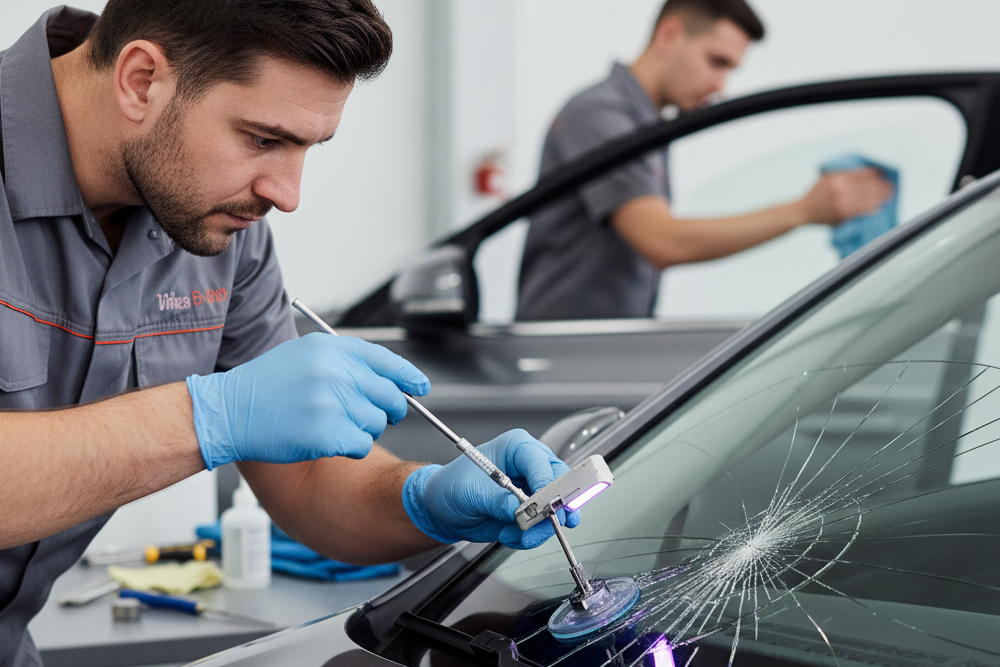
Resin injection is the most widely used professional method for chips and minor cracks, particularly in laminated glass, including windshields. In addition to making the damage almost undetectable, this procedure strengthens the glass and stops the fracture from getting worse.
How It Operates: Preparation: Any glass shards, dust, and moisture are thoroughly removed from the injured area. To enable the repair glue to completely penetrate the fracture, a tiny hole may be drilled in the middle of the chip. To prevent worsening the injury, this job needs to be done precisely.
Making a Vacuum: The damage is covered with a specialized tool. By producing a vacuum, this apparatus extracts all of the air from the chip and any related fissures. Because trapped air bubbles would degrade the repair and remain apparent, removing the air is an essential step.
Resin Injection: A premium, optically matched resin is injected into the void using the vacuum holding. Because the resin and glass have identical refractive indices, the damage may appear to vanish. The resin is then forced deeply into each microscopic crack by cycling the pressure.
Curing the Resin: An ultraviolet (UV) light is used to cure the resin once the fracture has been fully filled. This creates a robust, long-lasting seal by attaching the resin to the surrounding glass and hardening it in a couple of minutes.
Final Touches: After curing, a razor blade is used to scrape off any extra resin from the surface, and the region is polished until it is level and smooth with the rest of the glass. The end effect is a robust, visible restoration that is frequently difficult to see with the unaided eye.
The technician’s expertise and the resin’s quality are crucial. Professionals employ resins that, like glass itself, are flexible enough to expand and contract with temperature changes and long-lasting and resistant to yellowing with time.
Do you have a Question?
Get An Auto Glass Replacement Quote Now 866.278.7417
Eliminating Scratches
The look of a window, mirror, or glass door can be ruined by scratches on the glass, which can be caused by vandalism, unintentional abrasion, or vigorous cleaning. To eliminate scratches without causing distortion, experts employ a multi-step polishing procedure.
The Process of Grinding and Polishing: This technique entails polishing the glass surface back to a clear sheen after carefully abrading it to level it with the scratch’s bottom.
Deep Cleaning: To make sure there are no abrasive particles on the surface that might result in further scratches during the restoration, the surface is completely cleansed.
Abrasive Grinding: The technician gently grinds down the glass surrounding the scratch using portable polishing equipment equipped with a succession of increasingly finer abrasive discs. The process’s most sensitive step is this one. To avoid distorting the vision with a perceptible dip or “lensing” appearance, the technician must remove just enough glass to remove the scratch.
Pre-Polish Stage: The region may seem foggy following the initial grinding. In order to get rid of the grinding marks and get the surface ready for the final polish, the technician then switches to finer-grit discs.
Final Polish: A soft pad and a unique polishing solution, usually including cerium oxide, are used in this last phase. The surface is massaged with this slurry to bring back its natural clarity and brilliance. The heat produced by the friction contributes to the glass’s tiny chemical and mechanical smoothing, giving it a crystal-clear finish.
For minor to moderate scratches, this method works well. This technique might not work for really deep scratches or gouges since removing that much glass will unavoidably affect the image. Replacement may be the sole choice in some situations.
When Is Replacement the Only Solution
Sometimes the damage is too severe for a safe and long-lasting repair, even if expert restoration processes are quite successful. A trustworthy glass specialist will always put safety first and suggest replacement in the following situations:
Extensive Cracking: Long, intricate fractures, especially those that reach the glass’s edge, jeopardize the structural integrity more than a restoration can reliably fix.
Deep Damage: Repairing a chip or scratch that has gone too far into the glass is not advised, especially if the glass is laminated or tempered.
Contaminated Cracks: When damage is neglected for an extended period of time, moisture and dirt can build up and hinder the resin’s ability to adhere correctly, resulting in a poor and ugly repair.
Location on Windshields: To meet safety regulations, any damage to car glass that obstructs the driver’s line of sight or the operation of advanced driver-assistance systems (ADAS) frequently needs to be replaced completely.
The Distinction in Professionalism
Selecting a specialist for glass repair ensures lifespan and safety in addition to improving the appearance. Professionals have access to top-notch materials, industrial-grade equipment, and—above all—the education and expertise necessary to properly identify and handle glass damage.
You can see why it’s better to leave the task of fixing anything more than a small flaw to individuals who do it on a daily basis by being aware of these techniques. The next time you see a chip or scratch, you’ll know that it can be fixed to restore your glass’s strength and clarity with the correct knowledge.
The Secrets to Perfect Repairs: The materials you choose and the equipment you employ are frequently the two most important factors in a successful repair. Experts and committed enthusiasts may find that the quality of these components can make the difference between a quick fix and a flawless, long-lasting restoration.
Achieving a solution that is long-lasting, dependable, and sometimes imperceptible to the unaided eye is the goal of using premium resins and precise repair equipment. This tutorial will discuss the significance of purchasing high-quality resins and specialist equipment for your repair jobs.
We’ll go over the many kinds of resins that are out there, their unique uses, and why using precise equipment is essential to getting results that are on par with those of a professional. By the conclusion of this piece, you will know how to take your repair job from excellent to outstanding using the correct tools and materials, making sure that every repair is long-lasting.
The Basis for a Long-Lasting Repair
From repairing small chips in a countertop to regaining the structural integrity of automobile parts, resin is the foundation of innumerable repairs. But not all resin is made equally. Products can differ significantly in terms of their final strength, curing period, and chemical makeup. Choosing a high-quality resin guarantees that your repair will endure stress and time.
Recognizing the Different Types of Resins and Their Uses: The first step to a good repair is selecting the appropriate resin. Various formulas are made for certain materials and circumstances. The following list includes some of the most popular kinds of premium resins along with their advantages:
Resins for Epoxy: The most popular and adaptable resins for windshield repairs are probably epoxy. They are made up of two components, a resin and a hardener, which combine to form a strong chemical connection. This results in a rigid, resilient, and extremely sticky substance.
Excellent adherence to various surfaces, such as metal, wood, plastic, and ceramic, is one of its main advantages. They offer greater strength, chemical resistance, and low shrinkage when they cure.
Ideal for: Creating protective coatings, bonding various materials, filling big gaps, and structural repairs. They are the preferred choice for heavy-duty home repairs, boat repairs, and vehicle bodywork.
Resins made of polyester: Because of their strength and stiffness, polyester resins are frequently utilized in combination with fiberglass matting. They can be more brittle and smell harsher than epoxies, although they are usually less expensive.
Key Benefits: Creates a firm, solid surface and cures rapidly. It is perfect for building durable composite materials because of its strong connection with fiberglass.
Ideal For: Automotive body fillers, fiberglass repairs for boats and surfboards, and laminate projects.
Resins made of polyurethane: The flexibility and durability of polyurethane resins make them valuable. They are appropriate for situations where movement is anticipated because, in contrast to more stiff resins, they can absorb shock and flex without cracking.
Key Benefits: Provides an excellent mix of flexibility and hardness. They can adhere to a range of substrates and are UV and water resistant.
Ideal For: Concrete sealing, flexible plastic repairs, long-lasting floor coverings, and impact-resistant applications.
UV-Curable Resins: These novel resins cure almost instantly when exposed to ultraviolet (UV) light. Because the resin stays liquid until you’re ready to cure it, this feature gives you amazing control over the repair process.
Key Strengths: Extremely rapid drying time under UV light enables precision application and swift project completion. They harden and become transparent after curing.
Ideal For: Small, precise repairs such as making jewelry, sealing electronics, and repairing chips in windshields. They are especially helpful for repairs when it is impracticable to keep pieces in place for an extended period of time to cure.
Why Quality Matters
Using a low-quality, inexpensive resin might result in several issues. The bond could collapse under stress, the repair could discolor with time, or it might not be resistant to dampness and chemicals.
Superior raw ingredients are used to produce high-quality resins, which are then put through a thorough testing process to guarantee consistent performance. You may be sure that your repair will be robust, long-lasting, and durable if you get a high-quality product.
The Appropriate Equipment for the task. Even the greatest resin might fail if it’s not applied correctly. Precision repair tools are useful in this situation. These tools offer complete control over the restoration process, from surface preparation to the final finishing touches.
Do you have a Question?
Get An Auto Glass Replacement Quote Now 866.278.7417
Crucial Tools for Precision Repair
Anyone who is serious about repair work must assemble a toolbox with the appropriate tools. The following crucial precision instruments can significantly raise the caliber of your output:
Surface Preparation Tools: For a solid connection, a surface that is clean and ready is a must.
Micro-Sanders and Abrasives: You may roughen up sensitive surfaces with a precision sander or fine-grit sandpaper to improve adherence without causing harm.
To remove old paint, adhesive, or burrs that can interfere with the new resin, scrapers and deburring tools are crucial.
Tools for Mixing and Applying: Properly mixing and applying resin is crucial for obtaining its maximum strength potential.
Mixing Cups and Sticks: To make sure your resin and hardener are well combined and in the right proportion, use clean, non-porous containers and stir sticks. Calibrated mixing cups are a standard feature of many premium resin kits.
Syringes and Applicators: Syringes with different needle gauges are essential for precisely applying resin or injecting it into small crevices. They reduce clutter and waste by giving you control over the resin’s flow and placement.
Fine-Tipped Brushes: Small, premium brushes are ideal for applying a thin, uniform layer of resin to a surface.
Tools for Curing and Finishing: After the resin is put in, the task is not finished. The restoration looks professional when it is properly cured and finished.
UV Flashlights: A strong UV flashlight is essential when dealing with UV-curable polymers. The wattage and wavelength of the light might impact the curing speed and hardness, so select one that is suggested for your specific resin.
Heat Guns: Using mild heat to eliminate air bubbles and accelerate the curing process for some epoxy and polyurethane resins can produce a stronger, cleaner surface.
Polishing Kits: To make the resin merge in perfectly with the surrounding surface, it might need to be sanded and polished once it has completely dried. You may attain a smooth, glossy surface with the aid of a polishing compound and pad package that comes in several grits.
An Expert Workflow
Let’s take a look at a typical repair scenario: repairing a deep chip in a granite countertop, to show how these components function together harmoniously.
First, clear the chip of any loose material using a tiny scraper or deburring tool. To get rid of any oil or residue, use a solvent, such as denatured alcohol, to wipe the area.
Resin Selection: A high-quality, color-matching epoxy or a transparent, UV-curable resin would be excellent options for this application. A solid, long-lasting fill that complements the stone is the aim.
Application: If using epoxy, properly combine the two components according to the manufacturer’s directions. To accommodate for any shrinkage, fill the chip just above the surface using a syringe or a thin applicator. Apply UV resin straight to the chip if you’re using it.
Curing: Give epoxy the suggested amount of time to cure. UV resin may be cured in a matter of seconds by using a UV bulb. Before curing, any air bubbles can be gently popped using a heat gun.
Finishing: Carefully shave the surplus material flush with the countertop using a razor blade once the resin has solidified. Then, use a fine-grit polishing kit to sand and buff the area until it matches the gloss of the surrounding granite.
This meticulous process, which combines the appropriate glue with the appropriate instruments, guarantees a repair that is both robust and nearly undetectable.
Improve Your Repair Work
In the end, the caliber of your repairs is a reflection of your skill, your standards, and the pride you take in your craft. When you choose high-quality resins and invest in precise, reliable repair equipment, you’re doing far more than completing a task—you’re setting yourself up for consistent, professional success. Premium materials and tools allow you to work with accuracy and confidence, giving you the ability to handle a wider range of damage types and produce results that stand the test of time.
With every repair you complete, you build a reputation for work that’s dependable, long-lasting, and visually impressive. Customers notice the difference, and so does your own sense of accomplishment. Don’t let cheap supplies or subpar tools limit what you’re capable of achieving. Equip yourself with the best, deliver repairs you can be proud of, and take genuine satisfaction in every job you complete.
Mobile Safe Auto Glass
14241 E Firestone blvd suite 400,
La Mirada, CA 90638
Phone: (562) 608-1154
Toll Free: 1 866 278 7417
Mail: sales@mobilesafeautoglass.com
Get a FREE QUOTE today! You can get a free quote and schedule 24/7 using this free quote wizard.
Mon – Fri 8am – 5pm
Saturday 8am – 1pm
Sunday Closed