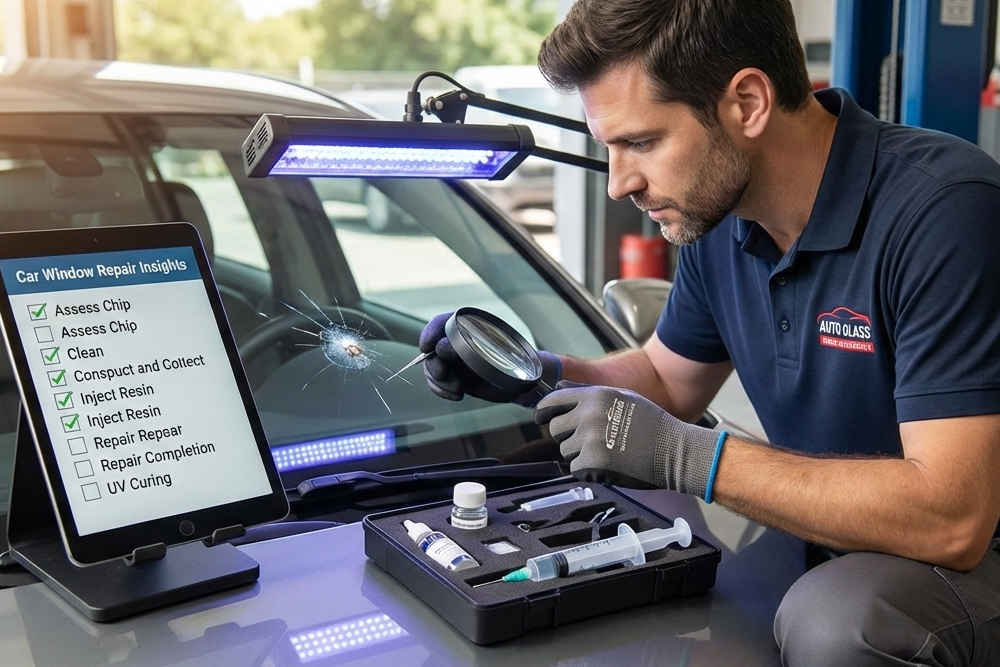
Window Repair Insights to Prevent Worsening Glass Damage
You are having a peaceful afternoon at home when you become aware of something: a thin, jagged line that seems to be flowing across the glass of your living room. It is possible that at first look, it appears to be a little cosmetic issue that is hardly worth receiving your attention. Nevertheless, that tiny crack is a time bomb that is waiting to explode in your glass. A little crack may rapidly become a broken pane if it is not addressed, which has the potential to compromise the safety of your home, as well as its energy efficiency and aesthetic appeal. The good news is that not every broken glass needs to be completely replaced, which may be rather costly.
Get An Auto Glass Replacement Quote Now 866.278.7417

Windshield Replacement & Repair
Our competitors push you into going to their shop to get your glass fixed-making it cheaper for them. We make it easier for YOU to get back on the road by offering free mobile repairs at your home or work. With our free mobile services servicing the entire Orange County & Los Angeles area, we can often handle your windscreen replacement the same day! So the next time you need a windshield replacement, give us a call.
Talk to a Windshield Replacement Specialist Now 866.278.7417

Calibration
Calibration is the process of returning a vehicle’s ADAS to OEM specifications. Calibration is necessary after a new glass installation, particularly a windshield with a camera mounted to it, to ensure that the ADAS features continue to function properly despite having been moved during installation. If a car’s ADAS is not properly calibrated, the system may not function safely. A misaligned camera could jeopardize the functionality of the system and lead to dangerous driving or accidents, so it is crucial that the cameras are aligned perfectly, which is what windshield calibration ensures.
Talk to a Calibration Specialist Now 866.278.7417

Fleet Auto Glass Repair
We provide expert auto glass repair and windshield replacement services for commercial fleets of all sizes. We are experienced with all manufacturers and machine types of domestic or foreign cars, trucks, vans, or commercial vehicles, including heavy equipment. Our same day mobile auto glass and windshield repair service will enable you to get back on the road faster and start saving you time and money instantly. Give us a call today! We are here to help!
Talk to a Fleet Auto Glass Specialist Now 866.278.7417
How Come Windows Get Cracked?
It is helpful to have an understanding of what created the problem before you can attempt to remedy it. Although it is long-lasting, glass is not indestructible. Your windows may be subjected to stress from a number of different reasons until they ultimately give way. Stress from Temperature: Variations in temperature are one of the most common reasons for the failure of glass.
The glass in a window will expand and contract at different rates depending on whether one section of the window is hot (for example, because it is sitting in direct sunlight) or whether another section is cool (because it is shaded by an overhang). A thermal stress crack is the result of this tension, which causes the fracture to appear. The majority of the time, they begin at the frame of the glass and wind their way across the pane.
This is the most evident cause of damage, and it is impact damage. An impact fracture can be caused by a baseball that moves out of place, a rock that is launched by a lawnmower, or debris that is tossed by a storm. It is common for these to take the form of a “starburst” pattern that extends outward from the site of contact.
The occurrence of pressure cracks is rather uncommon; however, it is possible for them to manifest in double-paned windows or insulated glass units. It is possible for the glass to bend and finally break if the windows are put at an elevation that is considerably different from where they were made, or if the pressure system that is contained inside the panes fails. It is common for pressure cracks to have the form of an hourglass when they appear.
Inadequate Installation: If a window frame is not squared off properly or if the glass is positioned too tightly within the frame, the structural tension will eventually cause the glass to crack. More often than not, these fissures begin around the corners.
Comparing the Costs of Repairing and Replacing Damage
“Can I just patch this?” is the first question that the majority of homeowners ask. The answer to this question is totally dependent on the extent of the damage and the location of the damage.
Repairing a window is typically a feasible alternative if the following conditions are met: The crack is small: in general, if the crack is less than 12 inches in length, it may be possible to repair the window. It is a single-pane window: Fixing older windows with resin or adhesives is significantly simpler than fixing windows with several panes of glass. In the event that the fracture has not broken all the way through the glass or affected the structural integrity of the pane, a cosmetic repair may be able to hold it together. The damage is minor.
It is probable that you will need to make an order for a replacement window unit or pane if the following conditions are met: The unit is a double-pane or IG unit: the seal is broken once a fracture emerges in an insulated glass unit. As a result of the gas fill (argon or krypton) escaping, moisture is allowed to enter. It is quite possible that the unit will fog up permanently if the glass is repaired since it will not restore the insulating value.
The glass has been tempered, which means that it does not break in a single stripe but rather shatters into thousands of small cubes that are dull. After it has been broken, tempered glass cannot be repaired in any way. When the fracture reaches the edge, the structural integrity of the building is compromised since the damage has spread to the frame. In the event of a slight stress, the glass has the potential to either fall out or fully shatter.
Do you have a Question?
Get An Auto Glass Replacement Quote Now 866.278.7417
Temporary Do-It-Yourself Solutions to Prevent the Spread of the Disease
It is possible that you may not be able to obtain a glazier to come to your residence right away. During this interim period, you will need to support the glass in order to prevent the fracture from multiplying as a result of wind, changes in temperature, or vibration. This article will discuss three successful temporary remedies.
The Clear Nail Polish Method: Clear nail polish may be used as a sealer for extremely small hairline cracks, and it is surprisingly efficient in doing so. Using dish soap and water, carefully clean the area in question. Ensure that it dries properly. Make sure that you fill the groove with clear nail paint before applying a layer of nail polish over the crack. After it has had time to dry, add a second layer.
Because of this, the gap is filled, and the two sides of the glass are held together, which buys you some time before you have to make a permanent repair. Adhesives that are strong (super glue): Cyanoacrylate glue, often known as super glue, is more powerful than nail polish and is an excellent choice for cracks that are somewhat broader. The window should be properly cleaned and dried. Along the fissure, apply a little quantity of adhesive to the surface.
Before the glue cures fully, scrape off any extra adhesive with a razor blade to ensure that the surface remains a level one. This is not a solution that is optimal from a cosmetic standpoint because it may result in the appearance of a line. When aesthetics are not your major concern and you simply need to hold the glass together during a storm or while waiting for a repair company, tape is your best friend.
Duct tape and masking tape are two types of tape that may be used for this purpose. Put the tape on both sides of the crack that you have there. This will not stop the crack from spreading permanently, but it will prevent fragments from going out of the window in the event that it breaks.
Alternatives for Professional Repairs
It is possible that you may consider having a professional inject resin into the window if you are looking for a long-term solution that does not need replacing the complete window. This method is comparable to that of repairing a windshield.
A specialist will clean the crack and then use a specialized suction tool to extract air from the fissure by using the vacuum tool. They next inject a resin of superior grade that cures when exposed to ultraviolet light. The shards of glass are brought back together by this glue, which also helps to restore the pane’s strength. The window is structurally intact and feels smooth to the touch, despite the fact that the crack may still be somewhat evident here and there.
When it comes to residential glass, however, this is a specialized service. In the long run, there are several glass businesses that would suggest that replacement is more cost-effective and safer than repair, particularly for contemporary windows.
Ignoring A Crack Sometimes Comes With Hidden Costs
The enemy of house care is, without a doubt, procrastination. It is possible to cause problems that go well beyond the glass itself if you choose to ignore a window that has cracked.
Increases in your monthly energy bill are a result of a break in the thermal envelope of your home. In the winter, costly heat escapes, and in the summer, hot air enters. Both of these phenomena occur. Just a minor breach can cause your heating, ventilation, and air conditioning system to work harder, which can result in considerably higher power costs.
Cracks allow rain and humidity to enter, which can lead to mold growth. This moisture has the potential to seep into the window frame, particularly if it is made of wood, as well as the drywall that is around it. Over time, this results in decay, structural damage, and the growth of mold, all of which pose a risk to one’s health and need a significant amount of money to repair.
Potential Security Threats: A window that is cracked is a vulnerable spot in the security of your house. It is a sign that the house is susceptible to being broken into by unauthorized individuals, which suggests that it is inadequately maintained. A solid pane is far more difficult to shatter silently than fractured glass, which is much easier to break.
Questions That Are Frequently Asked
Do you have the ability to fix a crack in a double-pane window? Although it is possible to “repair” it by applying adhesive or tape to it in order to stabilize it, it is not possible to “repair” it in a manner that will restore the window’s functionality. Once the glass is broken, the vacuum seal will no longer be present. The insulated glass unit (IGU) that is included within the current sash has to be replaced as the correct remedy.
How much does it cost to repair a window that has a break in it? Kits for do-it-yourself projects range in price from $15 to $30. In terms of both size and kind, the cost of professional glass replacement might vary greatly. While the cost of replacing a single pane might range anywhere from $100 to $200, the cost of replacing a double-pane IGU can often range anywhere from $200 to $600.
Do you think that if I don’t touch a crack, it will become worse? Absolutely, without a doubt. Changes in temperature, the pressure of the wind, and the settling of the home all contribute to the continual strain that is exerted on glass. The presence of a fracture indicates a vulnerability that will continue to grow along the route of least resistance until the glass entirely splits away from one another.
It Is Not Worth Waiting Till It Breaks
Inconvenient as window cracks may be, addressing them in a timely manner transforms a potentially catastrophic situation into a maintenance activity that may be easily managed. The most important thing is to take action, regardless of whether you settle for a speedy do-it-yourself stabilization with adhesive or hire a professional to replace the entire pane of glass.
It is time to evaluate the damage. If it is a fracture caused by heat stress or an impact break on a single pane, you should attempt to repair it with resin. You should begin planning your finances for a new unit in the event that the seal on your double-pane window has blown. You will safeguard the efficiency, security, and value of your house if you take action to fix the issue right away.
The Reasons Why You Should Not Ignore That Minor Deviation
In most cases, it begins as a line in the concrete that is barely visible or a crack in a wall that is very small. One could be tempted to disregard these minor flaws as being the result of regular wear and tear. However, that fracture, which appears to be of little consequence, can actually be the initial indication of a far more major and costly issue. It is possible to save a large amount of time, money, and worry in the future by gaining an understanding of the significance of early intervention.
The purpose of this piece is to show why even the slightest fractures require your urgent attention. In this section, we will discuss the common factors that contribute to them, the consequences that arise when they are not handled, and the actions that you can take to effectively address them. By the time you reach the conclusion, you will understand why taking prompt action is the most prudent and economical method of undertaking property care.
What Is the Science Behind Crack Spreading?
The appearance of cracks in components such as concrete, plaster, or drywall is not something that happens out of the blue. Most of the time, they are the consequence of stress that is greater than the strength of the material. A weak spot is created whenever a break appears in a material. All of the stress that will occur in the future will be concentrated at the tip of that fracture, which will make it much simpler for the crack to develop longer and wider. Fracture mechanics is the term used to describe this phenomenon.
Imagine it as a little rip in a piece of paper. This is how it looks. Once the tear has been started, it can be ripped open with very little power, although it does require some effort to get it started. When cracks appear in the foundation or walls of your home, they act in the same manner. A fracture that starts out as a hairline can soon become more extensive when subjected to pressure from a variety of environmental variables.
Common Causes of Cracks The creation and propagation of cracks in a structure can be caused by a number of different reasons, including the following: Settlement of the Foundation: The majority of structures settle over time. The foundation and the walls may be subjected to a significant amount of strain, which may result in cracks if the settling is not uniform.
Damage Caused by Water Water is a potent, forceful energy. It is possible for it to seep into small cracks, freeze, and expand, a process that is referred to as “frost heaving.” This expansion causes the crack to widen, which makes it possible for additional water to enter the crack the next time it rains or melts. This cycle has the potential to inflict considerable structural damage over periods of time. Water has the ability to erode the soil beneath a foundation, which might result in the soil shifting and cracking.
Materials undergo thermal expansion and contraction when they are heated, and they undergo contraction when they are cooled. These daily and seasonal temperature changes create movement in building materials, which can lead to stress cracks if they are not properly addressed. Constant vibrations can cause fractures to form and deepen over time in locations that have considerable foot traffic, adjacent construction, or strong vehicle movement.
This is especially true in regions where there is heavy vehicle movement. When cracks are ignored, what are the consequences? This is the cost of delay. Yet, delaying crack repair may appear to be a strategy to save money in the short term; yet, in the long run, it nearly always results in issues that are more severe and expensive.
One example of how little repairs may become major reconstructions is the fact that a small crack in a concrete driveway can frequently be patched with a filler that is both easy and affordable. In addition to preventing water from entering, this simple remedy also stops the fracture from making further progress. Should you choose to disregard it, water will invariably make its way into the sub-base.
This water has the potential to dissolve the foundation that lies beneath the concrete over the course of several seasons of freezing and thawing, which will result in the fracture developing into a major pothole. What was once a do-it-yourself fix that could have been completed for fifty dollars now takes a professional crew to dig and repour a whole portion of the driveway, which might end up costing thousands of dollars.
Similar to the last example, a little break in the drywall could just require some joint compound and a little bit of paint. If left unchecked, it may be an indication of a more significant structural problem. It is certain that the crack will widen as the structure continues to shift, which will eventually necessitate the replacement of a significant portion of the drywall. It is possible that you will also need to treat the structural issue that lies under the surface, which is an endeavor that is far more difficult and costly.
Cracks are more than simply a cosmetic concern; they can be signs of weakened structural integrity. Structural integrity is at risk when cracks appear. A significant cause for worry is the presence of fractures in the foundation walls. They have the potential to let moisture into your crawlspace or basement, which can result in the growth of mold, mildew, and decay. A foundation fracture that has been ignored might pose a threat to the structural integrity of the entire house, which is the worst possible scenario.
It is possible that the walls will start to bend, the flooring will become uneven, and the doors and windows may either become stuck or refuse to close correctly. You are no longer looking at a straightforward repair at this stage; rather, you are looking at a significant structural overhaul.
Do you have a Question?
Get An Auto Glass Replacement Quote Now 866.278.7417
By Taking Preventative Measures
In order to effectively manage cracks, prompt and immediate action is essential. You can safeguard the value of your property as well as the structural health of your building by treating them as soon as they occur. Make it a practice to examine your property at least twice a year, preferably in the spring and fall. This will ensure that your property is in good condition.
Take a tour of the inside and outside of the building, taking particular attention to the foundation walls on both the inside and the outside. Driveways, patios, and walks are all examples of common concrete surfaces. walls and ceilings on the interior, particularly those that surround door and window shutters. Keep an eye out for any new cracks or any modifications that may have occurred in the ones that are already present. Keeping track of their development over time might be made easier by taking photographs.
Before you can cure a crack, it is important to understand what caused it in the first place. Figure out what caused it. The presence of hairline cracks in plaster or drywall is often not a major cause for worry because they are typically caused by small settling or variations in humidity. A large amount of structural movement may be indicated by fractures that are jagged and diagonal in shape and that are broader at one end than the other.
A classic indication of foundation settling is the appearance of cracks in the stair steps of brick or masonry. If you see cracks that are horizontal, developing, or rather wide, it is recommended to seek the advice of a specialist. A precise diagnosis of the issue and a recommendation for the most appropriate course of action can be provided by a structural engineer.
Select the appropriate technique of repair. The technique of repair is determined by the location, size, and source of the fracture inside the material. The use of spackle or joint compound can be utilized to fill up gaps in drywall that are not structural in nature. For the purpose of preventing water from entering the concrete, minor fractures can be filled using a flexible polyurethane or epoxy filler.
Epoxy injections or foundation underpinning are two examples of the types of expert intervention that are frequently required to stabilize the building and permanently cure the problem when significant structural fractures are present. Even though there are certain small repairs that may be done by yourself, it is essential to recognize when it is time to bring in a professional. There are occasions when a faulty repair might cause more problems than it solves.
The Best Course Of Action Is Prevention
Even if you can’t stop your house from settling, there are things you can do to reduce the likelihood of severe fractures appearing in the walls. The management of water flow requires that you make sure that your gutters and downspouts guide water away from your foundation. Therefore, in order to avoid water from gathering around your house, the land surrounding your foundation should slope away from the structure.
The soil surrounding your foundation should be watered regularly in dry regions in order to prevent it from shrinking and causing the foundation to shift. This may be accomplished by maintaining a stable soil moisture level. Plumbing leaks should be addressed as soon as possible since even a slow leak can cause the soil beneath your property to get saturated, which can result in major structural issues.
Your Upcoming Steps
This seemingly little fracture might not seem like a problem right now, but it has the potential to do significant damage in the future. A proactive approach to property upkeep is something that can be taken if you have an awareness of the factors that are at play and the consequences that come with inaction. Maintaining the look of your house via routine inspections and rapid repairs will not only safeguard its structural integrity and financial worth over the long term, but it will also retain its beauty. Make sure you don’t wait for a little issue to escalate into a major hassle. Do something about it right now, and you can relax knowing that your investment is safe.
Mobile Safe Auto Glass
14241 E Firestone blvd suite 400,
La Mirada, CA 90638
Phone: (562) 608-1154
Toll Free: 1 866 278 7417
Mail: sales@mobilesafeautoglass.com
Get a FREE QUOTE today! You can get a free quote and schedule 24/7 using this free quote wizard.
Mon – Fri 8am – 5pm
Saturday 8am – 1pm
Sunday Closed