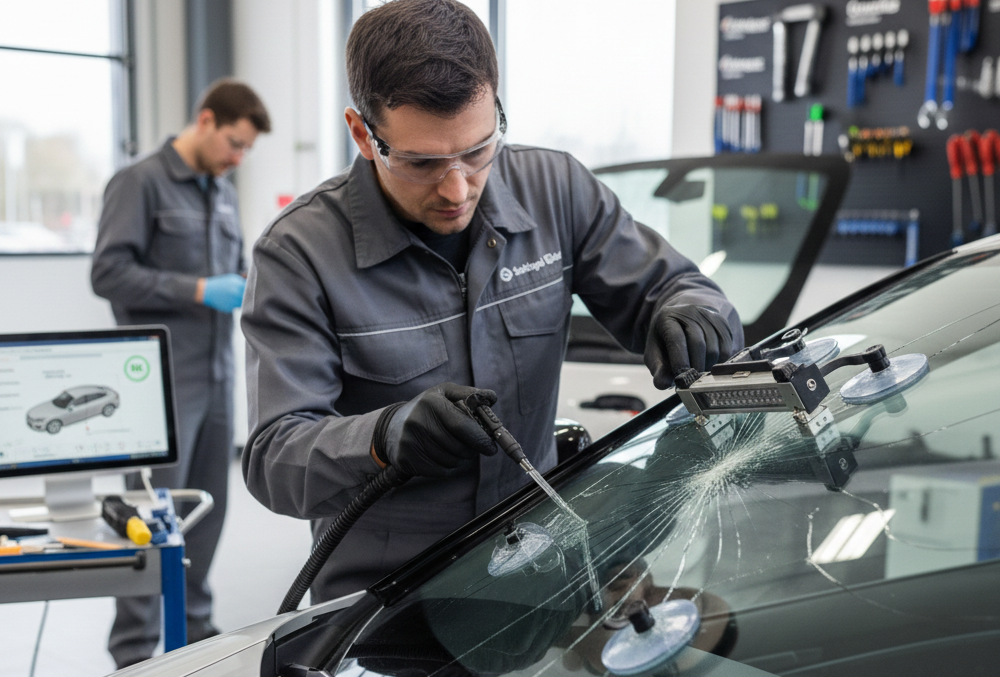
Window Repair Guidance For Handling Heat And Vibration Stress
A small inconvenience, like a chip in your car’s windshield, can seem harmless at first, but factors like temperature changes and road vibrations might quickly turn that tiny annoyance into a serious problem. Making sure you fully comprehend how these stressors affect the glass in your car is the first step to preventing costly repairs and guaranteeing your safety when driving. This lesson aims to illustrate how heat and vibration may harm car windows and what you can do to stop more damage. We’ll discuss the need for prompt window repair as well as how modern techniques may strengthen your windshield, saving you money and time while also protecting your safety.
Get An Auto Glass Replacement Quote Now 866.278.7417

Windshield Replacement & Repair
Our competitors push you into going to their shop to get your glass fixed-making it cheaper for them. We make it easier for YOU to get back on the road by offering free mobile repairs at your home or work. With our free mobile services servicing the entire Orange County & Los Angeles area, we can often handle your windscreen replacement the same day! So the next time you need a windshield replacement, give us a call.
Talk to a Windshield Replacement Specialist Now 866.278.7417

Calibration
Calibration is the process of returning a vehicle’s ADAS to OEM specifications. Calibration is necessary after a new glass installation, particularly a windshield with a camera mounted to it, to ensure that the ADAS features continue to function properly despite having been moved during installation. If a car’s ADAS is not properly calibrated, the system may not function safely. A misaligned camera could jeopardize the functionality of the system and lead to dangerous driving or accidents, so it is crucial that the cameras are aligned perfectly, which is what windshield calibration ensures.
Talk to a Calibration Specialist Now 866.278.7417

Fleet Auto Glass Repair
We provide expert auto glass repair and windshield replacement services for commercial fleets of all sizes. We are experienced with all manufacturers and machine types of domestic or foreign cars, trucks, vans, or commercial vehicles, including heavy equipment. Our same day mobile auto glass and windshield repair service will enable you to get back on the road faster and start saving you time and money instantly. Give us a call today! We are here to help!
Talk to a Fleet Auto Glass Specialist Now 866.278.7417
Why Vibration and Heat Make Window Damage Worse
The windshield of your automobile serves as a vital safety feature in addition to being a wind and rain barrier. It contributes up to 30% of the structural strength of your car and is essential to the deployment of airbags.
The integrity of the glass is compromised when it has a chip or crack. Heat and vibration are two prominent environmental conditions that might take advantage of this vulnerability.
The Effects of Temperature Variations: When heated, glass expands, and when cooled, it contracts. Even though your windshield is made to withstand these slow changes, a chip or fracture makes it vulnerable. Abrupt or severe temperature changes cause the glass to expand or contract at various rates, which puts a great deal of stress on the affected region.
For instance, turning on the air conditioner on a hot day or using your car’s defroster on a chilly morning might cause a tiny chip to grow into a lengthy crack. Drivers are sometimes caught off guard when these stress cracks develop without any fresh contact.
Road Vibrations’ Impact
The structure of your car is vibrated by every bump, pothole, and uneven surface you drive over. These vibrations are easily absorbed by a sound windshield. These continuous vibrations, however, have the potential to elongate a chip or break in glass that is already broken.
A stable chip can become a “floater crack” that spreads across the center of the windshield due to pressure from driving at high speeds or the little flexing of the car’s body over uneven terrain.
Typical Damage Types and Their Vulnerabilities: Window damage is not all the same. To identify the most effective repair technique and gauge the likelihood of spread, technicians categorize chips and cracks based on their size and shape.
Chips: A chip happens when a little fragment of glass from the windshield is removed by road debris, such as a rock.
Bullseye Chip: One of the simplest to fix, this round chip is comparatively stable. It may, however, expand in response to temperature changes due to retained moisture and air.
Star Break: From a central impact point, this chip has small cracks that radiate outward. The star’s “legs” are extremely vulnerable to spreading due to temperature stress and vibrations.
Combination Break: A cross between a bullseye and a star break, this kind of damage has several weak spots and is likely to expand if treatment is not received.
Breaks: Glass cracks are lines that are more likely to propagate and can range in severity.
Stress fracture: This fracture can develop without a clear impact point and is frequently brought on by abrupt temperature fluctuations.
Floater Crack: A crack that starts in the center of the windshield and is frequently caused by an untreated chip that has been subjected to vibrations.
Edge Crack: One of the most deadly kinds of cracks, it begins two inches from the edge of the windshield. Temperature variations put the most strain on the windshield’s edges, which accelerates the propagation of these cracks.
Repairing Windows: The best defense against heat and vibration deteriorating window damage is to address it as soon as possible. The majority of chips and minor cracks may be fixed quickly, cheaply, and effectively with a resin injection repair.
Do you have a Question?
Get An Auto Glass Replacement Quote Now 866.278.7417
The Operation of Resin Injection
This process strengthens the broken glass and stops cracks from spreading. Cleaning the Damage: To get rid of any dirt, a technician carefully cleans the chip or fracture. To guarantee that the repair glue will adhere properly, this step is essential.
Creating a Vacuum: To eliminate any air trapped inside the crack, a specialized instrument is put over the injury to produce a vacuum. The resin cannot completely penetrate the injury if this step is skipped.
Resin Injection: A premium, transparent resin is pumped into the vacuum. The resin is drawn into all of the chip’s or crack’s nooks and crannies by the vacuum, filling it entirely.
Curing the Resin: The resin is cured and hardened using an ultraviolet (UV) light. This procedure restores the structural integrity of the windshield by chemically bonding the resin to the surrounding glass.
Polishing: To achieve a smooth, transparent surface, the technician scrapes away any extra resin. Optical clarity can be increased by more than 80% with a good repair.
When Can’t You Avoid a Complete Replacement
For minor damage, window repair is an excellent alternative, but in certain cases, a complete windshield replacement is necessary to assure your safety.
Damage in the Driver’s Line of Sight: A little distortion may remain after repairs. Replacement is the safest option if the damage is squarely in the driver’s primary field of view.
Large Cracks: If there are several crossing cracks, long fractures (often more than six inches), or cracks that extend to the windshield’s edge, the glass is likely too damaged to be repaired.
Deep Damage: A replacement is required if the collision has broken through both of the laminated glass layers of the windshield.
Contaminated Damage: Over time, moisture and dirt may seep deeply into a fracture, making it difficult for the repair glue to effectively adhere. This is the reason it’s critical to respond quickly.
Protect Your Windshield Now
Avoid waiting for vibration and temperature to cause a minor chip to require a significant replacement. You may take preventative measures to preserve the integrity of your car’s glass by being aware of how these factors impact it. A prompt window repair is an easy, affordable way to restore your car’s safety and provide you with peace of mind while driving.
See a qualified car glass specialist if your windshield has a chip or crack. They are able to evaluate the damage and suggest the best course of action to ensure the safety of both you and your passengers.
The Impact of the Environment on Windshield Repair: Ignoring a little chip in your windshield might cause more serious issues than just a slight inconvenience. Many drivers are unaware that the environment has a big impact on how that initial damage develops and how it might be fixed. The environment surrounding your car may make a little fracture become a serious safety risk, whether it’s in the blazing summer heat or the bitterly cold winter.
Any automobile owner must comprehend these environmental variables. It not only aids in preventing more harm but also helps determine the most effective healing plan. A fix that functions flawlessly in one climate may not work in another. This tutorial will explain the effects of various weather patterns and environmental factors on your windshield and how to have it fixed correctly. By the conclusion, you’ll understand why technique and time are crucial for a long-lasting and secure windshield repair.
The Science of Glass Windscreens
Knowing the composition of your windshield might help you comprehend how the environment impacts it. These days, windshields are more than simply one sheet of glass. Made from laminated glass, they are an advanced piece of safety gear. This is made up of two glass layers with a thin, clear polyvinyl butyral (PVB) layer in between.
Your windshield’s strength and safety features come from its three-layer design. The outer layer of glass may fracture or crack when an item, such as a rock, strikes the windshield, but the PVB interlayer is made to keep the glass together and stop it from breaking into sharp pieces. This explains why a badly damaged windshield frequently has a web-like pattern rather than a stack of shattered glass.
Additionally, windshield repair is made easy by the PVB interlayer. The structural integrity and clarity of the windshield are restored when a specialist injects a specific resin into a chip or crack. This resin binds with the glass and PVB. However, temperature, humidity, and other external factors can have a big impact on the glass’s and PVB’s characteristics. This is where the difficulties and subtleties of windshield repair are relevant.
The temperature: Perhaps the most important environmental aspect influencing your windshield is temperature. Glass expands when heated and compresses when cooled, much like the majority of materials. Despite being minuscule, this shift puts a lot of strain on the windshield, particularly during sudden temperature changes.
The Impact of Heat on Windscreen Damage
Your vehicle may feel like an oven on sweltering summer days. Your windshield’s glass expands as a result of absorbing this heat. This expansion might put pressure on the weak spot, allowing damage to spread if you already have a chip or fracture. A little, star-shaped chip has the potential to grow into a lengthy, irreversible break very fast.
Heat affects the actual mending procedure as well. When working on a heated windshield, technicians need to use caution. The glue used for repairs cures more quickly at high heat, and the glass is more delicate.
A poorer repair that is more noticeable and less long-lasting might result from the resin failing to adequately permeate the whole fracture if it cures too soon. To guarantee that the glue flows properly and cures uniformly, skilled professionals frequently cool the windshield to the ideal temperature before starting the repair.
Quick Tip: To lessen the direct heat on your windshield on a hot day, try parking in the shade or using a sunshade. The abrupt shift in temperature can also cause cracks to spread, so avoid blasting the air conditioner on a very high setting directly into the heated glass.
The Risks Associated with Cold Weather
Winter presents a unique set of difficulties. The glass compresses as the temperature decreases. Any chips or fractures that already exist may become more pronounced as a result of this contraction’s strain. Another adversary in cold weather is moisture. Chips may absorb water, which causes them to expand when they freeze. The fracture is forced to grow outward by this expansion, which functions as a little wedge.
Another challenge is repairing a windshield in subfreezing conditions. Repair resin is made to function best at a certain temperature range. The epoxy becomes too thick and viscous to fit into the minute cracks of the damage if the glass is too cold.
As a result, the repair is insufficient and ineffectual. Before injecting any resin, technicians must warm the windshield and the surrounding region to a sufficient temperature. To prevent adding more stress points to the glass, this calls for expertise and the appropriate tools.
Quick Tip: One frequent method of removing ice from your automobile is to use the defroster, but be patient. Even an unbroken windshield may develop a stress crack due to an abrupt burst of hot air. The glass should be progressively warmed by the defroster.
Do you have a Question?
Get An Auto Glass Replacement Quote Now 866.278.7417
Moisture and Humidity
When it comes to windshield repair, moisture and humidity may be silent enemies. They can be just as harmful to a successful and long-lasting solution, even though their effects are frequently less rapid than those of temperature.
The Water Intrusion Issue: A chipped windshield leaves a hole in the glass’s outer layer. Moisture might enter this injured region through rain, mist, or even excessive humidity. There are several ways in which this water might impede the process of mending.
First, a direct link between the glass and the repair resin is created. The presence of water in the chip creates a barrier that stops the resin from attaching correctly. This results in a weak connection, and the repair will probably fail over time, allowing the fracture to widen or return.
Second, optical distortions may result from moisture trapped within the fix. The area where the repair was completed may appear foggy or cloudy. Delamination, in which the PVB interlayer starts to split from the glass layers, can also occasionally result from trapped water.
Fixing a Wet Windshield
A wet chip will never be attempted to be repaired by a qualified technician. Drying out the affected area fully is the first and most important procedure. Usually, specialist equipment that uses vacuum pressure and mild heat is used to remove any remaining moisture from the fracture.
Poor-quality repairs are frequently the result of rushing this step or not completely draining the water. When a chip appears on a wet day, it’s better to cover it with transparent tape until you can get it to a repair shop. Debris and water will be kept out in this way.
UV radiation and sunlight: UV radiation from the sun also affects how long your windshield lasts and how often it has to be repaired.
Curing the Resin: Nowadays, UV light is used to cure the majority of windshield repair resins. The technician covers the region with a UV light after injecting the resin into the chip. A chemical reaction brought on by this light solidifies the glue and re-bonds the glass. The resin may also be cured by the sun’s inherent UV rays, although this process is unpredictable.
If the resin is exposed to direct sunshine, it may cure too rapidly on the surface before completely penetrating the fracture. For this reason, during the injection phase, personnel are frequently seen working in shady spots or with coverings to block off natural light. To guarantee a flawless cure, they won’t add a regulated UV source until the resin has settled completely.
Effects on Repairs Over Time: The repair resin may deteriorate over time if it is continuously exposed to UV light. After months or years of exposure to the light, lower-quality resins may turn yellow or become hazy, re-exposing the initial damage.
UV inhibitors used in premium resins safeguard them from this deterioration, guaranteeing that the repair will be durable and clear for the duration of the windshield. It’s good to inquire about the resin quality used by the repair business you choose.
Get Ready for a Better Fix
Knowing how your surroundings impact your windshield enables you to take preventative measures rather than waiting until the damage has gone out of control. You may save time, money, and irritation by understanding how glass reacts to stress, which is influenced by temperature fluctuations, sun exposure, humidity, and even abrupt changes in the weather. Fixing a little chip is not only faster, but it’s also far less expensive and simpler than having to deal with a complete replacement, which frequently becomes the only choice if a fracture extends throughout the glass.
You may save minor damage from becoming much more serious by taking weather-appropriate modest measures, including parking in the shade during excessive heat or avoiding blasting hot air on a chilly windshield. By following these simple practices, you can preserve the structural integrity of your car’s glass and ensure that the circumstances are as favorable as possible when you do need repairs.
Selecting a skilled, experienced technician who is aware of these environmental factors and knows how to deal with them is equally crucial. To guarantee the greatest result, a qualified expert will utilize the necessary equipment, premium supplies, and weather-appropriate methods. When done properly, a high-quality repair will restore the safety, durability, and clarity of your windshield, protecting you no matter what the weather throws at you.
Mobile Safe Auto Glass
14241 E Firestone blvd suite 400,
La Mirada, CA 90638
Phone: (562) 608-1154
Toll Free: 1 866 278 7417
Mail: sales@mobilesafeautoglass.com
Get a FREE QUOTE today! You can get a free quote and schedule 24/7 using this free quote wizard.
Mon – Fri 8am – 5pm
Saturday 8am – 1pm
Sunday Closed