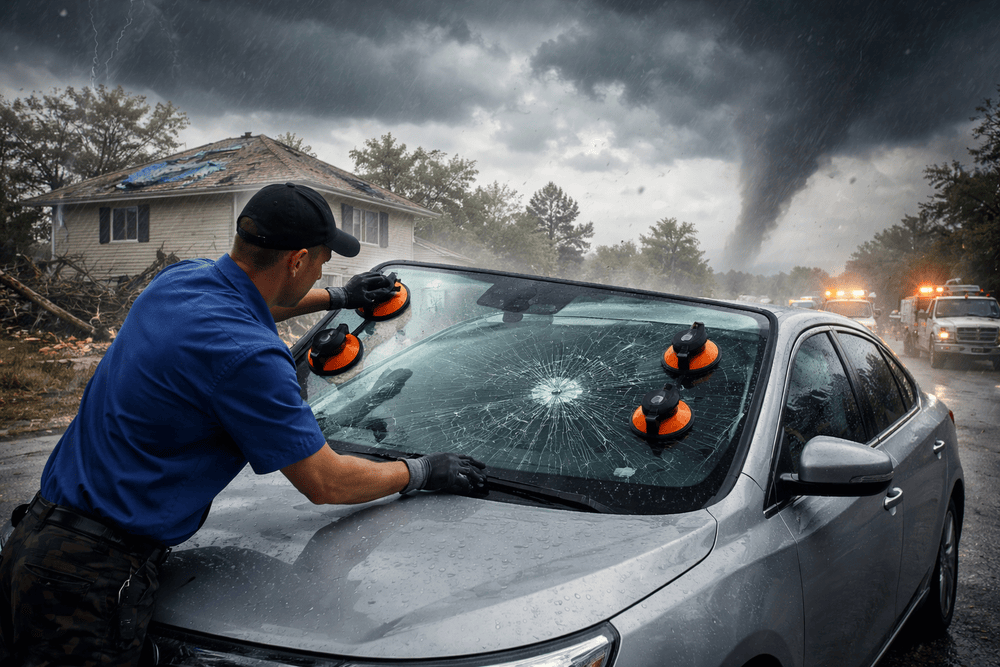
Weather Impact on Insurance Windshield Replacement
Driving in various seasons presents a varied set of difficulties. One day you’re using the air conditioner at full capacity, and the next you’re cleaning your vehicle of a thick film of ice. These abrupt changes do more than just put your patience to the strain. They greatly strain the auto glass of your car. The structural integrity of your windshield is strongly impacted by temperature swings, strong storms, and harsh weather. A single frigid night or a sweltering summer afternoon may suddenly transform a little, hardly perceptible rock chip into a vast web of fissures. You are left staring through a damaged piece of glass that puts your safety on the road at risk as that damage spreads.
Get An Auto Glass Replacement Quote Now 866.278.7417

Windshield Replacement & Repair
Our competitors push you into going to their shop to get your glass fixed-making it cheaper for them. We make it easier for YOU to get back on the road by offering free mobile repairs at your home or work. With our free mobile services servicing the entire Orange County & Los Angeles area, we can often handle your windscreen replacement the same day! So the next time you need a windshield replacement, give us a call.
Talk to a Windshield Replacement Specialist Now 866.278.7417

Calibration
Calibration is the process of returning a vehicle’s ADAS to OEM specifications. Calibration is necessary after a new glass installation, particularly a windshield with a camera mounted to it, to ensure that the ADAS features continue to function properly despite having been moved during installation. If a car’s ADAS is not properly calibrated, the system may not function safely. A misaligned camera could jeopardize the functionality of the system and lead to dangerous driving or accidents, so it is crucial that the cameras are aligned perfectly, which is what windshield calibration ensures.
Talk to a Calibration Specialist Now 866.278.7417

Fleet Auto Glass Repair
We provide expert auto glass repair and windshield replacement services for commercial fleets of all sizes. We are experienced with all manufacturers and machine types of domestic or foreign cars, trucks, vans, or commercial vehicles, including heavy equipment. Our same day mobile auto glass and windshield repair service will enable you to get back on the road faster and start saving you time and money instantly. Give us a call today! We are here to help!
Talk to a Fleet Auto Glass Specialist Now 866.278.7417
The Science of Thermal Stress on Auto Glass
The warmth of its surroundings causes glass to expand and shrink. Even though auto glass is made to resist high pressure, the laws of thermodynamics still apply. Glass undergoes thermal stress when the surrounding temperature changes quickly.
The Effects of Severe Heat: Cars parked outside during the summer are infamously difficult. The dashboard and the trapped air become quite hot when the car is exposed to direct sunshine.
This heat is absorbed by the glass, causing it to expand. Rapid contraction occurs from a quick decrease in temperature when you switch on your car’s air conditioning and blast cold air straight onto a burning windshield.
Tension is greatly increased by this uneven cooling process. This pressure will probably cause any microchips or tiny stars that are already present in the glass to bend and fracture into lengthy horizontal or vertical fissures.
Ice and Freezing Temperatures: Winter presents the opposite issue yet produces a similar outcome. Auto glass tightens and contracts in cold temperatures. The windshield gets somewhat more brittle when temps fall below freezing.
When drivers attempt to thaw their automobiles too soon, the true risk arises. A typical error that almost always results in broken glass is pouring warm water over a frozen windshield.
The glass may expand too rapidly even if the car’s heating is set too high and directed at a frozen windshield. Additionally, moisture might leak into little pieces that already present. The trapped moisture expands and pushes the glass apart from the inside out as it freezes.
Physical Damage and Severe Weather Events
Seasonal storms pose physical risks to your car in addition to temperature changes. A significant portion of yearly vehicle insurance claims are caused by weather-related incidents, with windshields suffering the most damage.
Hailstorms: One of the most damaging weather conditions for car glass is hail. Dense balls of ice hit the windshield with tremendous power as they fall at rapid speeds.
A windshield may be instantaneously shattered by a strong hailstorm, rendering the vehicle unsafe to drive. Even little hail may create significant cracks in the glass that impair your vision and need to be replaced right away.
High Winds and Debris: Gale-force winds are often brought on by strong storms. Gravel, tree branches, and other urban detritus are picked up by these winds and thrown at both parked and driving cars. When a vehicle kicks up a little pebble, it becomes a hazardous missile that may easily pierce your windshield’s protective layer.
How Vehicle Insurance Pays for Windshield Replacement: Your vehicle insurance coverage is your financial safety net in the event that the weather damages your windshield. However, coverage is totally dependent on your state’s rules and the kind of insurance you have.
Explaining Comprehensive Coverage: Comprehensive insurance covers weather-related windshield damage. This part of your coverage covers damage brought on by uncontrollable circumstances including theft, vandalism, accidents with animals, and natural disasters.
Your insurance company won’t pay for weather-related glass repairs if you merely have basic liability coverage. It will be necessary to pay for the replacement out of pocket.
Do you have a Question?
Get An Auto Glass Replacement Quote Now 866.278.7417
Full Glass Coverage and Deductibles
You need to verify your deductible if you have comprehensive coverage. If a replacement windshield costs $400 and your deductible is $500, your insurance will pay nothing. You are liable for the cost up to the deductible.
A “full glass coverage” or “zero-deductible glass” policy is an add-on that many insurance providers provide. This rider is often purchased by drivers who reside in regions vulnerable to severe weather or extensive road construction.
In the event that you have comprehensive glass coverage, your insurance provider will pay the whole cost of fixing your windshield, and you will not be required to pay a deductible for the service at any point. In some states, such as Florida, Kentucky, and South Carolina, insurance companies are legally required to waive the deductible for windshield repairs. These states include South Carolina or Kentucky.
Questions That Are Frequently Asked: Will there be an increase in my insurance rate if I file a claim of windshield damage? Your insurance premiums are often not significantly affected by submitting a comprehensive claim for a windshield replacement.
Weather-related damage is regarded as a “no-fault” event. However, your carrier may change your rates or cancel your zero-deductible glass rider if you file many claims in a short period of time.
Can my windshield be fixed instead of replaced? Repairs are possible if the damage is minimal. In general, a chip smaller than a quarter may be filled with resin.To maintain structural safety, the whole windshield has to be replaced if a crack is larger than a dollar bill or if the damage is directly in the driver’s line of sight.
How long does it take to fix a windshield? A windshield may often be replaced in one to two hours by a qualified auto glass expert. For the urethane glue to thoroughly dry, you will need to wait another hour before operating the car.
Keep Your Windshield Clear and Covered: The safety of your automobile depends on your windshield. In the case of a rollover, it ensures that the airbags will deploy correctly and supports the roof. You and your passengers are at danger if you ignore a weather-induced crack.
To find out your comprehensive coverage limitations and glass deductibles, review your vehicle insurance policy right now. Get in touch with your insurance provider to start a claim if your car’s glass has been broken due to a recent dip in temperature or a strong storm. Replacing your windshield as soon as possible guarantees that you will be prepared for any future weather.
Manage a Windshield Replacement Insurance Claim Wisely
On the highway, a tiny rock hits your windshield, creating a star-shaped break right in front of you. Most drivers encounter this annoying situation at some time.
The simplest course of action could be to ignore the damage, but regular driving vibrations and temperature fluctuations can soon transform a little chip into a big break. You may save a lot of time, money, and frustration by handling an insurance windshield replacement claim wisely.
Many drivers are reluctant to get in touch with their insurance companies because they think the procedure would be too difficult or that their rates will soar. Auto glass claims, however, are often among the easiest to handle.
You may avoid needless out-of-pocket expenses by navigating the specifics of your coverage. You may restore your car’s safety features without breaking the bank by being aware of your particular coverage, knowing when to make a claim, and choosing a reliable repair facility. Everything you need to know to effectively handle your windshield claim is included in this article.
Knowing Your Vehicle Insurance Coverage: You should be aware of what your vehicle insurance policy really covers before you call to report a broken windshield. Policies differ in how they handle glass damage. You may ascertain your financial responsibilities by looking over your disclosure page.
Comprehensive vs. Collision Coverage: Your vehicle insurance policy’s comprehensive section often covers windshield damage. Damage brought on by uncontrollable circumstances is covered by comprehensive insurance.
This includes hail, falling tree limbs, flying debris, vandalism, and harsh weather. Comprehensive coverage is applicable if a rock in front of you kicks up from a vehicle and fractures your window.
Conversely, collision coverage applies if your windshield breaks in an automobile collision with another car or a stationary object. Your windshield repair is covered by the larger accident claim if you rear-end another vehicle and the impact breaks it.
Explaining Full Glass Coverage
Full glass covering is an optional feature for certain drivers. You are fortunate if you reside in a state where this is provided or if local law requires it. The deductible for windshield replacements and repairs is waived with full glass coverage.
This implies that you pay nothing at all out of pocket and your insurance provider covers the whole cost. To find out whether you have this particular endorsement, see your policy documentation or speak with an insurance agent.
When Is the Right Time to Make a Windshield Claim? It’s not always the wisest financial decision to file a claim just because you have insurance. The extent of the damage must be assessed and compared to the deductible under your policy.
Evaluating the Damage: Replace or Repair?Not all cracked windshields need a complete repair. Auto glass professionals can often fix fractures smaller than a dollar note and chips smaller than a quarter. Fast, eco-friendly, and structurally sound repairs are made.
Because repairs are far less expensive than replacements, insurance companies strongly support them. In fact, if you choose a repair rather than a complete replacement, many insurers will completely waive your comprehensive deductible. A complete replacement is absolutely required for your safety if the damage is in your direct line of sight or if the fracture reaches the edge of the windshield.
Comparing Out of Pocket Expenses with the Deductible
You need to check your comprehensive deductible if a replacement is necessary. Typically, deductibles fall between $250 and $1,000.
For a cash quotation for the make and model of your particular car, give a couple nearby auto glass companies a call. It makes no sense to file a claim if the shop estimates you $300 for a new windshield but your deductible is $500. In either case, the whole $300 amount would be your responsibility.
Due to the required camera recalibration, replacing an advanced driver assistance system (ADAS) in a new car may easily cost upwards of $1,000. In such case, it makes sense to pay a $250 deductible in order to properly submit an insurance windshield replacement claim.
The Step-by-Step Guide to Filing Your Claim: It doesn’t have to be difficult to file a glass claim. Adhering to a methodical methodology guarantees prompt approval of your claim and accurate completion of the task.
Documenting the Damage: Take crisp pictures of your windshield before taking any further action. Take pictures of the impact site up close and from broader perspectives that include your license plate and the full windshield.
Make a note of the damage’s location, time, and date. In order to properly process the claim and confirm that the damage corresponds with a thorough occurrence, insurance adjusters need this information.
Getting in Touch with Your Insurance Company
Glass claims are handled by specialist departments at most big insurance companies. Generally, you may use your provider’s website, mobile app, or toll-free phone number to file a claim. Give them the date of the occurrence, your policy number, and the pictures you took.
Your coverage and deductible amount will be confirmed by the agent. Additionally, they will let you know whether a basic repair qualifies for a deductible waiver.
Selecting the Best Auto Glass Shop: Your insurance provider will probably suggest a favored shop or a certain auto glass network. Although following their advice is practical, you are legally free to choose any authorized repair shop of your choosing.
Make sure the shop has the equipment needed to adjust the windshield cameras if your vehicle includes features like automated emergency braking or lane departure alerts. Your safety features may malfunction if these systems are not correctly recalibrated, placing you in grave danger.
Will Your Premium Go Up If You File a Windshield Claim? Drivers often worry that utilizing their insurance to repair their windshield may result in higher monthly premiums. Your provider, your driving record, and your location all play a major role in reality.
Do you have a Question?
Get An Auto Glass Replacement Quote Now 866.278.7417
Premium Rates and No Fault Claims
A thorough, no-fault claim is made for windshield damage caused by flying debris. The damage was not caused by your careless driving. For a single comprehensive claim, many insurance companies do not increase rates.
Insurance companies are even forbidden by law in certain areas from increasing premiums based just on a no-fault comprehensive claim. However, your insurer may identify you as a high-risk client if you submit many glass claims in a little amount of time.
Regular claims may result in the insurer canceling your comprehensive coverage entirely or raising your premiums when your policy is renewed. Always save your claims for major costs rather than little repairs that you may easily pay for yourself.
Original Equipment Manufacturer (OEM) and Original Equipment Equivalent (OEE), often known as aftermarket glass, are the two kinds of glass you will come across while replacing your windshield.
OEM glass is produced by the same business that supplied your car’s original glass. It precisely matches the thickness, color, and specs of your original windshield. Independent businesses produce aftermarket glass. There may be some variation in its thickness or acoustic properties, despite the fact that it must comply with the mandatory minimum safety criteria.
Because aftermarket glass is far less expensive, insurance companies often choose to pay for it. Aftermarket glass is often fine if your automobile is older. However, OEM glass is strongly advised for the best sensor performance if you drive a more recent premium automobile or one that is largely dependent on ADAS cameras.
Common Questions
How long does it take to complete an insurance claim for a windshield replacement? Glass claims are usually processed quickly. They are approved by many insurance carriers in less than a day. After being approved, mobile glass professionals may often visit your house or place of business to repair the windshield in a day or two.
Does my deductible need to be paid in full up front? Yes, when the job is finished, you typically give the vehicle glass repair service your deductible. The remaining amount is paid to the store by the insurance carrier.
If I drive with a cracked windshield, would I get a ticket? Indeed. If the damage impairs the driver’s vision or jeopardizes the vehicle’s structural integrity, law enforcement officials may issue tickets for cracked windshields. It is preferable to deal with the harm as soon as possible.
Is camera recalibration covered by my insurance? Your comprehensive insurance coverage should cover the cost of camera recalibration if your car needs one after a windshield replacement, less your deductible. Recalibration is now seen by insurers as an essential part of the replacement process.
Get Back on the Road Safely: Managing your insurance windshield replacement claim wisely reduces the irritation of dealing with shattered car glass, which may be an unforeseen burden.
Examine your insurance documentation carefully to learn about your coverage limitations and deductibles. Determine if a simple repair will be sufficient or whether a complete replacement is required by carefully assessing the damage.
You can guarantee a high-quality repair by accurately recording the occurrence, choosing a reputable repair facility capable of handling camera recalibration, and being aware of the differences between OEM and aftermarket glass. Put your safety and visibility first, and make advantage of the perks you currently pay for to restore your car to perfect condition.
Mobile Safe Auto Glass
14241 E Firestone blvd suite 400,
La Mirada, CA 90638
Phone: (562) 608-1154
Toll Free: 1 866 278 7417
Mail: sales@mobilesafeautoglass.com
Get a FREE QUOTE today! You can get a free quote and schedule 24/7 using this free quote wizard.
Mon – Fri 8am – 5pm
Saturday 8am – 1pm
Sunday Closed