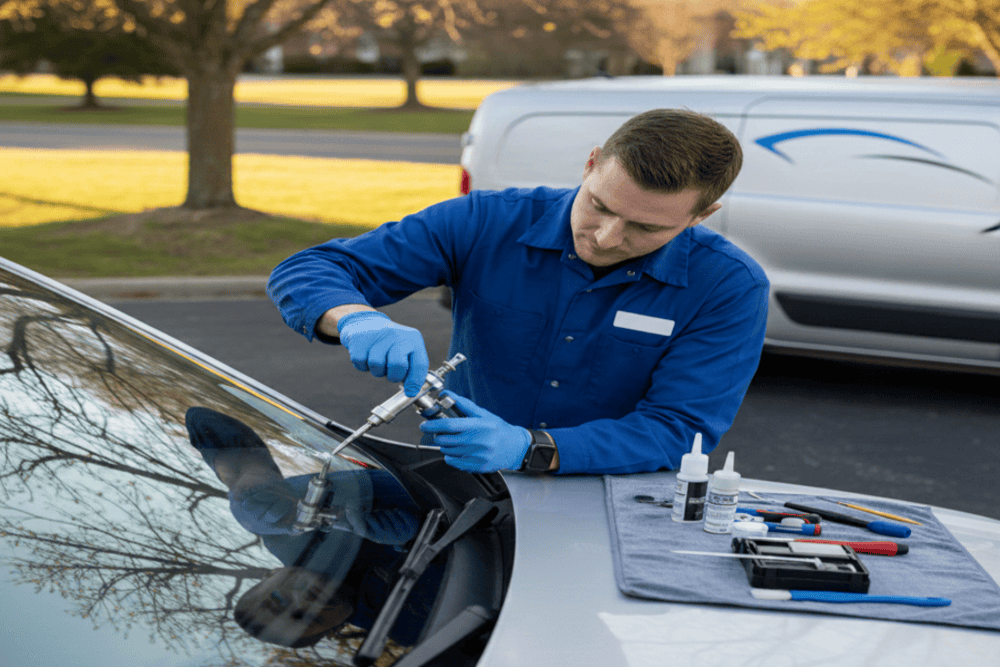
Understanding the Mobile Windshield Repair Procedure
Most often, it happens when you least anticipate it. A dump truck in the next lane throws up a piece of gravel as you are driving along the highway, possibly on your way to work or beginning a road vacation. A star-shaped chip appears in your line of sight as soon as you hear that nauseating pop. Ignoring it in the hopes that it won’t become worse may be your initial instinct. However, you know deep down that an unexpected pothole or a change in temperature may cause that tiny chip to grow into a huge fissure that covers the entire dashboard. The main problem is finding the time to make the necessary repairs. It’s not enticing to take a few hours off work to wait in an auto shop.
Get An Auto Glass Replacement Quote Now 866.278.7417

Windshield Replacement & Repair
Our competitors push you into going to their shop to get your glass fixed-making it cheaper for them. We make it easier for YOU to get back on the road by offering free mobile repairs at your home or work. With our free mobile services servicing the entire Orange County & Los Angeles area, we can often handle your windscreen replacement the same day! So the next time you need a windshield replacement, give us a call.
Talk to a Windshield Replacement Specialist Now 866.278.7417

Calibration
Calibration is the process of returning a vehicle’s ADAS to OEM specifications. Calibration is necessary after a new glass installation, particularly a windshield with a camera mounted to it, to ensure that the ADAS features continue to function properly despite having been moved during installation. If a car’s ADAS is not properly calibrated, the system may not function safely. A misaligned camera could jeopardize the functionality of the system and lead to dangerous driving or accidents, so it is crucial that the cameras are aligned perfectly, which is what windshield calibration ensures.
Talk to a Calibration Specialist Now 866.278.7417

Fleet Auto Glass Repair
We provide expert auto glass repair and windshield replacement services for commercial fleets of all sizes. We are experienced with all manufacturers and machine types of domestic or foreign cars, trucks, vans, or commercial vehicles, including heavy equipment. Our same day mobile auto glass and windshield repair service will enable you to get back on the road faster and start saving you time and money instantly. Give us a call today! We are here to help!
Talk to a Fleet Auto Glass Specialist Now 866.278.7417
Determining if You Need Repair or Replacement
To make sure the glass can truly be fixed, a technician will typically ask a few questions before coming. Not all cracks can be easily repaired. If the damage is excessive, it jeopardizes the glass’s structural integrity and necessitates a complete replacement.
A mobile repair is typically appropriate if:
Size: Although many technicians prefer to limit repairs to damage smaller than a quarter, the chip or crack is less than a dollar note (approximately six inches).
Depth: The inner layer of the safety glass has not been affected.
Location: The crack is away from the edge of the windshield and outside the driver’s direct line of sight because repairs may cause a minor distortion.
You are prepared for the mobile repair procedure if your damage meets these requirements.
The Mobile Repair Process: Step-by-Step: The technician doesn’t simply apply adhesive and walk away when they get to your place. Your glass’s structural strength will be restored through a precise chemical and mechanical process. This is precisely what takes place.
The First Assessment: The technician begins by closely examining the damage. They look for “legs”—tiny microcracks extending from the center—and measure the impact point’s depth. Additionally, they guarantee that the windshield is at a safe temperature.
The resin might not cure properly if the glass is either too hot (from exposure to the sun) or too cold. To maintain the glass temperature, they could use a heat gun, the car’s defrost or air conditioning system, or both.
Preparation and Cleaning
Perhaps the most important step is this one. The crack needs to be clear of moisture, debris, and glass dust in order for the repair glue to adhere to the glass. Usually, the technician will choose loose glass fragments from the impact crater using a specialized probe.
Before continuing, they must fully evaporate any moisture that may have become trapped inside the crack (this is typical on rainy or damp days). Over time, the repair will become hazy because of trapped water.
Drilling (If Necessary): The technician may need to make a cleaner path to guarantee that the resin enters all of the tiny crack’s crevices. They might drill a tiny, precise hole in the collision point. This allows the break to better take the resin without causing additional harm to the windshield.
Resin Injection: The technician places an injector or “bridge” tool right on top of the chip. By using this tool, a vacuum seal is created against the glass.
The vacuum cycle begins with the instrument sucking air from the crevice. There will be weak spots and bubbles if the air stays within.
The Injection Cycle: The technician injects a specific liquid resin once the air has been removed. The refractive index of glass and this resin are optically matched.
The resin is pulsed deep into the “legs” of the star break or fracture by the injector’s pressure-vacuum cycle. To make sure the dark patches, which signify air gaps, are going away, you might observe the technician using a mirror inside the vehicle.
Curing the Resin: The resin must solidify after the crack has been filled. Resin for windshield repairs is UV-cured and anaerobic. After taking out the injector, the technician will cover the wet resin with a curing tab, which is a tiny piece of plastic film.
After that, they expose the region to UV radiation. Specialists typically use a high-intensity UV lamp, but natural sunlight on a sunny day can also cure it. This procedure binds the glass together and stops the break from spreading by solidifying the liquid resin into a plastic in a matter of minutes.
Do you have a Question?
Get An Auto Glass Replacement Quote Now 866.278.7417
Cleaning and Polishing
The technician removes the curing tab once the resin has completely dried. On the surface, there will frequently be a tiny pile of extra dried resin. They scrape this flat with the surrounding glass using a razor blade. Lastly, they polish the impact point using a pit polish. By doing this, the repair becomes as transparent as possible, and the luster is restored.
Managing Your Expectations: Although mobile windshield repair is quite successful, it’s crucial to know how the final product will appear. Structural integrity, not aesthetic perfection, is the aim of repair. Most of the time, the repair will remove 80% to 95% of the damage.
You might still notice a minor imperfection, though, which frequently looks like a tiny insect splatter or a dried wet spot. This is referred to as the “scar” of the repair. Although the glass is secure and robust, the damage won’t completely go away like it would if it were struck by a magic wand.
Is it possible to perform mobile repair in the rain? Yes, technically, but it needs to be covered. The technician can work if you have a carport or garage. If your car is parked on the street during a downpour, they may have to reschedule. The adversary of a successful windshield repair is moisture.
What is the duration of the procedure? Speed is one of the main benefits of mobile repair. Typically, repairing a rock chip takes 30 to 45 minutes. You don’t waste time traveling to a store since they come to you.
Will my insurance cover the repair? Indeed, this is often the case. Many comprehensive policies eliminate the deductible for windshield repairs because insurance companies would prefer to cover a low-cost repair over an expensive replacement. The mobile repair firm can often handle the necessary paperwork.
Can I immediately wash my car? Indeed. The resin is completely hardened by the time the technician departs since it is cured with UV light during the procedure. You may drive, wash, or activate the wipers right away.
Avoid Waiting for the Crack to Widen
Comprehending the mobile windshield repair process makes it clear how easy and sophisticated it is. It is an elegant method of protecting your windshield without interfering with your day.
Time is of the essence if you have a rock chip. A repairable chip can become a complete loss overnight due to vibrations from driving, slamming car doors, and simple temperature changes. You may avoid the inconvenience of a shop visit by using a mobile service to keep your car safe and road-ready.
Understanding Windshield Repair: From Chip Assessment to Cure Every driver fears the sound of a loud crack on the highway. When a semi-truck tire launches a little rock, it might immediately jeopardize the safety of the vehicle.
A tiny rock chip may appear to be a minor aesthetic annoyance, but it is actually a structural vulnerability that could develop into a larger fissure. Windshield repair is a precise science.
It calls for perseverance, the appropriate equipment, and rigorous attention to protocol. If you rush the process, the repair won’t work, and the glass will likely appear worse than it did before or, worse, crack more when stressed.
Knowing the mechanics of windshield repair is crucial for technicians and serious do-it-yourselfers. It goes beyond just sticking glue in a hole.
Air is displaced, resin is injected under pressure, and the glass is chemically bonded back together. From the first evaluation of the damage to the last UV treatment, this book explains every step of a professional windshield repair.
Evaluating the Damage
Even before you reach for the tools, every effective repair starts. In the diagnostic stage of assessment, you determine whether you can salvage the windshield or if a complete replacement is required. The most frequent reason for unsuccessful repairs is skipping this step.
Determining the Type of Chip: The response of various impact damages to resin injection varies. Knowing the “personality” of the break assists in making the best decision.
Bullseye: A neat, round fracture including an impact point and a noticeable dark circle. Since the damage is contained within a cone of glass, these are typically the easiest to repair.
Short cracks that radiate outward from the impact point are known as star breaks. Because too much pressure can cause the star’s legs to spread, these need to be carefully controlled.
Combination Break: A cross between a star and a bullseye. These are typical and they need a full cycle of alternating vacuum and pressure to fill.
Half-Moon: Not a full circle, but comparable to a bullseye. It can be challenging to completely fill these due to the irregular formation of the air pocket.
Assessing Location and Size: Not all chips require repair. Certain limitations are set by industry standards (such as the ROLAGS standard). In general, the damage is a candidate for repair if it is smaller than a quarter, or around one inch in diameter. But location is important.
A repair may still leave a little distortion that could divert the driver if the damage is directly in the “acute area,” or the driver’s vital seeing area. Replacement is frequently the safer course of action in these situations. Furthermore, if the break reaches the glass’s edge, it likely irreparably damages the structural integrity.
Getting the Impact Point Ready
After the repair has been approved, planning is essential. Resin cannot be bonded to loose glass, dampness, or dirt. Glass expands and contracts in response to temperature. If a repair is attempted on a heated windshield, the glass may break under the pressure of the injector, or the resin may cure too quickly. On the other hand, a frozen windshield may cause the break to shrink, which would prevent resin from flowing.
The ideal temperature range for the glass is 70°F to 90°F. Cool the car gradually if it has been in the sun (never put cold water on heated glass). If it’s chilly, use a specialist heating tool or the car’s defroster to gradually warm the glass.
Cleaning and Drilling: Carefully remove any loose glass fragments from the impact pit using a probe. This makes room for the resin. At this point, avoid using glass or chemical cleaners, as these may contaminate the crack and hinder bonding.
Drilling is required in some situations. Resin cannot penetrate the break if the impact point is too small or sealed over. A clear path for the resin is created by carefully drilling a small hole into the impact pit without going through the laminate layer. This step is frequently necessary for old chips that have collected road grit or tight star breaks.
The core of the procedure is the injection process. The objective is straightforward: liquid resin is used to replace the trapped air inside the breach.
Putting the Bridge in Place
The injector is held directly over the impact location by the repair bridge. Here, precision cannot be compromised. The injector’s seal needs to be precisely centered over the pit. Resin will leak onto the glass surface instead of pushing its way into the crack if the seal is off-center, which will result in a loss of pressure.
The Vacuum Cycle: Air must escape before resin can enter. The resin cannot cover the tiny crevices because of trapped air. When the injector is in vacuum mode, the piston is drawn upward to produce negative pressure.
Usually, air bubbles will be visible rising through the injector’s resin. This indicates that the air is leaving the brake, which is a positive sign. Usually, this cycle continues for a few minutes or until the bubbles cease rising.
The Pressure Cycle: The injector is switched to the pressure cycle when the air is eliminated. The resin is forced into the space created by the air as the piston is pushed downward.
Here, visual investigation is crucial. As the resin fills the dark, murky parts of the break—which represent air—you should be able to see them change transparent when viewed from within the car.
Do you have a Question?
Get An Auto Glass Replacement Quote Now 866.278.7417
Changing Cycles
A single vacuum and pressure cycle is rarely sufficient. The tips of star breaks are frequently where stubborn air pockets lie. Usually, technicians switch between vacuum and pressure cycles several times. This “push-pull” mechanism makes sure that all of the crack’s tiny legs are filled and that no air is left.
Curing and Finishing: At this point, liquid resin has filled the crack, but the structural integrity has not yet been restored. It is necessary to solidify the liquid.
Applying Pit Resin: There will be a tiny bit of extra resin on the surface after the injector is taken out. To achieve a smooth, long-lasting surface flush with the glass, you need to use a certain “pit resin” or “pit filler.” This resin is thicker and harder than the injection resin.
Cover the pit resin with a curing tab, which is a tiny piece of plastic. By doing this, the resin is flattened to fit the glass’s shape, and oxygen is blocked, enabling anaerobic curing.
UV Curing
Because windshield repair glue is photopolymerizable, exposure to UV light causes it to solidify. The repair area is illuminated by a UV curing lamp.
The curing time typically takes three to five minutes, though it varies depending on the resin type and lamp strength. Resin can be cured by sunshine; however, this process is not always reliable. A professional UV lamp guarantees a thorough, consistent cure over the whole healing depth.
Scraping and polishing: Take out the UV lamp and peel off the curing tab once the resin has solidified. The surplus pit resin will solidify as a mound.
Scrape away extra resin with a razor blade at a 90-degree angle until it is flat with the surrounding glass. Last but not least, a brief buff with a cork or microfiber cloth and a dab of pit polish will restore the sheen, making the repair almost undetectable.
Common Repair Pitfalls: Errors can occur even when proper procedures are followed. By avoiding these typical mistakes, one can distinguish a novice from an expert.
Over-pressurizing: When excessive pressure is applied during the injection cycle, the resin pushes the glass layers apart, resulting in “flowering,” a permanent, unsightly ring surrounding the repair.
Moisture Contamination: If a windshield is repaired in the rain or with excessive humidity without first thoroughly drying the break, the repair will be hazy. Resin and water don’t mix.
Under-Curing: When UV light is removed too soon, the resin becomes pliable on the inside. The fix will eventually fail when it shrinks and separates from the glass.
Ignoring the Inner Layer: Occasionally, a rock strike might cause enough damage to the glass’s inner layer, or lamination. A typical external repair won’t work if you notice damage to the windshield’s interior surface.
Common Questions
After repair, will the chip fully vanish? No amount of correction can completely erase the damage. Restoring structural integrity and enhancing visibility are the objectives. A successful repair will remove 80% to 95% of the damage, usually leaving only a small spot or faint outline where the impact happened.
How much time does it take to fix a windshield properly? It usually takes 20 to 30 minutes for a professional repair. This considers the amount of time required to accomplish a complete UV cure and to correctly cycle between vacuum and pressure.
Can I replace a professional service with a do-it-yourself kit? Although do-it-yourself kits follow the same fundamentals, they frequently lack the high-quality resin and vacuum pressure found in professional instruments. Professional equipment is significantly more dependable for intricate breakage or deep damage, but they can handle very basic, little surface chips.
Securing the Glass for the Long Run: Repairing a windshield is a restorative procedure. By carefully proceeding from assessment to preparation, injection, and cure, you can transform a weak fracture into a strong, bonded surface.
You may troubleshoot challenging breaks and guarantee a high-quality outcome every time by comprehending the principles underlying the vacuum and pressure cycles. Following the procedure guarantees that the glass will stay safe and clean for many miles to come, whether you are maintaining your car or overseeing a fleet of vehicles.
Mobile Safe Auto Glass
14241 E Firestone blvd suite 400,
La Mirada, CA 90638
Phone: (562) 608-1154
Toll Free: 1 866 278 7417
Mail: sales@mobilesafeautoglass.com
Get a FREE QUOTE today! You can get a free quote and schedule 24/7 using this free quote wizard.
Mon – Fri 8am – 5pm
Saturday 8am – 1pm
Sunday Closed