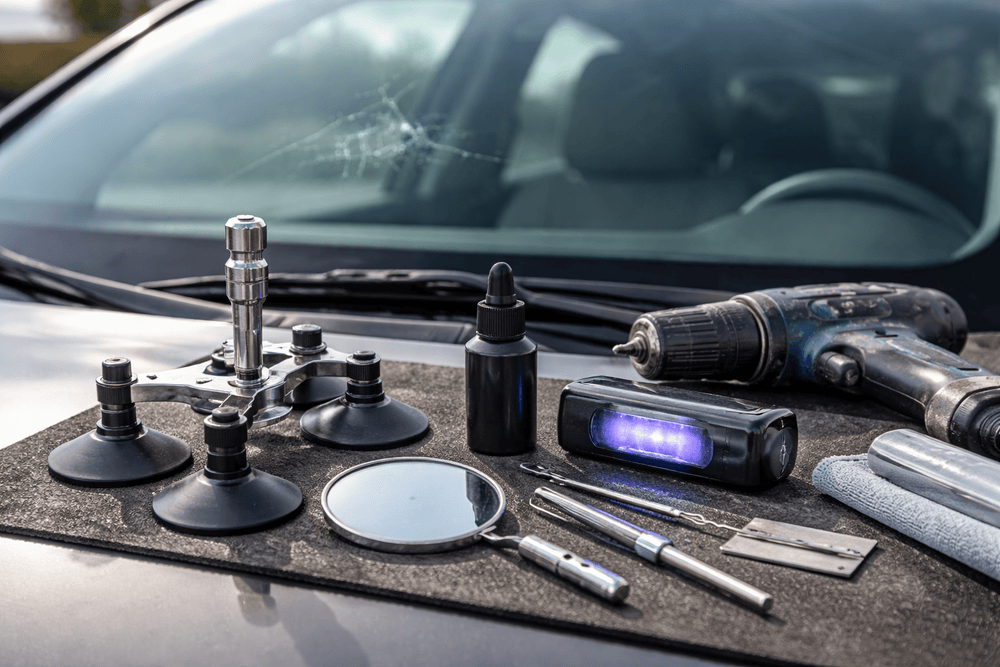
Tools Used in Broken Windshield Repair
You hear the dreaded snap as you’re traveling down the highway. Right in front of you is a bullseye crack caused by a rock that was kicked up by a truck. Although replacing the entire windshield might be your first thought, many chips and cracks can be readily fixed. However, how precisely can a sharp glass break become a smooth, translucent surface again? It’s not magic. It is a precise procedure that depends on pressure, chemistry, and a certain set of instruments. Expert car glass experts replace the air in the break with a curable resin that fuses the glass together using a specialized kit.
Get An Auto Glass Replacement Quote Now 866.278.7417

Windshield Replacement & Repair
Our competitors push you into going to their shop to get your glass fixed-making it cheaper for them. We make it easier for YOU to get back on the road by offering free mobile repairs at your home or work. With our free mobile services servicing the entire Orange County & Los Angeles area, we can often handle your windscreen replacement the same day! So the next time you need a windshield replacement, give us a call.
Talk to a Windshield Replacement Specialist Now 866.278.7417

Calibration
Calibration is the process of returning a vehicle’s ADAS to OEM specifications. Calibration is necessary after a new glass installation, particularly a windshield with a camera mounted to it, to ensure that the ADAS features continue to function properly despite having been moved during installation. If a car’s ADAS is not properly calibrated, the system may not function safely. A misaligned camera could jeopardize the functionality of the system and lead to dangerous driving or accidents, so it is crucial that the cameras are aligned perfectly, which is what windshield calibration ensures.
Talk to a Calibration Specialist Now 866.278.7417

Fleet Auto Glass Repair
We provide expert auto glass repair and windshield replacement services for commercial fleets of all sizes. We are experienced with all manufacturers and machine types of domestic or foreign cars, trucks, vans, or commercial vehicles, including heavy equipment. Our same day mobile auto glass and windshield repair service will enable you to get back on the road faster and start saving you time and money instantly. Give us a call today! We are here to help!
Talk to a Fleet Auto Glass Specialist Now 866.278.7417
The Tools for Inspection and Preparation
The damage needs to be evaluated and prepared before any resin comes into contact with the glass. The repair is likely to fail if the area is not accessible and clean.
Inspection Mirror: Technicians must view a fracture from all sides in order to fully comprehend its extent and seriousness. The inside of the windshield is equipped with an inspection mirror.
This eliminates the need for the repairman to continuously bend into the vehicle to observe the brake clearly from the outside. In order to guarantee that the resin reaches every area of the damage, it draws attention to the “legs” of the crack—the microscopic cracks extending from the impact point.
Carbide Probes: A probe is a sharp instrument that resembles a needle and is used to clean the impact site. It is used by the technician to carefully remove loose pieces of dirt, glass, or road debris from the chip’s “pit” (center). This is an essential step because if trapped material is not removed, it will be permanently sealed inside the glass, producing a visible imperfection.
Rotary Drill and Burrs: Occasionally, the chip’s opening is too tiny to efficiently inject resin. A tiny, fast rotary drill is employed in these situations. These are more accurate and lightweight than a typical home drill.
They delicately drill into the impact spot using small carbide burrs. Instead of drilling through the glass, the objective is to make a clear, easily accessible passageway to the air pocket underneath. This guarantees that the resin can enter the break without restriction.
The System of Injection
The operation’s core is this. After the glass has been prepared, the air needs to be expelled and a bonding agent added. The mounting device that secures the injector in position is called the Repair Bridge. Usually, a powerful suction cup is used to secure it to the windshield.
Directly above the damage, the bridge establishes a sturdy platform. Stability is essential since the seal will break and the repair will be jeopardized if the tool moves throughout the pressure cycle. Bridges come in a variety of forms:
Tripod bridges: For optimal stability on curved glass, these provide three points of contact.
Lever-style Bridges: These may be quickly attached and removed thanks to a suction lever.
The cylinder that performs the heavy lifting is called the injector, and it is attached to the bridge. It functions similarly to an advanced syringe. Two separate cycles are carried out by the injector: In order to draw air out of the crack, the vacuum cycle pulls the piston higher.
Pressure Cycle: It forces liquid resin into the void by pushing the piston downward.
Stainless steel or sturdy aluminum is used to make high-quality injectors that can handle the pressure needed to seal small gaps (like star breaks) without leaking.
Do you have a Question?
Get An Auto Glass Replacement Quote Now 866.278.7417
The Chemical Bonding Agents
Without the proper materials, the tools are useless. A specific type of acrylic acid called windshield repair resin cures when it comes into contact with ultraviolet light.
Low-Viscosity Resin: Technicians utilize a very thin, watery resin for the first injection. Because of its low viscosity, it can wick deeply into the break’s smallest nooks and crannies.
Because of its powerful capillary action, it can draw itself into the damage without using a lot of pressure. Since this epoxy is made to have the same refractive index as glass, once it cures, the windshield repair will hardly be noticeable.
High-Viscosity Pit Filler: The surface impact site, or pit, still needs to be sealed once the interior crack has been filled. For this, a thicker, more viscous glue is utilized.
It is robust enough to resist exposure to the weather and the sweep of windshield wipers. By serving as a cover, this “pit filler” seals the repair and gives it a smooth surface.
Equipment for Curing and Finishing: The resin must solidify after entering the fracture. Because windshield resin is anaerobic, it needs UV light to solidify and will not cure correctly in the presence of air.
UV Curing Light: Previously, windshield repairs had to be completed outdoors on bright days. Regardless of the weather, professionals now employ UV curing lights to solidify the resin in a matter of minutes.
LED Lights: High-intensity LEDs are used in contemporary kits. They run on batteries, are portable, and cure resin rapidly—often in less than a minute.
Tube Lights: Fluorescent UV tubes are used in older models. Despite their effectiveness, they are more brittle and frequently need a power cord.
Tabs for Curing
The repair area needs to be covered throughout the curing process because oxygen prevents the chemical reaction that hardens the resin. Curing tabs are tiny, translucent plastic squares made of Mylar.
The technician covers the wet resin with a tab after applying the pit filler. This flattens the resin and stops the oxygen supply, enabling the UV light to act efficiently.
Razor Blades: There will be extra firm resin on the glass’s surface after the resin has dried and the tab has been removed. This extra is scraped off with a typical industrial razor blade. The blade shears off excess resin flush with the glass without causing any scratches to the windshield when held at a 90-degree angle.
Pit Polish and Buffer: This last stage is purely decorative. Even after scraping, the repair may appear a little drab in comparison to the gleaming glass around it.
The repair is polished till it shines using a little cork or felt buffing wheel that is mounted to the drill after a drop of mild abrasive polish has been applied. Clarity is restored, and the fix feels smooth to the touch.
Tools for Temperature Control: Glass expands and contracts in response to temperature, which can cause a crack to appear or a snap to close. In order to assist a repair, technicians frequently need to adjust the glass’s temperature.
Heating Element: The glass can be gently expanded with the use of a lighter or a specialist heating tool. A tight fracture may “open” as a result, making it easier for resin to flow.
UV Shade: The resin may cure too quickly before it reaches the bottom of the crack if you’re working outside on a hot, sunny day. During the injection phase, the windshield is covered with a big umbrella or UV shield to keep the sun out.
The Significance of Expert Tools
Auto parts retailers may sell do-it-yourself windshield repair kits for a few bucks. These typically include a small resin tube, a simplified adhesive pad, and a plastic syringe. They lack the suction power and pressure required for a long-lasting repair on serious damage, even if they can work on extremely small surface chips.
Professional tools are made to be precise and repeatable. Compared to a plastic syringe, the stainless steel injectors can produce a lot more pressure, which guarantees that the resin fills the tiny crack tips.
The unique resins are designed to keep the view clean for years by preventing yellowing over time. The quality of the tools employed has a significant impact on the repair’s quality when it comes to a vehicle’s structural integrity.
Keep Your Vision Clear: Repairing windshields is an intriguing combination of chemistry and mechanics. A piece of glass that would normally wind up in a landfill can be saved by experts using injectors to control pressure, bridges to stabilize the area, and UV radiation to strengthen the bond.
Don’t disregard a rock chip that you see on your windshield. You may restore the safety and clarity of your view in less than half an hour by using the appropriate equipment and techniques to remedy that defect.
Why Expert Equipment Is Important for Windshield Repair: A tiny rock chip on a windshield may appear to be an easy remedy. You only need a small amount of resin and curing light, right? Although the idea is simple, it takes science to execute.
When it comes to auto glass, one crucial element frequently determines the difference between a “decent” and a “perfect” repair: the tools used. The desire to save money on tools is significant for technicians and business owners.
Low-cost entry-level kits are easily found online. Professional windshield repair, however, is an art form that requires accuracy. The structural integrity of the glass, the repair’s optical clarity, and ultimately your company’s reputation are all determined by the quality of your equipment.
Purchasing high-quality equipment for professionals is about providing a service that guarantees lifespan and safety, not merely about owning fancy tools. Here are some reasons why improving your toolbox is the best course of action for your company.
The Science of Vacuum and Pressure
Windshield repair is fundamentally about displacement. Resin must be used to replace the trapped air inside a break. This calls for a careful balancing act between cycles of vacuum and pressure.
The issue with do-it-yourself kits is that inexpensive injectors frequently use syringe-style plungers or basic screw mechanisms. These are capable of producing some pressure, but they are not consistent enough or strong enough to break through complex fractures or tight star breaks.
Additionally, they have trouble maintaining a vacuum; thus, air pockets are frequently left behind. When the light strikes these air pockets, they shimmer, giving the appearance of an incomplete windshield repair.
The Professional Advantage: Precision engineering goes into professional injectors. They make use of premium seals and pistons that are made to produce a strong vacuum that extracts every air molecule from the crack.
On the other hand, without blowing out the glass, they can produce the precise pressure required to push high-viscosity resin into the smallest microcracks. This degree of control enables a specialist to fully repair the damage, restoring the strength of the windshield and making the damage almost undetectable.
Not Every Chemical Is Made Equally
Hardware is not the whole story. The result is greatly influenced by the resin, the liquid gold of the business.
Generic, “one-size-fits-all” resins are frequently included in inexpensive kits. The optical clarity of glass is frequently absent from these inferior acrylics. When exposed to UV light and temperature changes, they may eventually yellow, shrink, or crack.
A cheap resin fix can appear fine for a week, but if you give it a hot summer or a cold winter, the windshield chip may spread or return. Expert systems make use of complex resin compositions.
They are made with precise refractive indices to precisely match the glass and are devoid of acid. They are also available in different viscosities.
A skilled technician is aware that the impact point should be covered with a thicker, pit-fill resin and the break body should be covered with a thin, penetrating resin. This chemical bonding guarantees that the repair restores the windshield’s structural integrity rather than merely patching the hole.
The Distinction Between Five Minutes and Five Years: The resin must solidify after it is in the break. Exposure to ultraviolet (UV) light causes this.
Low-cost kits frequently rely on weak, battery-powered UV lamps or the sun, which is erratic. Deep within the fracture, “uncured” resin results from weak curing lamps. The fix produces a weak point if the resin doesn’t fully harden. The break may reopen as a result of the vehicle’s vibration or the strain of the road.
High-intensity LEDs with particular wavelengths are used in professional curing lamps to quickly and completely cure resin. In just a few seconds, the resin will solidify from the top of the pit to the bottom of the crack thanks to a professional-grade light. For the shop owner, this speed boosts productivity, but more significantly, it ensures a long-lasting repair that won’t break down later.
Do you have a Question?
Get An Auto Glass Replacement Quote Now 866.278.7417
The Effect on the Reputation of Businesses
Your reputation is your cash in the service sector. Not only will a consumer be irritated if their windshield cracks a week after leaving your store due to subpar equipment, but they will also tell their friends.
Using expert equipment reduces the possibility of warranty work and liabilities. You can provide lifetime warranties on your work with confidence when you utilize the best tools since you know the repair is reliable.
This fosters trust. Consumers are prepared to pay more for a dependable service. Purchasing professional equipment is an investment in client happiness and referrals, not just in tools.
Ergonomics and Efficiency: Time is money. A technician who is having trouble with an intricate, low-cost bridge assembly is losing money.
Expert windshield repair bridges are made to be quick and simple to use. They have easy-to-clean parts, quick-mounting suction cups, and sturdy materials like anodized aluminum and stainless steel. They don’t take minutes to set up.
Professional equipment is also made to last. After fifty repairs, a cheap plastic injector may lose its threads. With the right care, a high-quality stainless steel injector may withstand thousands of repairs. The cost per repair is actually reduced over time by using high-quality equipment because you aren’t constantly replacing broken plastic parts.
Safety First: The Vehicle’s Structural Integrity It’s easy to overlook the windshield’s role as a safety feature. Up to 60% of the structural integrity of the cabin is provided by the windshield in a rollover accident. Additionally, it serves as the passenger-side airbag’s backstop.
The occupants’ safety is jeopardized if a windshield malfunctions due to a poorly performed repair. Expert equipment guarantees that the bonded area is at least as strong as the original glass.
Ethical technicians are aware that they are preserving a multi-ton vehicle’s safety features rather than merely repairing a cosmetic flaw. No professional should be willing to take the safety risk of using inferior equipment in order to save a few dollars.
How to Pick the Proper Tools
The alternatives can be overwhelming if you want to establish a business or modify your setup. What to look for in a professional kit is as follows:
For stainless steel injectors, look for accurate machining and longevity.
Superior Resins: Verify if the provider provides a range of viscosities and anti-yellowing assurances.
Strong UV Curing: LED technology is currently the benchmark for consistency and speed.
Training and Support: To help you become an expert with their tools, the top equipment manufacturers provide certification and continuing assistance.
In summary, windshield repair is a complex and specialized craft. The ceiling for quality is high, even though the entry barrier may appear low. It is frequently the toolset that distinguishes a true professional from a hobbyist.
You may guarantee improved aesthetic outcomes, more robust structural repairs, and a more effective workflow by using professional-grade equipment. Above all, you show a dedication to quality and safety that clients will appreciate. Make sure your equipment selection is apparent in a field that relies heavily on clarity.
Mobile Safe Auto Glass
14241 E Firestone blvd suite 400,
La Mirada, CA 90638
Phone: (562) 608-1154
Toll Free: 1 866 278 7417
Mail: sales@mobilesafeautoglass.com
Get a FREE QUOTE today! You can get a free quote and schedule 24/7 using this free quote wizard.
Mon – Fri 8am – 5pm
Saturday 8am – 1pm
Sunday Closed