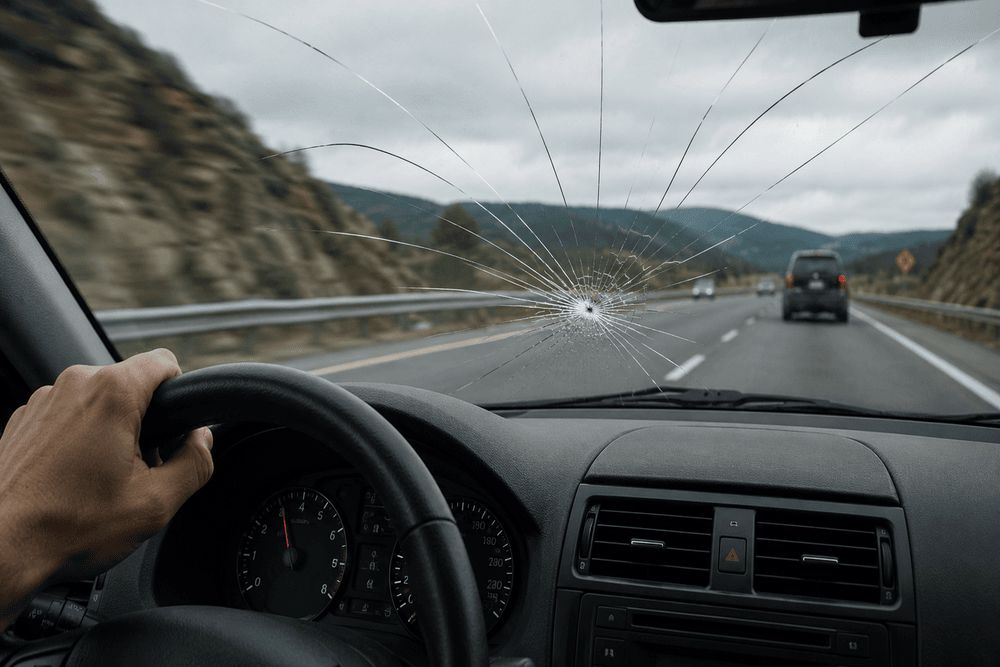
Road Vibration Makes You Fix Cracked Windshield Faster
A little chip in your windshield may not seem like a huge concern until all of a sudden it does. Road vibration is a quiet adversary that works against that little fracture you’ve been ignoring every time you drive. Knowing why vibration speeds up windshield deterioration might save future, much more costly repairs. This article discusses how cracks spread, what kinds of roads and driving behaviors accelerate the damage, and when to take action before a little chip turns into a complete windshield replacement.
Get An Auto Glass Replacement Quote Now 866.278.7417

Windshield Replacement & Repair
Our competitors push you into going to their shop to get your glass fixed-making it cheaper for them. We make it easier for YOU to get back on the road by offering free mobile repairs at your home or work. With our free mobile services servicing the entire Orange County & Los Angeles area, we can often handle your windscreen replacement the same day! So the next time you need a windshield replacement, give us a call.
Talk to a Windshield Replacement Specialist Now 866.278.7417

Calibration
Calibration is the process of returning a vehicle’s ADAS to OEM specifications. Calibration is necessary after a new glass installation, particularly a windshield with a camera mounted to it, to ensure that the ADAS features continue to function properly despite having been moved during installation. If a car’s ADAS is not properly calibrated, the system may not function safely. A misaligned camera could jeopardize the functionality of the system and lead to dangerous driving or accidents, so it is crucial that the cameras are aligned perfectly, which is what windshield calibration ensures.
Talk to a Calibration Specialist Now 866.278.7417

Fleet Auto Glass Repair
We provide expert auto glass repair and windshield replacement services for commercial fleets of all sizes. We are experienced with all manufacturers and machine types of domestic or foreign cars, trucks, vans, or commercial vehicles, including heavy equipment. Our same day mobile auto glass and windshield repair service will enable you to get back on the road faster and start saving you time and money instantly. Give us a call today! We are here to help!
Talk to a Fleet Auto Glass Specialist Now 866.278.7417
Why Do Windshield Cracks Spread Due to Road Vibration
When under stress, glass reacts differently than most other materials. A “stress concentration point”—a location where force isn’t uniformly distributed over the surface—is created by a break in your windshield, according to engineers.
The whole windshield bends slightly each time your car rolls over uneven terrain, strikes a bump, or passes a railroad track. The fracture, which is the weakest spot, is immediately subjected to mechanical stress as a result of that flex.
Fatigue crack propagation is the term for this phenomenon. Even tiny stress cycles may induce microscopic fractures at the crack tip to widen. The impact is gradual on a smooth roadway. It may happen quickly on a metropolitan road with plenty of potholes.
Laminated safety glass, which consists of two glass layers joined by a polyvinyl butyral (PVB) interlayer, is used to make modern car windshields. Although this construction prevents the glass from breaking upon contact, the exterior layer of the glass is still susceptible to fracture development. Vibration-induced stress may drive a fracture throughout the whole glass if the outer layer is weakened.
Road Conditions That Increase Windshield Damage
Driving with a cracked windshield is not always as difficult. Damage is accelerated far more quickly under certain circumstances than under others.
Rough pavement and potholes: Potholes result in abrupt, powerful collisions that travel straight through the suspension and frame of the car and onto the windshield. In a matter of seconds, a single forceful pothole hit might drive an existing fracture several inches or extend a chip into a crack. Over longer travels, a persistent low-frequency vibration caused by rough, uneven pavement accumulates.
Highway Speeds: Vibration frequency is increased at higher speeds. Even a seemingly smooth roadway produces more structural vibration and aerodynamic pressure at 70 mph than city driving at 25 mph. This long-term, high-frequency stress works especially well to spread fractures along the grain of the glass.
Gravel and Dirt Roads: In addition to vibration, debris impacts are an additional danger associated with unpaved roads. A modest chip might become a multi-inch fracture when one particle of gravel is thrown up by another car. Additionally, unpredictable, high-amplitude vibrations from gravel roads cause a lot of stress on a windshield that is already deteriorated.
Most drivers are surprised by loud music and subwoofers. Sound pressure waves produced by subwoofers and high-volume music systems cause the car’s interior, including the windshield, to tremble. A single powerful bass drive won’t break your glass, but over time, repetitive acoustic vibration on a damaged windshield causes cumulative stress.
How Fast Can a Windshield Crack Spread Due to Road Vibration? Since crack propagation is dependent on a number of factors, including the size and location of the initial damage, the kind of road, the outside temperature, and vehicle speed, there is no one right solution. But the rate of advancement may be startlingly quick.
In addition to vibration, temperature is important. Glass contracts in cold weather, tearing the edges of cracks apart. Expansion brought on by heat may push the margins of cracks closer together while also creating thermal stress.
Crack development is accelerated when the mechanical stress of road vibration is combined with temperature change. Under the improper circumstances, a chip smaller than a quarter may develop into a foot-long crack in only one week of frequent driving.
Particularly troublesome are cracks that start close to the windshield’s edge. Because they contact with the vehicle’s structure, edge fractures tend to spread more quickly than center cracks and seriously jeopardize the structural integrity of the glass.
Do you have a Question?
Get An Auto Glass Replacement Quote Now 866.278.7417
When Can a Windshield Crack Be Repaired
Repairing windshields instead of replacing them is only feasible in certain situations. The majority of vehicle glass makers and technicians adhere to a basic rule: resin injection can usually fix chips smaller than a quarter and cracks smaller than three inches. After that, complete replacement is often required.
For a number of reasons, the repair window closes soon. As the break grows, moisture and dirt get inside, contaminating the glass surface and reducing the effectiveness of resin bonding.
The likelihood that the break will grow over the repairable threshold increases with the amount of time you wait. At that point, a $50–$150 repair turns into a $200–$500+ replacement, sometimes much more, depending on the make and model of the car.
Safety is another factor. Compared to an undamaged windshield, a cracked one is structurally weaker. The windshield strengthens the roof and keeps the cabin from collapsing in a rollover accident. A damaged windshield increases the risk of harm since it is less efficient in this function.
How to Reduce Crack Progression While You Wait for Repair: There are things you may do to prevent more damage if you are unable to see an auto glass shop right away.
Steer clear of abrupt temperature swings. Avoid pouring hot water on frosty glass or using hot defrost on a chilly windshield. Crack development is significantly accelerated by thermal stress.
Cover the crack with transparent packing tape. This prolongs the healing window by keeping moisture and debris out of the fracture, but it won’t halt proliferation.
Does Windshield Repair Get Covered by Auto Insurance
Many drivers are unaware that comprehensive vehicle insurance often covers windshield repair with no out-of-pocket expenses. Insurance companies are mandated by law to pay for windshield replacement without imposing a deductible in a number of U.S. states, such as Florida, Kentucky, and South Carolina.
Comprehensive coverage usually includes glass damage from road debris, which is one of the most frequent sources of windshield chips, even in jurisdictions where this rule is not in place. Before making an out-of-pocket payment, check your insurance; you could already be protected.
Road vibration doesn’t give a damn about your schedule, so take action before the crack makes that decision for you. Every mile you drive with a broken windshield increases the likelihood that the damage will worsen beyond repair.
By next week, fixing a chip that costs less than $100 now may cost five times as much. The math is simple: determine the harm as soon as you can.
The majority of vehicle glass stores give free examinations, and many even provide mobile repair services. You’ll have more alternatives and spend less the sooner you take action.
Common Questions
Can I operate a vehicle with a cracked windshield? In theory, the answer is yes, however it depends on the position and size of the fracture.
In the majority of U.S. states, a crack that blocks the driver’s line of sight is prohibited. Driving with a cracked windshield poses a safety concern in addition to being illegal since road vibration will spread the damage and a structurally weaker windshield performs poorly in collisions.
How quickly does road vibration cause a windshield fracture to spread? Temperature, vehicle speed, road conditions, and crack size all affect how quickly cracks spread. A little chip may grow into a multi-inch fracture in a matter of days under challenging circumstances, such as uneven roads, temperature fluctuations, and high speeds. In general, cracks along the border of the windshield propagate more quickly than those in the middle.
What is the largest fracture that can be fixed without a complete replacement? The majority of vehicle glass specialists are able to fix cracks less than three inches and chips smaller than a quarter (about one inch in diameter).
If these measurements are exceeded, a complete windshield replacement is usually necessary. Even if a break is within the size restriction, contamination from moisture or dirt may prevent it from being repaired.
Is a broken windshield really harmed by road vibration from subwoofers? The windshield vibrates due to sound pressure waves produced by subwoofers.
This is safe if the windshield is intact. Repeated acoustic vibration increases cumulative mechanical stress on a cracked one and may progressively widen the fracture, particularly with extended exposure at high volume.
Is It Possible to Continue Driving Despite a Cracked Windshield
Vibration, temperature fluctuations, and the impact of road debris all hasten the damage caused by driving with a broken windshield. In a matter of days, tiny chips may develop into irreversible fissures. If you take action before the crack extends beyond six inches, repair is almost usually quicker and less expensive than complete replacement.
When they see a chip or crack, most drivers think, “I’ll take care of it later.” It makes sense as an instinct. The windshield repair seems like an issue for next week, the vehicle still starts, and the crack isn’t in your direct line of sight. The problem is that when you’re driving every day, next week looks completely different.
Continuous driving actively works against you in addition to delaying windshield repairs. Pressure, vibration, and debris exposure increase with each mile, turning a tiny, repairable chip into a complete replacement. You may avoid a significant safety risk and save hundreds of dollars by understanding how that process works.
In what ways can driving continuously exacerbate a cracked windshield? Seldom is a windshield crack static. Every driving increases the physical strain on the glass. There are four primary factors at play.
Road Vibration: Every bump, pothole, and uneven road surface causes vibrations that go through the frame of your car and straight into the windshield.
Vibration is extraordinarily good at expanding the lines of stress that cause glass breaks. After a week of everyday commuting, a chip that is neatly positioned at half an inch may start to move toward the glass’s margins.
Temperature Variations: Glass expands and contracts in response to heat and cold. Your windshield warms unevenly on a warm morning; it heats more quickly in bright sunshine and more slowly in shady places. There is a noticeable temperature difference between the glass surfaces inside and outside when the air conditioner is blasting on a hot day.
The crack is under strain due to the quick contraction on one side while the other remains heated. Drivers in cold climates deal with the same issue in reverse: rapidly heating the cabin on a chilly morning may cause a crack to widen in a matter of minutes.
Wind Pressure at Highway Speeds
Aerodynamic pressure pushes outward against the windshield at highway speeds. This is easily handled with a windshield that is physically sound. One that is cracked doesn’t.
The fracture is encouraged to spread across the glass since the crack serves as a weak spot where that pressure focuses. This is most prevalent with edge cracks, which begin within two inches of the edge of the windshield.
Debris Impact: There is a chance that another stone or piece of debris may hit the glass with each drive. A repairable chip may become a crack that covers the whole windshield when a new impact occurs close to an existing crack, connecting the two damaged areas very quickly.
When Can a Cracked Windshield Be Repaired? Most vehicle glass specialists employ a general repair threshold of a chip smaller than a quarter or a break shorter than six inches. A resin injection repair is usually successful within those dimensions, takes around 30 minutes, and is less expensive than a complete replacement.
Beyond that point, resin is unable to completely restore the glass’s structural integrity. At that point, complete windshield replacement is required by the majority of car glass specialists and vehicle safety regulations.
The crucial point is that after a few days of consistent driving in erratic conditions, a crack that is now three inches may grow to six inches. The window of opportunity for a rapid, low-cost repair is less than most drivers think.
Do you have a Question?
Get An Auto Glass Replacement Quote Now 866.278.7417
Driving with a Cracked Windshield Poses Safety Risks
There is more to a windshield than just blocking the wind. In a front-end collision, it provides around 30% of the vehicle’s structural strength and facilitates the passenger-side airbag’s deployment. In both areas, a damaged windshield performs noticeably worse.
The windshield prevents the roof from collapsing in a rollover. Research from the Insurance Institute for Highway Safety (IIHS) has shown a clear correlation between occupant survival rates in rollover collisions and roof strength. When protection is most required, a broken windshield makes it less effective.
A widening fracture decreases visibility in addition to posing a structural concern. Reaction time may be hampered by blind spots or visual distortion caused by glare from headlights or sunlight that refracts erratically through a fissure. Additionally, a cracked windshield is considered a car defect in many countries and may result in a traffic penalty, especially if the crack is inside the driver’s line of sight.
How Fast Can a Crack Spread While Driving Every Day? Because crack growth varies depending on the kind of damage, your local environment, and the amount of driving you do, there is no common schedule. Nonetheless, vehicle glass specialists often see the following trends:
The most stable and slowest to spread is a bullseye chip (circular impact damage), which may be repaired with caution for one to two weeks. After a cold snap or heat wave, a star break (many radial fractures from a central point) may grow more quickly and become irreparable in a matter of days.
The most serious kind of fracture is an edge crack, which may spread the whole length of the windshield in 24 to 48 hours. Any crack will advance more quickly the more you travel and the more erratic your climate is.
How to Handle a Cracked Windshield Immediately
There are methods that delay, but do not halt, crack propagation if you are unable to see a repair shop right away:
Make sure the crack is dry and clean. Resin cannot bind if there is moisture and dirt within a fracture. For the time being, cover tiny chips with transparent tape. Steer clear of drastic temperature swings. Avoid blasting air conditioning or heat straight at the windshield. When you can, park in the shade.
Drive carefully. Steer clear of highway speeds and uneven roads where vibration and wind pressure are at their peak. Make an appointment for a repair as soon as you can. There is seldom a need to wait more than a day or two since mobile car glass services will come to your site.
The Cost of Waiting vs. Taking Action: The average cost of a chip repair is between $50 and $150. For most basic cars, a complete windshield repair costs between $200 and $400; for cars with advanced driving assistance systems (ADAS) that need to have their cameras or sensors recalibrated after replacement, the cost is much higher.
The most obvious justification for moving quickly is the cost difference. After a week of everyday driving, a little discomfort and a small repair expenditure might increase by two or three times.
Put an End to that Cracks Clock
One of those issues that becomes more costly the longer you neglect it is a cracked windshield. Continuous driving creates the ideal environment—temperature stress, vibration, and debris—to transform a repairable chip into a complete replacement more quickly than most drivers anticipate.
Get it examined right now if the fracture is little. In an hour, a mobile repair specialist can often evaluate and repair the damage at your house or place of business.
Driving on a windshield that is structurally damaged puts you, your passengers, and other drivers at danger, so don’t wait to repair it if the fracture has already developed. Right now, the repair is more convenient than it has ever been.
Frequently Asked Questions: If my windshield is shattered, can I still drive? No journey is risk-free when the glass is damaged, although short excursions on calm roads at modest speeds are less dangerous.
The break may expand further due to vibration, temperature variations, and debris contact. Driving as little as possible until the repair is finished is the safest course of action.
How long until a chip becomes a fracture if it is not fixed? The majority of vehicle glass professionals advise fixing chips within one to two weeks, however this varies depending on the kind of chip and the environment. A single hot afternoon or chilly morning might cause a chip to break and need to be completely replaced.
Is windshield repair covered by auto insurance? Since repair is less expensive than replacement, many comprehensive vehicle insurance plans include windshield repair with no deductible. Before making an out-of-pocket payment, review your policy or give your insurer a call. You could have coverage that you are not using.
Is it against the law to drive with a cracked windshield? Although local laws differ, a crack in the driver’s sightline is illegal in many states and nations and may result in a traffic ticket or a failed vehicle inspection. During safety inspections, edge cracks are also often reported.
Will the fracture become inconspicuous after resin repair? Although it seldom makes chips and small fractures entirely undetectable, resin restoration greatly enhances their look. Restoring structural integrity and stopping the damage from spreading are the main goals of repair; aesthetic enhancement is a secondary advantage.
Mobile Safe Auto Glass
14241 E Firestone blvd suite 400,
La Mirada, CA 90638
Phone: (562) 608-1154
Toll Free: 1 866 278 7417
Mail: sales@mobilesafeautoglass.com
Get a FREE QUOTE today! You can get a free quote and schedule 24/7 using this free quote wizard.
Mon – Fri 8am – 5pm
Saturday 8am – 1pm
Sunday Closed