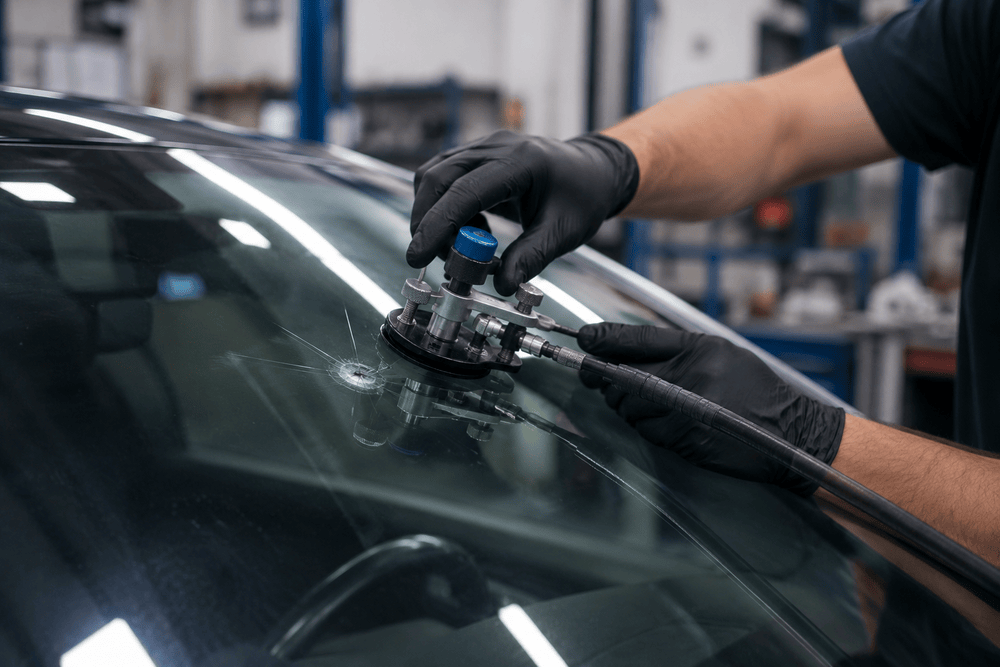
Modern Solutions for Chip Fix Cracked Windshield Damage
On the highway, a little pebble strikes your windshield, and all of a sudden you are gazing at a dime-sized chip. It’s simple to ignore it until the chip grows into a break that crosses the glass halfway. What used to need a complete windshield replacement may today often be corrected without leaving your driveway in less than an hour. With the advancements in chip repair technologies, you might save hundreds of dollars by being aware of your alternatives. This guide breaks down the most recent methods for fixing chipped and cracked windshields, clarifies when repairs are feasible vs when replacements are required, and assists you in selecting the best course of action for your circumstances.
Get An Auto Glass Replacement Quote Now 866.278.7417

Windshield Replacement & Repair
Our competitors push you into going to their shop to get your glass fixed-making it cheaper for them. We make it easier for YOU to get back on the road by offering free mobile repairs at your home or work. With our free mobile services servicing the entire Orange County & Los Angeles area, we can often handle your windscreen replacement the same day! So the next time you need a windshield replacement, give us a call.
Talk to a Windshield Replacement Specialist Now 866.278.7417

Calibration
Calibration is the process of returning a vehicle’s ADAS to OEM specifications. Calibration is necessary after a new glass installation, particularly a windshield with a camera mounted to it, to ensure that the ADAS features continue to function properly despite having been moved during installation. If a car’s ADAS is not properly calibrated, the system may not function safely. A misaligned camera could jeopardize the functionality of the system and lead to dangerous driving or accidents, so it is crucial that the cameras are aligned perfectly, which is what windshield calibration ensures.
Talk to a Calibration Specialist Now 866.278.7417

Fleet Auto Glass Repair
We provide expert auto glass repair and windshield replacement services for commercial fleets of all sizes. We are experienced with all manufacturers and machine types of domestic or foreign cars, trucks, vans, or commercial vehicles, including heavy equipment. Our same day mobile auto glass and windshield repair service will enable you to get back on the road faster and start saving you time and money instantly. Give us a call today! We are here to help!
Talk to a Fleet Auto Glass Specialist Now 866.278.7417
Why Taking Quick Action on Windshield Chips Is Important
At first glance, a chip may seem innocuous. In actuality, windshield damage seldom remains constant. A little chip may spider out into a large fracture almost overnight due to temperature fluctuations, traffic vibrations, and even a loud door slam.
A damaged windshield is a serious safety concern that goes beyond aesthetics. The Auto Glass Safety Council (AGSC) states that in a rollover accident, the windshield may contribute up to 30% of a car’s structural integrity. That structure is severely weakened by a fracture.
Additionally, several states consider cracked windshields to be a violation of the vehicle code, which may result in a fine during an inspection. The likelihood that a repair, as opposed to a complete replacement, would be adequate increases with the promptness of addressing a chip.
How Do Windshield Chip Repairs Really Operate? A transparent, optically matching resin is injected under vacuum pressure into the damaged region as part of modern chip repair. After filling the space left by the chip and adhering to the surrounding glass, the resin is cured using ultraviolet (UV) radiation.
After hardening, the glue significantly lessens the damage’s apparent appearance while restoring structural integrity. Depending on the chip’s age and intensity, the outcome may not always be evident, but a good repair usually lessens the damage’s appearance by 80–90% and, more crucially, prevents it from spreading.
Which Chip Types Are Repairable? Not every chip is made equally. The most prevalent kinds that react well to contemporary resin restoration are as follows: Bullseye chips are among the simplest to fix; they are circular impact points created by spherical objects.
Star breaks are short fractures that radiate from a central impact point; if the legs are less than three inches, they are often repairable. Half-moon chips are often suitable candidates for mending; they resemble bullseyes but have a half circle form.
Combination breaks: A combination of the aforementioned; repairable based on depth and size
Damage close to the edge of the windshield, chips immediately in the driver’s line of sight, and cracks longer than six inches are usually not suitable for repair. The suggested course of action in those situations is complete replacement.
Expert Mobile Repair Services
The emergence of mobile repair professionals is one of the most practical recent advancements in chip repair. Nowadays, companies like AutoGlass and comparable local suppliers provide qualified experts straight to your house or place of business. Most cars are safe to drive right away after the repair, which typically takes 30 to 45 minutes.
Because they do not need scheduling time at a store, mobile services have been particularly popular. The possibility to get a chip fixed in a parking lot while attending a business meeting is a real benefit for time-pressed drivers.
DIY Chip Repair Kits: DIY windshield repair kits have significantly improved for drivers who are at ease with a hands-on approach. Kits including a resin applicator, UV curing strips, and finishing pads are available for $10 to $30 from companies like Rain-X, Permatex, and Blue-Star.
In theory, the procedure is similar to expert repair; nonetheless, the outcome varies according to the user’s skill and the intricacy of the injury. Simple bullseye chips spotted early are ideal for DIY kits. A professional repair is the safest option for anything more complicated or for damage in a crucial sightline.
Insurance-Covered Repair: Windshield chip repair is often covered by comprehensive auto insurance policies at no cost to the policyholder, meaning there is no deductible. Repairs, which may cost anywhere from $200 to $500 or more depending on the car, are often preferred by insurers over complete replacements.
Before making an out-of-pocket payment, it is advisable to contact your insurer if you have comprehensive coverage. They will often put you in touch with an authorized repair company directly and take care of all the billing.
Do you have a Question?
Get An Auto Glass Replacement Quote Now 866.278.7417
When Repair Is Insufficient
No amount of resin can restore a windshield’s roadworthiness in some circumstances. When a crack is longer than six inches, replacement is required.
The driver’s main sight area is right in front of the chip or crack. The laminated glass’s inner layer is now damaged.
The windshield’s structural integrity is compromised by several chips. Stress concentrations are greatest a few inches from the windshield’s edge, where the damage is located.
Laminated safety glass, which consists of two glass layers joined by a polyvinyl butyral (PVB) interlayer, is used in modern windshields. The structural integrity of the windshield cannot be restored by resin alone if a chip enters the inner glass layer.
Modern Windshield Technology and Repair Issues
Windshield replacement and repair are more difficult for newer cars. Advanced Driver Assistance Systems (ADAS) sensors, such as lane departure, forward collision warning, and automated emergency braking, are integrated into or behind the windshield of many contemporary vehicles.
These sensors often need to be recalibrated in order to operate properly after any windshield maintenance. Inaccurate notifications or disabled safety features may arise from skipping recalibration. ADAS recalibration is now included in the service offered by reputable repair and replacement companies, however it’s important to clarify this before making a reservation.
Additionally, technicians skilled in those particular configurations are needed for cars with embedded antenna systems or heated windshields. Verifying credentials up front is important since not every shop is able to handle every kind of car.
Common Questions: How long does it take to fix a windshield chip? The majority of expert chip repairs take thirty to forty-five minutes. Depending on the user’s expertise, DIY kits could take a little longer.
After repair, will the chip be totally undetectable? Not all the time. The chip’s visibility is usually reduced by 80–90% after a professional repair; nevertheless, total invisibility is contingent upon the chip’s size, kind, and duration of neglect.
Does repairing a windshield scratch impact the glass’s structural integrity? Yes, a large amount of the structural integrity of the glass is restored by resin repair. On the other hand, an unrepaired chip may expand randomly and continue to degrade the windshield.
After a chip repair, can I drive right away? Yes, most of the time. After a professional repair, resin cures under UV light and is usually safe to drive right away. When it’s safe to drive, your technician will verify.
What happens if my chip is directly in front of the driver’s seat? Since even a partly visible repair might cause visual distortion, chips that are directly in the driver’s main sightline are often not suitable for repair. In this situation, replacement is often advised.
Final Thoughts on Chip Repair
If you take prompt action and choose the appropriate repair technique for the damage, a windshield chip doesn’t necessarily need to be replaced. Expert mobile services provide the ideal balance between ease of use and high-quality outcomes. For little chips, do-it-yourself kits are a good temporary solution.
Additionally, there’s no reason not to have a professional address it at no cost to you if your insurance covers it. The most important lesson is that little chips can be fixed. They seldom remain little if you give them time.
New Methods for More Effectively Repairing Cracked Windshields: Modern windshield repair has come a long way from the days of resin injection. Precision vacuum technology, transportable UV curing systems, and resins strengthened by nanotechnology are just a few of the new methods that have made it possible to restore structural integrity more quickly, effectively, and across a greater variety of fracture types than in the past.
A tiny chip in your windshield may seem like a small annoyance. If you leave it unattended for a week, the same chip may spread across the whole glass, turning a $50 repair into a $400 replacement. Technique is frequently the key to the difference. Additionally, windshield repair technology is now developing quickly.
Injecting a simple glue into the injured region and curing it under UV light was the conventional treatment for many years. Though not always, it did work. Crack size, depth, temperature, and technician competence all affected the results. Many fixes failed within months or left obvious deformities.
That is evolving. Even on damage types that were previously thought to be irreparable, a new generation of restoration techniques is producing stronger bonding, cleaner finishes, and longer-lasting outcomes. This article explains the best procedures now in use, how they stack up against more conventional approaches, and what to consider when selecting a repair provider.
Why Conventional Windshield Repair Techniques Frequently Fail
The majority of stores still use standard resin injection, which fills the air pocket left by a chip or fracture with clear sticky resin. This resin can restore up to 90% of the windshield’s original strength when properly cured. The issue is that “correctly” is more difficult to do than it seems.
Resin viscosity is impacted by temperature changes. Appropriate adhesion is hindered by moisture that is trapped in the fracture. Shallow vacuum systems leave tiny bubbles that weaken the repair and result in optical distortion since they are unable to remove all of the air before injection.
Conventional methods just aren’t able to distribute resin uniformly enough to be useful on longer cracks or intricate star-break patterns. These constraints have prompted scientists and vehicle glass experts to create more accurate and dependable substitutes.
Which Modern Windshield Repair Methods Are Available? Nanotechnology-Enhanced Resins: The creation of nano-resin formulae is one of the biggest developments in windshield repair. The designed nanoparticles in these resins, which are usually silica-based, enable the adhesive to reach deeper into micro-fractures than conventional resins.
After curing, the fill is more complete, the connection is stronger, and the optical clarity is higher. Additionally, restored windshields with nano-resins exhibit enhanced resilience to heat stress, which is a typical source of fracture propagation.
Advanced Vacuum and Pressure Systems: The simple screw-on bridge injectors that were used for many years have been superseded by contemporary vacuum injection systems. Using a deep vacuum to remove moisture and air from the crack and then injecting resin under carefully regulated pressure, today’s professional-grade equipment generates a two-stage procedure.
This two-step process guarantees that the damaged region is completely saturated with resin before curing starts. Compared to conventional injection processes, shops utilizing these technologies report far greater structural integrity and less visible repairs, meaning the final product is almost imperceptible to the unaided eye.
Do you have a Question?
Get An Auto Glass Replacement Quote Now 866.278.7417
UV Curing Technology on the Go
Just as crucial as properly injecting resin is properly curing it. Previous techniques depended on either natural sunlight or simple UV lamps, both of which yield inconsistent results based on exposure time, angle, and weather.
Regardless of the external environment, new transportable UV curing devices provide exact wavelengths and constant intensity. In order to guarantee a full bond, some systems use sensors that monitor the resin’s cure rate in real time and automatically modify exposure. In colder areas, where under-cured glue often results in repair failure, this degree of control is particularly crucial.
Bridge-Free Injection Systems: Conventional repair bridges, which are plastic frames attached to the windshield during injection, may unintentionally put stress on the glass, especially on laminated or curved windshields. Direct-adhesion nozzles, which deliver precise, localized pressure without the possibility of surface tension, are a novel kind of bridge-free injectors.
These solutions are especially useful for fixing damage close to the windshield’s borders, where conventional bridges are most difficult to properly place and structural integrity is most important.
Long-Crack Repair Techniques: In the past, complete windshield replacement was advised for cracks longer than around six inches since they were thought to be irreparable. This threshold is being altered by flexible resin formulas and new long-crack repair kits.
Technicians may now effectively repair fractures up to 12 to 14 inches in many situations by using a sequence of injection locations along the crack line. One of the primary failure mechanisms of earlier repair efforts on bigger damage is addressed by the flexible resins employed in these fixes, which allow glass movement without re-cracking.
Methods in Comparison to Complete Windshield Replacement
Replacement has always been the surefire solution—new glass without sacrificing strength or clarity. However, there are significant trade-offs. The apparent cost is that, depending on the make and model of the car and if the windshield has integrated sensors or heating elements, replacement usually costs three to eight times as much as repair.
Additionally, there is a calibration factor. Advanced driver assistance systems (ADAS) that use cameras located on the windshield, such as rain sensors, automated emergency braking, and lane-keeping assistance, are common in modern cars. These systems need to be professionally recalibrated after replacement, which increases the process’s cost and duration.
restoration is often the better option when modern restoration methods may restore 90–95% of the original strength with almost undetectable results—as long as the damage is discovered early and treated by an expert using current equipment.
If the break is less than 14 inches, doesn’t block the driver’s principal line of sight, and hasn’t pierced both layers of the laminated glass, choose repair. If the inner glass layer is damaged, the crack extends into the driver’s direct line of sight, or the damage is close to the windshield’s edge in a way that compromises structural integrity, replace it.
What Qualities Should a Windshield Repair Service Offer? Not every repair business has modernized its machinery. When assessing a supplier, find out explicitly what kind of resin they use, if they have a dual-stage vacuum system, and how they cure the resin. If a technician can confidently respond to such questions, they are probably using modern technology.
Additionally, find out whether the store provides an optical clarity warranty or satisfaction guarantee. There should be no discernible distortion in the restored region after high-quality repairs made using contemporary technology.
Avoid Waiting for Windshield Damage
Acting fast is the best thing you can do to safeguard both your pocketbook and your windshield. Crack development is accelerated by moisture, temperature fluctuations, and road vibrations. A chip that is fixed within 24 to 48 hours after it occurs has a far greater success rate than one that is left for a week or more.
The limit of what can be fixed has been increased by modern repair methods. However, no method is effective on a crack that has been tainted over time by debris, water, or dirt. Just as important as technique is speed.
Get in touch with a trustworthy car glass expert right away if you see a chip or crack; preferably, they should employ the most recent vacuum injection and UV curing technologies. The repair is more efficient, quicker, and less expensive than it has ever been. Early action maintains that state.
Frequently Asked Questions: Does a windshield always need to be replaced, or can a large crack be fixed? Cracks up to 12 to 14 inches can frequently be successfully repaired using contemporary long-crack repair techniques and flexible resin formulas. The location, depth, and presence of damage to the inner laminate layer all influence whether repair is necessary.
How long does it take to fix a contemporary windshield? With today’s vacuum injection and UV curing methods, the majority of expert repairs take 30 to 60 minutes. This timeframe accounts for the resin’s need to fully cure before the car is driven.
Will a windshield that has been fixed fracture in the same location again? Re-cracking is far less likely when a repair is done correctly utilizing flexible or nano-enhanced resin. Re-cracking is more likely to occur in places of significant structural stress or close to windshield edges than in the middle of the glass.
Does ADAS camera calibration change when a windshield is repaired? Since the windshield is not removed, ADAS recalibration is often not necessary for repairs alone. However, recalibrating any cameras or sensors attached to the glass is usually necessary for a complete replacement.
In comparison to replacement, how much does professional windshield repair cost? Depending on the kind and extent of the damage, repairs usually cost between $50 and $150. The cost of a complete replacement may be between $200 and $1,000 or more, and cars that are equipped with ADAS will also incur extra recalibration fees.
Mobile Safe Auto Glass
14241 E Firestone blvd suite 400,
La Mirada, CA 90638
Phone: (562) 608-1154
Toll Free: 1 866 278 7417
Mail: sales@mobilesafeautoglass.com
Get a FREE QUOTE today! You can get a free quote and schedule 24/7 using this free quote wizard.
Mon – Fri 8am – 5pm
Saturday 8am – 1pm
Sunday Closed