Insurance Windshield Replacement OEM vs Aftermarket
You hear a piercing snap while you’re driving along the highway. A spiderweb of broken glass is right in front of you after a stray gravel particle hit your windshield. The next step is clearly to replace the glass, so you make a claim by calling your motor insurance company. Two phrases that often cause confusion for drivers are mentioned by the salesperson during the phone call: OEM and aftermarket glass. Suddenly, you have to make a choice about car components that you most likely never gave any consideration to. Your car’s glass type has a significant impact on everything from the performance of sophisticated safety systems to the structural integrity of your vehicle. The kind of windshield that insurance companies will cover is usually subject to stringent regulations. The majority of drivers believe that their coverage will restore their vehicle to its original factory state.
Get An Auto Glass Replacement Quote Now 866.278.7417

Windshield Replacement & Repair
Our competitors push you into going to their shop to get your glass fixed-making it cheaper for them. We make it easier for YOU to get back on the road by offering free mobile repairs at your home or work. With our free mobile services servicing the entire Orange County & Los Angeles area, we can often handle your windscreen replacement the same day! So the next time you need a windshield replacement, give us a call.
Talk to a Windshield Replacement Specialist Now 866.278.7417

Calibration
Calibration is the process of returning a vehicle’s ADAS to OEM specifications. Calibration is necessary after a new glass installation, particularly a windshield with a camera mounted to it, to ensure that the ADAS features continue to function properly despite having been moved during installation. If a car’s ADAS is not properly calibrated, the system may not function safely. A misaligned camera could jeopardize the functionality of the system and lead to dangerous driving or accidents, so it is crucial that the cameras are aligned perfectly, which is what windshield calibration ensures.
Talk to a Calibration Specialist Now 866.278.7417

Fleet Auto Glass Repair
We provide expert auto glass repair and windshield replacement services for commercial fleets of all sizes. We are experienced with all manufacturers and machine types of domestic or foreign cars, trucks, vans, or commercial vehicles, including heavy equipment. Our same day mobile auto glass and windshield repair service will enable you to get back on the road faster and start saving you time and money instantly. Give us a call today! We are here to help!
Talk to a Fleet Auto Glass Specialist Now 866.278.7417
Knowing the Fundamentals of Windshield Glass
You must be fully informed about what the repair companies are providing before you make any judgments or argue with an insurance adjuster. Windshields are intricately designed parts of your car’s safety system, not simply plain sheets of glass.
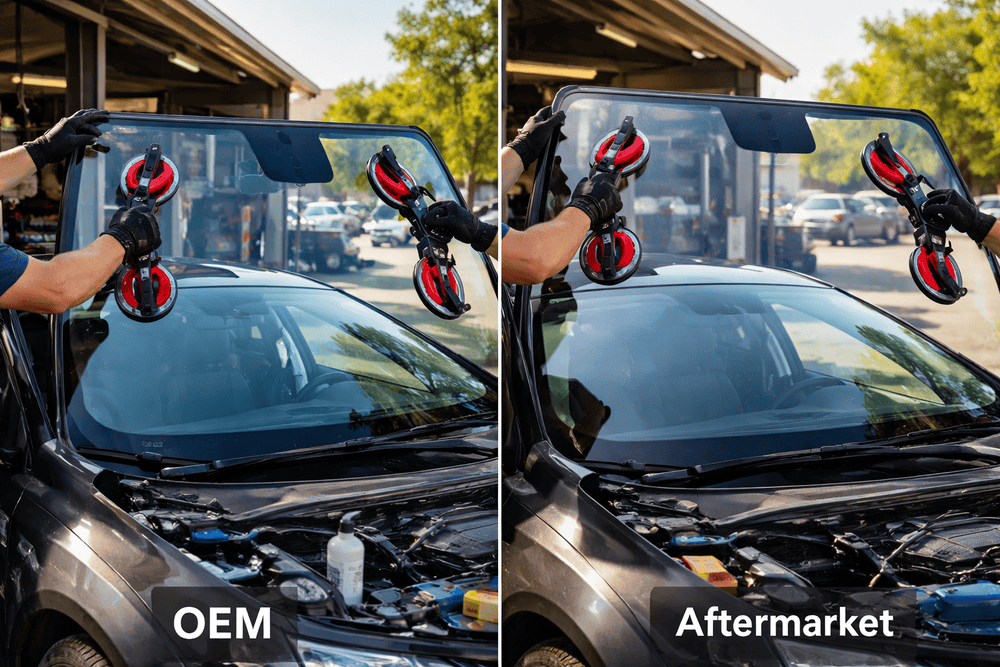
OEM Auto Glass: What is it? Original Equipment Manufacturer is referred to as OEM. OEM glass windshields are fitted at the manufacturer when you purchase a brand-new vehicle.
It is produced to the same dimensions, thickness, and specs specified by the vehicle’s original design by the same business that provided the carmaker. The automaker’s logo will usually be physically imprinted on the glass if you select an OEM replacement windshield.
It is identical to the original windshield in terms of durability, shape, and color tint. Automakers and dealerships strongly advise it since it is an identical reproduction of what came off the assembly line.
Aftermarket Glass: What Is It? Aftermarket glass, often known as OEE (Original Equipment Equivalent), is produced by businesses who don’t have a direct contract with the manufacturer of your particular car.
The windshield is reverse-engineered by these manufacturers to match the specs of your vehicle. Aftermarket manufacturers are unable to produce a 100% identical duplicate since automakers own copyrights to the precise design and unique technology utilized in their glass.
The thickness of the glass may change somewhat, the tint’s hue may differ slightly, or the acoustic damping qualities may alter slightly from the original. However, the Department of Transportation (DOT) has established basic safety requirements that must be met by any aftermarket glass supplied in the US.
The Fundamental Differences: OEM vs. Aftermarket: Three primary variables often determine which glass is best: total cost, compatibility with safety systems, and structural quality.
Standards for Safety and Quality
There is more to your windshield than just protecting your face from the wind and rain. In the case of a rollover, it keeps the car’s roof from collapsing inward and serves as a structural backup for the passenger-side airbag.
During the vehicle’s development phase, OEM glass is crash-tested alongside the car. You are well aware of how it will function in high-stress situations. The DOT regulations are met by aftermarket glass, guaranteeing a minimum degree of safety. High-quality glass with outstanding performance is produced by several aftermarket producers.
However, the quality might vary greatly amongst aftermarket brands due to the automaker’s lax control. It has been reported that certain less expensive aftermarket windshields might produce visual distortion, which can wear drivers out or give them headaches.
ADAS Calibration and Contemporary Sensors: Advanced Driver Assistance Systems (ADAS) are installed in contemporary automobiles. These systems include functions including adaptive cruise control, automated emergency braking, and lane departure alerts.
ADAS is usually powered by cameras and sensors that are installed directly to the windshield, behind the rearview mirror.
The OEM vs aftermarket controversy becomes crucial at this point. These delicate cameras may be calibrated incorrectly by even a millimeter difference in glass thickness or a little change in clarity.
The automated braking system may operate too late or not at all if an aftermarket windshield blocks the sensor’s line of sight. Many automakers specifically emphasize that only OEM glass should be used for replacements on ADAS-equipped vehicles due to these safety issues.
Cost and Availability: Cost reduction is the main driver for the existence of aftermarket glass. In most cases, an aftermarket windshield is far less expensive than an OEM one. Insurance companies like it precisely because of this pricing differential.
Aftermarket glass is also easily accessible. To enable same-day repairs, independent vehicle glass repair businesses maintain substantial stocks of aftermarket windshields. When an OEM windshield is ordered, the shop often needs to buy it straight from a nearby dealership, which might cause the repair procedure to take several days longer.
Do you have a Question?
Get An Auto Glass Replacement Quote Now 866.278.7417
How Insurance Manages Claims for Windshield Replacement
It might be difficult to navigate a labyrinth when dealing with insurance providers. Their main objective is to minimize their cash payment while restoring your car to a driveable state.
Rules for Comprehensive Coverage: Your vehicle insurance policy’s comprehensive section often covers windshield damage. This includes damage from uncontrollable occurrences like flying boulders on the roadway, fallen trees, and vandalism.
The insurance provider will examine the terms of your particular policy when you submit a claim. Standard vehicle plans include a language that states they will replace damaged parts with “parts of like kind and quality,” unless you have expressly bought an upgrade or a rider.
The Aftermarket Default Policy: “Like kind and quality” often refers to aftermarket components in the insurance industry. Insurance companies see aftermarket windshields as a suitable replacement for factory glass as they satisfy the necessary DOT safety requirements.
The insurance company will probably demand that you pay the difference out of pocket if you insist on OEM glass for your repair. For instance, if the OEM glass costs $800 and the aftermarket glass costs $300, the insurance company will pay $300 (less your deductible), leaving you to pay the remaining $500.
Policy Riders and OEM Endorsements
You should carefully examine your coverage before an accident occurs if you value having original factory parts. For a little monthly premium increase, you may add a “OEM endorsement” or rider to your policy from several insurance companies.
The insurance company is legally obligated to utilize only OEM parts for all repairs, including windshield replacements, as a result of this endorsement. Remember that some insurance companies only provide this rider for cars under two or three years old. The insurer may terminate the endorsement and switch back to aftermarket coverage if the vehicle reaches a certain age.
Should You Contest Your OEM Glass Insurance? Depending on the kind of car you drive, you may decide to battle for OEM glass or accept the insurance company’s aftermarket offer.
When OEM is Non-Negotiable: You have a good case for requesting an OEM windshield if your car is newer and has ADAS technology.
You may get a formal statement from the manufacturer stating that OEM glass is necessary for the safety sensors to operate correctly from your dealership. When you show your insurance adjuster this paperwork, they often accept the OEM glass without making you pay the difference since they don’t want to take responsibility for a broken safety system.
In a similar vein, OEM glass may be required if you drive a premium automobile or a leased vehicle. Any replacement components must be genuine manufacturing equipment, according to lease agreements. When you return the car at the conclusion of the lease, there may be significant penalties for breaking this restriction.
When Aftermarket is Perfectly Fine: An aftermarket windshield is often a safe and acceptable option if you drive an older car without sophisticated safety sensors affixed to the glass.
A trustworthy car glass store will find premium aftermarket glass that fits properly and has outstanding clarity. In some situations, it is just not financially feasible to spend hundreds of dollars out of pocket to have a manufacturer stamp on the glass.
How to Effectively Handle the Claims Process
The claims procedure may go considerably more smoothly if you take the appropriate action soon once after your windshield is damaged. To find out your comprehensive deductible, first check the declarations page of your insurance policy.
It is preferable to pay out of pocket rather than submit a claim if your deductible is $500 and the cost of an aftermarket replacement is just $350. Check to see whether you reside in a state that offers “full glass coverage” alternatives with no deductible.
Next, choose your repair business with caution. Insurance companies may attempt to direct you to one of their favored glass repair businesses. You are legally free to choose the repair facility of your choice.
Look for a store with Auto Glass Safety Council (AGSC) certification. A trustworthy shop will negotiate on your behalf with the insurance provider, outlining the reasons why your car needs a certain kind of glass or calibration process.
Lastly, if your automobile has ADAS, make sure it is properly calibrated. The insurance company must pay for the expense of recalibrating the cameras and sensors even if they accept an aftermarket windshield. Until the store provides proof that the system was correctly calibrated, do not leave.
Frequently Asked Questions (FAQ): If I make a windshield replacement claim, will my insurance rates increase? Comprehensive coverage, which is often intended for unavoidable incidents, includes windshield claims. Generally speaking, your insurance premiums won’t go up if you file a single glass claim. However, the insurer may identify you as a high-risk driver and increase your rates if you submit many claims in a short amount of time.
How long does it take to replace an insurance windshield? It often takes an hour to replace the glass physically. Nevertheless, it takes time for the urethane glue used to seal the windshield to cure. Before the automobile is safe to drive, you usually have to wait an extra hour or two. The whole appointment duration may be up to three or four hours if your car needs ADAS calibration.
Can I have my insurance company cover the cost of OEM glass? Unless you have an OEM endorsement on your insurance or you can demonstrate that aftermarket glass poses a real safety risk for your particular car model, you cannot make them pay for it. Your best option is to provide the adjuster the paperwork if the carmaker requires OEM glass for sensor calibration.
What happens if I use a rented automobile with an aftermarket windshield? The majority of leasing firms demand that the car be returned in its original factory condition. They will probably charge you the entire cost of replacing the car’s aftermarket windshield with an OEM windshield at dealership costs. Prior to approving a repair, always review your lease.
Selecting the Best Option for Your Car
It’s stressful enough to have a damaged windshield without having to deal with an insurance company regarding replacement parts. You are in control of the claims procedure if you are aware of the clear distinctions between OEM and aftermarket glass.
Always put your car’s functioning and safety first. Make a compelling case for OEM glass if your vehicle has sophisticated safety sensors that are meant to protect you.
If you have an older model, you may securely and affordably go back on the road with high-quality aftermarket glass. Review your insurance coverage now, and if using factory-original parts gives you piece of mind, think about adding an OEM endorsement.
Managing Insurance Windshield Replacement Options: Suddenly, a little chip on your windshield starts to expand into a lengthy, spiderweb-like fracture when a stray pebble kicks up from a construction vehicle on the highway and you hear the dreaded “smack.”
It is very risky to drive with a damaged windshield as it compromises both your sight and the structural integrity of your car. However, since they are uncertain about the expenses and how their vehicle insurance would handle the problem, many drivers are reluctant to get it serviced right away.
It may be similar to reading a foreign language while dealing with vehicle insurance plans. You may be wondering if you get to choose the repair shop, whether you have to pay out-of-pocket, or whether filing a claim would result in a sharp increase in your monthly rates.
It’s essential to comprehend your insurance windshield replacement possibilities in order to return to driving securely and economically. Everything you need to know about handling vehicle glass claims is broken down in this tutorial.
We will discuss the many kinds of insurance coverage, the argument between aftermarket and original manufacturer glass, and the easy-to-follow procedure for submitting a claim. You will have all you need to confidently deal with any unforeseen glass damage at the conclusion of this book.
Do you have a Question?
Get An Auto Glass Replacement Quote Now 866.278.7417
Comprehending Coverage for Comprehensive Auto Insurance
Your financial liability for windshield damage is determined by the kind of insurance coverage you have. Damage you inflict on other people and their property is covered by liability insurance. Your own windshield won’t be covered by it. You must have comprehensive coverage in order to get financial assistance for vehicle glass repair.
What Comprehensive Coverage Actually Means: Damage to your car brought on by uncontrollable circumstances is covered by comprehensive auto insurance. This covers falling items, animal collisions, theft, vandalism, and natural calamities. Comprehensive coverage kicks in if a tree limb falls on your parked vehicle during a storm or if a rock smashes your windshield on the highway.
However, a deductible is usually included in regular comprehensive coverage. Before your insurance provider pays the remaining balance, you have to pay this amount out of pocket. Your insurance won’t cover anything if a windshield repair costs $400 and your deductible is $500. The whole expense will be borne by you.
Full Glass Coverage Add-ons: Many insurance companies provide a “full glass coverage” add-on to save paying a large deductible for a reasonably frequent problem like a broken windshield.
This endorsement eliminates the deductible for glass replacements and repairs in exchange for a minor monthly rate increase. You won’t have to spend a dime out of pocket to get your windshield fixed if you have this coverage.
Full glass covering is typically a very valuable purchase for drivers who reside in places vulnerable to strong hail storms, commute through heavily constructed areas, or regularly travel on gravel roads.
Which Is Better, OEM or Aftermarket Glass?After your insurance claim is accepted, you will probably have to decide what kind of new glass to put in your car. Original Equipment Manufacturer (OEM) glass and aftermarket glass are the two primary types that insurance companies and vehicle glass stores usually provide.
Glass from the Original Equipment Manufacturer
OEM glass is produced by the same business that supplied your car’s original windshield during its construction. It satisfies the manufacturer’s precise requirements for thickness, hue, durability, and specs. It ensures a flawless fit and maintains the vehicle’s original safety regulations since it is exactly like the factory glass.
The price of OEM glass is a drawback. Compared to other possibilities, it is much more costly. As a result, a lot of insurance plans include provisions that say they will only pay for aftermarket glass. You may have to pay the difference out of pocket if you insist on OEM glass.
Aftermarket Auto Glass: Businesses other than the original manufacturer create aftermarket glass. The glass is legally okay to use since these producers still have to adhere to the Department of Transportation’s safety regulations.
Even though aftermarket glass is much less expensive, the quality might sometimes differ. It may change somewhat from the original in terms of thickness or color. In order to minimize claim expenses, the majority of insurance companies favor financing aftermarket replacements.
Aftermarket glass is often a safe and acceptable option if you drive an older car. However, your contract may call for OEM glass repairs if you drive a newer luxury automobile or a car that is leased from a dealership.
Mobile Safe Auto Glass
14241 E Firestone blvd suite 400,
La Mirada, CA 90638
Phone: (562) 608-1154
Toll Free: 1 866 278 7417
Mail: sales@mobilesafeautoglass.com
Get a FREE QUOTE today! You can get a free quote and schedule 24/7 using this free quote wizard.
Mon – Fri 8am – 5pm
Saturday 8am – 1pm
Sunday Closed