In Depth Car Glass Repair Breakdown for Better Road Safety
A little scratch on your windshield can seem like a minor cosmetic issue. It’s easy to forget, especially if you have a busy schedule. But that minor flaw might easily turn into a major safety hazard. A little fracture has the potential to grow, impair your eyesight, and compromise the structural soundness of your car. Understanding the principles of automobile glass crack repair is essential for both your safety while driving and the look of your vehicle. Sometimes fixing a broken windshield is preferable to replace it completely. In general, it is more economical, quicker, and environmentally friendly. The strength and purity of the glass may be restored with modern restoration techniques, making the damage almost undetectable.
Get An Auto Glass Replacement Quote Now 866.278.7417

Windshield Replacement & Repair
Our competitors push you into going to their shop to get your glass fixed-making it cheaper for them. We make it easier for YOU to get back on the road by offering free mobile repairs at your home or work. With our free mobile services servicing the entire Orange County & Los Angeles area, we can often handle your windscreen replacement the same day! So the next time you need a windshield replacement, give us a call.
Talk to a Windshield Replacement Specialist Now 866.278.7417

Calibration
Calibration is the process of returning a vehicle’s ADAS to OEM specifications. Calibration is necessary after a new glass installation, particularly a windshield with a camera mounted to it, to ensure that the ADAS features continue to function properly despite having been moved during installation. If a car’s ADAS is not properly calibrated, the system may not function safely. A misaligned camera could jeopardize the functionality of the system and lead to dangerous driving or accidents, so it is crucial that the cameras are aligned perfectly, which is what windshield calibration ensures.
Talk to a Calibration Specialist Now 866.278.7417

Fleet Auto Glass Repair
We provide expert auto glass repair and windshield replacement services for commercial fleets of all sizes. We are experienced with all manufacturers and machine types of domestic or foreign cars, trucks, vans, or commercial vehicles, including heavy equipment. Our same day mobile auto glass and windshield repair service will enable you to get back on the road faster and start saving you time and money instantly. Give us a call today! We are here to help!
Talk to a Fleet Auto Glass Specialist Now 866.278.7417
Knowing About Windshield Damage
You need to determine the kind of damage your windshield has received before looking into repair options. Auto glass specialists classify damage into a number of typical categories. The crack’s size, depth, and position determine the best repair technique.
Typical Crack Types
Chip: This happens when a tiny fragment of glass breaks off the windshield, usually as a result of hitting a rock or other object. Usually, it is where the harm starts.
Bullseye: A target-like circular fracture. It is evident that the glass’s exterior layer has a cone-like form.
Star Break: This type of fracture is characterized by a number of tiny, radial cracks that radiate outward from a central point of impact, giving it the appearance of a star.
Combination Break: This kind of break features a central impact point with radiating fractures and a circular pattern, combining the traits of a bullseye and a star break.
A crack is a single line of fracture that may be lengthy (covering a significant portion of the windshield) or short (less than a few inches). A collision close to the glass’s edge is frequently the source of cracks.
Just as crucial as the sort of injury is its placement. It might be difficult to fix a fracture in the Driver’s Primary Viewing Area (DPVA), which is the driver’s primary line of sight, without causing some distortion. Even a small flaw in the repair resin can be dangerous and distracting. Additionally, damage close to the windshield’s edge may weaken the seal, compromising the overall safety and structural stability of the glass.
The Science of Repairing Windshields
Windshield repair is a complex procedure that aims to fix the glass’s structural integrity rather than merely patch a break. Laminated safety glass, which is used to construct modern windshields, is made up of two layers of glass with a thin film of polyvinyl butyral (PVB) plastic sandwiched in between them. Because of the way it is constructed, the glass will not shatter into sharp fragments when it collides with something.
Typically, debris only harms the outer layer of glass when it strikes your windshield. The restoration process concentrates on this outer layer, leaving the PVB and the inner glass layer unaltered.
How Repairing Resin Operates: A premium injectable resin is essential to a successful windshield repair. This is a comprehensive summary of the process, which includes:
In the beginning, the technician will thoroughly clean the damaged area in order to remove any dirt and broken glass that may be present. To guarantee that the resin can adequately bind with the existing glass, this step is crucial. To aid the resin in completely penetrating the fracture, a tiny hole may occasionally be drilled into the middle of the impact spot.
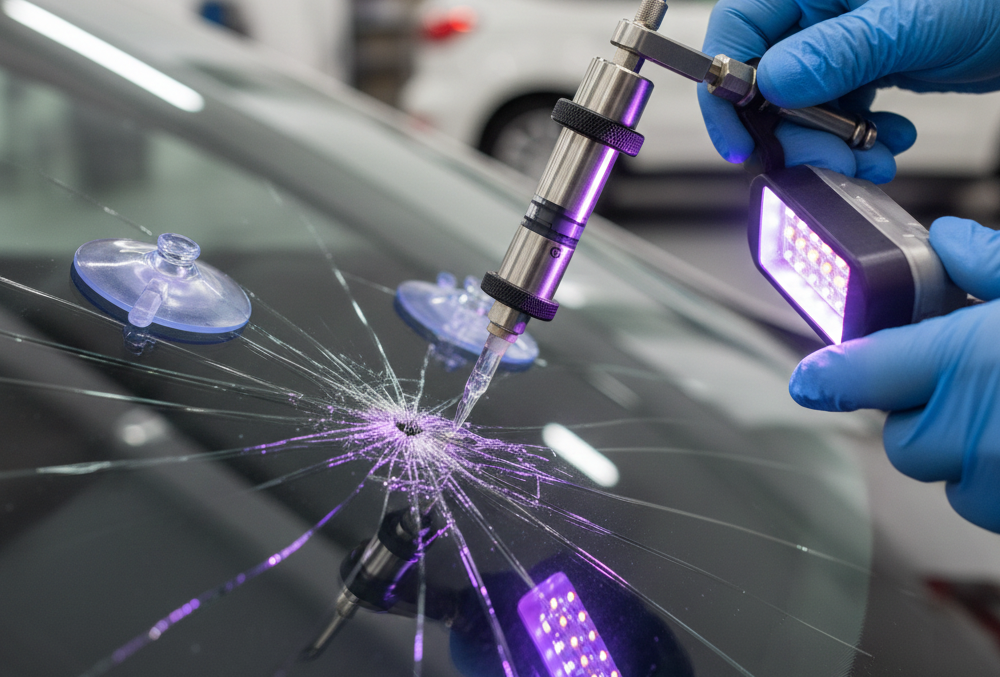
Injection and Vacuum: A specialized instrument is positioned right above the fissure. Through the creation of a vacuum, this device removes all of the air from the area that has been wounded. A specially prepared liquid resin is injected under pressure to fill all of the tiny cracks once the air has been removed.
Curing: After injection, the resin is exposed to ultraviolet (UV) radiation to solidify and cure it. This procedure sets off a chemical reaction that solidifies the resin by bonding it to the glass. In most cases, the curing procedure is little more than a few minutes long.
Finishing: Any extra material is gently scraped off the surface once the resin has completely dried. After that, the damaged area is polished to restore a clean, smooth surface that virtually eliminates the damage.
The windshield can regain up to 95% of its original optical clarity and 100% of its structural strength when the repair is done correctly by a qualified technician. As a consequence, the break is prevented from widening by an almost imperceptible repair.
Do you have a Question?
Get An Auto Glass Replacement Quote Now 866.278.7417
Fix vs. Replace
Even though contemporary repair methods are quite successful, not all windshield damage can be repaired. Your safety depends on knowing whether to choose a repair over a full replacement.
Repair Guidelines: If the damage to a windshield satisfies the following requirements, it is typically a suitable candidate for repair:
Size: The diameter of a chip should not exceed a quarter. The optimal length for a single crack is less than six inches, or around the length of a dollar note.
Depth: The damage must only reach the glass’s outermost layer. A replacement is required if it has penetrated the inner glass or the PVB layer
Location: If the repair has the potential to cause distortion, the damage should not be in the driver’s line of sight before performing the repair. Since they can undermine the entire structure, cracks that reach the windshield’s edge are likewise not good choices for repair.
Situations that necessitate the need for replacement: There are several circumstances in which a full replacement of the windshield is recommended:
Significant Damage: If there are several lengthy cracks or a single crack that is longer than six to twelve inches, it usually has to be replaced.
Inner Layer Damage: The integrity of the windshield is jeopardized if the impact has broken through the PVB layer and harmed the inner layer of glass.
Contamination: An untreated crack may fill with moisture and dirt over time, making it impossible for the resin to properly connect.
Location on Edge or in Sightline: Major cracks that extend to the glass’s edge or intricate breaks that are right in the driver’s line of sight are frequently irreparable, per safety regulations.
To determine the extent of the damage, it is usually preferable to speak with a qualified car glass expert. They are qualified to choose the best and safest course of action for your car.
The Prospects for Automobile Glass Technology
The glass business for automobiles is always developing. Future windshields should be tougher, smarter, and even more repairable thanks to upcoming technology.
A glass that has the ability to heal itself is one of the most exciting new breakthroughs that will occur in the future. Scientists are creating polymers that, when heated or exposed to sunshine, may spontaneously patch minor fractures. Minor chips could eventually become obsolete as a result.
Additionally, modern cars are increasingly equipped with augmented reality (AR) screens. These “smart windshields” have the ability to project data onto the glass, including navigation, speed, and safety alerts.
Professional servicing is more important than ever since repairing this sophisticated kind of glass calls for certain skills and tools. The distinction between a straightforward piece of glass and a sophisticated electronic component will continue to become more hazy as these technologies become commonplace.
Safeguard Your Safety and Windshield
No matter how little it may seem at first, a small crack in your windshield is a safety issue that should never be ignored. Temperature variations, road vibrations, or normal driving circumstances can cause even the smallest chip to spread swiftly, impairing structural integrity and visibility.
Thankfully, modern repair technologies today provide quick, reasonably priced, and incredibly dependable fixes for a variety of windshield problems, allowing you to drive again with total assurance. Hire a qualified, experienced expert to examine the region rather than waiting for a little defect to develop into a serious and expensive problem.
Their knowledge enables them to precisely assess the degree of damage, decide whether a replacement or repair is required, and use the best methods to regain strength and clarity. By being proactive, you can protect the health and safety of everyone inside your car in addition to prolonging the life of your windshield.
When Is It Possible to Repair a Windshield
Ignoring a little chip or fracture in your windshield might result in a pricey replacement, even if it can seem like a minor irritation. The good news is that you might be able to save both time and money by getting the windshield fixed for a variety of different types of damage. But not all damage is made equal, and a number of criteria influence whether a repair is a good idea.
When you see the initial damage, knowing what constitutes a successful repair can help you make an informed choice. The main factors that affect a windshield repair’s effectiveness will be covered in this tutorial, including the kind and extent of the damage, the amount of time you wait to fix it, and even the weather.
You will have a clear understanding of when to contact a professional and what to anticipate from the repair procedure at the conclusion. It’s all about timing.
The most crucial thing you can do when windshield damage occurs is to take prompt action. If left ignored, a minor chip that may have been easily fixed can suddenly turn into an irreparable break.
Reasons Not to Wait
A windshield is an essential structural part of your car and serves as more than simply a wind and rain barrier. It helps keep the roof from collapsing in a rollover accident, supports the passenger-side airbag during deployment, and contributes up to 30% of your car’s structural strength. You and your passengers are at risk if its integrity is compromised.
Here are some of the reasons why delaying maintenance is not a smart idea:
Contamination: Road filth, water, dust, and dirt will eventually seep into the chip or fracture. The repair resin’s ability to effectively bind with the glass is significantly hampered by this pollution. A less successful repair that could still be noticeable or might fail in the future is frequently the consequence of a polluted fracture.
Crack Expansion: One of the main causes of crack formation is temperature variations. When exposed to sun heat, glass causes it to expand, and when exposed to cold temperatures, it causes it to shrink. Overnight, this continuous strain may transform a little chip into a lengthy fissure that resembles a spiderweb. A simple bump, like slamming a car door or striking a pothole, might cause enough harm to spread.
Moisture Damage: Water that enters a fracture and freezes will expand, applying tremendous internal pressure on the glass. Because of this, the damage may spread quickly and frequently beyond what can be fixed.
The Perfect Window for Repair
As soon as you notice damage to your windshield, the best plan of action is to get it repaired as quickly as possible. A few hours or, at the very most, a few days should be sufficient time for this to take place. The cleaner the break and the more robust the ultimate repair, the sooner a specialist can clean the region and inject the resin. Repairing the imperfection in a short amount of time makes it nearly impossible to notice and restores the structural integrity of the glass.
Cover the damaged area with a piece of transparent tape if you are unable to see a repair business right away. Until you can have it properly repaired, this easy method can help keep moisture and debris out of the crack.
Not Every Damage Is Repairable: Many chips and cracks can be fixed, but some are just too bad. The main determinants of whether a repair is feasible or a complete replacement is required are the extent, kind, and location of the damage.
Depth and Size Are Important: Based on the extent of the damage, auto glass specialists can assess repairability using the following basic guidelines:
Chip Size: Generally speaking, a chip that is less than a quarter in diameter may be repaired. This enables the damaged region to be completely penetrated and bonded by the repair resin.
Generally speaking, a crack that is smaller than six inches in length, which is about equivalent to the length of a dollar note, may be repaired effectively. Although six inches is a typical limit, certain sophisticated repair techniques can tolerate larger cracks.
Depth: The laminated glass’s two layers must not have been damaged. When a windshield is formed, it is composed of two panes of glass that are separated by an interlayer of polyvinyl butyral, also known as PVB. In the event that the damage spreads to the inner layer, it is necessary to replace it since the structural integrity is not strong enough to allow for a trustworthy repair.
Do you have a Question?
Get An Auto Glass Replacement Quote Now 866.278.7417
Typical Repairable Damage Types
Different forms of windshield damage are categorized by technicians using unique nomenclature. When you contact for assistance, being aware of these might help you appropriately report the issue.
Bull’s-eye: This type of chip is round and frequently results from direct contact with a round item, such as a rock. Its outer layer of glass breaks in a cone form, creating a noticeable black circle. Generally speaking, bull’s-eye damage is among the simplest to fix.
An example of this type of damage is a star break, which is characterized by minute fractures that expand from a central impact point. This type of damage is similar to a starburst. A star break may typically be fixed if the cracks are not too deep.
This particular form of break is a combination break, which combines characteristics of a bull’s-eye break with a star break. It is characterized by a black circle in the center and fractures that spread outward. It is generally possible to fix something so long as the overall diameter is within the acceptable range of tolerances.
Half Moon (Partial Bull’s-Eye): This injury resembles a crescent moon and is comparable to a bull’s-eye but incomplete. In general, it is simple to fix.
When Is It Time for a Replacement
Almost always, certain kinds of damage necessitate a complete glass replacement:
Damage in the Driver’s Line of Sight: Even after the most extensive repairs, the glass may still be to some degree deformed. To prevent any possible vision impairment, most experts would advise a replacement if the damage is immediately in the driver’s primary viewing area.
Cracks at the Edge: The seal and the overall structural integrity of the glass are often jeopardized by cracks that begin at or extend to the windshield’s edge. These are extremely challenging to completely fix and frequently spread even after attempts at restoration.
Multiple Cracks: In the long run, a replacement is frequently the safest and more economical choice if there are more than two or three different chips or cracks.
Environmental Factors’ Effects: Unexpectedly, environmental factors have a big impact on windshield damage and repair success. The two most important environmental parameters to take into account are temperature and moisture.
The Impact of Weather on the Repair Process
Although professional auto glass specialists are prepared to handle environmental conditions, car owners should be aware of the difficulties. It is possible that the process of repairing will become more challenging in situations that are either highly hot or extremely cold. 60°F to 80°F is the best temperature range for windshield repairs.
To enable the resin to effectively flow into the fracture in extremely cold conditions, a technician would need to gradually reheat the glass. On the other hand, excessive heat may cause the glass to get excessively hot, which would cause the resin to cure too soon before it could completely penetrate the damage. In this case, a qualified technician will typically cool the glass.
Moisture: A quality windshield repair is hampered by rain, humidity, and condensation. Wet glass will not adhere to the repair resin. Before starting the injection procedure, a technician has to make sure the affected region is fully dry.
For this reason, if you have a chip that has to be fixed, it’s better to stay away from rainy days and car washes. Before continuing, a technician will use specialized tools to remove any remaining moisture from any damp damage.
Sunshine: Problems might also arise from direct sunshine. The repair resin is cured and hardened to form a strong bond by the ultraviolet (UV) radiation found in sunshine. However, the resin may cure too soon if it is exposed to direct sunshine too soon. Until the resin has completely filled the gap, technicians frequently operate in shady places or with coverings to prevent the sun.
What to Do Next
Take action as soon as possible if your windshield has a chip or crack in it before it gets any worse. Changes in temperature, vibrations in the road, or pressure from regular driving can cause even the tiniest impact point to expand suddenly. Using the aforementioned criteria, do an assessment of the damage, and then immediately get in touch with a reputable company that specializes in the repair of automobile glass.
To ensure you make the safest and most economical decision, a qualified expert can assess if the defect can be fixed or whether a replacement is required. You have the best chance of a successful, almost undetectable repair that restores your windshield’s clarity and structural integrity if you move promptly.
By acting soon, you can stop little damage from developing into a large crack that could impair your vision and necessitate an expensive replacement. You may avoid significant repairs and needless hazards in the future by making a little time and attention commitment today.
Mobile Safe Auto Glass
14241 E Firestone blvd suite 400,
La Mirada, CA 90638
Phone: (562) 608-1154
Toll Free: 1 866 278 7417
Mail: sales@mobilesafeautoglass.com
Get a FREE QUOTE today! You can get a free quote and schedule 24/7 using this free quote wizard.
Mon – Fri 8am – 5pm
Saturday 8am – 1pm
Sunday Closed