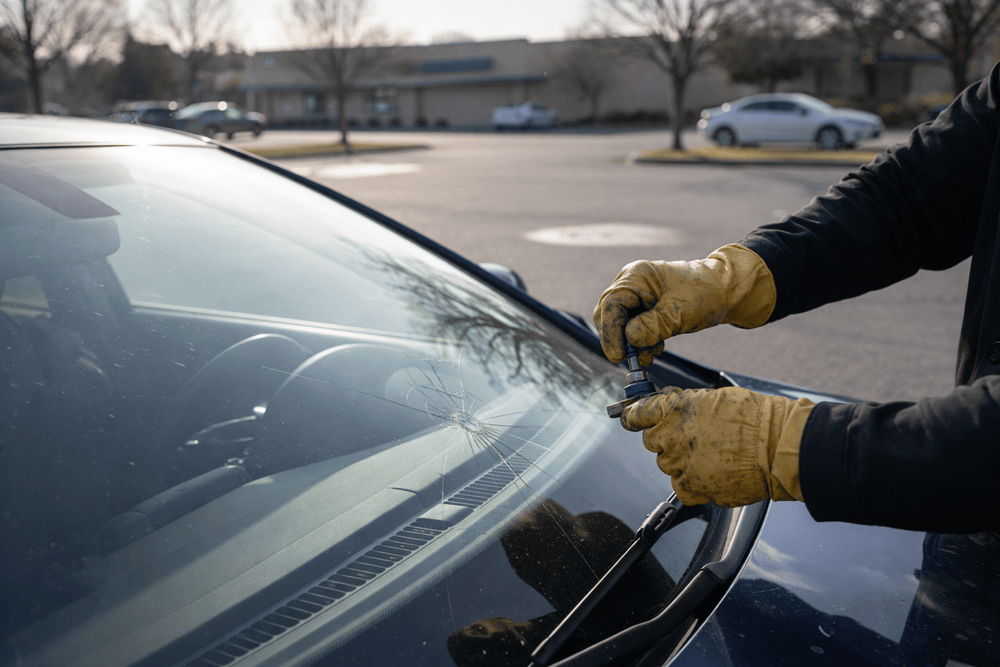
How Broken Windshield Repair Works Explained
Drivers are familiar with the sinking feeling. You’re enjoying yourself while driving down the highway, listening to music, when all of a sudden—snap. A passing truck kicks up a stone that strikes your windshield. A tiny, star-shaped chip is looking back at you as you flinch and glance at the glass. Ignoring it is appealing. It’s small, after all, isn’t it? But when exposed to temperature fluctuations or vibrations from the road, a small imperfection can swiftly grow into a large break. Before you realize it, you may need to replace your entire windshield rather than just make minor repairs. Advances in car glass technology have made it possible to repair these chips more quickly and efficiently. The science behind it is quite amazing, but it’s not magic.
Get An Auto Glass Replacement Quote Now 866.278.7417

Windshield Replacement & Repair
Our competitors push you into going to their shop to get your glass fixed-making it cheaper for them. We make it easier for YOU to get back on the road by offering free mobile repairs at your home or work. With our free mobile services servicing the entire Orange County & Los Angeles area, we can often handle your windscreen replacement the same day! So the next time you need a windshield replacement, give us a call.
Talk to a Windshield Replacement Specialist Now 866.278.7417

Calibration
Calibration is the process of returning a vehicle’s ADAS to OEM specifications. Calibration is necessary after a new glass installation, particularly a windshield with a camera mounted to it, to ensure that the ADAS features continue to function properly despite having been moved during installation. If a car’s ADAS is not properly calibrated, the system may not function safely. A misaligned camera could jeopardize the functionality of the system and lead to dangerous driving or accidents, so it is crucial that the cameras are aligned perfectly, which is what windshield calibration ensures.
Talk to a Calibration Specialist Now 866.278.7417

Fleet Auto Glass Repair
We provide expert auto glass repair and windshield replacement services for commercial fleets of all sizes. We are experienced with all manufacturers and machine types of domestic or foreign cars, trucks, vans, or commercial vehicles, including heavy equipment. Our same day mobile auto glass and windshield repair service will enable you to get back on the road faster and start saving you time and money instantly. Give us a call today! We are here to help!
Talk to a Fleet Auto Glass Specialist Now 866.278.7417
The Anatomy of Your Windshield
You must first comprehend what is being repaired to comprehend the repair. If your windshield were made of a single sheet of windowpane glass, it would break into lethal fragments when struck. It is composed of laminated glass instead.
Polyvinyl butyral (PVB) resin is layered between two layers of glass to create laminated glass. The exterior layer of glass is typically broken when a rock strikes your windshield repair, while the inner and middle PVB layers remain intact. In reality, the “chip” or “bullseye” you perceive is an air pocket formed where the PVB layer and exterior glass split.
A repair’s objective goes beyond simple aesthetic enhancement. The main goal is to use a specific epoxy to fill the air pocket, which will bind the glass back together and stop the crack from getting worse.
Step-by-Step: The Repair Process: Although do-it-yourself kits are available, professional repair businesses adhere to strict guidelines to guarantee that the repair will last. What usually occurs during a professional service is as follows.
Assessment and Cleaning: A professional assesses the damage before any tools come into contact with the glass. Not every chip can be fixed. The damage may usually be repaired if it is not directly in the driver’s line of sight and is less than a quarter (approximately an inch in diameter).
The region is thoroughly cleaned after it is judged repairable. Using a tiny pick or scribe, technicians clear debris and stray glass fragments from the impact spot. A good connection is hampered by moisture; thus, the region needs to be totally dry and wax- and dirt-free.
Drilling (Sometimes): Drilling into shattered glass may seem paradoxical, but it is occasionally required. A technician may use a micro-drill to construct a tiny passage if the impact site lacks a clear entrance for the resin to flow into. This process guarantees that the resin can get to the crack’s deepest areas.
Resin Injection
This is the operation’s central component. The technician places a specialized instrument—often referred to as an injector or bridge—directly over the chip. This apparatus produces a vacuum seal against the glass.
The instrument first removes air from the brake. Because air bubbles will keep the resin from fully filling the vacuum, it is imperative that the air be removed.
The instrument injects a liquid, curable resin into the chip after the air has been removed. Because this resin visually matches the glass’s refractive index, the fracture seems to “disappear” when it is filled.
Curing the Resin: To regain structural strength, the liquid resin must solidify. Ultraviolet (UV) light is used for this. For a few minutes, the technician will cover the repair area with a UV lamp.
The resin undergoes a chemical reaction in response to the UV rays, solidifying and forging a strong bond with the surrounding glass. The resin can be cured by natural sunshine on a sunny day, but experts utilize lights to guarantee a steady and quick curing.
Polishing and Pit Filling: To make sure the windshield is smooth, extra resin is scraped off the surface using a razor blade once it has hardened. The repair area will then be polished by a specialist. The structural integrity is restored, and the visual distraction is greatly diminished, even if the chip won’t entirely disappear—there will typically be a tiny, faint imperfection where the impact happened.
Do you have a Question?
Get An Auto Glass Replacement Quote Now 866.278.7417
Why Fixing Is Better Than Replacing
If the damage permits, it is nearly always preferable to have a repair rather than a complete replacement.
Cost: Compared to replacements, repairs are substantially less expensive. To prevent the greater expense of a replacement later on, several insurance policies even cover repairs with a $0 deductible.
Time: Usually, a repair takes half an hour. In addition to the time needed for the adhesive to cure before you can drive safely, a replacement may take hours.
Safety: Your original windshield’s factory seal is extremely durable. In the event of a rollover, it is safer for the structural integrity of the car’s cabin to have the original seal in place.
Frequently Asked Questions: After correction, will the chip totally vanish? No, not entirely. The majority of the repair is structural. Even though the damage will be 70% to 90% less visible, you can still notice a tiny mark or little distortion where the rock struck.
Is it possible to fix a long crack? The length determines this. It is frequently possible to fix cracks that are less than three inches long, or roughly the length of a dollar bill. Anything longer typically requires a complete replacement because it undermines the glass’s structural integrity too much.
Does a do-it-yourself repair kit work? You can, but the outcomes differ. Compared to consumer kits, professional equipment employs higher pressure and higher-quality resin. You will probably require a new windshield if you make a mistake on a do-it-yourself repair.
Avoid Waiting Until It Cracks. Windshield repair science is a time-sensitive endeavor. Dirt, moisture, and temperature changes continually widen that tiny chip into an irreversible crack. By taking care of the damage early on, you may preserve your original glass by utilizing vacuum injection and contemporary resin technology.
As soon as you notice a chip, have it evaluated. It’s a simple, low-cost solution that maintains both your car’s safety and your road vision.
Comprehending the Windshield Repair Procedure
Every driver’s fear is that unique “pop” sound. A piece of gravel that a truck has stirred up hits your windshield as you are driving down the highway and going about your business. Your heart sinks when you see it—a tiny, jagged star directly in the glass.
Frequently, panic strikes right away. Is it going to spread? Does the entire windshield need to be replaced? What is the price of this? The good news is that efficient repairs that preserve your car’s structural integrity and save time and money are made possible by modern auto glass technology.
But the procedure is far more involved than just applying adhesive to a crack. It is an exact fusion of chemistry, physics, and expert craftsmanship. Your car’s windshield repair is a surgical operation.
The patient must be evaluated, the area must be prepared, the cure must be injected, and a full recovery must be guaranteed. You may better understand why professional repair is frequently the safest option if you know what transpires between the initial examination and the final curing step.
The Critical Inspection: A technician must ascertain whether the damage is truly repairable before any tools come into contact with the glass. Not every fracture or chip can be saved.
The Factor of Size and Depth
The “dollar bill” test was once used as a general rule of thumb: if the damage could be covered by a dollar bill, it was repairable. With the advancement of technology, specialists can now fix wider cracks, sometimes up to 12 or 14 inches, depending on the tools used in the shop.
But depth is important. Two layers of glass are encased in a layer of polyvinyl butyral (PVB) plastic to form a windshield. A complete replacement is typically required if the damage has severely damaged the inner plastic layer or pierced through both layers of glass.
Location, Location, Location: The location of the damage is just as crucial as its extent.
Driver’s Line of Sight: The repair may cause a small distortion if the chip is right in front of the driver. Even a small imperfection might produce glare from headlights and sunshine or divert a vehicle. For safety reasons, replacement is frequently advised in these situations.
The Glass’s Edge: More than those in the middle, cracks close to the windshield’s edge jeopardize its structural integrity. Because of the tremendous load on the glass’s perimeter, repairs there are more likely to fail or spread.
Sensors and Cameras: Advanced Driver Assistance Systems, or ADAS, are installed in many modern cars and are frequently located behind the windshield. To guarantee that the safety systems function properly, damage close to these sensors may affect their calibration, requiring a replacement.
Determining the Type of Damage
To choose the best course of action, technicians classify damage. A “bullseye” is a neat, round fracture in the outer layer of glass that has a cone. From the point of impact, a “star break” contains tiny cracks extending outward. That’s precisely what a “combination break” is. To make sure the resin fills in all of the tiny nooks and crannies, each calls for a somewhat different method.
Drilling & Preparation: The actual work starts as soon as the expert provides the all-clear. Here, the objective is to make the repair resin’s pathway clear and accessible.
Temperature Stabilization: Glass has erratic temperatures. When heated, it expands, and when cooled, it contracts. A repairable chip can become a complete replacement if you attempt to fix a hot windshield with cool resin (or vice versa). This is because the thermal shock can cause the fracture to run rapidly.
By placing the car in a climate-controlled bay or employing specialized heating and cooling equipment to balance the surface temperature, technicians will stabilize the glass temperature.
Cleaning the Wound: Road grime, crushed glass particles, and occasionally wetness are found at the impact point. Resin is unable to adhere to water or dirt. If it has been raining, technicians may use a specialized moisture evaporator in addition to using a probe to find any stray glass fragments. The final product will appear hazy, and the bond will be poor if moisture is trapped inside the patch.
Establishing an Entry Point
Occasionally, the impact point is too tiny for the resin to enter efficiently. In these situations, the technician carefully widens the impact point using a precision drill equipped with a tiny burr. Drilling a hole in broken glass may seem contradictory, but it guarantees that the resin can get to the deepest areas of the fracture.
The main component of the repair procedure is the resin injection cycle. The technician fastens a device known as a “bridge” to the windshield. With the help of suction cups, this gadget positions an injector exactly over the damage.
The Vacuum Cycle: Since air already fills a crack, resin cannot be simply pushed into it. Two objects cannot occupy the same space simultaneously due to the laws of physics. Thus, really eliminating the air is the first step. By creating a vacuum, the injector extracts air from the crack. Sometimes, if you look closely, you can see little bubbles of air leaking through the seal.
The Pressure Cycle: The cycle transitions to pressure after the air is removed. A customized acrylic resin is forced into the void by a mechanical or hydraulic plunger. The resulting substance is an optical-grade resin made to have the same refractive index as glass, not merely superglue.
This effectively makes the repair almost undetectable because light does not bend differently through it than it does through the glass. There may be multiple repetitions of this vacuum and pressure cycle. Complete displacement—zero air pockets, 100% resin fill—is the aim.
Curing and Hardening: At this point, liquid resin has been poured into the crack. Although it is not yet permanent, it is keeping the glass together. It must be solidified, or “cured.”
Do you have a Question?
Get An Auto Glass Replacement Quote Now 866.278.7417
The Power of UV Light
Windshield repair glue is both photopolymer (it reacts to light) and anaerobic (it cures without air). Technicians place a specialized ultraviolet (UV) lamp over the repair area. The molecules in the resin cross-link and harden due to the photochemical reaction caused by the UV light.
Often, this process takes only a few minutes to complete. The windshield’s structural strength is restored when the liquid resin solidifies into a strong, long-lasting plastic that joins the two sides of the crack. By doing this, the stress of driving, temperature fluctuations, and potholes are prevented from causing the crack to widen.
Pit Filling: Easy flow is a feature of the injection resin. But the “pit”—the surface impact point—needs something more durable. To produce a smooth, rigid outer shell, a thicker, higher-viscosity resin known as “pit filler” is applied to the very surface. UV light is also used to heal this.
The Final Polish: The windshield repair typically resembles a tiny, dried droplet of glue after the UV lamp is turned off. The extra cured resin is scraped off by the technician using a razor blade, completely leveling it with the surrounding glass.
Lastly, the repair area is buffed using a cork or specialty polishing pad that contains a light abrasive. This brings back the clarity and sparkle. A successful repair should increase the cosmetic look by 80% to 95%, even though it will never be 100% optically correct (you may still notice a faint imprint or a speck where the impact occurred).
Common Questions
Can I get my car washed right away after having my windshield fixed? Indeed. The resin is completely solidified by the time you leave the store since UV light is used to cure it. The repair won’t be impacted by soap, water, or car washes.
Will the chip vanish entirely? No. Structural stability—preventing the break from spreading—is the main objective of windshield repair. There will probably be a tiny scar or imperfection where the rock struck, even though the appearance will greatly improve.
Can a do-it-yourself repair kit match the quality of a professional repair? In general, no. Professional shops employ superior resins and equipment that can pull a much stronger vacuum, even if do-it-yourself kits operate on similar principles.
Long-term crack prevention is more likely with a competent repair. Additionally, if you make a mistake with a do-it-yourself repair, it is frequently impossible for a professional to correct it later since the crack is now blocked with low-quality, cured glue.
Don’t Wait to Repair: The intricacy of the windshield repair procedure makes it clear that experts should handle this task. Every stage is intended to restore safety to your car, from the exact vacuum pressure needed to eliminate air pockets to the particular UV wavelengths required for curing.
Speed is the most crucial lesson to learn. The longer a chip is left unfixed, the more moisture and dirt build up inside, making a clean repair challenging. Even worse, that tiny chip could suddenly spread throughout the entire windshield due to temperature changes and vibrations from the road.
Please schedule an inspection promptly if you hear the concerning pop. It can make the difference between an expensive, comprehensive windshield replacement and a speedy, reasonably priced repair.
Mobile Safe Auto Glass
14241 E Firestone blvd suite 400,
La Mirada, CA 90638
Phone: (562) 608-1154
Toll Free: 1 866 278 7417
Mail: sales@mobilesafeautoglass.com
Get a FREE QUOTE today! You can get a free quote and schedule 24/7 using this free quote wizard.
Mon – Fri 8am – 5pm
Saturday 8am – 1pm
Sunday Closed