Highly Recommended Auto Glass ADAS Calibration Facts
Your automobile looks like new again after having your windshield replaced. But is driving really safe? The task is incomplete until the Advanced Driver-Assistance System (ADAS) in your vehicle has been correctly recalibrated. A significant number of motorists are not aware that the windshield is one of the most essential components of the sophisticated safety features that their vehicle possesses. After a replacement, skipping the calibration procedure might jeopardize both your safety and your vehicle’s operation. The key details about ADAS calibration will be covered in this article, along with what to look for in a competent car glass service and why it’s crucial.
Get An Auto Glass Replacement Quote Now 866.278.7417

Windshield Replacement & Repair
Our competitors push you into going to their shop to get your glass fixed-making it cheaper for them. We make it easier for YOU to get back on the road by offering free mobile repairs at your home or work. With our free mobile services servicing the entire Orange County & Los Angeles area, we can often handle your windscreen replacement the same day! So the next time you need a windshield replacement, give us a call.
Talk to a Windshield Replacement Specialist Now 866.278.7417

Calibration
Calibration is the process of returning a vehicle’s ADAS to OEM specifications. Calibration is necessary after a new glass installation, particularly a windshield with a camera mounted to it, to ensure that the ADAS features continue to function properly despite having been moved during installation. If a car’s ADAS is not properly calibrated, the system may not function safely. A misaligned camera could jeopardize the functionality of the system and lead to dangerous driving or accidents, so it is crucial that the cameras are aligned perfectly, which is what windshield calibration ensures.
Talk to a Calibration Specialist Now 866.278.7417

Fleet Auto Glass Repair
We provide expert auto glass repair and windshield replacement services for commercial fleets of all sizes. We are experienced with all manufacturers and machine types of domestic or foreign cars, trucks, vans, or commercial vehicles, including heavy equipment. Our same day mobile auto glass and windshield repair service will enable you to get back on the road faster and start saving you time and money instantly. Give us a call today! We are here to help!
Talk to a Fleet Auto Glass Specialist Now 866.278.7417
What is ADAS calibration
The purpose of advanced driver-assistance systems, sometimes known as ADAS, is to simplify and improve the general safety of driving. These systems have attributes such as
Warnings about lane deviation
Alerts for forward collisions
Emergency braking that operates automatically
Cruise control that adapts
Help with lane-keeping
To function properly, the Advanced Driver Assistance System (ADAS) requires a network of cameras and sensors, the majority of which are mounted directly onto the windshield. The car’s computer receives data from these sensors, which “see” the road, other cars, and pedestrians.
The process of accurately realigning these cameras and sensors to guarantee that they function in accordance with the requirements of the car manufacturer is known as ADAS calibration. The placement of these parts may change by millimeters following a windshield replacement. Although it might not seem like much, even a small misalignment can result in hazardous faults by causing the system to misread its environment.
Why ADAS Calibration Is Necessary for Windshield Replacement
A significant part of the safety system of your car is the windshield, which not only shields you from the elements but also protects you from the wind and rain. It also serves as the “eyes” of your ADAS in contemporary cars.
The camera bracket is taken off of the old glass and installed on the new one when a professional repairs your windshield. The camera’s location and angle will unavoidably vary during this operation. The system may misinterpret distances and the placement of objects on the road if its viewing angle is not calibrated.
Think about the repercussions:
It is possible for a forward collision alarm to miss a stopped car.
Instead of keeping you in the middle, a lane-keeping assist can divert you into a different lane.
Unexpectedly or not at all, automatic emergency braking may engage.
Because of this, the majority of automakers require ADAS recalibration following any procedure that can alter the camera’s alignment, such as replacing the windshield, fixing an accident, or even just aligning the wheels.
Do you have a Question?
Get An Auto Glass Replacement Quote Now 866.278.7417
ADAS Calibration Types
The specific ADAS recalibration technique required depends on your car’s make and model.
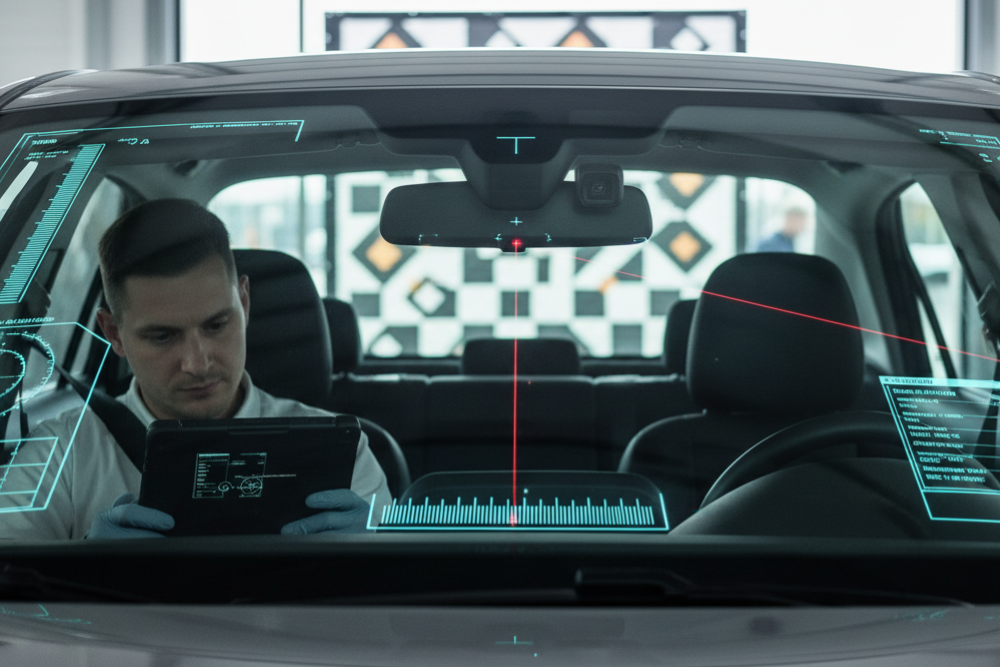
Calibration That Is Static; While the vehicle is immobile, static calibration is carried out in a controlled workshop setting. Technicians position a precise target board or pattern in front of the car at a predetermined distance.
The technician utilizes specialist diagnostic equipment to modify the camera’s alignment until it satisfies the manufacturer’s exact specifications once the ADAS camera scans this target. For this technique to work, the floor must be precisely level and the dimensions must be exact.
Adaptive Calibration: The technician must drive the car on the road for a predetermined distance at a predetermined speed in order to perform dynamic calibration. The ADAS camera recalibrates itself while driving by reading lane markers and other road characteristics.
The technician starts the procedure and keeps an eye on it using portable diagnostic equipment to make sure it ends properly. Clear, visible road markers and ideal weather are prerequisites for this approach.
For certain cars to completely regain ADAS capability, both static and dynamic calibration are necessary. A qualified mechanic will be aware of your vehicle’s particular needs.
Selecting the Best Auto Glass Repair
It is not possible for every auto glass shop to possess the equipment required to complete ADAS calibration. When you need to replace your windshield, it’s crucial to choose a supplier who possesses the necessary equipment, education, and experience.
What to look for in a well-regarded auto glass service is as follows:
Technicians with certification: Make sure that the technicians have had ADAS recalibration training and certification. They have to be familiar with the particular protocols for different car models and brands.
The right tools: The target systems and specific diagnostic equipment needed for both static and dynamic calibration must be available in the shop. Find out whether they have the tools required for your particular car.
Dedication to Safety: A trustworthy supplier would never consider calibration to be an optional extra. They will incorporate it into the windshield replacement procedure since they recognize how important it is for safety. Documentation attesting to the successful completion of the calibration should also be provided.
Use of High-Quality Glass: The replacement windshield’s actual quality is also important. Premium Original Equipment Manufacturer (OEM) or comparable glass ensures a flawless fit, crucial for accurate camera positioning and reliable ADAS performance.
The Price of Security
Even though ADAS calibration raises the price of a windshield replacement, it is an essential component of the fix. When you choose to cut corners in order to save money, you put not only yourself but also your passengers and other drivers in danger. Be careful to verify with your insurance carrier because many plans cover the cost of calibration as part of a windshield replacement claim.
Your car’s cutting-edge safety features will continue to operate as intended and offer the protection you depend on each and every time you drive if you invest in a professional, manufacturer-specified repair from a certified facility.
A Well-Defined Route to Security: The necessity for auto repairs increases along with the technical sophistication of automobiles. For millions of automobiles on the road today, ADAS calibration is now a basic safety need rather than a mysterious procedure.
When it comes to fixing your windshield, you should steer clear of selecting a company that takes shortcuts. Put your safety first by selecting a reputable car glass supplier who recognizes the value of accurate ADAS recalibration. In addition to obtaining a new piece of glass, you’re guaranteeing that your car’s advanced safety measures will be there to keep you safe when you need them most.
What is the calibration of the windshield: You had your windshield replaced after it cracked. You’re prepared to resume driving, and the new glass looks fantastic. However, did you realize that many drivers fail to do this important last step? The process of replacing the windshield on a modern car includes more than simply replacing the glass. The most crucial safety functions in your car might be jeopardized if you miss the ADAS calibration process.
On the vast majority of brand-new vehicles, advanced driver assistance systems (ADAS) are included as standard equipment. Adaptive cruise control, lane-keeping assistance, and automatic emergency braking are some of the features that are powered by a network of cameras and sensors. Often, these systems install the main camera directly on your windshield. Replacing the windshield can alter the location and angle of the camera, even slightly. As a result of this minor adjustment, the system as a whole could become unstable at the very moment when you require it the most.
This article will define windshield calibration, discuss its importance for your safety, and outline the steps involved. By the conclusion, you’ll see why, following a windshield replacement, this procedure is essential for every modern car.
What is ADAS
A group of safety features called Advanced Driver-Assistance Systems (ADAS) are intended to lessen human error and increase driving safety. They monitor the environment around the vehicle, warn the driver of any threats, and, in some cases, take over the vehicle automatically to prevent collisions. They do this by combining lidar sensors, radar, and cameras.
One of the most important parts of the ADAS suite is the forward-facing camera, which is often positioned in the top-center of the windshield. It serves as the system’s “eye” by supplying the visual information required for several essential operations.
The following are typical ADAS functions that depend on this camera:
You are notified by the Lane Departure Warning (LDW) if your car begins to veer out of its lane without warning.
Lane Keeping Assist (LKA) is a feature that gently directs the vehicle back into its lane if it detects that it has drifted off course by mistake.
Automatic Emergency Braking (AEB): Prevents or lessens the force of an accident by automatically applying the brakes when it detects an impending collision with another car or pedestrian.
Adaptive Cruise Control (ACC) is a feature that automatically adjusts your speed while keeping a predefined space between you and the vehicle in front of you.
Road signs, such as speed restrictions, may be recognized using Traffic Sign Recognition (TSR), which then shows them on your dashboard.
When you repair your windshield, you remove the camera and then reinstall it on the new glass. It just takes a few millimeters of misalignment for the camera to misread the road ahead. Such an error might make your safety features useless or, worse, unpredictable if it misses lane markers or miscalculates the distance to another vehicle.
Do you have a Question?
Get An Auto Glass Replacement Quote Now 866.278.7417
The Significance of Windshield Calibration
Refocusing a camera lens is analogous to ADAS calibration. The images will be distorted and indistinct if the lens is even a little out of focus. Likewise, your ADAS camera’s “view” of the road will be erroneous if it isn’t precisely calibrated. As a consequence of this, there may be significant risks to public safety.
A system that is not properly calibrated could lead to the following issues:
Not activating when required: In an emergency, the automated emergency braking may fail to activate because it fails to recognize an obstruction.
Turn on unnecessarily: When you’re absolutely within your lane, the lane-keeping assistance might abruptly steer the car, which could be unsafe. Give bogus warnings: Even while you’re driving properly, the lane departure system may keep sending you annoying alarms.
The majority of automakers specifically mandate ADAS calibration following windshield repair to guarantee that their safety systems operate as intended. Not doing so may cause liability issues in an accident and endanger you and your passengers. Maintaining your car’s safety integrity requires a system that is calibrated correctly.
The Procedure for Windshield Calibration
Only skilled personnel with specialist equipment should carry out the exact and technical procedure of windshield calibration. The two basic types of calibration are known as static and dynamic calibration. While many vehicles require a combination of both, some just need one.
Calibration That Is Static: A regulated workplace setting is used for static calibration. Technicians utilize particular targets and patterns positioned in front of the car at specified heights and distances while it is parked in a designated service bay.
Preparation: Because these elements might impact the car’s height and alignment, the technician makes sure the vehicle is on a level surface and that elements like tire pressure and fuel level adhere to manufacturer standards.
Target Setup: In front of the vehicle, a dedicated rig holds large, printed targets. The guidelines provided by the car manufacturer determine the precise positioning.
The technician connects a diagnostic instrument to the car’s computer for calibration. The ADAS camera scans the targets and modifies its settings until it is precisely aligned with the vehicle’s center axis as the tool starts the calibration procedure.
In a controlled environment, this technique enables a very accurate and reproducible alignment.
Adaptive Calibration: As the name implies, dynamic calibration is carried out while the car is moving.
Setup: A technician plugs a portable calibration tool into the car’s onboard diagnostics port, or OBD-II port.
Driving Procedure: The technician operates the car at a predetermined pace, often between 30 and 60 mph, on a well-defined route. For the camera to read the roadways, the lane markers must be clearly visible.
Calibration: The diagnostic tool asks the system to calibrate while the drive is underway. The ADAS camera aligns itself by identifying lane markers and other road elements. Depending on the car and the state of the roads, the procedure might take anywhere from fifteen minutes to an hour.
The demands of the manufacturer will determine whether your car needs static, dynamic, or both kinds of calibration. The precise process for your make and model will be known to a qualified car glass expert.
Make Sure You Stay Safe While Driving
Modern automobiles are technical marvels with sophisticated safety systems, but their effectiveness depends on how well they are calibrated. Making sure your ADAS is correctly recalibrated after a windshield repair is not only advised but also a crucial safety need.
You can drive with assurance knowing your new windshield is secure and your car’s safety systems are operating properly if you engage with a trustworthy auto glass provider that recognizes the significance of this procedure. For your own safety as well as the protection of other drivers, calibration is an extremely important step. Do not cut corners on it.
Mobile Safe Auto Glass
14241 E Firestone blvd suite 400,
La Mirada, CA 90638
Phone: (562) 608-1154
Toll Free: 1 866 278 7417
Mail: sales@mobilesafeautoglass.com
Get a FREE QUOTE today! You can get a free quote and schedule 24/7 using this free quote wizard.
Mon – Fri 8am – 5pm
Saturday 8am – 1pm
Sunday Closed