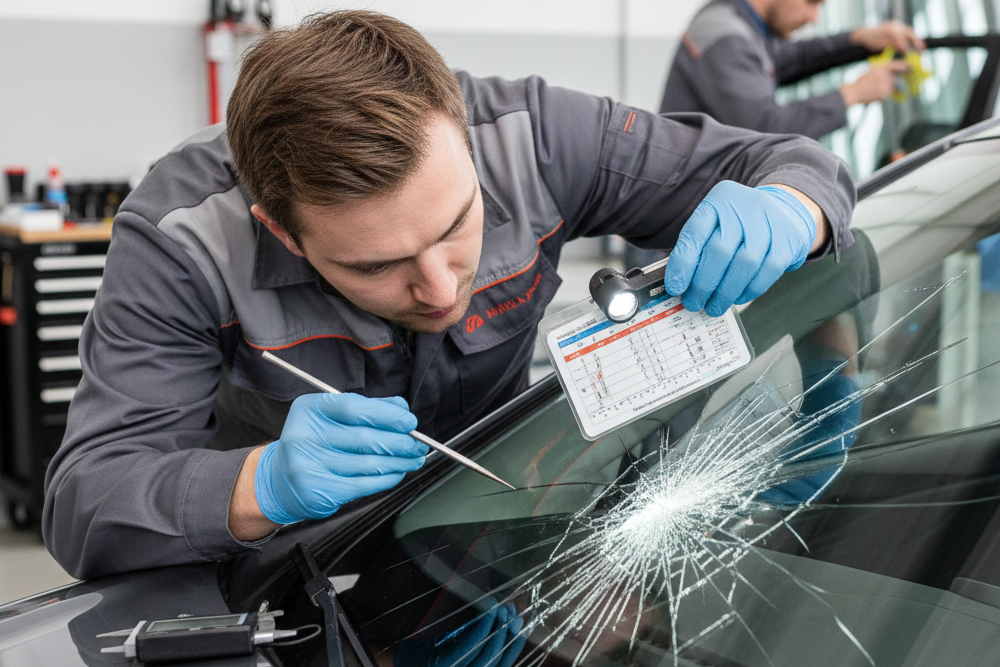
Car Windshield Crack Repair Precision Analysis
Even while that tiny chip on your windshield might not seem like much right now, neglecting it could cause more serious issues later on. A small fracture may grow fast, blocking your visibility and jeopardizing your car’s structural stability. Knowing when and how to fix a windshield crack is important for safety reasons as well as looks. A thorough examination of windshield crack repair is given in this tutorial. We will examine the many forms of damage, the actual repair procedure, and the variables that dictate whether a straightforward repair or a complete replacement is required. After reading this page, you’ll know enough to make an informed choice that will keep your car secure and your road vision unobstructed.
Get An Auto Glass Replacement Quote Now 866.278.7417

Windshield Replacement & Repair
Our competitors push you into going to their shop to get your glass fixed-making it cheaper for them. We make it easier for YOU to get back on the road by offering free mobile repairs at your home or work. With our free mobile services servicing the entire Orange County & Los Angeles area, we can often handle your windscreen replacement the same day! So the next time you need a windshield replacement, give us a call.
Talk to a Windshield Replacement Specialist Now 866.278.7417

Calibration
Calibration is the process of returning a vehicle’s ADAS to OEM specifications. Calibration is necessary after a new glass installation, particularly a windshield with a camera mounted to it, to ensure that the ADAS features continue to function properly despite having been moved during installation. If a car’s ADAS is not properly calibrated, the system may not function safely. A misaligned camera could jeopardize the functionality of the system and lead to dangerous driving or accidents, so it is crucial that the cameras are aligned perfectly, which is what windshield calibration ensures.
Talk to a Calibration Specialist Now 866.278.7417

Fleet Auto Glass Repair
We provide expert auto glass repair and windshield replacement services for commercial fleets of all sizes. We are experienced with all manufacturers and machine types of domestic or foreign cars, trucks, vans, or commercial vehicles, including heavy equipment. Our same day mobile auto glass and windshield repair service will enable you to get back on the road faster and start saving you time and money instantly. Give us a call today! We are here to help!
Talk to a Fleet Auto Glass Specialist Now 866.278.7417
Knowing About Windshield Damage
There is a wide variety of damage that may occur to a windshield. The crack’s location, size, and nature are important determinants of the best course of action. To evaluate the damage and determine if a repair is possible, auto glass experts employ particular categories.
Windshield Crack Types: A chip or ding is a tiny, impact-related blemish on the glass’s outer layer that is frequently brought on by a flying rock or piece of debris. Usually, it resembles a little pit.
Bullseye: A round fissure that resembles a target. It is brought on by a spherical item striking you directly.
Star Break is a type of damage that is characterized by the presence of minute fractures that are shaped like stars and radiate outward from a central point of impact.
Combination Break: This sort of break includes aspects of a star break and a bullseye break, with various crack patterns visible from the impact zone. As the name suggests, this type of break contains features of both types of breaks.
A single line of glass fracture is called a crack. Road vibrations and temperature fluctuations can cause cracks to spread quickly, and they can be small (less than 6 inches) or lengthy (more than 6 inches).
Stress Crack: Often brought on by drastic temperature changes, such as using hot water to de-ice a frozen windshield, these cracks show up without any discernible impact point.
The Difference Between Repairing and Replacing
Three important considerations determine whether to replace or repair your windshield: the extent, location, and size of the damage. For repairs, the majority of vehicle glass specialists adhere to a straightforward rule of thumb.
Situations That Encourage Repair: In general, if the damage satisfies the following requirements, it can be repaired.
Dimensions: A bullseye or chip should have a diameter of no more than a quarter, or around one inch. The optimal length for a single crack is less than six inches. Six inches is a common rule; however, some more recent methods can manage greater fractures.
Location: If the damage is not in the driver’s direct line of sight, there is a greater chance that it will be repaired to the vehicle. Minor distortions from repairs may remain, endangering the driver’s view. Additionally, because they might damage the entire structure, cracks that extend to the windshield’s edge are sometimes challenging to completely fix.
Depth: The damage must only affect the windshield glass’s outer layer. In order to manufacture windshields, laminated glass is utilized. This type of glass is made up of two layers of glass with a plastic interlayer in between. In the event that the fracture has expanded to both levels, a replacement is definitely required.
Do you have a Question?
Get An Auto Glass Replacement Quote Now 866.278.7417
Situations Needing Replacement
In certain cases, a complete windshield replacement is usually required:
Major Cracks: In general, cracks larger than 6 to 12 inches cannot be safely and successfully fixed.
Damage in the Driver’s Line of Sight: To prevent visual distortion, any chip or crack that blocks the driver’s primary seeing area needs to be replaced.
Edge Cracks: Replacement is the safest course of action when a crack reaches the windshield’s edge since it jeopardizes both the seal and the overall structural integrity.
In the event that the damage has not only penetrated the exterior layer of glass but also reached the inner layer, a repair will not be sufficient to fix the problem.
Multiple Cracks: It’s usually best to replace a windshield completely if it has a lot of chips and cracks.
An explanation of the windshield repair procedure. The strength and purity of your glass may be restored with modern windshield repair, which is an accurate and efficient procedure. Despite its seeming complexity, it may be divided into a few essential processes.
The technician begins by doing a comprehensive cleaning on the afflicted area. This is followed by the preparation of the area. The chip or fracture is meticulously cleaned to eliminate any stray glass shards, dirt, or moisture. Taking this step is necessary in order to ensure that the repair resin will be able to cling to the glass in the proper manner.
Making a Pathway: The technician might have to drill a tiny hole into the impact location for some chip types. This makes it possible for the repair glue to gently enter each area of the break.
Resin Injection: The injured region is covered using a specialized instrument. Due to the fact that it generates a vacuum, this instrument is able to remove any remaining traces of air from the fissure. The vacuum is subsequently fully filled by injecting a transparent, liquid resin under high pressure.
Curing the Resin: To level the surface after filling the crack, the technician uses a tiny bit of pit filler. The restored region is then exposed to an ultraviolet (UV) light. In only a few minutes, the resin is cured and hardened by the UV light, forming a solid, long-lasting connection with the surrounding glass.
Polishing and Finishing: To restore the surface’s smoothness and clarity, any extra resin is scraped off with a razor blade once it has completely dried. When done properly, the restoration is frequently almost undetectable.
The Value of Taking Prompt Action
A little, low-cost windshield repair might become a more expensive replacement if it is put off. Time is crucial for the following reasons:
Crack Propagation: One of the main factors contributing to crack development is temperature variations. The glass may expand when exposed to the sun’s heat or shrink when exposed to cold air or the air conditioner in your automobile. The injured region is under stress from this cycle, which causes the fracture to widen.
Contamination: If a chip or crack is left untreated, dirt, dust, and water may leak in. Because the resin won’t be able to properly bind with the glass, this pollution may make a successful repair more challenging, if not impossible.
Safety Compromise: The function of your windshield extends beyond only keeping out rain and wind. It is a crucial component of the safety system that your vehicle possesses. It plays a significant role in the correct deployment of the airbags in the event of a collision and provides up to thirty percent of the structural strength of the car. During a collision, a windshield that has been damaged may fail, which increases the likelihood of injuries occurring.
Locating the Ideal Expert
Do-it-yourself windshield repair kits are available; but, in terms of quality and durability, they typically fall short of the services provided by professionals. A skilled technician has the knowledge, superior resins, and the appropriate equipment to guarantee a safe and accurate repair.
Look for trained professionals that provide a warranty on their work when selecting a repair service. You may rest easy knowing that the repair will last thanks to this.
What to Do Next for a Clearer Drive: A broken windshield is a safety issue that has to be fixed right once, not just a small irritation. You may make an informed choice that safeguards your health and your finances by being aware of the various kinds of damage and the restoration procedure.
Don’t wait for that little chip to become a major problem if you can help it. Regularly check your windshield, and if you see any damage, get it evaluated by a licensed car glass specialist. You may avoid a pricey replacement tomorrow and guarantee a clear and safe vision of the road ahead with a fast repair now.
What Micro Fracture Mapping Tells Us About the Integrity of Auto Glass
You most likely perceive a smooth, sturdy barrier shielding you from the wind and road debris when you glance at your car’s windshield. It’s simple to assume that the glass is in pristine condition unless there is a noticeable chip or spiderweb break. But underneath that immaculate exterior is a complicated web of tension and other vulnerabilities that are hidden from view.
Micro-fracture mapping is useful in this situation. This advanced analytical method is transforming our understanding of vehicle glass safety. Experts can forecast how glass will respond to stress by spotting minute flaws before they become disastrous failures.
Understanding this technology provides an intriguing look into the engineering that keeps us safe for both car owners and safety aficionados. It also emphasizes the possibility that the “harmless” stone strike might be more hazardous than it appears.
Knowing the Make Up of Automobile Glass
We must first comprehend the canvas that micro-fracture mapping examines in order to fully grasp what it achieves. Standard windowpane glass is not the same as auto glass. Generally speaking, it may be divided into two types: tempered glass, which is used for side and rear windows, and laminated glass, which is used for windshields.
In order to produce laminated glass, a layer of polyvinyl butyral (PVB) is sandwiched in between two layers of glass. If the glass breaks, this mechanism is meant to keep it together so that the pieces don’t fly into the cabin.
Tempered glass, on the other hand, is subjected to heat treatment in order to make it more durable than conventional glass. Additionally, it is designed to shatter into dull, almost insignificant bits rather than sharp ones when it is struck. Glass is still fragile in spite of its strong engineering.
It is vulnerable to physical impact, temperature fluctuations, and stress. Even the best car glass has little defects that were introduced during production or regular usage. These are the antecedents of the fissures that we finally observe.
Micro Fracture Mapping
A diagnostic technique called micro-fracture mapping is used to find and show tiny cracks in glass that are too small for the human eye to notice. The material’s integrity is seriously compromised by these fractures, which can be as tiny as a human hair or even smaller.
Advanced imaging technologies are frequently used in the process, including:
Using sound waves to find disruptions in the material density is known as ultrasound scanning.
Precision lasers are used in laser imaging to look for imperfections on the glass’s surface and depth.
Finding heat fluctuations that point to stress areas or fractures in the material’s continuity is known as thermal imaging.
The end product is a thorough “map” of the glass that shows any existing damage and high stress points. This map displays the windshield’s secret history, highlighting areas where debris strikes, installation pressure, or even abrupt temperature changes have deteriorated it.
The risks that mapping has uncovered: Micro-fracture mapping yields grave revelations. They show that the integrity of vehicle glass is frequently jeopardized long before a break becomes apparent.
The Cumulative Impact Of Stress
The cumulative nature of glass damage is one of the main discoveries. Even while it might not do any damage, a single tiny pebble striking your windshield causes a microfracture, which is a localized stress point.
These microfractures get bigger over time when the car shakes while driving and the glass expands and contracts according to the weather. Mapping demonstrates how a large fracture may form when a series of small, disconnected stress spots abruptly join.
Errors in installation: Installation-related problems can also be found by mapping. The margins of a windshield are subjected to uneven pressure if it is not adjusted precisely.
Poorly fitted windshields frequently have “stress halos” surrounding them on microfracture maps. These regions are particularly vulnerable to spontaneous breaking, in which the glass appears to break without apparent cause.
Vulnerability to heat shock: Have you ever gone to the trouble of putting hot water on a windshield that had frozen? The method of micro-fracture mapping makes it very evident that this is not a good idea. A dense network of thermal stress fractures may be seen on maps of glass exposed to drastic temperature variations. The glass’s structural integrity is much diminished, making it less effective at shielding people in a rollover accident even if it doesn’t break right away.
The Significance of Auto Glass Integrity for Safety
There is more to the windshield than simply preventing wind from blowing through it; it is a crucial component of the car’s structure. The windshield supports as much as 60% of the cabin roof’s structural integrity in a rollover collision. The roof is more likely to fall if the glass breaks because of pre-existing microfractures.
Additionally, the windshield is necessary for the passenger-side airbags to deploy correctly. During deployment, the airbag provides the passenger with a cushioning effect by bouncing against the windshield. The airbag may deploy wrongly and leave the passenger vulnerable if the glass is weak enough to break under the force of the bag.
Micro-fracture mapping emphasizes how critical it is to deal with glass damage right away. It offers empirical evidence that the “wait and see” strategy for windshield repair is risky.
Do you have a Question?
Get An Auto Glass Replacement Quote Now 866.278.7417
Glass Maintenance Future
Micro-fracture mapping is currently widely employed in forensic accident analysis and industrial quality control. On the other hand, technology may make its way into the consumer market when it becomes more widely available.
Take for example the experience of having your windshield undergo a “health check” when you take your vehicle in for repair. Before a breakdown happens, a technician might scan the glass and display to you a heat map of stress locations, suggesting that you replace the windshield. In addition to preventing the inconvenience of unplanned roadway failures, this preemptive strategy may save lives.
Until then, the takeaway from micro-fracture mapping is still quite clear: be mindful of the material’s fragility. Drivers should be careful not to subject their car’s glass to excessive stress, and small chips should be fixed quickly to restore structural integrity.
How to Keep Your Car Glass Safe
There are doable things you can do to reduce micro-fractures and increase the lifespan of your windshield while you wait for sophisticated scanning to be standard practice at your neighborhood car repair shop.
Steer clear of abrupt temperature swings. The secret is to gradually heat and cool. In the winter, defrost your automobile gradually instead of applying intense heat to frozen glass. During the summer, park in the shade to prevent excessive heat accumulation.
Keep a safe following distance. The vast majority of microfractures are caused by debris that was kicked up by other vehicles during traffic accidents. Maintaining a safe distance lessens the chance of high-velocity hits, particularly from trucks and construction equipment.
Change your wipers on a regular basis. Surface scratching may result from worn-out wiper blades. Micro-fracture mapping reveals that although these scratches are minor, they have the potential to grow with time, resulting in surface tension that weakens the glass.
Fix the chips right now: Don’t disregard a rock chip if you receive one. By filling the gap and re-bonding the glass, resin injection repairs can stop the microfractures from getting worse.
A Fresh View on Transparency
The unseen layers of vehicle glass have been removed via micro-fracture imaging, exposing a dynamic and occasionally unexpectedly delicate world under the surface. By demonstrating how even the slightest, hidden flaws may affect your windshield’s strength and resilience over time, it challenges the notion that what we cannot see can’t harm us.
We can make better, more educated decisions on vehicle maintenance and long-term safety if we comprehend the science underlying these microscopic fractures, including how they develop, spread, and react to stress.
Drivers are empowered to be proactive rather than reactive by this improved understanding. Early diagnosis of even a minor flaw might be the deciding factor in whether or not a costly replacement is carried out or a rapid repair is performed. It also emphasizes how crucial it is to select skilled specialists who can precisely identify and address these little flaws before they become more serious.
On the next occasion that you are behind the wheel, make sure to pause for a moment and appreciate the technological marvel that is there in front of you. It’s more than just a piece of glass; it’s a barrier made to keep you safe from weather, debris, and unforeseen road dangers. One of the easiest yet most crucial things you can do to keep yourself safe on every drive is to know what makes it strong and maintain it in optimal shape.
Mobile Safe Auto Glass
14241 E Firestone blvd suite 400,
La Mirada, CA 90638
Phone: (562) 608-1154
Toll Free: 1 866 278 7417
Mail: sales@mobilesafeautoglass.com
Get a FREE QUOTE today! You can get a free quote and schedule 24/7 using this free quote wizard.
Mon – Fri 8am – 5pm
Saturday 8am – 1pm
Sunday Closed