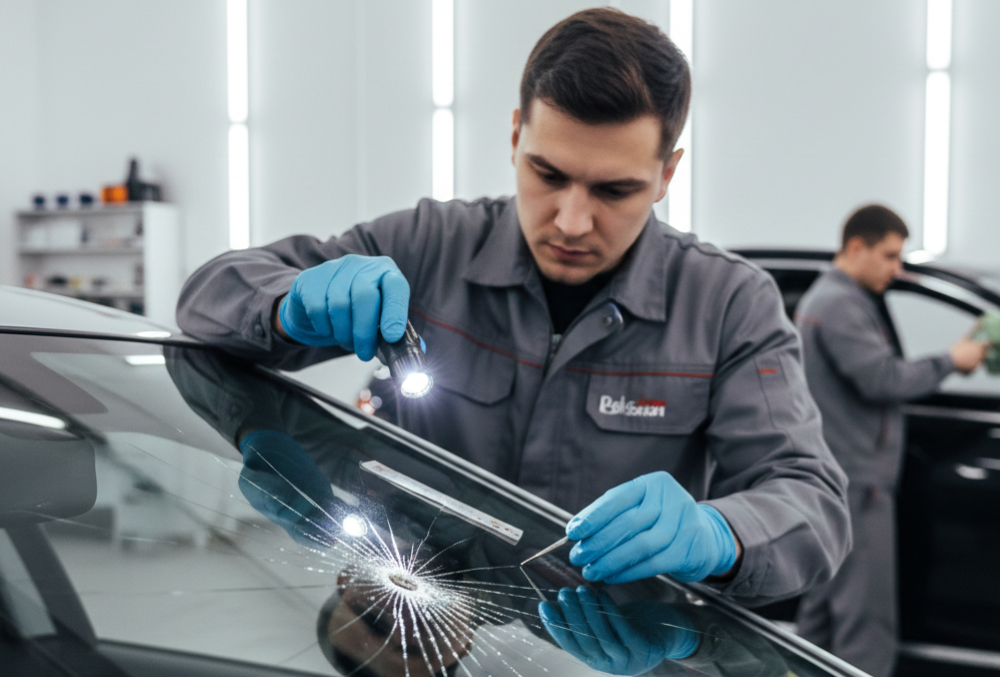
Car Windshield Crack Repair Integrity Testing
You’re traveling when all of a sudden—whoa! Your windshield has a star-shaped crack from a stray pebble. The expense and inconvenience of a complete replacement may be your first consideration. What about a fix, though? Specialists using modern technology can repair many varieties of windshield cracks, often for a fraction of the price of a new one. A windshield that has been properly restored ought to be just as sturdy and safe as the original. To restore the glass’s integrity, a unique resin is injected into the fracture and allowed to cure. By doing this, the windshield’s structural integrity is restored, stopping the damage from getting worse and guaranteeing that it will be able to keep you safe in an accident.
Get An Auto Glass Replacement Quote Now 866.278.7417

Windshield Replacement & Repair
Our competitors push you into going to their shop to get your glass fixed-making it cheaper for them. We make it easier for YOU to get back on the road by offering free mobile repairs at your home or work. With our free mobile services servicing the entire Orange County & Los Angeles area, we can often handle your windscreen replacement the same day! So the next time you need a windshield replacement, give us a call.
Talk to a Windshield Replacement Specialist Now 866.278.7417

Calibration
Calibration is the process of returning a vehicle’s ADAS to OEM specifications. Calibration is necessary after a new glass installation, particularly a windshield with a camera mounted to it, to ensure that the ADAS features continue to function properly despite having been moved during installation. If a car’s ADAS is not properly calibrated, the system may not function safely. A misaligned camera could jeopardize the functionality of the system and lead to dangerous driving or accidents, so it is crucial that the cameras are aligned perfectly, which is what windshield calibration ensures.
Talk to a Calibration Specialist Now 866.278.7417

Fleet Auto Glass Repair
We provide expert auto glass repair and windshield replacement services for commercial fleets of all sizes. We are experienced with all manufacturers and machine types of domestic or foreign cars, trucks, vans, or commercial vehicles, including heavy equipment. Our same day mobile auto glass and windshield repair service will enable you to get back on the road faster and start saving you time and money instantly. Give us a call today! We are here to help!
Talk to a Fleet Auto Glass Specialist Now 866.278.7417
A Windshield Function in Vehicle Safety
It’s necessary to understand why the integrity of your windshield is so vital before we talk about testing. It’s an essential part of your car’s safety system, not merely a window to look through.
Structural Support: Up to 30% of a car’s structural strength comes from the windshield. It protects the people inside by preventing the roof from collapsing in a rollover accident. A damaged windshield is unable to provide this assistance.
Deployment of Airbags: To properly inflate toward the passenger, the passenger-side airbag is made to deploy upward by bouncing off the windshield. The airbag’s power can blow out a windshield that isn’t tight or sturdy enough, making it useless.
Occupant Retention: The windshield serves as a backstop in an accident, keeping passengers from being thrown from the car.
Your safety depends on a competent and long-lasting repair because even a tiny break can undermine the entire structure.
Guidelines for Repairing Windshields
The industry relies on a set of standards to ensure the safe and efficient execution of repairs. The most well-known of these is the National Windshield Repair Division’s (NWRD) Repair of Laminated Automotive Glass Standard (ROLAGSTM). These recommendations specify what kinds of damage can be fixed and how it should be done.
What Kind of Damage Is Repairable: Not all damage can be repaired, according to ROLAGSTM. The standard lays out requirements according to the kind, extent, and location of the damage.
Bull’s-eye: A circular fracture frequently brought on by a round item. Most cases allow for repair if the diameter is less than one inch.
Star Break: A fracture that radiates tiny fissures from the site of impact. If the overall diameter is less than two inches, they are usually repaired.
A combination break, which is often repairable if it falls within a two-inch diameter, is a cross between a bull’s-eye and a star break.
Cracks: If a single line crack is six inches or less, it is frequently repairable. Longer repairs are possible with certain sophisticated procedures, although this relies on the technician’s equipment and level of experience.
When Is It Time for a Replacement
Repairing damage that is in the driver’s direct line of sight is discouraged by ROLAGSTM since even a flawless repair may result in a little distortion of vision.
Reaches the windshield’s edge.
Has several intricate fractures.
Penetrates the laminated glass’s two layers.
In these cases, trustworthy specialists would always advise a complete replacement, putting safety above a temporary solution.
How is the integrity of windshield repairs tested?: How can the strength of a repair be confirmed once it’s finished? The resins, equipment, and techniques specialists employ have undergone extensive laboratory testing to demonstrate their efficacy, even though they don’t usually do damaging tests on your car. These tests mimic the forces a windshield might experience in the real world.
Do you have a Question?
Get An Auto Glass Replacement Quote Now 866.278.7417
Testing for Adhesion and Cohesion
How effectively the resin adheres to the glass is crucial to the outcome of the repair. Adhesion testing evaluates how well the repair glue adheres to the original windshield glass.
Pull tests, in which force is applied to a repaired part to see how much stress it can withstand before the resin detaches, may be used by technicians in a laboratory environment.
Cohesion Testing: The test assesses the resin’s internal strength after curing. To keep the glass together and prevent it from breaking under pressure, the resin needs to be sufficiently strong.
These tests guarantee that the materials used to repair the glass will be able to return it to its original strength.
Testing for Impact Resistance: A windshield that has been restored has to remain resilient against impacts in the future. Steel balls of various sizes and weights are dropped from various heights onto a repaired area in laboratories to test this.
Verifying that the mended area won’t break or fracture under an impact that an undamaged windshield might withstand is the aim. A good repair ought to be as impervious to fresh damage as the original glass.
Testing temperature and Weather Cycles
Your car’s windshield endures harsh weather, from icy winter evenings to sweltering summer days. The glass and the repair resin expand and shrink as a result of these temperature changes.
Thermal cycling: Repaired windshields are repeatedly and quickly heated to temperatures ranging from -40°F to 180°F in a laboratory. This determines if the resin will hold together and remain structurally sound over time without breaking, shrinking, or discoloring.
UV Exposure: Certain materials can deteriorate due to the sun’s UV radiation. To ensure that they won’t turn yellow or break after years of exposure to the sun, repair resins are evaluated for UV stability.
Tests of Visual Clarity and Distortion: A repair should not obscure the driver’s view. The resin should be optically transparent and as near to the glass’s refractive index as feasible after curing.
Testers look for any distortion, haziness, or cloudiness that can affect vision in the corrected region. Even while a little “scar” could be noticeable from some perspectives, it shouldn’t impede safe driving.
Your Role in Ensuring an Effective Repair
You may take precautions to guarantee a high-quality repair even though specialists and material manufacturers handle the majority of the testing.
Select a Certified Technician: Seek repair businesses with qualified technicians from groups such as NWRD. They have been taught to adhere to industry best practices and standards such as ROLAGSTM, as evidenced by this accreditation.
Inquire about the warranty: Reputable repair shops guarantee their work. For as long as you own the car, find out whether they provide a warranty that ensures the repair won’t spread or discolor.
Move Fast: Repairing a fracture that is new is simpler than one that has become soiled and wet. To improve the likelihood of a successful and almost undetectable repair, get the damage evaluated as soon as feasible.
The Last Word on Windshield Security
You don’t always need a costly repair when your windshield cracks. Modern restoration methods may consistently restore the strength and safety of your windshield when carried out correctly by a qualified technician utilizing premium materials. The resins and techniques employed undergo rigorous testing to demonstrate their ability to withstand collisions, severe temperatures, and the strains of regular driving.
You can be sure that your repaired windshield will continue to protect you and your passengers if you choose a qualified specialist who follows industry standards. A competent repair preserves one of your car’s most vital elements and is more than simply a cosmetic fix. It’s an essential safety operation.
Vibration and Auto Glass flaws: It might be more than a small irritation if you hear a faint buzz or rattle coming from your windshield. That sound could be your car’s way of alerting you to a problem with its glass, even if it’s simple to write it off as a loose trim piece or an old seal. The vibration response of a car is frequently the first indicator of more serious, concealed problems with the glass in your car.
It’s critical to comprehend these vibrations to identify any issues before they become significant safety risks. Your car’s structural integrity may be jeopardized by a small, invisible fracture or a poor installation, which might have an impact on everything from airbag activation to roof stability during a rollover.
This article will discuss how vibrations may indicate underlying problems with your car’s windshield. To keep your car safe and sound while driving, we’ll go over the typical reasons, the science behind why they occur, and what you can do to identify and resolve these issues.
Auto Glass Function in Vehicle Structure
The windshield, back window, and side windows of your automobile are essential parts of its structural structure and serve more purposes than simply keeping the weather out. The premise behind the design of modern cars is that the auto glass will greatly increase the stiffness of the chassis.
Windshields: In a rollover accident, a correctly placed windshield may contribute up to 60% of the cabin’s structural strength. It ensures that the passenger-side airbag deploys accurately toward the person by serving as a backstop.
Side and rear glass: In a similar vein, the side and rear windows contribute to the vehicle’s overall rigidity by keeping the structure from bending and twisting under pressure.
Broken glass or incorrect installation compromise this structural support system. The vehicle’s frame may flex more than intended, causing sensations and sounds that alert you to a problem.
How Hidden Flaws Are Revealed by Vibrations
In essence, vibrations are sound waves moving through a substance. These vibrations are uniformly distributed and muted in a piece of vehicle glass that is correctly placed and unbroken. A defect, on the other hand, interferes with this process. These are the typical problems that vibrations might reveal.
Problems with the installation and sealing: Poor installation is the most common source of vibrations connected to vehicle glass. For a proper seal, the adhesive bead holding the glass in place needs to be uniformly thick and continuous.
Glue Gaps: Weak spots are produced if the technician leaves urethane glue gaps. A whistling or buzzing sound can be produced by forcing air through these openings at rapid speeds. Additionally, these openings let moisture in, which can cause rust to develop on the car’s structure.
Inadequate Curing: It takes time for the glue to properly cure and bind with the car frame and glass. The seal may move if the vehicle is driven too soon after installation, causing stress spots that cause vibrations.
Inaccurate Glass Fit: A faulty fit may arise from using aftermarket glass that doesn’t quite match the original equipment manufacturer’s (OEM) specs. Vibrations and rattles might result from a millimeter of variance that prevents a suitable seal.
Stress fractures and microscopic cracks: Occasionally, the glass itself is the issue. Although they may not be immediately apparent, a tiny rock chip or a stress fracture caused by temperature fluctuations might result in a point of weakness.
The frame bends when the vehicle moves, and the glass experiences this stress. Under this continuous pressure, a micro-crack may spread, causing the crack’s edges to vibrate against one another.
This condition frequently results in a high-pitched buzzing or humming noise that varies depending on the road surface and speed. Because they can spread swiftly and cause complete glass collapse without notice, these microscopic fractures are especially deadly.
Do you have a Question?
Get An Auto Glass Replacement Quote Now 866.278.7417
Issues with Trim and Molding
The rubber or plastic molding that surrounds your car’s window gives it a polished appearance and acts as a wind and water deflector. This trim may vibrate against the car body or the glass if it becomes loose, broken, or brittle with age.
Since it’s a very easy remedy, molding is frequently one of the first things to check. At highway speeds, a loose piece of trim may flap, making a perceptible tapping or rattling sound. Although it poses less of a structural risk than a poor seal, it can still allow water to enter, which over time may cause corrosion and other damage.
Identifying the Vibration’s Cause: There are a few diagnostic actions you may perform if you think a strange noise is coming from your car’s glass.
The Tape Test: This is an inexpensive and efficient method for identifying air leaks brought on by a defective seal. While traveling at a pace where the noise is audible, instruct a passenger to cover the windshield’s borders with pieces of painter’s tape. If the noise stops when a specific area is taped, you have likely found the source of the leak.
The Water Test: While you sit inside the car and look for leaks, have someone use a hose to spray water over the glass’s borders. Look closely at the space surrounding the dashboard and headliner. Any indication of moisture indicates a compromised seal. A high-pressure jet might push water past an otherwise sufficient seal, so proceed with caution.
Visual Inspection: Look closely for any tiny chips or cracks in the glass, especially along the edges where the trim frequently hides them. Additionally, look for any indications of degradation, cracking, or looseness in the molding.
Professional Assessment: It is preferable to speak with a qualified car glass expert if you are unable to identify the source on your own. They can spot delamination, stress fractures, and minor installation defects that are not obvious to the human eye since they have the necessary equipment and expertise. To make sure the glass is physically strong and the seal is intact, they can conduct a pressure test.
What to Do Next for a Safer Ride
It is not worth the danger to ignore a vibration that appears to be coming from your car’s glass. You and your passengers may be at risk due to the underlying source of the sound, which is a symptom. In an accident, a damaged window or windshield won’t function as it should, which might have disastrous results.
If you’ve found a problem, have it fixed by a professional right away. A skilled expert can identify if the problem requires a total replacement or reinstallation of the glass, a simple repair of the trim, or a repair of the seal.
Demand certified technicians who utilize premium products that adhere to OEM specifications. You can make sure your car’s most crucial safety systems are operating properly by paying attention to the small signals it sends you, such as a slight vibration.
Mobile Safe Auto Glass
14241 E Firestone blvd suite 400,
La Mirada, CA 90638
Phone: (562) 608-1154
Toll Free: 1 866 278 7417
Mail: sales@mobilesafeautoglass.com
Get a FREE QUOTE today! You can get a free quote and schedule 24/7 using this free quote wizard.
Mon – Fri 8am – 5pm
Saturday 8am – 1pm
Sunday Closed