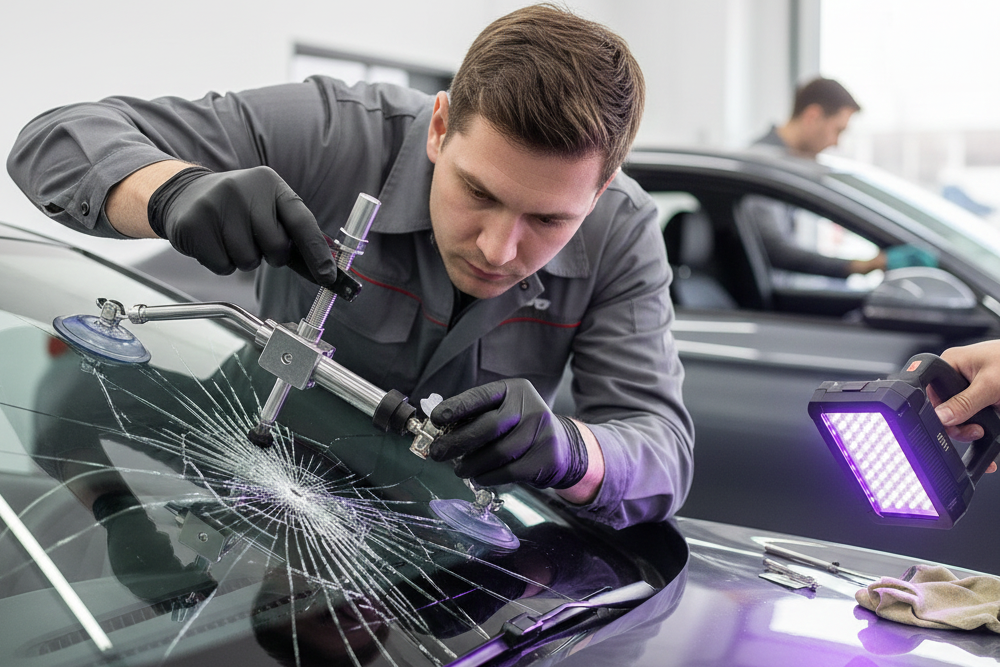
Car Windshield Crack Repair Advanced Techniques
Even though a tiny chip or crack in your car’s windshield can seem like a trivial inconvenience, neglecting it might cause more serious issues. A little fracture in your windshield may ultimately need to be replaced due to temperature fluctuations, driving vibrations, and even cleaning your car. Thankfully, there are a number of cutting-edge methods available in contemporary vehicle glass technology that may restore the integrity and clarity of your windshield. When you see a flaw in your glass, knowing these cutting-edge restoration techniques can help you make an informed choice. This tutorial will examine the advanced methods used by experts to repair windshield cracks, elucidating the science underlying the fixes and their remarkable efficacy.
Get An Auto Glass Replacement Quote Now 866.278.7417

Windshield Replacement & Repair
Our competitors push you into going to their shop to get your glass fixed-making it cheaper for them. We make it easier for YOU to get back on the road by offering free mobile repairs at your home or work. With our free mobile services servicing the entire Orange County & Los Angeles area, we can often handle your windscreen replacement the same day! So the next time you need a windshield replacement, give us a call.
Talk to a Windshield Replacement Specialist Now 866.278.7417

Calibration
Calibration is the process of returning a vehicle’s ADAS to OEM specifications. Calibration is necessary after a new glass installation, particularly a windshield with a camera mounted to it, to ensure that the ADAS features continue to function properly despite having been moved during installation. If a car’s ADAS is not properly calibrated, the system may not function safely. A misaligned camera could jeopardize the functionality of the system and lead to dangerous driving or accidents, so it is crucial that the cameras are aligned perfectly, which is what windshield calibration ensures.
Talk to a Calibration Specialist Now 866.278.7417

Fleet Auto Glass Repair
We provide expert auto glass repair and windshield replacement services for commercial fleets of all sizes. We are experienced with all manufacturers and machine types of domestic or foreign cars, trucks, vans, or commercial vehicles, including heavy equipment. Our same day mobile auto glass and windshield repair service will enable you to get back on the road faster and start saving you time and money instantly. Give us a call today! We are here to help!
Talk to a Fleet Auto Glass Specialist Now 866.278.7417
When Is It Possible to Repair a Windshield
It’s crucial to understand which kinds of damage may be repaired before delving into the methods. The majority of vehicle glass specialists concur that if the harm satisfies specific requirements, repairs may be feasible.
In general, if a crack is less than 12 to 14 inches, it is an excellent candidate for repair.
It hasn’t gotten to the windshield’s edge.
Because the repair may leave a slight distortion, the damage is not immediately in the driver’s line of sight.
A “bullseye,” “star,” or “combination” crack less than a quarter is the damage.
It is normally safer to replace the entire windshield if the fracture is exceedingly deep, lengthy, or complicated. A qualified specialist can evaluate the damage and suggest the best course of action.
Advanced Repair Methods Described
Simple do-it-yourself kits are no longer enough for modern windshield crack repair. Experts employ specific equipment and supplies to guarantee a long-lasting and almost imperceptible repair. The main step in this procedure is to inject a transparent, curable glue into the fracture to strengthen and reattach the glass.
Injection of High-Pressure Resin: The resin injection is the most important part of any professional windshield repair. A customized injector tool that installs directly over the fracture is used in advanced repair systems. By creating a vacuum over the injured region, this equipment accomplishes two crucial goals:
Eliminating Moisture and Air: Any air, moisture, and debris that are trapped inside the fissure are drawn out by the vacuum. This is important because any impurities that remain might hinder the resin’s ability to adhere correctly, resulting in a poor or obvious repair.
Establishing a Resin Channel: The vacuum makes room for the resin to flow into each and every microscopic crack fissure by eliminating the air.
The instrument injects the resin under high pressure after creating a vacuum. The liquid resin is forced deep into the fracture by this pressure, guaranteeing a full fill. Professionals utilize high-viscosity, optically matched resins with the same refractive index as glass because the quality of the resin is crucial. This makes the fix nearly undetectable since, once cured, the resin bends light in the same manner as the surrounding windshield.
Pit Filler and Polishing Procedure
Following the filling of the crack’s main body, the technician turns to the surface impact site, or “pit.” This area is covered with a second, thicker resin known as a pit filler. The repair is shielded from the weather by this thicker resin, which is made to be more resilient and weatherproof.
The last stages after applying pit filler are polishing and curing. This guarantees a seamless, smooth finish that complements the rest of the windshield flawlessly.
UV (Ultraviolet) Curing: When exposed to particular UV light wavelengths, resin used in windshield repair is designed to cure, or harden. Technicians apply a small UV light immediately over the repaired region after injecting the resin. The strong UV light emitted by this lamp causes a chemical reaction in the resin, which hardens and bonds it to the glass in a matter of minutes.
Leaving the windshield in the sun is not nearly as efficient as this regulated curing method. The UV lamp guarantees a steady and quick cure, resulting in a more robust and long-lasting connection. Additionally, it keeps the glue from expanding or contracting, which might jeopardize the quality of the repair.
Do you have a Question?
Get An Auto Glass Replacement Quote Now 866.278.7417
Advanced Injector and Bridge Systems
Additionally, the instruments required to carry out the repair have advanced to a very advanced level. Precise placement and pressure control are made possible by contemporary “bridge” systems, which are the frames that secure the injector.
Mounts That Can Be Adjusted: These systems have magnetic mounts or suction cups that can be made to match the shape of any windshield. Effective vacuum and pressure cycles depend on the injector being precisely perpendicular to the glass, which is ensured by this.
Dual-Cycle Injectors: Unremoved from the bridge, certain sophisticated injectors are capable of operating in both vacuum and pressure cycles. In addition to streamlining the procedure, this lowers the possibility of air reentering the breach in between cycles.
Heating Elements: Some high-end repair kits come with a tiny heating element for repairs in cold weather. A more thorough fill can be achieved by gently warming the glass to facilitate the resin’s flow into small crevices.
Why Hiring a Professional Is Worth It
Even while do-it-yourself kits are available, they can’t match the outcomes of a professional repair. From high-pressure injectors to specialized UV curing lights, the tools professionals employ are made to provide a long-lasting and secure solution.
Up to 95% of the windshield’s original structural integrity—a vital component of your car’s safety—can be restored with expert repair.
Airbags and other safety features work as intended when the windshield is fixed correctly. When the passenger-side airbag deploys, the windshield offers vital support. The airbag could not deploy properly if the glass is damaged.
How to Take Care of Your Windshield After Repair: A few easy procedures will assist guarantee the lifespan of the restoration once your windshield has been properly fixed.
Steer clear of power washers: Avoid high-pressure car washes during the first 24 to 48 hours since the power of the water may erode the new repair.
Be Aware of Temperature: Shortly after the repair, try to avoid abrupt and drastic temperature swings, such as turning the defroster on high on a chilly day.
Quickly fixing cracks using cutting-edge restoration methods can help you save money, keep your car safe, and have a clean view of the road.
Restore the Strength of Your Windshield
Ignoring a crack in your windshield is not worth the danger. With today’s sophisticated methods, a professional repair is a quick, safe, and efficient fix. It keeps you and your passengers safe by preserving the structural integrity of your windshield in addition to restoring its beauty. Don’t wait for a crack in your windshield to widen. To find out if these cutting-edge techniques are suitable for you, speak with a qualified car glass specialist.
How Windshield Cracks Are Predicted by Heat Tests: Even if that tiny chip in your windshield doesn’t seem like much right now, what happens if the temperature drops dramatically over night and then rises sharply during your morning commute?
Auto glass is subjected to extreme temperature changes, which can cause tiny flaws to develop into large cracks. Auto glass producers thoroughly test this using a technique known as thermal shock or heat-cycle testing, so it’s not simply a hypothetical situation.
Knowing how these tests operate will help you understand how long your windshield will last and why minor damage shouldn’t be disregarded. This article will describe heat-cycle testing, how it’s carried out, and what it may tell you about the possibility of glass cracks in your car. You’ll have a better understanding of the factors at work and the significance of prompt windshield repair at the end.
Heat cycle testing
Manufacturers utilize heat-cycle testing, often referred to as thermal shock testing, as a quality control procedure to assess a material’s reaction to abrupt and drastic temperature fluctuations. This test mimics the most severe environmental circumstances that a windshield may encounter in the context of automobile glass.
Imagine leaving your car parked for hours in the sweltering summer heat and then turning up the air conditioning. Or imagine using the defroster to swiftly remove ice from the glass on a chilly winter’s morning.
The glass expands and contracts as a result of these abrupt temperature changes. This tension can lead to the formation or propagation of a fracture if there are any vulnerabilities, such as tiny defects or preexisting chips.
Finding these weak spots before the windshield ever reaches your automobile is the aim of heat-cycle testing. Manufacturers may make sure the glass satisfies strict safety and durability requirements by putting it through controlled, accelerated temperature cycles.
How to Conduct a Heat Cycle Test
Although particular stages differ from manufacturer to manufacturer, a heat-cycle test for windshields entails a number of essential phases. The glass is put within a dedicated environmental room that can quickly and precisely regulate its temperature.
This is how a typical test cycle appears:
Heating Phase: The chamber is heated to a very high temperature, frequently as high as 180°F (82°C). This mimics what might happen on a hot day with direct, strong sunshine. To make sure the glass has expanded completely, it is kept at this temperature for a predetermined amount of time.
Rapid Cooling Phase: The temperature then rapidly and sharply lowers. This is frequently accomplished by quickly injecting cold air or spraying the hot glass with cold water, which lowers the temperature to freezing or lower in a couple of seconds. This mimics situations like applying a defroster right away to a frozen windshield or a sudden, chilly downpour on a hot day.
Repetition: To replicate the accumulated stress a windshield experiences during its lifespan, this cycle of intense heating and cooling is repeated several times, often hundreds of times.
Inspection: Technicians carefully examine the windshield for any indications of failure throughout the testing procedure. They search for any delamination (separation) of the glass layers, the development of new fractures, and the spread of preexisting defects.
This meticulous procedure strains the glass to its breaking point, exposing any weaknesses that can cause failure under actual circumstances.
Do you have a Question?
Get An Auto Glass Replacement Quote Now 866.278.7417
What Your Windshield Can Tell You Through Heat Cycle Testing
Heat-cycle test results offer vital information regarding the structural soundness of a windshield. What the testing can reveal regarding possible crack failures is as follows.
The Effects of Minor Defects: Even little flaws in the glass that are not visible to the human eye might serve as the precursor to a large break. Heat-cycle testing aids in determining if these innate defects are likely to cause issues.
Concentrated pressure is produced as the glass expands and compresses around these places due to thermal stress. Glass is considered safe if it can endure several cycles without developing these defects. Otherwise, it suggests a flaw in the production process that can cause spontaneous breaking.
The Risk of Current Scratches and Chips: Your windshield is already vulnerable if there is a little chip from a stray pebble or a scratch from a worn-out wiper blade. These damaged patches serve as stress risers throughout a heat cycle. Pressure builds up at the chip’s edges as a result of the glass’s uneven expansion and contraction.
Windshields with pre-existing damage are far more likely to fail, according to heat-cycle testing. After a few simulated temperature changes, a little “bull’s-eye” chip can quickly grow legs and cover the whole windshield.
The Value of a Well-Done Installation: The installation of a windshield is just as important to its functionality as the glass itself. Urethane, the glue used to attach the glass to the automobile frame, needs to be sufficiently flexible to allow for the expansion and contraction of the metal body of the vehicle as well as the glass.
Glass may develop pressure points if the incorrect glue is used or placed incorrectly. When a windshield is fully mounted, heat-cycle testing might identify installation flaws that could otherwise go overlooked until an unanticipated fracture shows up.
How to Handle Damaged Windshields
It’s obvious that ignoring a chip or little fracture is a dangerous risk given what heat-cycle testing shows us. The next significant temperature shift could necessitate a complete windshield replacement.
If your windshield is damaged, you should take the following actions right away:
Determine the Damage: The chip can probably be fixed if it is less than a quarter in size and out of the driver’s direct line of sight.
Move Fast: A proper repair becomes more challenging the longer you wait because additional moisture and debris might enter the chip. The fracture may potentially spread at any time due to variations in temperature.
Seek Professional Repair: To restore the glass’s structural integrity and stop the damage from spreading, a qualified auto glass specialist can inject a unique resin into the chip.
By taking care of the issue as soon as possible, you may frequently save an expensive complete replacement and guarantee that your windshield will continue to be as sturdy and secure as the day it passed its final quality check.
Safeguard Yourself and Your Glass
A clear view into the durability of your car’s windshield is provided by heat-cycle testing. It demonstrates how environmental factors continuously test the integrity of glass and how little flaws may swiftly grow into major issues.
Every change from hot to cold and back again stresses the glass, causing little weak spots that you might not even notice at first to bend and expand. These cycles have the potential to transform a benign speck into an expanding fissure that eventually spreads like a spiderweb across the surface.
The main lesson is straightforward: don’t undervalue a tiny chip. In addition to saving you money over time, promptly fixing any damage to your windshield maintains the vital safety barrier it offers.
Imagine it as a barrier that protects one of your car’s most crucial structural elements—a shield that helps airbags deploy, keeps you safer in crashes, and keeps you visible in all sorts of weather. You’re investing in your safety and the longevity of your automobile when you take care of problems early.
Mobile Safe Auto Glass
14241 E Firestone blvd suite 400,
La Mirada, CA 90638
Phone: (562) 608-1154
Toll Free: 1 866 278 7417
Mail: sales@mobilesafeautoglass.com
Get a FREE QUOTE today! You can get a free quote and schedule 24/7 using this free quote wizard.
Mon – Fri 8am – 5pm
Saturday 8am – 1pm
Sunday Closed