Car Window Chip Repair for Fast Damage Control
The sound of a stone knocking against the windshield is a nuisance. However, the small chip that remains appears to be harmless. Ignoring that little chip could end up costing you a lot. There is a possibility that a little flaw might rapidly develop into a significant crack, which would put the vehicle’s construction and visibility at risk. It is in the best interest of automobile owners to rapidly fix chips in the windshield. Fast and inexpensive, it protects against injuries and damage to the road. This guide will walk you through the process of identifying window chip damage, fixing it, and the benefits of doing so.
Get An Auto Glass Replacement Quote Now 866.278.7417

Windshield Replacement & Repair
Our competitors push you into going to their shop to get your glass fixed-making it cheaper for them. We make it easier for YOU to get back on the road by offering free mobile repairs at your home or work. With our free mobile services servicing the entire Orange County & Los Angeles area, we can often handle your windscreen replacement the same day! So the next time you need a windshield replacement, give us a call.
Talk to a Windshield Replacement Specialist Now 866.278.7417

Calibration
Calibration is the process of returning a vehicle’s ADAS to OEM specifications. Calibration is necessary after a new glass installation, particularly a windshield with a camera mounted to it, to ensure that the ADAS features continue to function properly despite having been moved during installation. If a car’s ADAS is not properly calibrated, the system may not function safely. A misaligned camera could jeopardize the functionality of the system and lead to dangerous driving or accidents, so it is crucial that the cameras are aligned perfectly, which is what windshield calibration ensures.
Talk to a Calibration Specialist Now 866.278.7417

Fleet Auto Glass Repair
We provide expert auto glass repair and windshield replacement services for commercial fleets of all sizes. We are experienced with all manufacturers and machine types of domestic or foreign cars, trucks, vans, or commercial vehicles, including heavy equipment. Our same day mobile auto glass and windshield repair service will enable you to get back on the road faster and start saving you time and money instantly. Give us a call today! We are here to help!
Talk to a Fleet Auto Glass Specialist Now 866.278.7417
Reasons to Pay Attention to Windshield Chips
Although it might not seem like much, a tiny chip in your windshield’s glass is a vulnerable spot. For a variety of reasons, that chip could develop into a break that obstructs your vision and requires a full windshield replacement.
Temperature Variations: One of the main reasons why chips expand is extreme temperature variations. A sudden temperature difference between the inside and outside of the glass occurs, for example, when you put on the air conditioner on a hot day or turn on the defroster in your car on a cold morning. A tiny chip could easily break and spread over the windshield due to this heat stress.
Driving Vibrations: Driving on a daily basis causes continuous vibrations that strain your windshield. A chip can become a long, meandering crack just by driving over a speed bump, hitting a pothole, or even merely navigating uneven terrain. The chip has already damaged the glass’s structural integrity, making it more susceptible to these normal stresses.
Structure: Your windshield is an important part of your car’s safety system; it does more than just block wind and rain. It supports the passenger-side airbag when it deploys, helps prevent you from being thrown from the vehicle in an accident, and provides up to 30% of the structural strength of your vehicle in the event of a rollover. This structure is weakened by a chip, which lessens its capacity to protect you in an accident.
Recognizing Chip Types for Fixing
Chips are not all made equal. To ascertain whether a repair is feasible, a car glass specialist will first evaluate the kind, extent, and location of the damage. Some common chip types that are typically repairable are as follows:
Bull’s-Eye: A circular chip that frequently results from a round rock. It features a dark circle where the collision happened and a cone in the outer layer of glass.
Star Break: This kind of damage looks like a star because it has small cracks that spread out from the point of impact.
Combination Break: As the name suggests, this type of break is a cross between a bull’s-eye and star break, with cracks extending from the damage’s center.
Half Moon (Partial Bull’s-Eye): This is a common candidate for repair and resembles a semi-circular bull’s-eye.
Most of the time, a chip that is less than a quarter of an inch and not in the driver’s line of sight can be fixed. In addition to being challenging to fix, chips or cracks on the very edge of the windshield may jeopardize the seal.
Do you have a Question?
Get An Auto Glass Replacement Quote Now 866.278.7417
The Procedure for Repairing Windscreen Chips
The speed and effectiveness of windshield chip repair is one of its best features. Often, a competent technician can complete the work in about 30 minutes, enabling you to quickly and safely resume driving.
This is a full explanation of how it works:
Preparing: The technician begins by cleaning the impacted area to remove any damp, debris, or shattered glass. This makes sure that the fix resin and the glass will stick together well. To make a clear path to the interior layer of the damage, a small drill might be utilized.
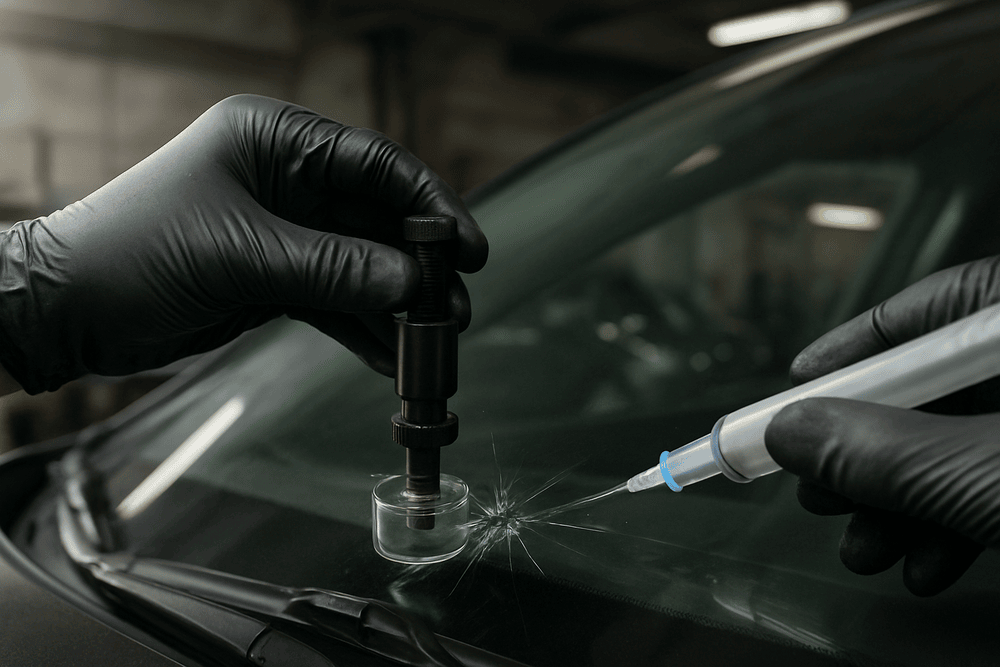
Vacuum Sealing: The chip is covered with a specialized tool. By creating a vacuum, this gadget removes any trapped air from the fissure. For the repair to be successful, the air must be removed so that the resin can fill the entire chip.
Resin Injection: Once the air is out of the chip, a clear, high-quality resin is poured into it. The resin fills the gap and forms a bond with the glass to give it strength and clarity again.
Curing: The restored region is exposed to an ultraviolet (UV) light. The UV light hardens and cures the resin in just a few minutes, making a strong link that will last.
After the resin has set, any extra is scraped off and the surface is polished until it is shiny. As a result, the windshield’s structural integrity is restored and the repair is nearly invisible.
Do it Yourself Kits versus Professional Repair
You may have questioned if you could simply patch the chip yourself after seeing do-it-yourself windshield repair kits at auto parts stores. Although these kits may appear to be an inexpensive and practical answer, there are serious risks associated with them.
The resin used in do-it-yourself kits is frequently of lower quality than that used by professionals, which results in a weaker and potentially short-lived connection. Additionally, the offered instruments are less efficient at clearing the chip of air, which may lead to a hazy, insufficient repair. A professional repair is frequently impossible if a do-it-yourself replacement fails because the partially filled chip cannot be adequately cleaned and refilled. Replacing the complete windshield is the only option left.
If you hire a professional, you can be sure that the job will be done right the first time. With the right tools, expertise, and premium materials, technicians can safely restore the strength and clarity of your windshield. Chip repair is also often a free or low-cost option because insurance often covers it with no deductible.
What to Do Next
Over time, a tiny chip in your windshield will only get larger and more costly. The secret to a straightforward, cost-effective solution is to move quickly. You may preserve clear vision, strengthen your windshield, and save money by having the chip properly fixed rather than having to replace it entirely.
Avoid waiting for a chip to spread through your windshield. Get in touch with a reputable car glass repair company right away to have it looked at. You can keep yourself safer on the road and save time, money, and stress by getting a speedy repair immediately.
How to Fix a Chipped Windshield and Stop the Crack
That sinking feeling as a rock leaps up and smacks your windshield is obvious. What starts as a tiny, almost unnoticeable chip can quickly spiderweb into a huge crack, obscuring your visibility and eventually leading to a pricey full windshield repair. But what if you could halt the damage before it even begins?
The secret to keeping a small chip from growing into a major one is to act quickly. Ignoring it won’t make it go away; in fact, temperature changes, traffic vibrations, or even just closing your car door can cause the chip to enlarge. You may save hundreds of dollars and maintain your original factory-installed windshield—which is frequently a safer option—with a quick and simple repair.
You can learn dependable techniques for repairing windshield chips from this tutorial. We’ll go over how to use a do-it-yourself (DIY) repair kit, discuss when it’s best to hire a professional, and offer advice on how to keep your windshield safe from further harm. You’ll know enough by the end to manage that next rock chip with assurance and maintain a safe and clear view of the road.
Knowing About Windshield Damage
It’s helpful to know what you’re dealing with before attempting to patch a chip. The best mode of action will depend on the sort of damage, as not all chips are made equal. Laminated glass, which is used for windshields, has two pieces of glass in the middle of which is a thin film of PMB plastic. Because of its design, the glass won’t break into jagged fragments when struck.
Rocks and other objects often damage the top layer of your glass. Whether or not this damage can be remedied depends critically on its size, shape, and depth.
Typical Windshield Chip Types: The most techniques for repairing windshieldEssentials for Repairing Chips in Automobile Glass you’ll come across are as follows:
Bull’s-Eye: This round chip is called “Bull’s-Eye” because it looks a lot like a target. A dark circle with a distinct impact point defines it. If they’re not too big, these are frequently simple to repair.
Star Break: Tiny fractures that radiate outward from a central impact point in the shape of a star are the hallmark of this type of damage. If left untreated, a star break can spread rapidly due to its many legs.
Combination Break: This type of break is a mix of a bull’s-eye break and a star break, as the name suggests. In the middle, there is a round chip, and cracks come out of it. It may be more difficult to fully fix these.
Half Moon (Partial Bull’s-Eye): This shape is not a full circle, but it resembles a semicircle and a bull’s-eye.
Chip or Pit: The windshield has a tiny piece of glass missing, but there are no visible cracks. Usually, they are the simplest to fill and fix.
Generally speaking, if a chip is smaller than a quarter and any cracks are shorter than a dollar note, it is most likely repairable. But if the damage is right in front of the driver’s eyes or goes through both layers of glass, replacement is usually the only safe choice.
Do it Yourself Windscreen Repair
A do-it-yourself repair kit can be an efficient and cost-effective solution for minor, straightforward chips like a pit or bull’s-eye. These kits are commonly accessible online and at auto parts retailers. To connect the glass and stop the chip from spreading, they inject a clear resin into the damaged region, which cures.
The overall procedure is the same, even though brand-specific instructions may differ. This is how a standard windshield repair kit is used.
Get the damaged area ready: The most important component of a successful repair is preparation.
Clean the Chip: Carefully remove any loose glass pieces from the impact location with a tiny pin or needle. Take care not to enlarge the chip.
Wipe It Down: Use rubbing alcohol and a cloth to clean the vicinity of the chip. This eliminates any debris, grease, or dirt that would impede the resin’s ability to stick.
Keep It Dry: Make sure that the chip and the glass around it are totally dry. Dry the chip using a hair dryer set to low if there is any moisture trapped inside. Never try to fix a windshield that is wet or in the rain.
Apply the Adhesive Seal: An adhesive seal and a suction cup applicator are included in the majority of do-it-yourself packages.
Put the Seal in Place: Make sure the impact point is centered within the opening before placing the adhesive seal over the chip after peeling off the backing from one side.
Attach the Pedestal: Press the plastic pedestal—which contains the resin—firmly onto the seal after removing the backing from the top. Over the chip, this procedure forms a chamber for the resin.
Inject the Repair Resin: The damaged area needs to be filled with the repair resin.
Fill the Pedestal: Squeeze the specified quantity of drops (often three to six) into the pedestal after snipping the tip off the resin bottle.
Put the syringe in: Insert the syringe into the pedestal’s aperture and press it down until a tight seal is formed.
Make a Vacuum: Lock the syringe in place by pulling its plunger upward. As a result, the chip’s air is drawn out and a vacuum is created, allowing the resin to seep into all of the microscopic crevices. Let it sit for as long as the kit’s directions say to, which is usually 10 minutes.
Pressurize and Cure the Resin: Pressurizing the resin will be the next step after the vacuum cycle.
Release and Reposition: Push the plunger down after removing the syringe to allow air to return. The resin is pushed firmly into the chip by this pressure.
Allow it to Cure: For roughly 20 minutes, leave the complete equipment in place. Since UV radiation aids in the resin’s hardening, some kits advise doing this in direct sunshine. You can use a UV lamp if you’re in a garage.
Apply the Curing Strip: Take out the applicator assembly when the resin has had a chance to solidify. Place a clear curing strip over the repaired area after applying a single drop of resin directly to it. Any air bubbles can be gently smoothed away with a razor blade.
Final Touches: Cleaning up and removing extra resin are the last steps.
Scrape Away Excess: Use the included razor blade to carefully scrape off the curing strip and any extra hardened resin when the resin has completely cured beneath it (an additional 15 to 20 minutes in the sun). To prevent scratching the glass, hold the blade at a 45-degree angle.
Polish the Area: Use a cloth to clean it. Only a tiny, subtle imperfection should remain after the repair, making it nearly undetectable.
Do you have a Question?
Get An Auto Glass Replacement Quote Now 866.278.7417
When to Consult an Expert
Although they have limitations, do-it-yourself kits are excellent for small repairs. Knowing when a professional repair is the safer and better option is essential.
A qualified technician should be contacted if:
The harm is severe: A professional repair is required if any cracks are longer than a few inches or if the chip is bigger than a quarter. Technicians use higher-quality resins and specialist tools to manage more serious damage.
The chip is clearly visible to the driver. Occasionally a small deformation results from do-it-yourself repairs. It is preferable to leave this region to the experts because any flaw in the driver’s immediate field of view could pose a safety risk.
The harm is multifaceted: it is challenging to fully fill huge combination breaks or star breaks with long legs with a typical DIY kit. Professionals have the right tools to make sure that the glue fills the crack all the way to the edge.
The windshield’s edge has the damage: Cracks and chips close to the windshield’s edge weaken its structural integrity and increase the likelihood that they will spread. Almost invariably, these need expert care.
You lack confidence: If you have questions about the process or are worried about worsening it, consult an expert. Replacement may be the only choice if a poorly done do-it-yourself repair prevents a professional from fixing it later.
Learn How to Get a Clearer Windshield
A small chip in your windshield doesn’t mean you need to get a new one. By acting quickly and using the best repair method, you can stop the damage and maintain the integrity and safety of your vehicle. For small pits and bull’s-eyes, a do-it-yourself repair kit provides an effortless and affordable fix. But if the damage is larger, more complex, or in your line of sight, it’s best to consult a pro.
Don’t overlook that dreadful “thwack” of a rock striking your glass the next time. Please assess the situation, evaluate the damage, and proceed with the necessary repairs. You may save a lot of time, money, and trouble later on by putting in a little work today. Confidence.
Mobile Safe Auto Glass
14241 E Firestone blvd suite 400,
La Mirada, CA 90638
Phone: (562) 608-1154
Toll Free: 1 866 278 7417
Mail: sales@mobilesafeautoglass.com
Get a FREE QUOTE today! You can get a free quote and schedule 24/7 using this free quote wizard.
Mon – Fri 8am – 5pm
Saturday 8am – 1pm
Sunday Closed