Car Insurance Windshield Replacement Coverage Guide
On a sunny afternoon, you are speeding along the highway. A small pebble ricochets right into your field of sight as a gravel truck suddenly strikes a hump. That little chip has grown into a jagged line that crosses your field of view by the time you turn into your driveway. It is really annoying to deal with damaged car glass. The damage jeopardizes your car’s structural integrity and blocks your vision of the road, posing a major safety risk. Calling a repair shop is probably going to be your first inclination, followed right after by checking your bank account. The crucial issue then arises: would this be covered by your motor insurance?
Get An Auto Glass Replacement Quote Now 866.278.7417

Windshield Replacement & Repair
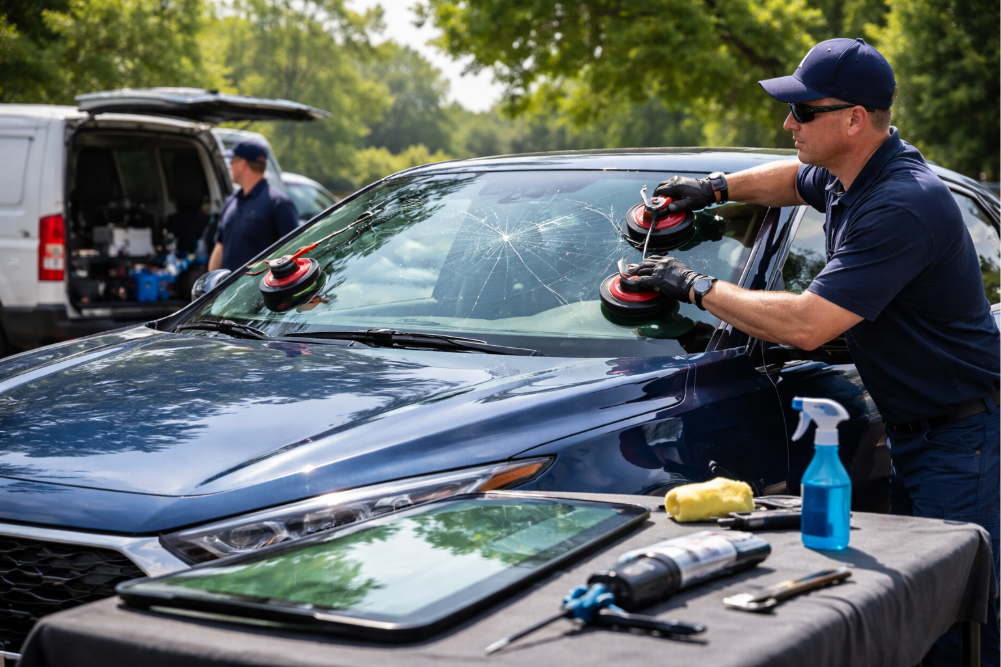
Our competitors push you into going to their shop to get your glass fixed-making it cheaper for them. We make it easier for YOU to get back on the road by offering free mobile repairs at your home or work. With our free mobile services servicing the entire Orange County & Los Angeles area, we can often handle your windscreen replacement the same day! So the next time you need a windshield replacement, give us a call.
Talk to a Windshield Replacement Specialist Now 866.278.7417

Calibration
Calibration is the process of returning a vehicle’s ADAS to OEM specifications. Calibration is necessary after a new glass installation, particularly a windshield with a camera mounted to it, to ensure that the ADAS features continue to function properly despite having been moved during installation. If a car’s ADAS is not properly calibrated, the system may not function safely. A misaligned camera could jeopardize the functionality of the system and lead to dangerous driving or accidents, so it is crucial that the cameras are aligned perfectly, which is what windshield calibration ensures.
Talk to a Calibration Specialist Now 866.278.7417

Fleet Auto Glass Repair
We provide expert auto glass repair and windshield replacement services for commercial fleets of all sizes. We are experienced with all manufacturers and machine types of domestic or foreign cars, trucks, vans, or commercial vehicles, including heavy equipment. Our same day mobile auto glass and windshield repair service will enable you to get back on the road faster and start saving you time and money instantly. Give us a call today! We are here to help!
Talk to a Fleet Auto Glass Specialist Now 866.278.7417
How Windshield Damage Is Covered by Auto Insurance
Auto insurance comes in a variety of coverage options. You should review certain parts of your insurance declaration page about the glass in your car.
Explaining Comprehensive Coverage: Your main source of financial security if your windshield is broken or cracked is comprehensive coverage. Comprehensive insurance covers damage to your vehicle caused by unforeseen events.
This includes falling branches, vandalism, inclement weather, collisions with animals, and rocks hurled by other vehicles into the road. If a stray baseball smashes your window, comprehensive coverage is activated.
Comprehensive coverage covers the cost if a strong hail storm leaves your glass appearing like a spiderweb. However, if you are the only owner of your vehicle, comprehensive insurance is not required. Your lender will almost definitely demand that you transport your automobile if you lease or finance it.
Add-ons for Full Glass Coverage: Full glass coverage is an optional policy endorsement offered by some insurance companies. This rider may be added to your current comprehensive coverage. With full glass coverage, you may have your glass fixed or replaced without having to pay an out-of-pocket deductible since it particularly targets damage to windows and windshields.
Adding complete glass coverage to their policy is sometimes quite beneficial for drivers who commute through busy construction zones or often travel on gravel roads. The expense of a new windshield is readily covered by the little monthly insurance increase.
Glass and Collision Coverage
Collision coverage is available when your car hits another car or a fixed object like a fence or telephone pole. Your collision policy will cover the replacement of your windshield as part of the total vehicle repair claim if you are in a car accident and the impact causes it to break.
Limitations on Liability Coverage: Almost all states have laws requiring liability insurance. It includes damage you do to other people and their property. It does not cover repairs for your own vehicle. Your provider won’t pay for the replacement of your windshield if you merely have basic liability insurance.
What Will Your Policy Cover: Repair vs. Replacement? Whenever feasible, insurance firms want to reduce costs. It is costly to replace a complete piece of automobile glass, particularly on contemporary cars with heads-up displays, lane departure cameras, and rain sensors. Consequently, rather than replacing the glass, suppliers typically choose to repair it.
When Insurance Pays for Repairs: The damaged region is repaired by injecting a specific transparent resin. Under UV light, the resin cures, strengthening the glass and concealing the imperfection. If the damage satisfies certain requirements, insurance companies will often allow a repair:
When a total Replacement Is Needed: If the damage is more than what is advised for repairs, a total replacement is necessary. The vehicle’s structural integrity is jeopardized by deep gouges, spiderweb fractures, and large cracks.
The windshield offers vital support in a rollover collision to prevent the roof from collapsing. You and your passengers are placed in grave danger while driving with seriously damaged glass.
Your insurance provider will pay for the cost of a new windshield, the labor required for installation, and the recalibration of any safety sensors affixed to the glass if a replacement is judged essential. However, unless you have complete glass coverage or reside in a state with a waiver, you will be liable for paying your comprehensive deductible.
Do you have a Question?
Get An Auto Glass Replacement Quote Now 866.278.7417
Comprehending Windshield Deductibles
Your deductible is the amount you agree to pay out-of-pocket prior to the start of your insurance coverage. If a new windshield costs $800 and your comprehensive deductible is $500, your insurance will cover the remaining $300.
States with zero deductibles: State laws have a significant impact on vehicle insurance rules. Many states have approved legislation forcing insurance companies to waive the deductible for windshield repairs.
These jurisdictions place a high priority on driving safety, making sure that citizens don’t put off fixing hazardous, broken glass because they can’t pay the deductible. Currently, Florida, Kentucky, South Carolina, Arizona, Massachusetts, and New York are among the states having zero-deductible glass legislation.
You may get a replacement at no cost if you have comprehensive coverage in one of these states. To find out whether you qualify, check the standards provided by your state’s department of insurance.
Making a Claim vs. Paying Out of Pocket: In some cases, the cost of a replacement windshield is less than your coverage deductible. It is useless to file an insurance claim if a nearby glass shop offers you $400 for a replacement and your comprehensive deductible is $1,000.
The claim will remain on your driving record, and your insurance company will not make any payment. Prior to formally filing a claim with your provider, always ask a respectable repair business for a cash quotation.
How to Make a Claim for a Windshield Replacement
Generally speaking, filing a glass claim is the quickest and simplest kind of insurance claim to handle. To speed up the paperwork, the majority of large carriers employ specialized glass claims departments.
Record the Damage: Take crisp pictures of the damage from both the inside and the exterior of the automobile before you touch the glass or move it. To give the chip or fracture a sense of size, place a penny next to it. If the insurance adjuster requests visual documentation of the occurrence, save these pictures for your records.
Contact Your carrier: You may often submit a glass claim via the website, mobile app, or customer service hotline of your insurance carrier. The representative will inquire about the general size of the fracture, the reason for the break, and the date the damage happened. After that, they will check your coverage limitations and see whether you have a deductible.
Select a Repair Shop: Large national glass repair shops are often partnered with insurance carriers. The agent may attempt to direct you to one of their favored suppliers. Legally, you are free to choose any authorized repair facility.
Just provide your insurance adjuster with their contact details if you would rather choose a local, independent technician. To replace the glass in your driveway, a lot of mobile glass repair companies will even come to your home or place of business.
After a glass claim, would your insurance rates increase? Because they worry that their monthly rates would soar, drivers often hesitate to make glass claims. Windshield damage is often seen as a non-fault claim as it is covered by comprehensive coverage. A wayward pebble striking your automobile is an inevitable natural occurrence.
A single comprehensive claim for a broken windshield seldom results in an increased premium. Insurance companies, however, assess your total risk profile. Your provider may consider you a high-risk client and modify your premiums at renewal time if you submit four glass claims in a single year. Your premium will probably stay the same if you only submit a glass claim once every several years.
Common Questions Concerning Windshield Coverage
Are windshields covered by liability insurance? No. Only harm you inflict on other individuals is covered by liability insurance. To be eligible for financial aid for a damaged windshield, you must have collision or comprehensive insurance.
Can I replace it with aftermarket glass? High-quality aftermarket glass, sometimes referred to as Original Equipment Equivalent, or OEE, is typically covered under insurance plans that indicate they will cover glass of “like kind and quality.” If you are determined to get Original Equipment Manufacturer (OEM) glass directly from the manufacturer of your vehicle, you may have to pay the difference out of pocket.
How long does it take to fix a windshield? The physical replacement process usually takes an hour to complete. However, it takes time for the urethane glue that was used to seal the glass to cure properly. After the installation is finished, the car must remain motionless for at least one to two hours before you may safely drive it.
Make Way for Safe Driving: A broken windshield is more than just an aesthetic irritation. It undermines your car’s structural framework, decreases your visibility, and endangers everyone within. You can determine what your comprehensive coverage covers and if you need to add a full glass endorsement by looking over your vehicle insurance declarations page right now.
Spend five minutes contacting your agent or logging onto your insurance site. Verify your current comprehensive deductible and inquire about your state’s particular glass coverage regulations. The next time a stray pebble strikes your automobile, you can arrange a repair right away without worrying about the whole cost if you are aware of your coverage specifics in advance.
The Operation of Auto Glass Coverage
How windshield damage is addressed is determined by your main vehicle insurance policy. Glass repair is not always covered by insurance. To determine your precise advantages, you must carefully examine your particular coverage kinds.
Comprehensive Coverage: Your vehicle insurance’s comprehensive section often covers windshield damage. Your car is protected from uncontrollable circumstances with comprehensive coverage.
This includes boulders flying off construction equipment, vandalism, severe weather, and falling tree branches. In the event that a golf ball breaks your windshield while your car is parked, comprehensive coverage begins to pay.
Collision Coverage: If your car collides with another vehicle or a stationary object and your windshield breaks, the damage is covered. Your replacement windshield should be covered by the property damage liability insurance of the other motorist if they are at fault for the collision.
Full Glass Coverage Add-Ons: Full glass coverage is an optional add-on offered by several large insurance companies. To transport this passenger, drivers must pay a slightly higher monthly fee.
The elimination of the out-of-pocket deductible for glass replacements and repairs is the primary advantage of comprehensive glass coverage. Adding this coverage to your insurance is often a prudent financial move if you reside in a region with extensive highway construction or commute on gravel roads.
Do you have a Question?
Get An Auto Glass Replacement Quote Now 866.278.7417
When Repairs Are Covered by Insurance
With a specialist resin, auto glass experts can often repair tiny chips and fractures. Because it is inexpensive and maintains the original seal, insurance companies like this choice. Most carriers will completely waive your deductible if you opt for a repair instead of a replacement.
When a total Replacement Is Needed: If the damage is severe, compromises the vehicle’s structural integrity, or obstructs your vision, a total replacement is necessary. In these cases, the cost of a replacement windshield, less your comprehensive deductible, will be covered by your insurance provider.
Understanding Your Windshield Deductible: Your deductible is the amount of money you must pay out-of-pocket before your insurance coverage is activated. For instance, if the cost of replacing the windshield is $800 and your comprehensive deductible is $500, you pay $500 and your insurance pays the remaining $300.
Using Insurance vs. Paying Out of Pocket: There are situations when submitting a claim just does not make financial sense. You would be better off paying for the full procedure out of pocket if a nearby auto glass shop bids you $350 for a new windshield but your deductible is $500. In this case, there is no financial gain from filing a claim.
Prior to officially submitting an insurance claim, always get a price from a reliable vehicle glass repair business. You may decide whether or not to use your coverage if you are aware of the true retail cost.
Your insurance company is required to pay for the whole cost of the windshield replacement if your car is registered and insured in one of these states. There will be no out-of-pocket expenses. In some places, such as Arizona and New York, insurance firms are required to provide clients with at least zero-deductible glass coverage.
Will Your Premium Go Up Due to a Glass Claim
Drivers often fear that their monthly insurance costs will rise significantly if they report a broken windshield. Auto glass claims are usually considered “no-fault” claims. Insurance companies often do not punish you for the damage since a flying rock is completely beyond your control.
Filing a single comprehensive claim for a windshield replacement seldom affects your premium. However, your provider may consider you a high-risk client and modify your prices if you make many glass claims in a short period of time.
OEM vs. Aftermarket Glass: The kind of glass the shop installs is another important consideration when it comes to insurance replacements. Insurance companies have stringent guidelines on what they will cover, and not all glass is made equal.
The Quality Difference: Original Equipment Manufacturer (OEM) glass is produced by the same firm that built the original windshield for your automobile.
It is exactly the same as the glass you drove off the dealership lot in terms of thickness, fit, and polish. Third-party businesses produce aftermarket glass. It may not have the same acoustic soundproofing or tint shades as the original, but it must still adhere to minimal safety requirements.
Negotiating for OEM Glass: Insurance companies prefer to cover the cost of aftermarket glass since it is much less costly. Your insurance probably makes it clear that the provider will only pay for aftermarket replacement parts if you drive an older car.
You may often persuade the insurance company to accept OEM glass if you drive a brand-new car or a fancy vehicle with sophisticated sensors. OEM glass is often necessary for safety devices to calibrate properly. If your carrier refuses to cover the whole cost of OEM glass, you often have the option to pay the difference out of pocket.
How to Make a Claim for a Windshield Replacement
Compared to submitting a claim for a serious vehicle accident, filing an auto glass claim is often considerably quicker and simpler. The majority of big insurance companies have divisions just for glass claims.
Document the Damage: As soon as it’s safe to do so, take clear photos of the shattered glass. Take both large views of the whole windshield and the license plate of the car, as well as close-ups of the hit location. Make a note of the precise time, date, and place where the harm happened.
Contact Your Provider: Use the mobile app or give your insurance agent a call to begin the claim process. Be ready to provide the images you took and the date of the occurrence. The agent will examine your policy, verify the amount of your deductible, and explain the advantages of your particular coverage.
Choose an Approved Auto Glass Shop: Insurance companies often keep a list of approved auto glass repair shops. Although you are legally free to choose any repair facility, utilizing an in-network shop simplifies the invoicing procedure.
You simply need to turn in your deductible since the business will handle payments directly with your insurance provider. A lot of contemporary glass companies now provide mobile service, which means they will come to your house or place of business to repair the glass.
Get Back on the Road Safely: Having to deal with a broken windshield is a bothersome disruption to your everyday schedule. Fortunately, auto insurance policies are designed to mitigate the financial effects of these unanticipated events.
You may approach the repair procedure with confidence if you are aware of the unique vehicle glass rules in your state and have reviewed your comprehensive coverage limitations. Make sure your car is put back in the safest possible condition by taking the time to assess your deductible and speak with nearby repair experts.
Mobile Safe Auto Glass
14241 E Firestone blvd suite 400,
La Mirada, CA 90638
Phone: (562) 608-1154
Toll Free: 1 866 278 7417
Mail: sales@mobilesafeautoglass.com
Get a FREE QUOTE today! You can get a free quote and schedule 24/7 using this free quote wizard.
Mon – Fri 8am – 5pm
Saturday 8am – 1pm
Sunday Closed