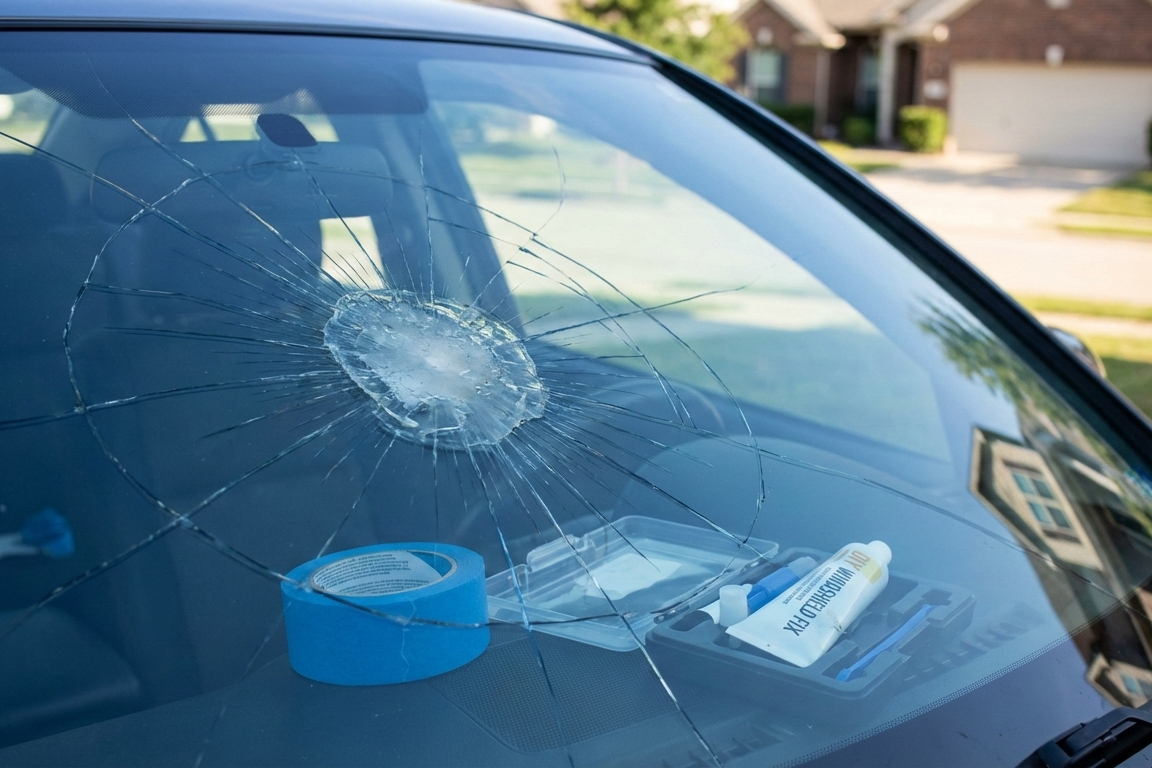
Avoid Cracking Problems Caused by DIY Glass Repair Mistakes
Unmistakable is the sound they make. The impact of a rock that was stirred up by the semi-truck in front of you and collides with your windshield causes a loud thud that can be heard throughout the cabin. You make a startled movement and look at the glass, and there it is: a little chip that is jagged and right in front of your eyes. An instant feeling of frustration creeps in. You begin to compute the amount of time and money that will be necessary to correct it. Finally, a concept comes to mind. It is possible that you have seen those repair kits available for less than twenty bucks at the local auto parts store or online. In a matter of minutes, the package claims to deliver professional results.
Get An Auto Glass Replacement Quote Now 866.278.7417

Windshield Replacement & Repair
Our competitors push you into going to their shop to get your glass fixed-making it cheaper for them. We make it easier for YOU to get back on the road by offering free mobile repairs at your home or work. With our free mobile services servicing the entire Orange County & Los Angeles area, we can often handle your windscreen replacement the same day! So the next time you need a windshield replacement, give us a call.
Talk to a Windshield Replacement Specialist Now 866.278.7417

Calibration
Calibration is the process of returning a vehicle’s ADAS to OEM specifications. Calibration is necessary after a new glass installation, particularly a windshield with a camera mounted to it, to ensure that the ADAS features continue to function properly despite having been moved during installation. If a car’s ADAS is not properly calibrated, the system may not function safely. A misaligned camera could jeopardize the functionality of the system and lead to dangerous driving or accidents, so it is crucial that the cameras are aligned perfectly, which is what windshield calibration ensures.
Talk to a Calibration Specialist Now 866.278.7417

Fleet Auto Glass Repair
We provide expert auto glass repair and windshield replacement services for commercial fleets of all sizes. We are experienced with all manufacturers and machine types of domestic or foreign cars, trucks, vans, or commercial vehicles, including heavy equipment. Our same day mobile auto glass and windshield repair service will enable you to get back on the road faster and start saving you time and money instantly. Give us a call today! We are here to help!
Talk to a Fleet Auto Glass Specialist Now 866.278.7417
What Is the Truth Behind the Universal Repair Kit
Do-it-yourself solutions have a number of problems, the most significant of which are the tools themselves. A plastic plunger, a tiny tube of generic resin, and a curing strip are often included in the majority of consumer-grade kits. These kits are supposed to be “one size fits all.” Damage to automobile glass, on the other hand, is seldom consistent.
Bullseyes, star breaks, half-moons, and combination breaks are some of the unique forms of chips that are classified by professional specialists through their classification system. Taking a distinct technique is necessary for each category. In the case of a star break, for example, there are little legs that radiate forth from the center and need to be filled with care in order to prevent the break from spreading. Attempts to drive resin into these small fractures using a basic plunger kit frequently meet with failure.
For more information, experts make use of high-quality resins that have viscosities that vary depending on the temperature and the type of damage that is being repaired. One viscosity is provided by a do-it-yourself kit. It will not be able to enter the fracture if it is too thick, and if it is too thin, it will not connect with the glass in a way that is strong enough to keep it together.
Moisture And Debris Are Being Captured
When it comes to house repairs, one of the most common mistakes that may occur occurs before the resin is ever applied. It is necessary for the injured area to be chemically clean and completely dry before any attempt at restoration can be made. Dust particles, filth from the road, and powdered glass are all included within that little chip. Injecting glue on top of this debris will result in a poor connection between the two surfaces. Instead of adhering to the auto glass, the resin will make contact with the dirt, which may eventually result in the repair becoming discolored or failing.
Moisture is an even more formidable adversary. In the event that you wash your vehicle or use windshield wiper fluid immediately prior to attempting to fix it, water molecules will become trapped inside within the crack. Although you might not be able to see them, they are present. The water is contained within the resin after it has had time to cure. When winter arrives and the temperature lowers, the water that has been stored freezes and expands, causing the glass to break from the inside out and destroying the windshield in an instant. In order to guarantee that the break is in perfect condition before it is filled, professionals make use of sophisticated vacuums and drying processes.
Lack of Sufficient Air Removal
In order to restore the structural integrity of the glass, it is necessary to entirely replace the air that is still present within the crack with resin. To do this, a cycle of pressure and vacuum is required. In most cases, do-it-yourself kits depend on a straightforward syringe mechanism to generate a vacuum. Despite the fact that the idea is valid, it is difficult to put into practice using inexpensive plastic equipment. When utilizing a manual plunger, it is extremely challenging to produce sufficient vacuum suction to remove all of the air bubbles that are trapped inside of a difficult crack.
The presence of air bubbles results in the formation of weak spots. Due to the fact that these spaces scatter light, the chip is still visible while driving, which may be quite distracting. Above all else, air pockets make it possible for the auto glass to bend in a different way than the resin, which ultimately results in stress cracks in the future.
Do you have a Question?
Get An Auto Glass Replacement Quote Now 866.278.7417
Curing That Is Not Done Correctly
The resin used in auto glass is anaerobic and photo-reactive, which means that it cures when it is exposed to ultraviolet (UV) radiation. Professional repair businesses make use of ultraviolet (UV) lamps with a high intensity, which cure the resin at a certain wavelength and speed. This ensures that the resin hardens uniformly over the whole depth of the repair.
Do-it-yourself kits need you to park in the sun. Ultraviolet rays are produced by the sun; however, they are not constant. Shadows, clouds, and the time of day are all factors that might influence the curing process. In the event that the top layer cures more quickly than the resin that is located deep within the fracture, the repair will contract and peel away from the auto glass.
On the other hand, if the resin is exposed to sunlight too early—before it has completely penetrated the break—it may solidify prematurely, which will obstruct the flow of the resin and leave the repair unfinished. For those who do not have access to professional equipment, timing is key, and it is a game of guesswork.
Using an Excessive Amount of Pressure
Accidentally smashing the windshield while attempting to repair a chip is possibly the most ironic blunder that could have been made. It is necessary to apply pressure in order to force the resin into the crack. The suction cups or adhesive pads that are provided in repair kits are used to connect the plastic bridges or pedestals that are included with the materials. One of the most typical mistakes that users make is that they overtighten the injector screw in an effort to ensure that the resin penetrates the damage to a greater depth.
Windshields are constructed out of laminated glass, which consists of two layers of glass followed by a layer of vinyl in between. There is strain around the outermost layer. It is possible for the glass to break rather readily if you apply an excessive amount of point pressure to a vulnerable location (the chip). It is possible for a chip that was once a quarter-sized chip and could be repaired to suddenly become a detectable twelve-inch fracture across your viewing area, necessitating the replacement of the whole windshield.
Concerning the Unseen Dangers
In addition to the aesthetic concerns and the possibility that the fracture can widen, there is a serious safety concern that must be taken into consideration. It is not just the wind that your windshield is designed to stop. It is capable of providing up to forty-five percent of the structural integrity of the cabin in current cars in the event of a front-end collision and up to sixty percent in the event of a rollover accident.
In addition to this, the airbag on the passenger side is dependent on the windshield to act as a backstop. When the airbag is deployed, it launches itself upward and has the effect of protecting the passenger by bouncing against the glass. The power of the airbag might shatter the auto glass or rip the windshield out of the frame altogether, rendering the airbag unusable. This could happen if the windshield has been weakened as a result of a do-it-yourself repair that was not done correctly.
Is It Worth It If You Consider the Financial Reality?
The desire to save money is the fundamental impetus behind do-it-yourself repairs. On the other hand, this is frequently a false economy. The fact that windshield chip repairs are likely covered by their vehicle insurance policy without a deductible is something that a lot of drivers are unaware of. As a result of the fact that insurance companies would rather pay sixty dollars for a competent repair than more than four hundred dollars for a replacement, they frequently waive the expense for the driver. In this particular circumstance, you will not incur any out-of-pocket expenses for a professional repair.
A professional chip repair is typically within your price range, even if you have to pay for it out of your own cash. Contrast this with the possibility of damaging the windshield by using a do-it-yourself kit. Even if the repair is unsuccessful, a professional will not be able to return and correct your error. After the resin has been allowed to set in the crack, the technique cannot be undone. You are left with no other choice except to undergo a complete replacement at that time, which is a price that is substantially more than what the first expert repair would have been.
Questions That Are Frequently Asked
Is it possible to use a do-it-yourself kit to repair a large crack? You should not attempt to patch cracks that are longer than a dollar note on your own. This is a recommendation that comes highly recommended. It is necessary to use specialist tools in order to drill stop-holes and bridge the gap in order to prevent the fracture from spreading further. Small chips, such as bullseyes or stars, are often the only ones that may be used with do-it-yourself kits.
Will a do-it-yourself fix render the chip undetectable? To make a chip absolutely undetectable, no repair, not even a professional one, can be performed. Eighty to ninety percent improvement in clarity and restoration of structural integrity are the goals. Due to the use of lower-quality resin and trapped air, do-it-yourself kits sometimes result in the chip appearing foggy or unclean. Immediately after receiving a chip, what would you recommend I do?
In order to prevent dirt and moisture from entering the chip, cover it with a piece of transparent tape. If you want to prevent the fracture from spreading, you should avoid operating your defroster or air conditioner on high since it might produce significant temperature swings. Do not hesitate to get in touch with a reputable repair firm as soon as possible. Will a poor do-it-yourself repair affect the inspection of my vehicle? Indeed. There is a possibility that your vehicle will fail a safety inspection if the repair is in the driver’s line of sight and causes visual distortion due to trapped air or poor resin quality during the examination.
Do Not Take Any Chances With Your Glass
Despite the fact that it is obvious that a quick and inexpensive patch might be appealing, your windshield is much too crucial to be treated like a craft project. There is very little room for error, and the repercussions of a mistake might range from a distracting visual imperfection to a damaged safety system.
When a rock hits your window, the first thing you should do is check your insurance coverage. It is possible that a professional repair will not cost you anything. It is well worth the price to have the peace of mind that comes from knowing that the structural integrity of your car is not compromised, even if it is not. In order to maintain a clear and secure vision of the road, you should leave the resin to the professionals.
The High Price of Windshield Repairs That Are Not Expensive
The sound of a loud crack on the highway is the worst dread of any driver. A little pebble hits your hood and ricochets off of it, leaving a horrible bullseye square in the middle of your field of vision. You watch helplessly as it happens. Your initial reaction could be to run away in fear because of the price. You might feel compelled to grab your phone and look for “how to fix a windshield chip at home.” This could be your second inclination.
There is a plethora of “hacks” on the internet that promise to fix that crack for a little amount of money by utilizing common home goods such as super glue, clear nail paint, or inexpensive do-it-yourself repair kits. Certainly, it is attractive. If you already have a tube of Krazy Glue stashed away in the junk drawer, there is no reason to spend money at a repair business.
The difficulty is that windshields are not only windows; rather, they are intricate structural components of your car. In many cases, attempting a quick cure through the use of the incorrect materials does not only fail to address the problem, but it also actively makes the situation worse. Something that begins as a straightforward chip that can be fixed for $80 might rapidly deteriorate into a crack that cannot be fixed and requires a complete replacement that can cost as much as $500. It is for the following reasons that those internet-famous fast solutions almost always result in costly regrets, and why the only option to rescue your auto glass is through the intervention of an expert.
A Look at the Components That Make Up a Windshield (And Why Glue Is Effective)
Understanding what it is that home adhesives are attempting to cure is necessary in order to comprehend why they are unsuccessful. The windshield on your vehicle is not a single pane of auto glass like the one that is in the window of your kitchen. A laminated safety sandwich is what it is called; it consists of two layers of curved glass with a layer of polyvinyl butyral (PVB) plastic sandwiched in between them.
In most cases, the exterior layer of the glass is broken when a rock strikes it, but the interior layer and the plastic remain intact. In order to provide a proper repair, it is necessary to inject a particular resin into the crack. Three characteristics are required of this resin: it must penetrate deeply into the minute crevices that are present in the fracture. In order to make it invisible, it must cure in a transparent manner such that it matches the refractive index of the glass. Restoring the outer layer’s structural integrity requires a strong bond between the two layers.
When it dries, super glue, which is cyanoacrylate, becomes brittle. Because it is not meant to expand and contract with the glass, it will not do so when your vehicle is heated by the sun or cooled by the air conditioner. This not only forms a surface seal but also prevents the break from being penetrated. What is the end result? However, the air continues to be confined within the crack. On a day with high temperatures, the trapped air expands, which causes it to apply pressure on the glass. This pressure causes the chip to spread out into a gigantic spiderweb break.
As a result of the “Lock-Out” effect, a repair is transformed into a replacement. The impact that professionals refer to as the “lock-out” is the most hazardous component of a do-it-yourself repair operation. Repairing a windshield professionally requires access to the vehicle. A technician will first use a suction tool to remove air from the chip, and then they will apply pressure in order to drive glue into the chip. You will have successfully blocked the entry point if you have previously covered the surface of the chip with nail polish, super glue, or a resin that is included in a generic do-it-yourself kit.
After a foreign material has had time to cure inside the chip, it is impossible for a specialist to remove it. They are unable to securely drill through it without the possibility of breaking the auto glass, and they are unable to dissolve it without causing damage to the PVB layer. You have essentially “locked out” the prospect of having a professional repair done on your vehicle since you are seeking to save money by doing a fast fix. It is now necessary to replace the entire windshield because of a chip that a technician might have mended in twenty minutes in the past.
Do you have a Question?
Get An Auto Glass Replacement Quote Now 866.278.7417
Unseen Threat to Safety Systems and Safety Systems
The automobiles of the 1990s are very different from the ones that are available now. These days, the windshield serves as a lens for the eyes of your vehicle. Cameras that are located immediately behind the windshield are frequently utilized by Advanced Driver Assistance Systems (ADAS), which include functions such as lane departure warning, automated emergency braking, and rain sensors.
The lenses of these cameras have been adjusted so that they can see through the glass with complete clarity. Refraction Problems: The optical clarity of automotive glass is not comparable to that of household glues and low-quality resins that are used for do-it-yourself projects. They have the ability to produce a prism effect or a blur. Malfunction of the Sensors: If the “fix” is located anywhere near the field of vision of the camera, it has the potential to confuse the sensors. It is possible that this will cause your vehicle to brake suddenly or to fail to recognize a lane marker.
The expense of a new piece of glass is not the only thing that you will have to consider if you make a mistake when repairing a modern automobile. The cost of ADAS recalibration, which is a specialist procedure that can quadruple the cost of a windshield repair, is another factor that you need to take into consideration.
The Fallacy of the Do-It-Yourself Kit
There are do-it-yourself windshield repair kits available at auto parts stores, and they claim to deliver expert results. Although they are an improvement over nail polish, they seldom live up to their claims for a number reasons, including the following: Inadequate Pressure: In order to alternate between sucking air out and driving glue in, professional equipment will utilize large pressure cycles. There is just not enough power that can be generated by inexpensive plastic syringes that are offered in do-it-yourself kits to displace all of the air pockets in a tight star break.
Resin of Poor Quality: Professional resins are available in a variety of viscosities, which vary according to the temperature and the kind of break. A “one-size-fits-all” resin is used in do-it-yourself kits, which makes it difficult to penetrate small fractures because it is either too thick or too thin to hold a bond. Inadequate Curing: In order to cure resin, UV light is required. For instantaneous hardening of the repair, professionals make use of intense ultraviolet lights. The sun powers do-it-yourself kits. It is possible that the glue may not cure completely if a cloud passes over or if you do the repair operation in the shade. This will result in a weak bond that will disintegrate as soon as you hit a pothole.
Here Is What You Ought To Do Instead
In the event that a rock strikes your windshield, speed is of importance; nevertheless, rushing into a repair that is not up to par is not the solution. Immediately protect the chip from damage. Clear packing tape is the only “hack” that’s genuinely helpful in this situation. In the event that you are unable to visit a store right away, you should cover the chip with a piece of transparent packing tape. In spite of the fact that this does not repair the damage, it does prevent dirt, water, and washer fluid from entering the crack. When compared to a dirty fracture, a clean crack is significantly simpler for a professional to repair.
Verify that you have insurance. There are a lot of motorists who are unaware of the fact that windshield repair, as opposed to replacement, is frequently covered by comprehensive insurance policies that have no deductible. It is much more likely that your insurance company will pay $70 to repair a chip than it will spend $700 to replace the glass in the future. In order for you to get it done correctly, it might be practically free for you. The damage is being evaluated. In general, the chip can be mended if it is less than a quarter in size and if it is not directly in the line of sight of the driver. If you attempt to fix it on your own and are unsuccessful, that option will be removed.
Do Not Take Any Chances With Your Safety
When it comes to a vehicle’s structural integrity, a windshield may give up to 45% in the event of a front-end collision and up to 60% in the event of a rollover. Your passenger airbag is located on the backboard of your vehicle. It is a poor estimate to compromise this essential safety element in order to save a few bucks.
The temptation of the fast remedy is something that may be understood. There is no one who would want to arrange a service appointment for a pebble damage that is so little. On the other hand, the chemistry involved in auto glass repair is quite harsh. Nail polish and super glue are examples of blunders that are irreversible and may transform relatively slight inconveniences into significant costs. Instead of trying to fix the glass yourself, you should call a professional when it breaks.
Mobile Safe Auto Glass
14241 E Firestone blvd suite 400,
La Mirada, CA 90638
Phone: (562) 608-1154
Toll Free: 1 866 278 7417
Mail: sales@mobilesafeautoglass.com
Get a FREE QUOTE today! You can get a free quote and schedule 24/7 using this free quote wizard.
Mon – Fri 8am – 5pm
Saturday 8am – 1pm
Sunday Closed