Auto Window Replacement Methods for Reliable Clean Installs
Having a car window that is broken or cracked is not just an eyesore; it also poses a threat to the driver’s safety. Both the structural integrity of your car and your visibility on the road are put at risk as a result of this. When the time comes for a replacement, having a thorough grasp of the procedure will guarantee that you receive an installation that is dependable, clean, and risk-free. In this article, you will be guided through the expert procedures that are utilized for the replacement of automobile windows. If you are aware of the components that comprise a professional installation, you will be able to ask the appropriate questions and select a service provider that will not take shortcuts.
Get An Auto Glass Replacement Quote Now 866.278.7417

Windshield Replacement & Repair
Our competitors push you into going to their shop to get your glass fixed-making it cheaper for them. We make it easier for YOU to get back on the road by offering free mobile repairs at your home or work. With our free mobile services servicing the entire Orange County & Los Angeles area, we can often handle your windscreen replacement the same day! So the next time you need a windshield replacement, give us a call.
Talk to a Windshield Replacement Specialist Now 866.278.7417

Calibration
Calibration is the process of returning a vehicle’s ADAS to OEM specifications. Calibration is necessary after a new glass installation, particularly a windshield with a camera mounted to it, to ensure that the ADAS features continue to function properly despite having been moved during installation. If a car’s ADAS is not properly calibrated, the system may not function safely. A misaligned camera could jeopardize the functionality of the system and lead to dangerous driving or accidents, so it is crucial that the cameras are aligned perfectly, which is what windshield calibration ensures.
Talk to a Calibration Specialist Now 866.278.7417

Fleet Auto Glass Repair
We provide expert auto glass repair and windshield replacement services for commercial fleets of all sizes. We are experienced with all manufacturers and machine types of domestic or foreign cars, trucks, vans, or commercial vehicles, including heavy equipment. Our same day mobile auto glass and windshield repair service will enable you to get back on the road faster and start saving you time and money instantly. Give us a call today! We are here to help!
Talk to a Fleet Auto Glass Specialist Now 866.278.7417
Considering the Importance of Having Professionals Replace Your Windows
The windows of your car are essential components of safety engineering. The windshield, in particular, is responsible for up to thirty percent of the structural strength of your car and is extremely important for the correct deployment of the airbags. An improperly placed window has the potential to fail in the event of a collision, which raises the risk of harm. The reason for this is because a professional installation is not only about appearances; it is also about safety.
For the purpose of ensuring that the new window is properly attached to the frame of the vehicle, a skilled technician will employ certain techniques and materials of superior quality. Through this procedure, the vehicle’s structural integrity is restored, and a waterproof seal is ensured and guaranteed. If you want to be sure that the job is done correctly, the best method to do it is to take your vehicle to a licensed mechanic.
A Detailed Explanation of the Procedures Involved in Transforming Automobile Windows
The replacement of an automobile window requires a method that is quite careful. Although there may be some slight differences between specialists, the fundamental processes that are required for a dependable and clean installation are always the same.
Assessment of the Vehicle and Protection of the Vehicle The first thing that each skilled technician does is to evaluate the damage and get the vehicle ready for the replacement. This entails the following:
In order to safeguard both the inside and outside of the vehicle, the technician will install protective covers on the dashboard, the seats, and the body of the vehicle located around the window area. In this way, any scratches that may be caused by tools or damage caused by the urethane glue are avoided.
The specialist will first inspect the damage in order to select the most effective method for removal. This involves determining the degree of the damage. This entails being ready to vacuum up all of the pieces of glass that are present in a damaged side or rear window. In the case of a windshield that has been cracked, it is necessary to carefully arrange the removal of the old glass.
Taking Out the Old or Damaged Window The process of taking out the old window is an important step that demands accuracy in order to prevent the structure of the car from being permanently damaged.
When it comes to windshields, technicians make use of specialist instruments, such as a cold knife or a wire-out tool, in order to cut through the conventional urethane glue that is responsible for holding the windshield in place. When they want to remove the glass from the pinch weld, which is the metal frame that the window is attached to, they work carefully around the perimeter of the glass.
In the event that the glass is broken, the technician will first remove any big pieces that are still attached to the window frame. This applies to both the side and rear windows. To ensure that no sharp shards are left behind, they will then do a thorough vacuuming of any glass fragments that have been found within the car, including those that have been found inside the door panels.
After the old glass has been removed, the frame of the car has to be completely prepared for the new window. This is the first step in the pinch weld preparation process. In order to ensure a solid and long-lasting relationship, this is likely the most important step that can be taken.
Getting Rid of Old Urethane The technician will use a scraper or a utility knife to gently cut away the old urethane glue that is on the pinch weld. This will leave a thin, flat foundation that is around one to two millimeters in thickness. The new glue will adhere to this foundation, which offers a perfect surface for the bonding process. It is not advisable to completely remove the old urethane since the new bead clings better to the old material than it does to the bare metal during the cleaning process.
In order to eliminate any dirt, rust, or debris that may be present, the pinch weld is given a thorough cleaning before being primed. A specialized primer is sprayed in the event that any scratches have let the naked metal show through. The use of this primer avoids the formation of rust, which, if left unchecked, might eventually damage the adhesive bond. Additionally, the new glass is cleaned and primed in the regions that will be utilized for the application of the urethane.
The process of applying the new urethane glue is now complete. After the frame and the new glass have been prepped, it is time to apply the adhesive. Technical professionals make use of polyurethane (urethane) glue that is of superior quality, has a rapid drying time, and complies with the Federal Motor Vehicle Safety Standards (FMVSS).
The technician will use a caulk gun to apply a fresh, continuous bead of urethane around the whole pinch weld or directly onto the new glass. This is the process known as “laying the bead.” For a full and even seal, the bead must have a uniform height and breadth, producing a triangle shape. This is necessary to achieve perfect sealing. In the event that the bead has any gaps, it may result in water leaks or wind noise.
Putting in the New Window: This stage needs accuracy, and in the case of bigger windows like the windshield, it is often performed by two experienced technicians.
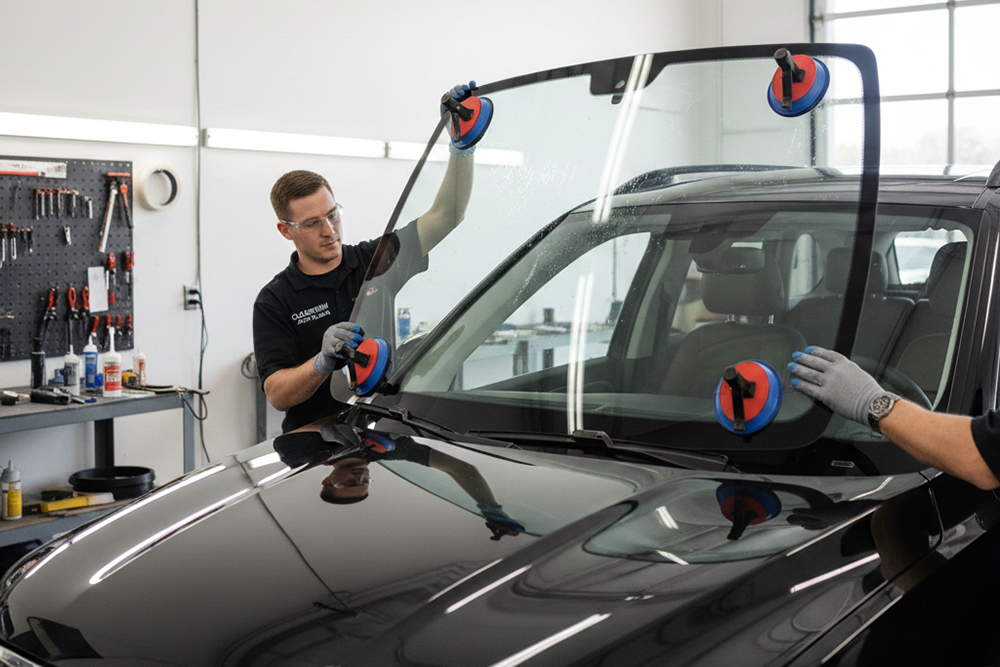
The glass is then set in position by carefully lifting the new window and inserting it into the opening that has been made. The experts make use of suction cups to ensure a firm grip on the glass and to ensure that it is exactly aligned with the frame of the car. After the glass has been positioned, it is then gently pushed down in order to verify that it is in firm contact with the urethane bead.
Securing the Window: In order to prevent the new window from moving about while the glue is curing, technicians will frequently apply retention tape to secure it in place. There should be a minimum of twenty-four hours that this tape is left on the car.
Following the establishment of the window, the procedure is not yet complete; finishing touches and curing time are still required. Following the completion of the final procedures, the customer is guaranteed to get their vehicle in perfect condition and to have a complete understanding of the post-installation needs.
In the process of reassembling, all of the moldings, trim, windshield wipers, and rearview mirrors that were previously removed are now being reinstated.
Final Cleanup: The technician will do a final cleanup, which includes removing any protective covers and vacuuming any material that is still present. In order to provide you with a clear view, the new window has also been cleaned.
Time to Drive Away Safely: The technician will provide you with information on the “Safe Drive-Away Time.” This is the very minimum amount of time that must pass before the urethane has cured to the point where it satisfies the safety criteria. In most cases, it can take anywhere from thirty minutes to several hours, depending on the kind of glue that was used and the external circumstances, such as the temperature and the humidity. In order to guarantee your safety, it is essential that you adhere to this rule.
Do you have a Question?
Get An Auto Glass Replacement Quote Now 866.278.7417
Picking a Dependable Replacement Service to Work With
Different vehicle glass providers offer different levels of quality. When choosing a provider, it is useful to inquire about their procedures. A corporation with a good reputation will be open and honest about the procedures they use and the components they employ. Their adherence to safety standards will be emphasized, and they will hire licensed experts who are well-versed in the most recent installation procedures.
By gaining an awareness of the components that comprise a dependable and spotless car window replacement, you will be able to have the peace of mind that your vehicle is in capable hands and that your new window will continue to protect you for many years to come.
How to Improve the Window Seal on Your Vehicle
Not only do the windows of a car provide a view of the road, but they also play an important role in the structure of the vehicle and serve as a protection mechanism against the elements. By properly sealing your windows, you may prevent rain from entering your vehicle, lessen the amount of noise from the road, and keep the temperature inside your vehicle stable. The seals on these windows can become worn down with time, which can result in leaks, foggy glass, and even corrosion.
The procedures for obtaining and maintaining a great auto window seal will be outlined in this tutorial, which will lead you through the process. The procedure of sealing your windows for long-term clarity and protection will be covered in detail, beginning with the identification of typical problems and continuing through the process step by step. By the time you reach the conclusion, you will have a better understanding of how to maintain the safety, dryness, and comfort of the inside of your vehicle.
The Importance of Having a Good Window Seal
It is common practice to refer to the rubber and plastic seals that surround the windows of your vehicle as weatherstripping. These seals serve as your primary line of protection against the elements. In excellent condition, they offer a number of important advantages, including the following:
Protection from the elements: A secure seal prevents water from entering your vehicle during wet or snowy conditions, therefore shielding the inside from the effects of moisture damage, mildew, and wear and tear.
Noise Reduction: Seals that are doing their job effectively filter out a large amount of wind and road noise, resulting in a driving experience that is both quieter and more pleasurable altogether.
Efficiency in Climate Control Proper seals make your heating and air conditioning systems function more efficiently by keeping air from the outside from entering the vehicle. This allows you to keep the temperature inside the vehicle at a comfortable level without having to exert any additional effort.
Integrity of Structure: Window seals, despite their seeming little size, provide a significant contribution to the overall stiffness of the frame of your car. Their assistance in securing the glass in place is of utmost significance for the purpose of ensuring safety.
If you choose to ignore a failing seal, it may result in expensive repairs in the future. These repairs may include damaged electronics and upholstery, as well as rust that may jeopardize the body of your vehicle.
How to Recognize a Defective Window Seal
Having the knowledge of what to look for is necessary before you can repair a seal. If you are aware of where to look, it is typically not difficult to identify the telltale indicators of a window seal that is deteriorating.
When performing a visual inspection, the first step is to thoroughly inspect the rubber seals that surround each window. Take note of:
Cracks and brittleness: Over time, the rubber may become hard, brittle, and cracked as a result of exposure to the sun and fluctuations in temperature.
Gaps or Shrinkage: The seal may move away from the glass or the body of the vehicle, resulting in gaps that are apparent to the naked eye.
A clear indication that the seal has been broken is the presence of tears and other forms of damage, such as rips or holes in the material.
Despite the fact that discoloration is not usually an indication of failure, severe fading might be an indication that the rubber is getting older and consequently losing its flexibility.
Symptoms that indicate a leak may be present even if a visual assessment does not reveal any evident damage. Other symptoms may indicate that there is a leak.
Carpets or Upholstery That Are Wet The presence of unexplained wetness on the floor or seats of your vehicle, particularly after it has rained, is a typical indication that there is a water leak.
The presence of persistent fogging on the inside of your windows, particularly when the humidity level is low, is considered to be an indication that moisture is being held within the cabin.
In the event that you are driving at greater speeds and suddenly notice a rise in whistling or whooshing sounds, this is typically an indication that air is escaping through a crack in the seal.
Odors of Mustiness: If you notice a musty odor or a mildew odor that persists within your vehicle, this is a clear indication that there is a concealed water leak that has been sitting for some time.
In addition, carrying out a straightforward “water test” using a hose might be of assistance in determining the precise position of a leak. While you remain inside and keep an eye out for any drips, have a buddy spray water around the perimeter of the windows.
Do you have a Question?
Get An Auto Glass Replacement Quote Now 866.278.7417
A Guide to Fixing and Resealing Your Automobile’s Windows
It is possible that you may be able to fix the present seal, but it is also possible that you will need to replace it totally. This will depend on the extent of the damage. The stages involved in a typical resealing process are summarized here.
Collect Your Materials: Before you start, check that you have all of the necessary tools and equipment. The following items are required: a high-quality car glass sealer, which is often an adhesive based on urethane; In order to remove old sealant, you will need a gasket scraper or a utility knife; isopropyl alcohol or an adhesive remover; clean microfiber cloths; masking tape; a caulking gun; gloves; and safety glasses.
Perform a Complete Cleaning of the Area: A clean surface is the foundation for effective adhesion. To get rid of any filth, dust, or grime that may be present, you should start by washing the window and the area around it using a cleaner that is designed for general use.
In the following step, you will need to remove any old sealant that is loose from the glass as well as the frame of the vehicle by using your scraper or utility knife. If you want to prevent scratching the paint or the glass, behave gently. As soon as the majority of the old material has been removed, wipe clean the area with a cloth that has been soaked in isopropyl alcohol or an adhesive remover. This will remove any residue that may still be there. Ensure that it dries properly.
Using Masking Tape: In order to get a finish that is both clean and professional-appearing, it is recommended that masking tape be applied around the borders of the glass and the body of the vehicle. This will prevent the new sealant from going on your paint or the primary surface of the window, as well as create a nice border for the new sealant to fall inside. A tiny and consistent gap should be left in the area where the new sealant bead will go.
To apply the new sealant, load the caulking gun with the auto glass sealant and then go further. Beads of sealant should be applied in a steady and continuous manner into the space that you have formed, beginning at one corner. Ensure that the bead is of the same size by moving at a steady rate throughout the process. It is of the utmost importance to apply sufficient sealant to adequately cover the gap without allowing it to overflow.
When you have finished applying the sealant all the way around the glass, you can use a plastic tool or your gloved finger to carefully smooth the bead. During this procedure, which is referred to as “tooling,” the sealant is pushed into the gap, which results in a finish that is smooth and waterproof.
Immediately after tooling the sealant, remove the masking tape in a precise manner. This will allow the sealant to cure successfully. If you want the cleanest line possible, pull it away at a 45-degree angle.
Time is required for the sealant to fully cure. It is important to check the instructions provided by the manufacturer because the curing time might change based on the product and the circumstances of the environment. For the sealant to become tack-free, it normally takes at least a few hours, and it can take up to twenty-four hours for it to completely cure. During this time period, you should refrain from washing the automobile or setting it out in the rain.
How to Know When to Call a Professional
Re-sealing a window is a do-it-yourself procedure that many people are able to handle, but there are situations in which it is preferable to seek the assistance of a professional. In the event that the glass is broken, the frame is rusty, or you are dealing with a windshield that is physically attached to the vehicle, it is more prudent to delegate the task to a professional. Glass specialists for automobiles are equipped with the specific tools and years of expertise necessary to ensure that the task is completed correctly, thus ensuring both safety and a flawless seal.
Keep your window seals in good condition to ensure long-term clarity. Once your windows have been properly sealed, a little bit of upkeep may go a long way toward extending the life of the weatherstripping.
Regular Cleaning: It is important to clean the seals on a regular basis using a solution of mild soap and water in order to eliminate dirt and debris that might cause the rubber to deteriorate.
Put on a Conditioner: Apply a conditioner or rubber protectant on your rubber at least a couple times each year. These compounds facilitate the maintenance of the rubber’s pliability and softness, therefore keeping the rubber from drying out and breaking.
When cleaning your vehicle, you should avoid putting harsh chemicals on the seals. This is because these chemicals can cause the rubber to degrade; therefore, you should avoid using oil-based solutions or strong solvents.
An Unmistakable Way Forward
Keeping the window seals on your vehicle in good condition is a process that is not only simple but also provides considerable advantages. You can protect your car from water damage, decrease road noise, and guarantee that your climate control system operates properly if you examine your weatherstripping on a regular basis and solve any problems as soon as they arise. Having a window that is correctly sealed is essential to having a ride that is both pleasant and well-protected, regardless of whether you choose to handle the repair yourself or to bring in a professional.
Mobile Safe Auto Glass
14241 E Firestone blvd suite 400,
La Mirada, CA 90638
Phone: (562) 608-1154
Toll Free: 1 866 278 7417
Mail: sales@mobilesafeautoglass.com
Get a FREE QUOTE today! You can get a free quote and schedule 24/7 using this free quote wizard.
Mon – Fri 8am – 5pm
Saturday 8am – 1pm
Sunday Closed