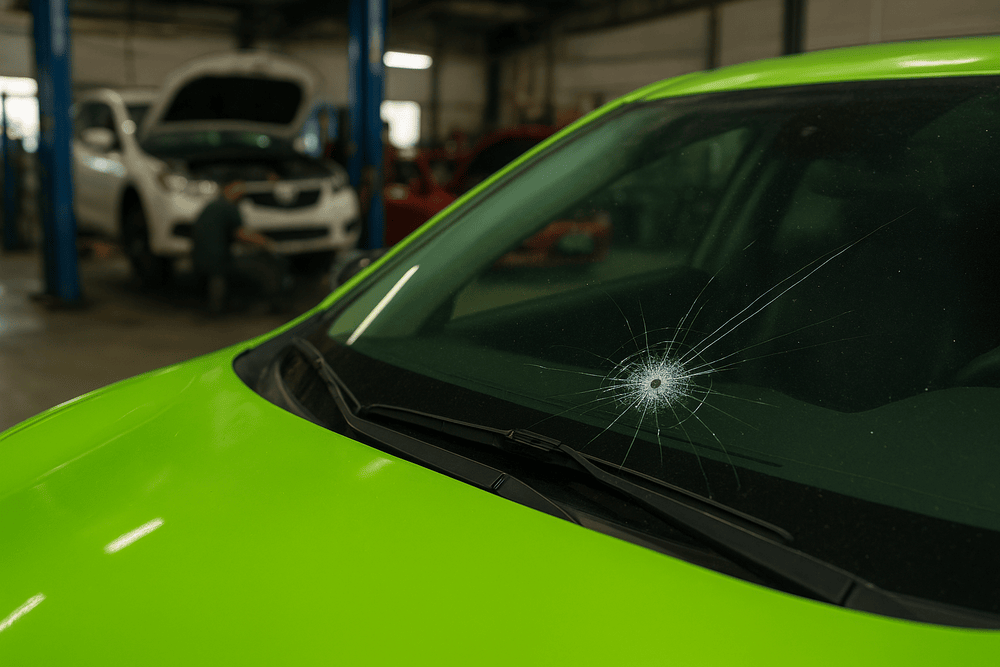
Auto Chip Repair Techniques Every Driver Should Know
After driving, drivers don’t like to hear rocks hitting their windshield. Frequently, a little, but perceptible, chip remains in the glass. Even while a tiny chip might not seem like much, it can quickly develop into a large crack that needs windshield repair. Prompt windshield chip repair saves time, money, and irritation. The fundamentals of auto chip repair that every motorist should understand are covered in this lesson. This lesson covers evaluating the damage, repairing it yourself, and determining whether to call in experts. We’ll talk about how to figure out how bad the damage is, how to fix it yourself, and when to leave it to the pros.
Get An Auto Glass Replacement Quote Now 866.278.7417

Windshield Replacement & Repair
Our competitors push you into going to their shop to get your glass fixed-making it cheaper for them. We make it easier for YOU to get back on the road by offering free mobile repairs at your home or work. With our free mobile services servicing the entire Orange County & Los Angeles area, we can often handle your windscreen replacement the same day! So the next time you need a windshield replacement, give us a call.
Talk to a Windshield Replacement Specialist Now 866.278.7417

Calibration
Calibration is the process of returning a vehicle’s ADAS to OEM specifications. Calibration is necessary after a new glass installation, particularly a windshield with a camera mounted to it, to ensure that the ADAS features continue to function properly despite having been moved during installation. If a car’s ADAS is not properly calibrated, the system may not function safely. A misaligned camera could jeopardize the functionality of the system and lead to dangerous driving or accidents, so it is crucial that the cameras are aligned perfectly, which is what windshield calibration ensures.
Talk to a Calibration Specialist Now 866.278.7417

Fleet Auto Glass Repair
We provide expert auto glass repair and windshield replacement services for commercial fleets of all sizes. We are experienced with all manufacturers and machine types of domestic or foreign cars, trucks, vans, or commercial vehicles, including heavy equipment. Our same day mobile auto glass and windshield repair service will enable you to get back on the road faster and start saving you time and money instantly. Give us a call today! We are here to help!
Talk to a Fleet Auto Glass Specialist Now 866.278.7417
Evaluating the Damage
You must take a close look at the chip before you can make a decision. The type, amount, and location of the damage will decide whether you can fix it yourself or need to get help from a professional.
Windshield chip types include: Chips are not all made equal. To figure out how bad the damage is, you must first figure out what kind of damage it is.
Bull’s-Eye: This round chip looks a lot like a target, which is how it got its name. Its outer layer of glass has a cone-shaped depression and a noticeable black circle.
Star Break: This type of damage looks like a starburst and is made up of small cracks that spread out from a center point of impact. If left untreated, these fissures have the potential to expand rapidly.
Combination Break: As the name suggests, this type of break is a mix of a bull’s-eye and a star break. It has a circular chip in the middle with cracks radiating outward.
The half-moon, also known as the partial bull’s eye, is a semi-circular chip that resembles an unfinished bull’s eye.
Crack: One line in the glass, it can be long or short. Professional assistance is usually required for any crack longer than a dollar bill.
When to Try a Do-It-Yourself Repair: For minor damage, a do-it-yourself windshield repair kit may be a viable option. In general, if the chip satisfies the following requirements, you can try to fix it yourself:
Dimensions: The chip’s diameter is less than a quarter.
Depth: Only the windshield glass’s outer layer has been damaged.
The chip is not right in front of the driver’s eyes. Small distortions left over from repairs may be distracting.
Cracks: If the damage is greater, directly in your line of sight, or has penetrated deeply into the glass, it is recommended to obtain professional assistance right away. Any accompanying cracks are less than six inches.
Homemade Repair for Windshield Chips
If you decide the chip is small enough to fix at home, the next step is to get a DIY windshield repair kit. Most of the time, you can find these kits at auto parts shops for between $10 and $20. They have an applicator method and a unique glue that fills the chip and stops it from spreading.
To ensure a successful repair, adhere to the following steps:
Clean and Prepare the Area: A clean surface is crucial to the success of your repair.
Clean the Chip: Carefully remove any loose glass pieces from the impact location using a razor blade or a tiny pin. Take care not to enlarge the chip.
Wipe It Down: Make sure the area surrounding the chip is completely clean by using a dry, clean microfiber cloth and a tiny bit of rubbing alcohol. Make sure the glass is completely dry before going any further, as any wetness could make the resin less stable.
Apply the Seal and Pedestal: The majority of repair kits include a plastic pedestal that serves as the application instrument along with an adhesive seal.
Put the Seal in Place: Make sure the impact point is centered within the opening before placing the adhesive seal over the chip after peeling off the backing from one side.
Attach the Pedestal: Press the plastic pedestal firmly onto the seal after removing the backing from the top. This makes a space over the chip so that the glue can be injected.
Introducing the fix: The most important step in the procedure is the resin. The objective is to fill the chip all the way with resin.
Get the resin ready: Trim the resin tube’s tip.
Fill the Pedestal: The resin will flow into the chip when the proper amount—typically a few drops—is squeezed into the pedestal.
Use the Syringe: Slide the kit’s included plunger or syringe into the pedestal. To produce a vacuum that sucks the resin in and draws air out of the chip, most kits need you to pull and lock the syringe. Let it sit for the duration of the instructions, which is usually ten minutes. The resin will then be forced deeper into the cracks by applying pressure with the plunger pushed down once the vacuum has been released.
Cure the Resin: The resin must cure after filling the chip to solidify and fuse with the glass.
Take the Applicator Off: The pedestal and seal assembly should be carefully removed from the windshield.
Put the Curing Strip on: Apply a tiny drop of resin to the mended area, then cover it with the curing film that comes with it. This preserves the resin during its hardening process and smoothes the surface.
Exposure to Sunlight: Position your vehicle in the middle of the day. The resin must be cured by UV radiation from the sun. This process usually takes between 15 and 60 minutes, but it depends on the kit and how much sunlight there is.
Last touches: Once the resin is completely dry, you can finish the fix.
Peel the curing strip off to remove it.
Scrape Off Extra Resin: Use a razor blade held at a 45-degree angle to gently scrape off any extra, hardened resin from the surface of the glass. At this point, the repair ought to feel smooth to the touch.
Although the mended region might still be noticeable, the chip will be much less noticeable, and the glass’s structural integrity will be restored.
Do you have a Question?
Get An Auto Glass Replacement Quote Now 866.278.7417
When to Consult an Expert
Although do-it-yourself kits are excellent for little repairs, there are some circumstances that call for specialist knowledge. Get in touch with a qualified car glass expert if the chip is bigger than a quarter.
Your crack is longer than six inches.
The damage can be seen clearly by the car.
The chip has pierced deeper than the glass’s outer layer.
For some reason, you don’t trust yourself to fix it.
Experts employ superior resins and specialized equipment, which frequently result in a stronger, more transparent restoration. To ensure your safety while driving, they can also assess whether the windshield is too damaged and requires a complete replacement.
Next Steps to Get a Better Windshield
A chip in your window is not only an eyesore, but it can also be dangerous.The best approach to preventing a minor issue from growing into a costly and dangerous one is to act right now. A do-it-yourself repair kit provides a fast and economical way to fix minor damage and strengthen your windshield. But for more serious harm, a professional’s knowledge is crucial.
Knowing these repair methods will help you make an informed choice that keeps your windshield clear and you safe while traveling.
Repairing a Chip can Save your Windshield
There’s a little ping to begin. A little star appears on your windshield after a truck kicks up a pebble on the highway. Although it’s simple to overlook, that tiny chip represents a major issue just waiting to happen. A small cosmetic flaw can swiftly develop into a giant crack, necessitating a complete and expensive windshield replacement.
A chip in your paint job can be fixed right away, and it won’t cost you much. Taking quick action will protect your windshield, save you money, and guarantee that your car stays safe while driving.
This article will describe the significance of that tiny chip, how to fix it, and why it’s an essential step in preserving the value and safety of your vehicle. By the time it’s all over, you’ll see why prompt repair is not only advised but also necessary.
The Significance of a Tiny Chip
A windshield is an important part of your car’s structure, and it does more than just keep wind and rain out. In front-end crashes, the windshield makes up to 45% of the cabin’s structural strength. In rollovers, it makes up to 60%. This strength is undermined by a chip, which leaves a vulnerable area that could break under duress.
The Science of Dissemination: A chip is a tiny crack in the laminated safety glass’s outer layer. This tiny crack may grow into a huge, irreparable fissure for several reasons:
Temperature Variations: As the temperature changes, your windshield expands and compresses. When you turn on the air conditioner or defroster on a hot day or a cold day, they put stress on the glass. Since a chip is a weak point, this thermal stress often leads to sudden fractures that spread throughout the windshield.
Bumps & Vibrations: Driving on a daily basis causes continuous vibrations. A chip in your car’s glass may fracture more if you hit a pothole, drive over a speed bump, or even just close your door too forcefully.
Moisture and Debris: Water may seep into the chip and expand into ice if the temperature falls below freezing. The expansion forces the chip to spread by applying tremendous internal pressure on the glass. Also, dirt and other debris could get on the chip, which would make it harder to fix cleanly later.
It’s risky to ignore a chip. When it spreads is the question, not if it will. An answer that was once easy and cheap could quickly become very expensive.
The Procedure for Chip Repair
Repairing windshield chips is a surprisingly quick and efficient procedure. It significantly enhances the damage’s aesthetic appeal while restoring the glass’s structural integrity. Here is a comprehensive overview of how professionals address this issue.
Preparation and Cleaning: Cleaning the affected area thoroughly is the first step. Using specialized tools, the technician cleans the chip of any moisture, debris, and stray glass fragments. For the repair adhesive to properly adhere to the glass, the impact point must be dry and clean.
How to Make a Vacuum: Next, a gadget is put on top of the semiconductor. To eliminate any trapped air inside the chip, this instrument forms a vacuum seal around the impact point. Because it enables the resin to enter each and every microscopic crack, eliminating the air is crucial.
At this point, a special clear resin is pumped into the chip after the air has been sucked out. Because this plastic is optically the same as glass, the chip seems to disappear. The technician softly presses on the area to make sure that the resin fills the hole and doesn’t leave any air pockets.
Setting the Resin: Once the chip is full, an ultraviolet (UV) light is used to set the resin. In just a few minutes, this solidifies the resin and forges a solid connection with the surrounding glass. The cured resin reinstates the integrity of the windshield and inhibits the propagation of the chip.
Final Step: The technician polishes the area to a clear, smooth finish by scraping off any extra resin from the surface. When done properly, the repaired area is frequently almost undetectable, and the windshield’s structural integrity is completely restored. The whole process usually takes less than thirty minutes.
Do you have a Question?
Get An Auto Glass Replacement Quote Now 866.278.7417
The Cost Benefit Study
The size, location, and cost of the damage are the three main considerations when deciding whether to replace or repair a damaged windshield.
Under What Circumstances Can a Windshield Be Repaired?
In general, if a chip satisfies certain requirements, it can be repaired:
Dimensions: The chip’s diameter is less than a quarter.
Location: The damage is not in the driver’s line of sight because the repair process might cause a small shift.
Depth: The chip has not penetrated the laminated glass’s two layers.
Cracks: If the chip has already begun to break, it can frequently still be fixed if the crack is smaller than a dollar bill.
The Economic Benefit of Repair: The cost difference is the strongest argument for prompt chip repair. Compared to a complete windshield replacement, a professional chip repair is substantially less expensive. Additionally, a lot of motor insurance plans will pay for a chip repair in full, frequently with no deductible. This option is preferred by insurers since it spares them from having to pay for a future replacement that would be far more costly.
It’s not easy to replace a new windshield. Advanced Driver Assistance Systems (ADAS) put cameras and sensors on the windshield of many new cars. Recalibrating these systems after a replacement adds significant time and cost to the task. Fixing the chip completely avoids this issue.
What to Do Next
A small chip on your window is more than just an annoyance; it’s a time bomb. The longer you wait, the more likely it is that the break will get dangerous, expensive, and impossible to fix.
Don’t let a bad road or a change in the weather dictate your choice. Check your windshield frequently for any fresh dings or chips. Should you encounter one, please have it promptly assessed by contacting a qualified auto glass expert. The best approach to save money, maintain the safety features of your car, and keep your windshield in top shape is to take immediate action.
Mobile Safe Auto Glass
14241 E Firestone blvd suite 400,
La Mirada, CA 90638
Phone: (562) 608-1154
Toll Free: 1 866 278 7417
Mail: sales@mobilesafeautoglass.com
Get a FREE QUOTE today! You can get a free quote and schedule 24/7 using this free quote wizard.
Mon – Fri 8am – 5pm
Saturday 8am – 1pm
Sunday Closed