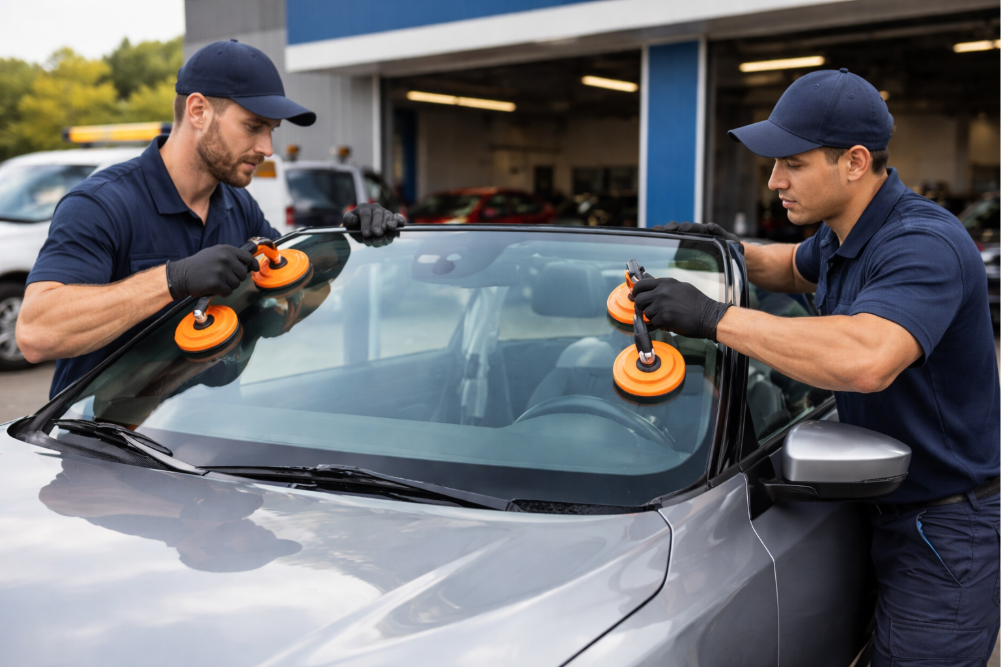
Aftermarket Windshield Replacement for Car Insurance
When a stray pebble hits your car on a sunny afternoon, driving along the highway may quickly become unpleasant. A little chip quickly grows into a big fissure just across from you. You are aware that in order to maintain your car safe and legal to drive, you must get a replacement right away. The claims adjuster may tell you that an aftermarket windshield is covered by your coverage during that phone conversation. You may hesitate and consider if it would be better to demand an Original Equipment Manufacturer (OEM) part. Any automobile owner must comprehend the distinctions between OEM and aftermarket windshields.
Get An Auto Glass Replacement Quote Now 866.278.7417

Windshield Replacement & Repair
Our competitors push you into going to their shop to get your glass fixed-making it cheaper for them. We make it easier for YOU to get back on the road by offering free mobile repairs at your home or work. With our free mobile services servicing the entire Orange County & Los Angeles area, we can often handle your windscreen replacement the same day! So the next time you need a windshield replacement, give us a call.
Talk to a Windshield Replacement Specialist Now 866.278.7417

Calibration
Calibration is the process of returning a vehicle’s ADAS to OEM specifications. Calibration is necessary after a new glass installation, particularly a windshield with a camera mounted to it, to ensure that the ADAS features continue to function properly despite having been moved during installation. If a car’s ADAS is not properly calibrated, the system may not function safely. A misaligned camera could jeopardize the functionality of the system and lead to dangerous driving or accidents, so it is crucial that the cameras are aligned perfectly, which is what windshield calibration ensures.
Talk to a Calibration Specialist Now 866.278.7417

Fleet Auto Glass Repair
We provide expert auto glass repair and windshield replacement services for commercial fleets of all sizes. We are experienced with all manufacturers and machine types of domestic or foreign cars, trucks, vans, or commercial vehicles, including heavy equipment. Our same day mobile auto glass and windshield repair service will enable you to get back on the road faster and start saving you time and money instantly. Give us a call today! We are here to help!
Talk to a Fleet Auto Glass Specialist Now 866.278.7417
What Is an OEM Windshield
The same business that made your car’s original glass also makes Original Equipment Manufacturer (OEM) windshields. Your car had an OEM windshield fitted when it first came off the manufacturing line.
These windshields are made in accordance with the precise guidelines set out by the manufacturer. In terms of thickness, color, durability, and form, they are identical to the original glass. An OEM windshield can often be recognized by looking for the manufacturer’s emblem immediately imprinted into the bottom corner of the glass.
OEM windshields provide a precise fit since they are exact reproductions of the original component. They reduce the possibility of visual distortion, water leakage, and wind noise. These windshields are especially made by automakers to blend in perfectly with the structural integrity of your vehicle.
The cost of an OEM windshield is its main disadvantage. They cost a lot more than other solutions. Unless your automobile is brand-new, many regular auto insurance plans do not cover them by default due to their greater cost.
An Aftermarket Windshield: What Is It? Glass manufacturers that are not directly connected to the car manufacturer provide aftermarket windshields. To build a replacement that matches your particular make and model, these firms reverse-engineer the original glass.
Aftermarket glass businesses are legally obligated to make small changes to the thickness or tint of windshields because automakers have copyrights on the precise design and size of their windshields. Consequently, the automaker’s branding will not appear on an aftermarket windshield.
Aftermarket glass comes in many levels. An excellent aftermarket choice is Original Equipment Equivalent (OEE). OEE windshields are produced for the aftermarket supply chain without the official automobile brand label, yet they are often produced by the same businesses that make OEM glass. They provide a very close fit to the original while adhering to stringent safety regulations.
Cost reductions are the main benefit of an aftermarket windshield. They are substantially less expensive to make and readily accessible. As a result, the majority of motor insurance providers favor approving replacement claims for aftermarket glass.
However, there might be significant differences in quality between various aftermarket producers. Some less expensive aftermarket windshields may have worse acoustic layers, minor visual distortion, or an imperfect fit that causes wind noise at high speeds.
How Windshield Replacements Are Handled by Auto Insurance
Your comprehensive coverage often covers the damage when you make a claim for a damaged windshield. Comprehensive coverage addresses uncontrollable events including flying road debris, vandalism, and fallen limbs.
The goal of insurance companies is to return your car to its pre-loss state while controlling their operating expenses. Standard insurance plans specifically indicate that the insurer will utilize aftermarket components for repairs since aftermarket glass is much less expensive than OEM glass.
The insurance will almost probably choose an aftermarket windshield if you drive an older car. A premium aftermarket windshield is regarded by the insurance provider as functionally comparable to the original glass. The insurance considers their commitment satisfied as long as the glass satisfies the Department of Transportation’s safety regulations.
Is It Possible to Request an OEM Windshield from Your Insurance Company? The assurance that comes with OEM parts is preferred by many drivers. You have a few options to discuss with your insurance provider if you want an OEM windshield.
Verify the precise wording of your insurance policy first. An optional addition to your insurance that ensures the use of original parts for any accident or comprehensive repair is known as a “OEM endorsement” or “OEM rider.” This rider avoids future discussions with the adjuster, but you pay a somewhat higher premium for it.
Your insurance may automatically accept an OEM replacement if your automobile is just a year or two old. Insurance companies understand that very new cars lose a lot of value when repaired using aftermarket components, and it often takes some time for replacement glass for brand-new models to become available.
You may still request OEM glass if your vehicle is older and you don’t have an OEM rider. The insurance provider will only demand that you pay for the difference in cost out of pocket. After deducting your deductible, the insurance will pay for the aftermarket windshield; the remaining amount needed to buy the original glass will be your responsibility.
Do you have a Question?
Get An Auto Glass Replacement Quote Now 866.278.7417
The Technology Underpinning the Glass
These days, windshields are very complicated parts. Advanced Driver Assistance Systems (ADAS) are powered by sensors, cameras, and lasers. Important safety features like rain-sensing wipers, adaptive cruise control, automated emergency braking, and lane departure alerts are all part of these systems.
For the cameras behind the rearview mirror to work properly, the glass must be completely clean and exactly curved. A camera’s calibration may be thrown off by even a millimeter of distortion in the glass, which might lead to safety systems failing just when you need them most.
Strict position statements on ADAS and windshield replacements are released by several automakers. To guarantee that their safety features function as intended, companies like Mercedes-Benz, Honda, and Subaru often declare that only OEM glass should be used.
In order to prevent liability concerns, some insurers will approve an OEM repair if the carmaker maintains that aftermarket glass jeopardizes the safety systems. Regardless of the kind of glass you choose, a qualified technician must carefully recalibrate ADAS before replacing a contemporary car’s windshield.
Common Questions Concerning Windshield Replacement
Is OEM glass covered by insurance? Because aftermarket glass is more affordable, it is often covered by standard vehicle insurance coverage. When you set up your insurance, you may get an OEM parts endorsement to guarantee coverage for OEM glass. If not, you would have to cover the difference in price out of pocket.
Will my warranty be terminated if I purchase an aftermarket windshield? Your car’s warranty is not immediately invalidated when you install an aftermarket windshield. However, the dealership could decline to pay for that particular repair under warranty if the aftermarket glass results in a particular issue, such as a water leak that harms the dashboard electronics.
An excellent level of aftermarket glass is called Original Equipment Equivalent (OEE). It is not subject to the carmaker’s final quality control inspections and does not bear the official logo of the automaker, even though it is often produced to very comparable standards as OEM glass and sometimes by the same parent firm.
Does my insurer’s recommended vehicle glass shop have to be used? The choice of repair business is legally yours.
Because they can negotiate cheaper labor and parts costs with them, insurance firms like networks of glass businesses. You may have to pay for any expenses that go beyond the insurer’s typical reimbursement limitations if you take your automobile to the dealership or an independent expert.
Making the Correct Decision for Your Car: Your car, your spending limit, and your insurance coverage will ultimately determine whether you choose an OEM or an aftermarket windshield.
Pushing for an OEM windshield is a wise choice if you drive a premium car, a brand-new model, or one that is substantially outfitted with cutting-edge driver assistance technologies. Your safety features will function flawlessly thanks to the precise fit and optical clarity.
However, a premium OEE aftermarket windshield offers superior safety and durability at a fraction of the price if you drive an older car without a sophisticated camera system. To find out precisely what your comprehensive coverage entails, review your vehicle insurance policy right now.
If you want complete peace of mind for upcoming repairs, think about getting an OEM endorsement. A qualified car glass specialist should always be consulted in order to understand the best glass solutions for your particular make and model.
The Complete Guide to Glass Replacement for Windshields
Abruptly, a pebble strikes your windshield, creating a wide break directly in front of you. As soon as you pull over, you evaluate the damage and consider the cost of repairs. Fortunately, windshield replacements are often covered by motor insurance.
On the other hand, there is a significant decision that you may not anticipate making throughout the process. It is necessary to make a decision on the kind of glass that will be used for the replacement.
The majority of drivers believe that a new windshield is the same as the one that was installed at the factory. The truth is far more nuanced. Repair businesses provide different grades of materials, and insurance companies have particular standards about what kind of glass they will pay for.
Your choice will have an effect on everything, including the structural integrity of your vehicle and the safety systems that it already has. In order to successfully navigate the process of filing an insurance claim, it is vital to have a fundamental understanding of vehicle glass.
You can advocate for the best result for your car if you understand the differences between original parts and aftermarket substitutes. In order to ensure that you return to driving safely, this book explains all you need to know about selecting glass during an insurance windshield replacement.
Knowing Your Windshield Glass Options: Three types of vehicle glass are usually available when a technician repairs your windshield. Each has its own cost, requirements for quality, and consequences for insurance.
Glass from the Original Equipment Manufacturer
The OEM replacement glass will have a Honda stamp if you drive a Honda. It is identical to the thickness, color tint, and specs of the glass your automobile had when it came off the production line.
OEM glass is made by automakers to blend in perfectly with the frame of the car. Because it goes through the same stringent testing as the original components, it provides the greatest level of quality assurance. But since this superior quality is more expensive, insurance firms are reluctant to pay for it for older cars.
For instance, a glass producer may produce Ford’s official factory windshields. A Toyota windshield may be made by the same manufacturer.
It is constructed to very high standards by a respectable, factory-level manufacturer, but it won’t bear the Toyota brand. Compared to genuine OEM parts, OEE glass is somewhat less expensive and offers almost flawless fit and polish.
Aftermarket Glass: Independent producers that do not have agreements with OEMs create aftermarket glass. Aftermarket firms reverse-engineer the glass since they are unable to lawfully replicate the OEM windshield’s precise patented design.
This causes little changes in hue, thickness, and curvature. Although aftermarket glass must adhere to the Department of Transportation’s minimal safety requirements, manufacturers’ quality control practices vary greatly. When granting a typical claim, most insurance companies choose this option since it is the least expensive.
How Insurance Providers Manage Windshield Replacements
When you file a glass claim, your insurance provider goes through a certain series of steps. You may negotiate better conditions for your repair by being aware of their viewpoint.
Explaining Comprehensive Coverage: Your vehicle insurance policy’s comprehensive section often covers windshield damage. Incidents that do not involve a collision with another vehicle are covered under comprehensive coverage. This includes boulders thrown up by vehicles on the roadway, fallen limbs, and vandalism.
You may be required to pay a deductible before the coverage begins, depending on your insurance. While some jurisdictions require insurers to provide zero-deductible glass coverage, others let businesses use your regular comprehensive deductible to the repair.
The Right to Select Your Repair Shop: The insurance agent will probably suggest a certain network of vehicle glass repair facilities when you report a broken windshield. You may even be sent straight to a third-party glass claims administrator.
It is permissible for you to choose the repair facility of your choice. You are not required to utilize the store that your insurance provider suggests. Independent retailers may be prepared to bargain with the insurance company on your behalf in order to get OEM or OEE parts, and they often have more flexibility in locating better glass.
Do you have a Question?
Get An Auto Glass Replacement Quote Now 866.278.7417
Why Aftermarket Glass Is Encouraged by Insurers
Profit margins drive the operations of insurance businesses. Original equipment manufacturer (OEM) glass is much more costly than aftermarket glass. The use of aftermarket parts for regular replacements results in annual cost savings for insurance companies that amount to millions of dollars.
A clause that states “like kind and quality” is often included in the majority of insurance quotes and policies. This enables them to replace factory-original parts with aftermarket ones as long as the aftermarket part serves the same fundamental purpose. The insurance company can demand that you pay the difference out of pocket if you insist on OEM glass.
OEM vs. Aftermarket: Making the Correct Decision: Safety, technology, and cost must be taken into consideration when choosing between factory-original and aftermarket glass.
Safety and Structural Integrity: Your windshield serves a lot more purposes than just keeping the wind out. It is an essential structural part of your car.
The windshield is responsible for providing up to sixty percent of the roof crush protection for the cabin in the event of a rollover accident. In addition to that, it serves as the backstop for the airbag on the passenger side.
The precise fit needed to preserve this structural integrity is guaranteed by OEM glass. In the event of an accident, an improperly installed aftermarket windshield might fly out, jeopardizing the activation of the airbags and causing the roof to collapse.
The absence of regulated quality control adds a degree of danger, even though many aftermarket brands are quite safe. Cameras and sensors that are put behind the windshield are a significant component of advanced driver assistance systems (ADAS), which are found in current automobiles.
These components are the source of power for advanced driver assistance systems (ADAS), which include adaptive cruise control, automatic emergency braking, and lane departure alarms, among others.
These cameras need a view of the road that is flawlessly contoured and extremely clear. The ADAS may fail if an aftermarket windshield has even a millimeter of deformation.
The vehicle may fail to recognize an obstruction or stop without cause. As a result, numerous automakers publish service advisories that clearly specify that only OEM glass should be used for repairs on cars with ADAS.
Aesthetics and Resale Value
Sometimes less expensive aftermarket glass has aesthetic defects. You may see a color tint that doesn’t quite match your side windows or a little wavy pattern along the glass’s borders. Poorly fitted aftermarket windshields are also more likely to cause water leaks and wind noise.
OEM glass preserves the value of your automobile if you want to sell it or return a leased vehicle. Drivers who turn in cars with unapproved aftermarket equipment, such as windshields, are often penalized by leasing firms.
Steps to Take When Filing a Windshield Claim: Proactively filing your claim guarantees that your car will get the finest possible repair.
Examine Your Policy Details: Go over your policy documentation before contacting your insurance agent. Seek for a particular endorsement for glass coverage.
Verify the amount of your comprehensive deductible. Making a claim is a waste of time if the cost of the replacement is lower than the amount of your deductible policy. You will be responsible for paying for everything out of your own money, and there is a possibility that your premium may increase.
An OEM endorsement is a feature of several premium insurance plans. The insurance provider is technically required to supply factory original parts for all repairs, including the windshield, if you pay more for this rider.
Express Your Glass Preferences: Clearly explain the kind of glass you anticipate when you make the claim. Insurance companies are much more likely to accept OEM glass without a struggle if your automobile is very young, often less than two or three years old.
Cite any ADAS features your automobile has if they resist. The insurance company is often forced to approve the OEM replacement by bringing up the manufacturer’s safety advice about the forward-facing cameras.
Mobile Safe Auto Glass
14241 E Firestone blvd suite 400,
La Mirada, CA 90638
Phone: (562) 608-1154
Toll Free: 1 866 278 7417
Mail: sales@mobilesafeautoglass.com
Get a FREE QUOTE today! You can get a free quote and schedule 24/7 using this free quote wizard.
Mon – Fri 8am – 5pm
Saturday 8am – 1pm
Sunday Closed