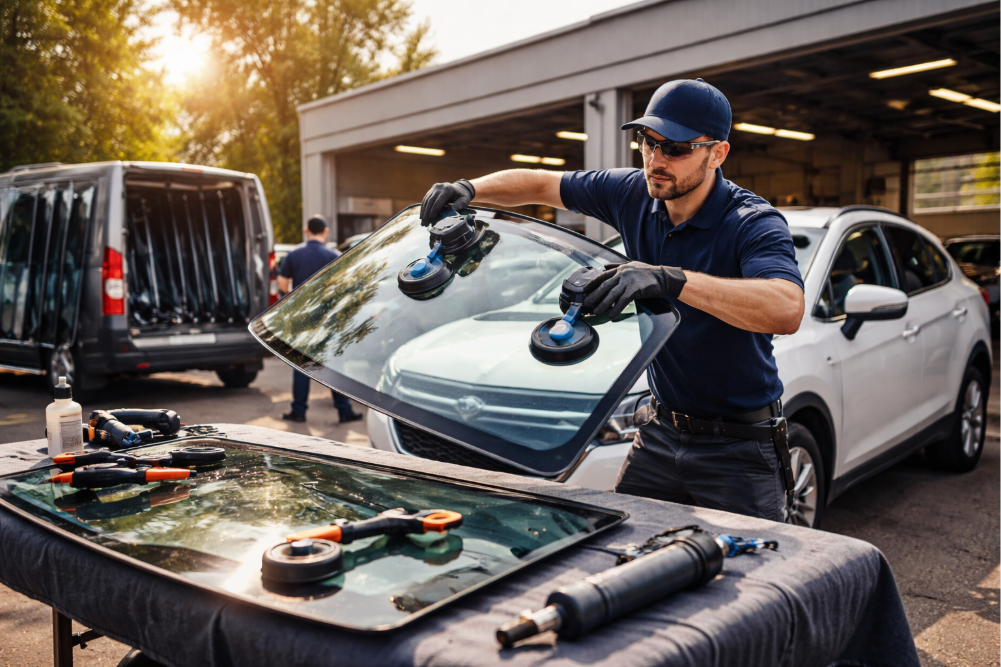
Aftermarket in Chip Insurance Windshield Replacement
All it takes to destroy your windshield is a stray pebble on the roadway. Your next course of action is often to contact your auto insurance company when that loud cracking sound reverberates throughout your car. You may come across a word that might be confusing during that conversation or while reviewing your chip insurance policy: aftermarket glass. Before you authorize any repairs, it’s important to understand what this implies for the functioning, safety, and value of your car. A common misconception among drivers is that insurance would automatically replace a broken windshield with the exact same glass that was in the vehicle when it was manufactured. Seldom is this the case.
Get An Auto Glass Replacement Quote Now 866.278.7417

Windshield Replacement & Repair
Our competitors push you into going to their shop to get your glass fixed-making it cheaper for them. We make it easier for YOU to get back on the road by offering free mobile repairs at your home or work. With our free mobile services servicing the entire Orange County & Los Angeles area, we can often handle your windscreen replacement the same day! So the next time you need a windshield replacement, give us a call.
Talk to a Windshield Replacement Specialist Now 866.278.7417

Calibration
Calibration is the process of returning a vehicle’s ADAS to OEM specifications. Calibration is necessary after a new glass installation, particularly a windshield with a camera mounted to it, to ensure that the ADAS features continue to function properly despite having been moved during installation. If a car’s ADAS is not properly calibrated, the system may not function safely. A misaligned camera could jeopardize the functionality of the system and lead to dangerous driving or accidents, so it is crucial that the cameras are aligned perfectly, which is what windshield calibration ensures.
Talk to a Calibration Specialist Now 866.278.7417

Fleet Auto Glass Repair
We provide expert auto glass repair and windshield replacement services for commercial fleets of all sizes. We are experienced with all manufacturers and machine types of domestic or foreign cars, trucks, vans, or commercial vehicles, including heavy equipment. Our same day mobile auto glass and windshield repair service will enable you to get back on the road faster and start saving you time and money instantly. Give us a call today! We are here to help!
Talk to a Fleet Auto Glass Specialist Now 866.278.7417
What Is an Aftermarket Windshield
Repair shops often provide two primary types of glass when vehicle glass has to be replaced. Knowing the difference makes it easier to see precisely what is being installed on your vehicle.
Original Equipment Manufacturer (OEM) Glass: OEM glass is made by the same company that made the original glass for the particular type of car you drive.
It is identical to the factory original in terms of thickness, hue, marking, and characteristics. The Honda logo will be imprinted in the corner of the new glass if you drive a Honda.
Aftermarket glass, also known as Original Equipment Equivalent (OEE) or OEE, is produced by a different business from the one that initially provided the glass for your car.
The carmaker’s emblem cannot be legally imprinted on the glass by these manufacturers. Nonetheless, they are legally obligated to produce the windshield in precisely the same dimensions as the original.
How Chip Insurance Manages Windshield Replacements: Glass replacement and repair are covered by the majority of comprehensive vehicle insurance plans. Additionally, some drivers have “chip insurance” or special glass coverage that completely eliminates the deductible.
The Insurance Preference for Aftermarket Glass: Aftermarket glass is far less expensive than OEM glass, and insurance firms are profit-driven businesses.
The cheap pricing are a result of competition among aftermarket producers. Your insurance adjuster will almost always approve aftermarket glass when you submit a claim for a complete windshield replacement.
Legally, aftermarket glass satisfies this requirement as it complies with federal safety regulations. Your insurance wording often specifies that the insurer would cover replacement parts of “like kind and quality.”
Are Aftermarket Windshields Dependable and Safe? For every motorist in need of a new windshield, safety comes first. Beyond only protecting your face from the wind, the windshield has other purposes. It provides the backstop for passenger-side airbag deployment and supports the roof in the case of a rollover, making it an essential structural element of the car.
DOT Approval and Quality Standards
The Department of Transportation’s (DOT) safety regulations must be met by all car glass in the United States. For durability, shatter resistance, and optical clarity, aftermarket glass is put through a thorough testing process. An aftermarket windshield fitted by a qualified technician is safe and physically sound from a safety perspective.
The ADAS Difficulty: Advanced Driver Assistance Systems (ADAS) are standard in modern cars. These systems include functions including adaptive cruise control, automated emergency braking, and lane departure alerts. These systems often have cameras and sensors installed just behind the windshield.
This is where problems with aftermarket glass may sometimes arise. The camera’s image may be distorted if the aftermarket glass has even minor variations in thickness or curve.
For ADAS features to work effectively, several automakers explicitly indicate that OEM glass must be utilized. Regardless of the kind of glass used, these cameras must be properly recalibrated after every windshield replacement.
Can OEM Glass Be Requested Instead? Accepting aftermarket glass is not absolutely required, although it does take some work to obtain insurance to cover OEM glass.
Policy Riders for OEM Parts: Before an accident occurs, you may add an OEM endorsement or rider to your policy from certain insurance carriers. This rider ensures that all replacement parts utilized in a claim, including the windshield, will be OEM for a little premium increase.
Do you have a Question?
Get An Auto Glass Replacement Quote Now 866.278.7417
Making the Difference Payment
You may still ask your repair shop for OEM glass even if your coverage only covers aftermarket glass. The going pricing for the aftermarket glass will be covered by the insurance carrier, and the out-of-pocket difference to upgrade to OEM will be your responsibility. This difference might be anything from a few hundred to more than a thousand dollars, depending on the car.
Steps to Take When Filing a Windshield Claim: It takes some planning to handle a glass claim successfully. To guarantee a high-quality repair, adhere to following guidelines.
Examine Your Coverage: Verify your deductible level and look for any OEM endorsements by reading the terms of your insurance. You may avoid surprises at the repair shop by being aware of your coverage limitations in advance.
Ask About the Glass Manufacturer: Find out which brand of aftermarket glass a vehicle glass repair shop uses by contacting them. High-quality OEE glass that closely resembles OEM specifications is produced by reputable companies like Pilkington, PGW, and Safelite.
Verify Calibration Capabilities: If your vehicle has ADAS, be sure the glass shop has the tools and certification necessary to recalibrate the camera. Until the shop verifies that the systems have been correctly recalibrated, do not leave.
Making the Correct Decision for Your Car: Although dealing with a broken windshield may be stressful, knowing your alternatives for a replacement gives you piece of mind. To find out precisely what kind of glass coverage you presently have, check your vehicle insurance policy right now.
Consider contacting your agent to add an OEM endorsement to your policy if you drive a newer car that is primarily dependent on safety sensors. You may save a great deal of trouble down the line by safeguarding your car’s safety systems today.
How to Replace Your Windshield with Insurance
A stray pebble unexpectedly strikes your automobile while you are minding your own thing and traveling down the highway at a typical pace. It’s easy to hear the harsh breaking sound.
A small chip starts to spiderweb over your field of vision in a matter of seconds. Nearly every motorist has windshield damage at some time, but repairing it is still a difficult task.
It takes more than just contacting a repair business to handle the aftermath of a shattered windshield. Your security is instantly jeopardized. In addition to ensuring that airbags deploy properly in the event of an accident, the windshield gives your car’s roof substantial structural support.
You and your passengers are placed in grave danger when you drive with compromised glass. The financial issues begin to surface as soon as you identify the safety problem.
Particularly for contemporary cars with sophisticated driver-assistance systems, auto glass repair may be shockingly costly. The cost of replacement is increased by sensors, cameras, and rain gauges integrated into the glass. Of course, the majority of drivers seek assistance from their vehicle insurance policy.
The secret to having your automobile replaced correctly without breaking the bank is to understand your insurance windshield replacement alternatives. Different sorts of damage are covered by different plans, and the amount you must pay out of pocket may even be determined by state legislation. You can make an educated choice that gets you back on the road in a safe and economical manner by weighing your choices.
Comprehending Comprehensive Auto Insurance
The comprehensive section of your vehicle insurance policy often covers windshield damage. Comprehensive insurance protects damage from unforeseen circumstances, in contrast to collision insurance, which covers damage from collisions with other cars. This includes pebbles thrown up by other automobiles, vandalism, severe weather, and fallen tree limbs.
Standard comprehensive deductibles: Your insurance company will probably cover the cost of replacing your windshield if you have comprehensive coverage. Your deductible must still be paid first. Usually, deductibles fall between $250 and $1,000.
The insurance company only pays $100 if your replacement is $600 and your deductible is $500. In some cases, the replacement cost is completely less than your deductible, thus you will be responsible for paying the whole amount.
Options for complete glass coverage: complete glass coverage is an add-on offered by some insurance providers. You won’t be required to pay a deductible for vehicle glass claims if you choose to carry this policy and pay the somewhat higher monthly cost.
The whole cost of the replacement is paid for by the insurance provider. If you travel on gravel roads or highways that are often used by construction trucks, this option is quite advantageous.
Which Is Better, OEM or Aftermarket Auto Glass? Original Equipment Manufacturer (OEM) and aftermarket glass are the two kinds of glass that the shop usually offers when you bring your vehicle in for a windshield replacement. Since insurance companies often have stringent guidelines on what they will reimburse, it is crucial to understand the differences between these items.
Glass made by the same firm that produced the original windshield for your car is known as Original Equipment Manufacturer (OEM) glass. It precisely matches the thickness, hue, and requirements of the glass that is put on the manufacturing line.
OEM glass is the most costly choice since it is highly specialized and bears the marking of the carmaker. OEM glass is preferred by many car owners to guarantee that sophisticated safety features are properly calibrated.
Glass from Aftermarket
Aftermarket glass, often known as Original Equipment Equivalent (OEE), is produced by businesses that do not have contracts with automakers. The Department of Transportation’s fundamental safety regulations are still followed by these firms. Aftermarket glass is much less expensive than OEM glass, even if it may differ somewhat in thickness or color.
What your insurance provider will cover: Insurance providers want to minimize their payout expenses. The majority of typical insurance only pay for aftermarket glass.
You may have to cover the cost difference out of pocket if you insist on utilizing OEM glass for an older car. However, some suppliers may automatically accept OEM glass to preserve the vehicle’s manufacturer warranties if your automobile is relatively young, usually two years old or less.
Making the Correct Decision: Not every vehicle glass damage need a complete replacement. Whenever feasible, insurance companies highly advise fixing the glass. Repairs are quicker, less expensive, and preserve the original factory seal.
When a simple fix is successful: Auto glass specialists can often fix minor chips and fractures. Generally speaking, a repair is feasible if the chip is less than a quarter or if the fracture is shorter than a dollar bill.
A transparent, curable resin is injected into the injured region by the technician. By doing this, the glass’s structural integrity is restored and the fracture is stopped from expanding. If you decide to fix the glass rather than replace it, many insurance companies will completely waive your comprehensive deductible.
When a complete replacement is required: Some damage cannot be safely fixed. A complete replacement is necessary if a crack is more than six inches long, crosses the windshield’s edge, or is directly in the driver’s line of sight.
When significant damage is attempted to be repaired, the glass becomes structurally fragile. In the event of a rollover, a compromised windshield may suddenly break or fail to hold the top of the car.
The Impact of Windshield Claim Filing on Your Rates
Because they worry that their monthly costs may soar, drivers are often reluctant to contact their insurance company. Your local state regulations and your provider’s internal procedures will determine how a windshield claim is handled.
The function of no-fault claims: When a pebble strikes your automobile, it’s seen as an inevitable, no-fault event. For a single comprehensive claim, the majority of large insurance companies do not increase rates.
They understand that your careless driving did not cause the harm. However, the insurer may label you as a high-risk client and modify your rates if you submit many complete claims in a little amount of time.
State regulations and free windshield replacement: The way insurance companies handle glass claims depends on where you live. A few states, such as South Carolina, Florida, and Kentucky, have regulations specifically intended to promote safe driving.
In these states, carriers must legally waive the deductible for windshield replacements if you have comprehensive insurance. They are not allowed to raise your premiums based just on that claim, and they cannot charge you out of pocket.
How to File a Windshield Claim Step-by-Step: It doesn’t have to be a tiresome task to file an auto glass claim. You may expedite the approval and completion of the repair by adhering to a defined procedure.
Do you have a Question?
Get An Auto Glass Replacement Quote Now 866.278.7417
Evaluate and Record the Damage
After parking your car in a secure spot, check the windshield. Take crisp, well-lit pictures of the crack or chip from several perspectives. For scale, place a penny next to the damage. The insurance company is prevented from contesting the extent of the damage by this paperwork, which demonstrates precisely what occurred.
Get in touch with your insurance company: To start the claim, give your insurance agent a call or use the mobile app. Give the incident’s date, time, and location.
Describe the damage’s extent and send in your pictures. The agent will go over your policy, verify the amount of your deductible, and go over your alternatives for coverage.
Select the car glass shop of your choice: Insurance companies often collaborate with certain major auto glass businesses. To expedite the charging process, they may strongly advise you to utilize one of their linked stores.
You are not required by law to follow their advice. You are free to choose any authorized vehicle glass repair shop. Just provide your claims and adjust the contact details of your preferred local, independent store.
Common Questions
Does my insurance need me to utilize the repair business it recommends? No. You are legally entitled to choose the repair facility that best suits your needs.
Regardless of where you take the car, your insurance company must respect your policy, even if utilizing an in-network shop may make the paperwork simpler. Before arranging the service, make sure the business of your choice takes your insurance.
How much time does it take to repair a windshield? It typically takes one to two hours for an expert to repair a windshield.
The urethane glue requires time to dry when the new glass is placed. Before the car is safe to drive, you will usually have to wait an extra hour.
Will a cracked windshield not pass the state inspection? Your automobile may fail due to a broken windshield if your state mandates yearly vehicle safety inspections.
The driver’s line of sight is thoroughly examined by inspectors. Any discoloration, chip, or break in that particular viewing region is an automatic failure. You may avoid the hassle of a refused inspection sticker by having the glass fixed in advance.
Is recalibration necessary while changing a windshield? Yes, for the majority of contemporary cars. Automatic emergency braking, adaptive cruise control, and lane departure alerts all depend on cameras installed behind the windshield. To guarantee that the safety systems operate correctly after a replacement, these cameras need to be professionally recalibrated.
Getting You Back on the Road Securely
While dealing with a broken windshield interferes with your everyday activities, taking prompt action keeps a little nuisance from turning into a serious risk. Driving with broken glass reduces your sight and jeopardizes the structural integrity of your car.
Examine your vehicle insurance coverage now for a few minutes. Find out whether your carrier provides complete glass coverage and check your comprehensive deductible.
You can deal with the issue calmly if you know precisely what your insurance covers before a rock strikes your vehicle. Prioritize your own and your passengers’ safety by speaking with a trustworthy local car glass specialist about your alternatives for repair or replacement.
Mobile Safe Auto Glass
14241 E Firestone blvd suite 400,
La Mirada, CA 90638
Phone: (562) 608-1154
Toll Free: 1 866 278 7417
Mail: sales@mobilesafeautoglass.com
Get a FREE QUOTE today! You can get a free quote and schedule 24/7 using this free quote wizard.
Mon – Fri 8am – 5pm
Saturday 8am – 1pm
Sunday Closed