DIY vs Professional Broken Windshield Repair
Every driver experiences the unsettling sound of a stray rock hitting their windshield. Your gaze instantly flickers to the glass, looking for any damage. Hopefully, the only damage left is a speck of dust. At other times, you’re left with a chip that resembles a star or a dangerous crack that looks like it might creep over your field of vision. After the immediate annoyance subsides, the practical questions begin. Would it be necessary to visit a repair shop immediately? Can you put it out of your mind for a few days? Most importantly, do you need the help of an experienced professional, or can you fix this issue yourself with an inexpensive kit from the auto parts store?
Get An Auto Glass Replacement Quote Now 866.278.7417

Windshield Replacement & Repair
Our competitors push you into going to their shop to get your glass fixed-making it cheaper for them. We make it easier for YOU to get back on the road by offering free mobile repairs at your home or work. With our free mobile services servicing the entire Orange County & Los Angeles area, we can often handle your windscreen replacement the same day! So the next time you need a windshield replacement, give us a call.
Talk to a Windshield Replacement Specialist Now 866.278.7417

Calibration
Calibration is the process of returning a vehicle’s ADAS to OEM specifications. Calibration is necessary after a new glass installation, particularly a windshield with a camera mounted to it, to ensure that the ADAS features continue to function properly despite having been moved during installation. If a car’s ADAS is not properly calibrated, the system may not function safely. A misaligned camera could jeopardize the functionality of the system and lead to dangerous driving or accidents, so it is crucial that the cameras are aligned perfectly, which is what windshield calibration ensures.
Talk to a Calibration Specialist Now 866.278.7417

Fleet Auto Glass Repair
We provide expert auto glass repair and windshield replacement services for commercial fleets of all sizes. We are experienced with all manufacturers and machine types of domestic or foreign cars, trucks, vans, or commercial vehicles, including heavy equipment. Our same day mobile auto glass and windshield repair service will enable you to get back on the road faster and start saving you time and money instantly. Give us a call today! We are here to help!
Talk to a Fleet Auto Glass Specialist Now 866.278.7417
Recognizing the Damage
You must evaluate the situation before choosing a repair technique. Not all windshield damage is the same, and whether a do-it-yourself attempt is even possible depends mainly on the type of collision.
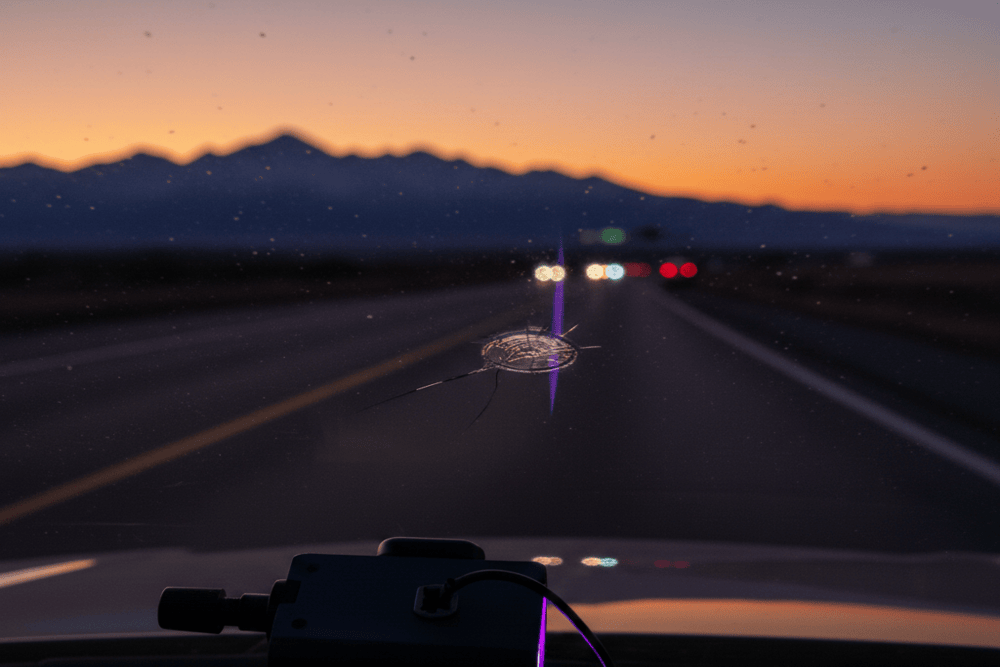
These are the two most prevalent forms of minor damage: bullseye and star chips. A “star” contains tiny fractures radiating outward, whereas a “bullseye” is a neat, round break with a pit in the middle. If these are less than a quarter, they should often be fixed rather than replaced.
Long Cracks: The structural integrity of the glass is seriously jeopardized if a windshield chip extends into a line longer than three inches. Most do-it-yourself kits struggle to handle long cracks. Without specialized equipment, it is challenging to get the resin to flow through the entire length of the crack.
Placement Is Important: Where is the damage? Even a successful repair may leave a small, potentially distracting distortion if the chip is immediately in the driver’s line of sight. Professional evaluation is essential since the tension on the glass is greater if the damage is close to the windshield’s edge.
The Argument for Do-It-Yourself Repair Kits You can probably find windshield repair kits for less than $20 on the pegs in any car aisle. Typically, these kits come with a curing film, a syringe or applicator, and a specialty resin. The idea is straightforward: fill the air pocket and fuse the glass back together, inject resin into the chip.
The Advantages of Do It Yourself
Savings on costs: Price is the most evident benefit. The cost of a DIY kit is much lower than what a shop may charge for an uninsured windshield repair. This procedure is a desirable choice if you have a limited budget and the damage is not too great.
Convenience: On a Saturday morning, you may complete it in your driveway. You don’t have to wait in a lobby, drive to a store, or schedule an appointment. The convenience factor is considerable for minor cosmetic concerns.
The dangers of do-it-yourself Resin Quality: Industrial-grade materials utilized by experts are typically stronger and more durable than consumer-grade resin. DIY fixes have a higher chance of failing, discoloring, or yellowing over time, which will eventually cause the crack to widen.
User Error: Repairing a windshield is an art form. Resin must be forced in by applying pressure once a vacuum is created to remove air from the break. The repair will be weak if air bubbles are left trapped inside.
Excessive pressure could unintentionally cause the crack to widen. You cannot undo a repair once you try it and the resin hardens. If it breaks or looks terrible, a full windshield replacement is often your only option.
False Sense of Safety: A structural remedy is not always equivalent to a cosmetic one. Even if you fill the surface pit, the windshield will still be weak if the underlying glass layers are not properly bonded.
Do you have a Question?
Get An Auto Glass Replacement Quote Now 866.278.7417
The Argument in Favor of Expert Repair
Auto glass specialists use advanced equipment that goes well beyond a plastic syringe. To make sure the resin reaches the deepest areas of the crack, they usually employ a bridge system that affixes to the glass and cycles between vacuum and pressure.
The Advantages of Expert Services Structural Integrity: Your windshield serves more purposes than just keeping insects out of your teeth. The windshield provides up to 60% of the roof’s structural strength in a rollover accident. It also acts as the backstop for your passenger-side airbag. In order for the glass to shield you in an accident, an expert makes sure it maintains its strength.
Superior Aesthetics: Professionals can get far closer to invisibility than a novice do-it-yourselfer, although no repair will completely erase a chip. They are adept at finishing repairs and polishing without taking the driver’s focus away.
Warranty and Insurance: Most reliable retailers offer a warranty for their work. If the repair fails and the fracture spreads, they often credit the cost of the repair toward a replacement.
Furthermore, chip repairs are often covered by insurance coverage with no deductible. Such an arrangement implies that you might not have to pay anything for a professional repair.
The Drawbacks
Time and Logistics: You must make an appointment in advance. Even though mobile services are widely available and can visit your house or place of business, you still need to schedule a time for the technician to arrive.
Price (not including insurance): A professional repair can cost anywhere from $60 to $150 if you only have liability coverage or if you have a high deductible that does not exempt you from glass claims. It is definitely more than a $15 kit, and it is reasonable.
Choosing: A Safety-First Method: Safety needs to be your top priority when assessing your selections. Similar to airbags and seatbelts, a windshield is a safety device.
A do-it-yourself kit is a low-risk experiment if the damage is a small surface pit that is not in your direct line of sight and is smaller than a dime. However, if the damage is more extensive, deep, or close to the glass’s edges, the margin for error disappears. If the windshield breaks during an accident or if the crack grows and a $400 replacement is needed a week later, the money you save on a kit is meaningless.
Consider the “Quarter Test,” which suggests that a repair is likely possible if the damage completely covers a quarter. Professional evaluation is non-negotiable if it’s larger. Regardless of who does the work, you most likely need a full replacement if the crack is longer than a dollar bill.
Common Questions
Can a long crack be fixed by me? It is strongly discouraged. Small chips (bullseyes or stars) are the focus of DIY kits. High stress on the glass causes long cracks. If you attempt a do-it-yourself repair on a lengthy fracture without drilling stop points and using specific resins, it is likely to fail and the crack will continue to expand.
If I file a claim for windshield repair, will my insurance rates increase? Most of the time, the answer is no. Instead of paying more than $500 for a replacement later, insurance companies would rather pay $100 for a repair. They usually don’t raise premiums for comprehensive glass claims because it saves them money. To be certain, check with your particular supplier.
What is the duration of a repair? Typically, a professional repair takes half an hour. Depending on the resin’s curing time (which typically requires direct sunlight or UV light), a do-it-yourself kit could take anywhere from 30 to 60 minutes.
What happens if a do-it-yourself repair goes wrong? The resin permanently hardens after curing. You can’t dissolve it and begin anew. The entire windshield will probably need to be replaced if the repair is hazy, bubbling, or doesn’t stop the crack.
Don’t Put Off It: When it comes to windshield repair, timing is more important than who does it.
When the temperature changes, windshields expand and compress. When you switch on the air conditioner on a hot afternoon or use your defroster on a cold morning, the glass is put under a lot of stress. The vulnerable point is additionally agitated by vehicle vibrations.
In just a few days, a small, repairable chip might become an irreparable spiderweb crack. Act quickly whether you decide to call a professional or get a kit.
As soon as possible after impact, cover the chip with clear tape to help keep moisture and debris out until it can be mended, which will improve the outcome. However, remember that the windshield provides protection for both you and your passengers. Trust the professionals to maintain that barrier when you’re unsure.
Not Every Windshield Repair Is Made Equally
Every driver fears the sound of a rock striking their windshield with a sudden, sharp crack. As soon as you look at the glass, you spot a little starburst or bullseye chip just in front of you. Your initial instinct might be to find the quickest and least expensive way to remove the flaw. It’s only a small amount of glue and glass, after all.
In actuality, there’s a huge difference between a high-quality windshield repair and a “quick fix.” Although the fundamental idea—using resin to fill a void—remains the same, how it is carried out varies greatly according to the person performing the work, the equipment they use, and the materials they inject.
A shoddy repair can result in a chip that eventually grows into an irreparable crack, a distracted view, and a weak area in the structural integrity of your car. Protecting your vehicle and your pocketbook requires an understanding of why quality varies.
The Chemistry of the Resin: The liquid resin used to seal the crack is the most important factor in windshield repair. All resins appear to the inexperienced eye to be transparent liquids, yet their chemical engineering is intricate.
Clarity and Refractive Index: Premium professional resins are made to match the glass’s refractive index. This makes the repair as unnoticeable as possible by preventing light from bending or distorting when it travels through the repaired area. Cheaper resins frequently fall short of this index, resulting in a hazy or murky area on the windshield that can be distracting, particularly in direct sunshine or at night beneath lamps.
Viscosity Matters: Different viscosities (thicknesses) of resins are needed for different kinds of breaks. An extremely low-viscosity resin is required to wick into the tiny fissures of a tight “star break” with thin legs.
A thicker filler resin is required to seal the impact site of a “bullseye” with a huge pit. Professional specialists blend different resins according to the type of damage. A “one-size-fits-all” resin is typically available from low-quality stores or do-it-yourself kits, and it rarely works flawlessly on any break.
Resistance to Yellowing: Poor-quality acrylics can deteriorate over time due to UV radiation from the sun. After a few months, cheap resin has a tendency to discolor or shrink, making the patch apparent once more or, worse, failing entirely. Stabilizers found in premium resins keep the bond intact throughout the vehicle’s life and stop discoloration.
Do you have a Question?
Get An Auto Glass Replacement Quote Now 866.278.7417
The Physics of Vacuum and Pressure
Resin injection is insufficient; the air must be eliminated first. This is where the $15 DIY kit from the car parts store differs from professional equipment.
In essence, a rock chip is an air pocket that is wedged between glass layers. The air has nowhere to go if resin is injected on top of it. It prevents the resin from adhering to the glass surface by creating bubbles. As a result, there is a weak spot where the crack might expand quickly. Expert repair methods employ a complex vacuum and pressure cycle:
Vacuum Cycle: The instrument creates a void by drawing air out of the brake.
Pressure Cycle: The resin is forced into each tiny crack by hydraulic pressure.
To guarantee a perfect fill, high-end tools can switch between these cycles several times. High-quality (typically thicker) resin cannot be forced into the tips of a crack by a cheap plastic syringe because it cannot create the pressure or vacuum needed to eliminate all the air.
The technician’s proficiency is crucial. In the wrong hands, even the best tools are worthless. Reading the glass is necessary for the skill of windshield repair. Because glass is erratic, each break responds to pressure in a unique way. Break Drilling: In certain cases, a break is too tight to take resin.
A competent technician knows when to drill a tiny hole into the air pocket using a micro-drill. This task calls for a firm touch; if you drill too deeply, the laminate layer—the plastic middle—will be punctured, destroying the windshield. If you drill too shallowly, the resin won’t flow.
Temperature Control: Glass expands in hot weather and shrinks in cold weather. When doing a repair on a sweltering summer day, a technician is aware that they must first cool the glass to a certain temperature range.
The resin immediately cures before filling the crack if the glass is overheated. The glass is brittle and may shatter more when the injector pressure is applied if it is too cold.
Correct Curing
Resin is cured by ultraviolet (UV) radiation rather than drying by air. Experts ensure a consistent cure by using high-intensity UV lamps, which harden the resin in a matter of minutes.
Strictly depending on sunshine, which fluctuates in intensity according to the time of day and clouds, might result in uneven curing, which puts internal stress on the windshield repair and weakens the connection.
Comparing Structural Integrity with Cosmetic Enhancement There is a widespread misperception that the main objective of windshield repair is to make the damage go away. The main objective is safety, even though a proper repair would greatly improve the appearance (typically by 80% to 95%).
Your windshield can contribute up to 45% of the structural integrity of the cabin in a front-end accident and up to 60% in a rollover. It also serves as the backstop for your passenger-side airbag. The airbag might not deploy properly if the glass breaks due to a shoddy repair.
Superior repairs guarantee that the windshield maintains its factory safety rating by strengthening the glass’s structural integrity and stopping the crack from spreading. When you hit a pothole or switch on your defroster, low-quality repairs are frequently only cosmetic surface patches that don’t do anything to prevent the glass from splitting much more.
The Investment in Your Safety Is Worth it. Keep in mind that you are paying for more than simply labor when you notice price differences across repair shops. You are paying for the resin’s quality, the equipment’s sophistication, and the technician’s expertise in handling delicate glass.
Windshields are more than just windows; they are safety devices. Choosing a high-quality windshield repair guarantees that the deterioration will be permanently stopped, your view will stay unobstructed, and your vehicle’s structural integrity will not be jeopardized. When it comes to car safety, quality should always come first.
Mobile Safe Auto Glass
14241 E Firestone blvd suite 400,
La Mirada, CA 90638
Phone: (562) 608-1154
Toll Free: 1 866 278 7417
Mail: sales@mobilesafeautoglass.com
Get a FREE QUOTE today! You can get a free quote and schedule 24/7 using this free quote wizard.
Mon – Fri 8am – 5pm
Saturday 8am – 1pm
Sunday Closed